
Lexington Rare Earth Analysis and the Future of American Mineral Security
Geochemical Profiles of Central Appalachian Coalbeds
Lexington rare earth analysis encompasses specialized non-destructive and micro-analytical testing workflows to identify, quantify, and extract critical rare earth elements from Appalachian coalbeds, underclays, and byproducts to bolster domestic supply chains. Understanding the geochemical distribution of critical minerals across the Appalachian Basin requires evaluating discrete coal seams, their stratigraphic sub-units, and their host rocks. Detailed investigations of deposits such as the Pond Creek seam in Pike County, the Leatherwood coal, and the Fire Clay coal demonstrate that rare earth elements and yttrium (REY) are not distributed homogeneously throughout the stratigraphy. Instead, they concentrate within specific lithotypes, volcanic ash partings (tonsteins), and basal seat earths.
In the Pond Creek coalbed, REE concentrations exhibit marked vertical variability. Detailed investigations into the geochemistry of the Pond Creek coalbed reveal that whole-coal total REE levels shift from under 300 ppm in dull, detrital-rich upper benches to over 1,000 ppm (ash basis) in select bright clarain and vitrain-rich lithotypes (specifically within zone 4 of the bed). This localized concentration contrasts with typical sedimentary background levels and highlights the role of post-depositional geochemical processes.
Similarly, regional studies documenting the distribution of rare earth elements in eastern Kentucky coals indicate that the Fire Clay coal seam owes a major portion of its REE enrichment—averaging roughly 103 ppm on an ash basis with local hot spots exceeding 900 ppm—to a well-preserved volcanic ash-fall tonstein parting. In the Leatherwood coal, REE signatures correlate directly with seam petrology, displaying pronounced light rare earth element (LREE) enrichment across upper benches and heavy rare earth element (HREE) enrichment in basal units adjacent to floor rocks.
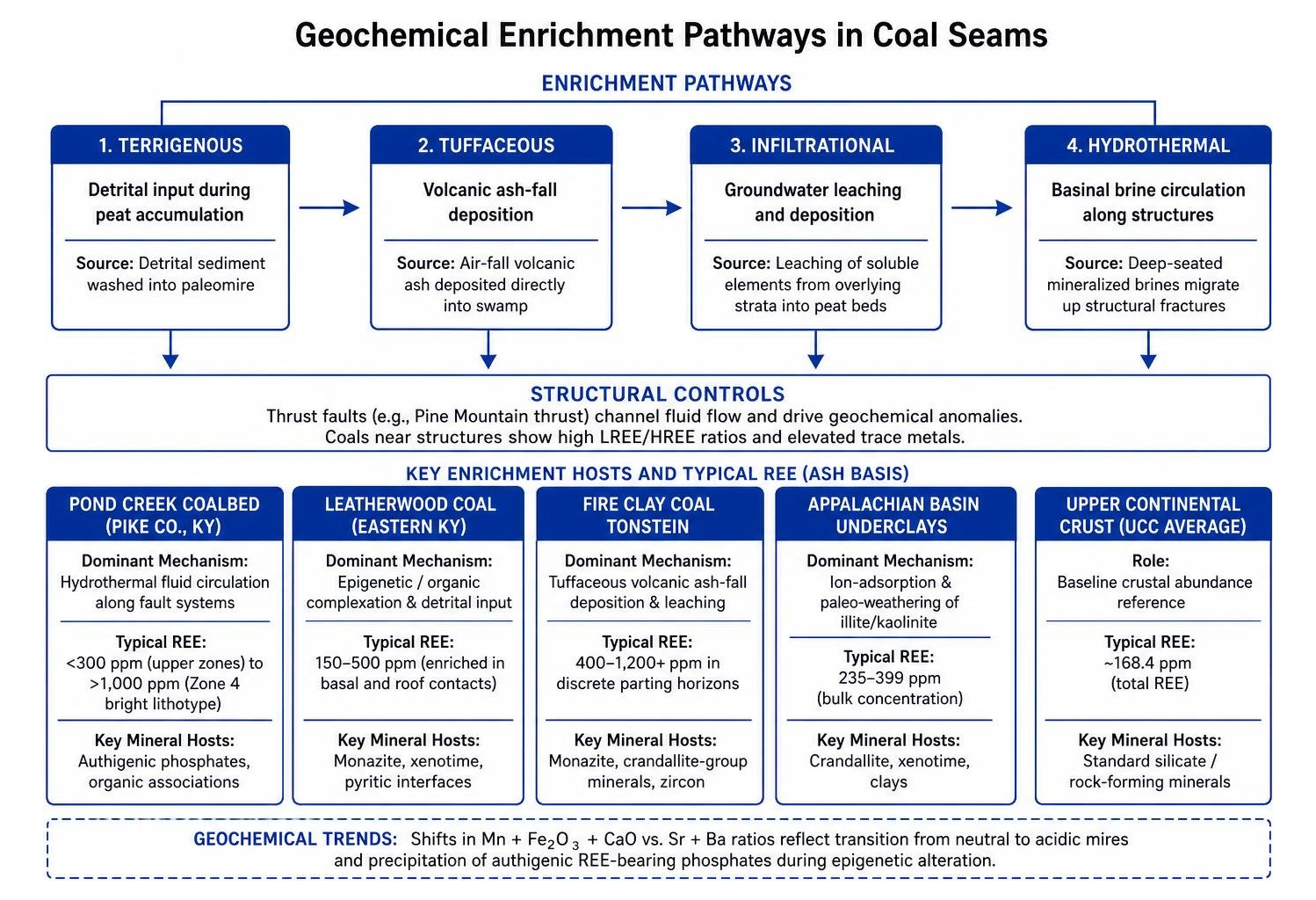
| Deposit / Material | Dominant Enrichment Mechanism | Typical REE Concentration (Ash Basis) | Key Mineral Host Phases |
|---|---|---|---|
| Pond Creek Coalbed (Pike Co., KY) | Hydrothermal fluid circulation along fault systems | <300 ppm (upper zones) to >1,000 ppm (Zone 4 bright lithotype) | Authigenic phosphates, organic associations |
| Leatherwood Coal (Eastern KY) | Epigenetic / organic complexation & detrital input | 150–500 ppm (enriched in basal and roof contacts) | Monazite, xenotime, pyritic interfaces |
| Fire Clay Coal Tonstein | Tuffaceous volcanic ash-fall deposition & leaching | 400–1,200+ ppm in discrete parting horizons | Monazite, crandallite-group minerals, zircon |
| Appalachian Basin Underclays | Ion-adsorption & paleo-weathering illite/kaolinite | 235–399 ppm bulk concentration | Crandallite, xenotime, clays |
| Upper Continental Crust (UCC Average) | Baseline crustal abundance reference | ~168.4 ppm total REE | Standard silicate/rock-forming minerals |
Geochemical Signatures and Enrichment Mechanisms
The geochemical signatures of Central Appalachian coalbeds point to four primary genetic modes of enrichment:
- Terrigenous: Detrital sediment washed into the paleomire during peat accumulation.
- Tuffaceous: Air-fall volcanic ash events that deposited fine-grained felsic minerals directly into the swamp environment.
- Infiltrational: Groundwaters leaching soluble elements from overlying strata and depositing them within permeable peat beds.
- Hydrothermal: Deep-seated, mineralized basinal brines migrating upward through structural fractures.
Structural geology plays a decisive role in Kentucky’s high-grade anomalies. Regional thrust systems, notably the Pine Mountain thrust fault, acted as conduits for warm, mineral-bearing hydrothermal brines. Coals situated near these structural zones frequently display high LREE/HREE ratios, anomalous trace metal concentrations (including elevated germanium, gallium, and strontium), and altered fluid migration pathways. Trace inorganic indicators, such as shifts in Mn + Fe2O3 + CaO versus Sr + Ba ratios, reflect a transition from neutral or weakly acidic precursor mires to increasingly acidic, epigenetically altered environments that precipitated authigenic REE-bearing phosphates.
Critical Mineral Abundance in Underclays and Partings
Beyond the organic coal matrix, fine-grained floor strata known as underclays (seat earths) host meaningful critical mineral reserves. As detailed in microanalytical research on Appalachian Basin underclays, these argillaceous seat earths frequently exhibit total REE concentrations between 235 ppm and 399 ppm, substantially higher than the global Upper Continental Crust average of ~168.4 ppm (Yang et al., 2020).
Data presented in technical surveys on critical minerals in Appalachian coals and associated sediments demonstrate that underclays are particularly enriched in yttrium and heavy lanthanides, with yttrium abundances reaching up to 114 ppm (averaging 34 ppm across broad sample suites). These strata also contain notable concentrations of gallium (mean ~40 ppm), vanadium (mean ~146 ppm), and zirconium (mean ~192 ppm).
These underclays represent unconventional, low-grade, high-volume deposits analogous in some extraction characteristics to southern Chinese ion-adsorption clays, where a portion of the lanthanide series is loosely adsorbed onto the surfaces of kaolinite and illite matrices or held within microcrystalline crandallite-group minerals.
Advanced Methodologies in Lexington Rare Earth Analysis
Accurate characterization of coal-hosted rare earths requires an integrated analytical workflow. Because these elements exist in trace concentrations across heterogeneous carbonaceous matrices, quantitative chemical assays must be paired with high-resolution mineralogical imaging.
At Elemental Analysis Inc., located in Lexington, Kentucky, our analytical workflows support critical mineral projects by combining rapid non-destructive screening methods with precise destructive wet-chemistry techniques. Navigating these options is simplified by consulting our quick start guide to elemental analysis methods, which outlines technique selection based on sample matrix and detection limit requirements.
Non-Destructive Screening in Lexington Rare Earth Analysis
Field exploration and high-volume sample processing rely on non-destructive screening to flag mineralized horizons without destroying the core record:
- Portable X-ray Fluorescence (pXRF): Rapid in situ core scanning measures proxy elements (such as Y, Zr, Sr, and Ba) that correlate closely with total REE concentrations (R² > 0.80 for total REE and R² > 0.95 for heavy REE).
- Proton-Induced X-ray Emission (PIXE): As the premier commercial PIXE laboratory, we provide non-destructive trace element detection with low detection limits for medium-to-heavy elements, avoiding spectral interferences from complex coal-ash matrices.
- Core Logging Integration: High-density continuous scanning captures thin volcanic tonsteins and localized enriched lithotypes that would otherwise be diluted during composite channel sampling.
When exploration campaigns require rapid sample evaluation, our fast elemental testing labs with destructive and non-destructive tests allow teams to make timely data-driven decisions during drilling and sampling programs.
Microscale Characterization and Mineral Speciation
After identifying bulk concentrations, determining chemical speciation and phase association dictates extraction feasibility. Because rare earth minerals in coal and underclays are exceptionally fine—often smaller than 10 to 20 micrometers—they require micro-analytical characterization:
- Field Emission Electron Probe Microanalysis (FE-EPMA) & SEM-EDS: Locates discrete micro-grains of monazite, xenotime, and crandallite dispersed within clay matrices or organic macerals.
- Focused Ion Beam Scanning Electron Microscopy (FIB-SEM): Generates 3D volumetric reconstructions of sub-micron pore structures, organic-mineral interfaces, and grain boundaries to evaluate acid contact access.
- Synchrotron-Based Micro-X-ray Fluorescence (µXRF): Maps elemental correlations across spatial domains, identifying whether light REEs associate with Ca-P-Sr-Ba minerals (crandallite series) or if heavy REEs partition into iron-bearing phases and organic complexes.
For specialized testing configurations that combine mineral liberation analysis with chemical digestion assays, our team designs custom workflows; review the ins and outs of custom lab testing to evaluate technical options.
Economic Viability, Extraction Logistics, and Processing Infrastructure
Extracting critical minerals from coal byproducts requires lower-cost, higher-yield separation technologies than conventional hard-rock mining. The U.S. Department of Energy (DOE) establishes a benchmark of 300 ppm total REE (dry ash basis) as an initial economic threshold for coal-based feedstocks. Multiple Appalachian formations meet or exceed this target, especially when processed as pre-concentrated fly ash, underclays, or coarse refuse reject streams from preparation plants.
Research spearheaded in the state includes the deployment of a pilot-scale plant to extract rare earth elements in coal country, proving the technical viability of producing high-purity rare earth oxide concentrates from local coal refuse. These initiatives align with federal support programs, including the DOE’s funding for the advanced processing of rare earth elements and critical minerals, which accelerates the scale-up of domestic mineral separation flowsheets.
Evaluating Feasibility: Coal Waste vs. Traditional Hard-Rock Mining
Sourcing critical elements from coal waste streams provides several operational and environmental advantages over traditional hard-rock open-pit mines:
- Zero Overburden Removal: Billions of tons of coal refuse, coarse preparation reject, and combustion ash are already mined, crushed, and stockpiled on the surface, eliminating explosive blasting and massive rock excavation costs.
- Lower Radioactive Handling Burdens: Unlike hard-rock carbonatite ores (such as bastnäsite or monazite sand deposits) that carry high thorium and uranium activities, Appalachian coal byproducts contain low specific radioactivity, streamlining NRC regulatory compliance.
- Acid Mine Drainage (AMD) Remediation: Treating acidic coal refuse runoff presents a unique co-benefit: AMD treatment precipitates can serve as secondary feedstocks, capturing dissolved rare earths while neutralizing environmental liabilities.
To manage environmental compliance and assay precision, companies partner with certified testing providers; our overview on outsourcing inorganic elemental analysis outlines key analytical standards.
Leveraging Regional Coal Infrastructure and Workforce
Kentucky possesses an industrial ecosystem built for bulk materials processing and transport. Eastern Kentucky’s extensive rail logistics, heavy barge facilities on the Ohio and Big Sandy rivers, and existing electrical grid capacity provide infrastructure that would require billions of dollars to build in greenfield mining regions.
Furthermore, regional engineering programs, mining workforces, and the extensive geochemical archives maintained by the Kentucky Geological Survey coal analyses database provide an operational foundation. By combining high-capacity coal washing infrastructure with hydrometallurgical processing hubs, the region can evolve from pure fuel extraction into advanced critical mineral recovery.
Strategic Supply Chain Impacts and National Security Implications
As of 2026, the United States remains exposed to foreign critical mineral monopolies, depending heavily on imports for refined rare earth metals, separated oxides, and sintered neodymium-iron-boron (NdFeB) permanent magnets. These elements are essential for defense systems—including precision-guided munitions, radar transducers, and military aircraft—as well as civilian green-energy applications like electric vehicle traction motors and direct-drive wind turbine generators.

Developing domestic, unconventional separation and refining capacity in the Appalachian Basin provides a secure, counter-cyclical supply buffer. Reclaiming valuable elements from domestic coal streams directly aligns with federal supply chain reshoring initiatives and domestic content mandates.
Academic and Federal Collaboration in Lexington Rare Earth Analysis
Lexington, Kentucky serves as an intellectual and technical center for critical mineral development. Collaborative programs linking the University of Kentucky, the Department of Energy’s National Energy Technology Laboratory (NETL), and independent commercial testing facilities have established the geochemical baselines, thermodynamic models, and recovery flowsheets necessary to derisk commercial investments.
Through systematic sampling and chemical quantification across Appalachian basins, these partnerships turn geological surveys into actionable mineral processing operations.
Frequently Asked Questions About Appalachian REE Characterization
What REE concentrations make Appalachian coal deposits economically viable?
The U.S. Department of Energy considers feedstocks containing 300 ppm total REE on a dry whole-sample or ash basis as prospective exploration targets for coal and related strata. However, economic viability depends heavily on the extractability of the elements (ion-exchangeable vs. refractory phosphate minerals) and the relative proportion of high-value magnet critical elements (neodymium, praseodymium, dysprosium, and terbium).
How do hydrothermal fault systems influence REE enrichment in eastern Kentucky?
Hydrothermal fluids circulating along major structural faults, such as the Pine Mountain thrust system, transported dissolved trace metals and lanthanides through regional fractures. When these warm basinal fluids contacted organic-rich peat beds, changes in pH, redox state, and sulfur chemistry caused the precipitation of authigenic REE-bearing minerals, generating zones enriched well beyond detrital background levels.
What are the main analytical challenges in measuring REEs in coal matrices?
Coals contain complex, refractory aluminosilicate and carbonaceous matrices. Complete dissolution requires total multi-acid digestion techniques (including hydrofluoric acid) or alkali fusion to break down resistant zircon, monazite, and tourmaline grains without losing volatile components. Additionally, non-destructive spectroscopy requires sophisticated correction models to eliminate matrix absorption, inter-element overlaps, and background scatter generated by low-Z carbon matrices.
Conclusion
The future of American mineral security relies on identifying unconventional domestic resources and deploying advanced analytical methods to characterize them. Appalachian coal deposits, volcanic ash tonsteins, and underclays represent a domestic mineral reserve capable of diversifying critical element supply chains while supporting regional environmental remediation.
Unlocking these assets requires rigorous analytical characterization—from preliminary non-destructive screening to trace-level quantification and sub-micron mineral speciation. Elemental Analysis Inc. provides the testing expertise, advanced instrumentation, and rapid-turnaround capabilities necessary to support exploration, process design, and pilot-scale refining projects across Kentucky and the United States. To learn more about the physical properties and supply chain dynamics of these critical metals, read our complete guide to rare earth elements and their history.
Scientific References
Jon Yang, Scott Montross, Jim Britton, Mengling Stuckman, Christina Lopano, Circe Verba. “Microanalytical Approaches to Characterizing REE in Appalachian Basin Underclays.” Minerals, 2020. DOI 10.3390/min10060546.