
How Mining Rare Earths Turns Rock Into Critical Materials
Mining rare earths starts with finding ore that contains enough of the right minerals to recover. The ore is dug up and concentrated, then processed to separate individual rare earth elements. Those elements can be refined for products such as powerful magnets. The hard part is often separation, not digging.
The 17 rare earth elements are not especially scarce in Earth’s crust. They are called “rare” because rich, workable deposits are harder to find. In 2026, that challenge matters well beyond the mine: rare earth magnets help power electric vehicles, wind turbines, robots, and defense equipment, while processing remains heavily concentrated in China.
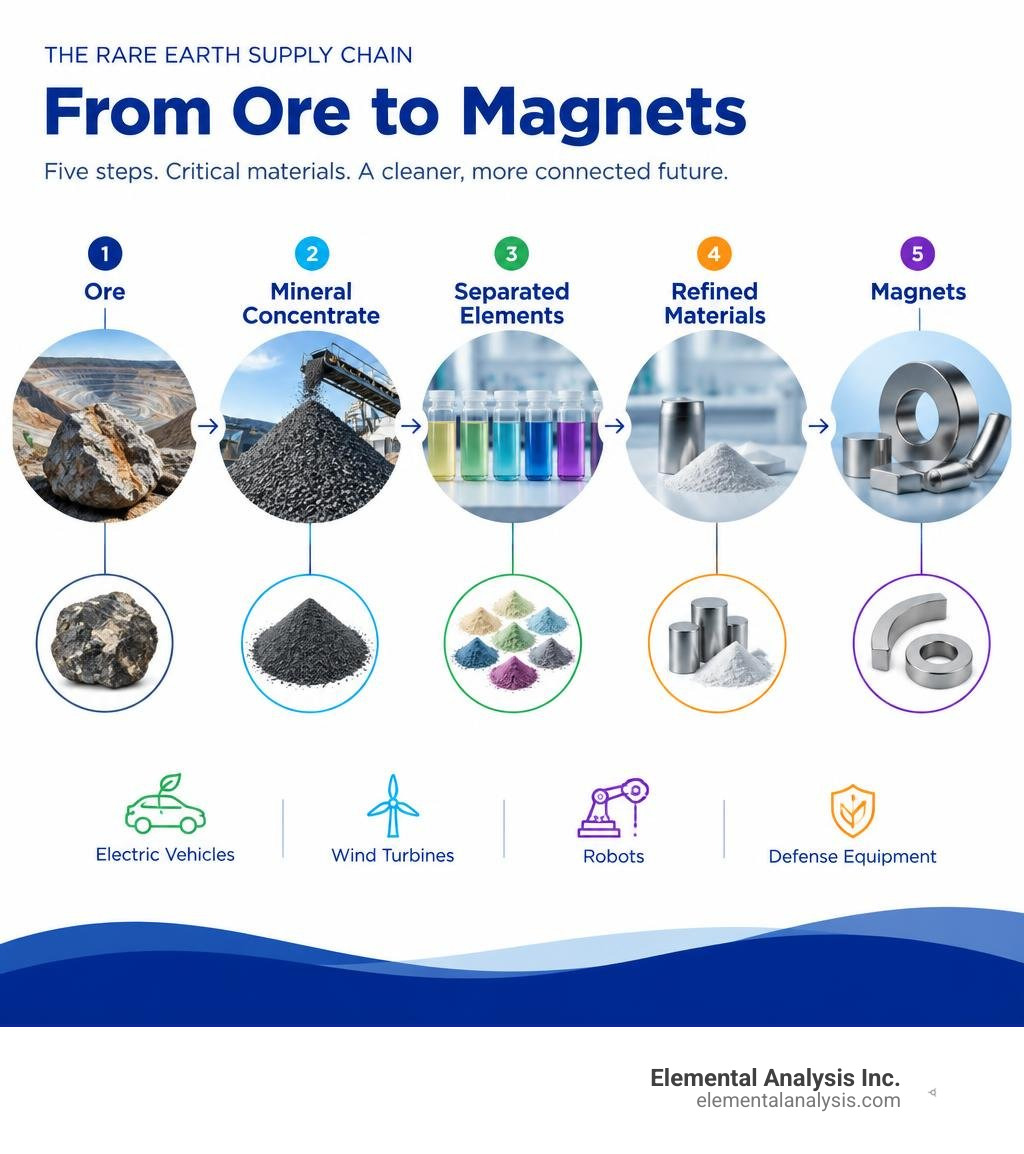
Mining rare earths terms you need:
The Geology and Complexity of Mining Rare Earths
The term “rare earths” has confused students, investors, and policymakers for well over a century. Geologically speaking, these seventeen metallic elements—scandium, yttrium, and the fifteen lanthanides spanning lanthanum to lutetium—are remarkably plentiful. Cerium, for instance, is more abundant in Earth’s continental crust than copper, lead, or tin, while even the rarest heavy lanthanides are more common than gold or platinum. We explore their foundational chemistry and historic discovery in a complete guide to rare earth elements and their history.
The real bottleneck is mineralogical dispersion. Unlike gold, iron, or copper, which form rich, concentrated underground veins that miners can cleanly dig out, rare earths rarely concentrate into pure native ores. Instead, they substitute into the crystal lattices of hundreds of rock-forming host minerals, primarily bastnäsite (a carbonate-fluoride mineral) and monazite (a phosphate mineral). In most locations, total rare earth oxide (TREO) concentrations are stubbornly low, often making the process of mining rare earths uneconomical unless massive processing volumes or exceptionally rich deposits are available.
Extracting these elements requires fine grinding of millions of tons of hard rock, followed by flotation to produce a mineral concentrate, and ultimately complex chemical hydrometallurgy to separate individual elements that share nearly identical ionic radii and valence charges.
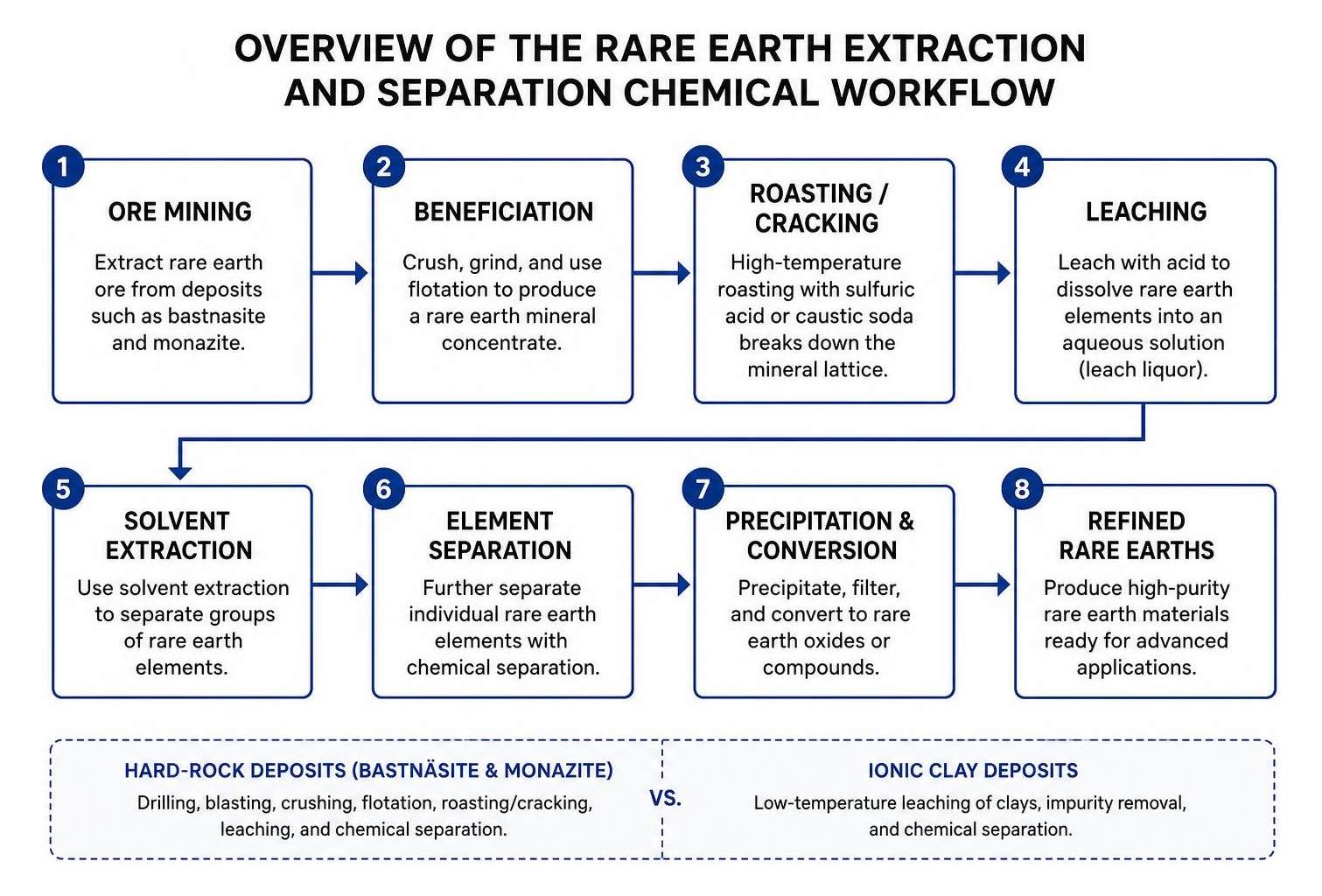
Conventional Hard-Rock Mining Rare Earths vs. Ionic Clays
The global industry relies on two primary geological deposit types, each requiring vastly different chemical processing flowcharts:
- Hard-Rock Mineral Deposits (Bastnäsite and Monazite): Hard-rock mining involves heavy drilling, blasting, and mechanical crushing of dense granite or carbonatite ores. Beneficiation uses froth flotation to create a concentrate, which is then subjected to high-temperature thermal roasting with concentrated sulfuric acid or caustic soda cracking. This thermal breakdown destroys the mineral lattice so the elements dissolve into an acidic leach liquor.
- Ionic Adsorption Clays (Regolith-Hosted Deposits): Weathered granite in subtropical environments produces soft clays where trivalent rare earth ions are loosely bound (adsorbed) onto clay mineral surfaces rather than trapped inside tough crystalline matrices. Processing does not require crushing or roasting; operators wash the clays with an electrolyte solution like ammonium sulfate via simple cation exchange. Most importantly, ionic clays naturally concentrate heavy rare earth elements (HREEs).
| Deposit Type | Primary Mineral Hosts | Extraction Method | Energy Footprint | HREE Proportion | Key Global Locations |
|---|---|---|---|---|---|
| Hard-Rock | Bastnäsite, Monazite, Xenotime | Open-pit blasting, flotation, acid roasting | High (thermal & chemical cracking) | Low to Moderate (LREE dominant) | USA, Australia, South Africa, Angola |
| Ionic Clay | Adsorbed ions on kaolinite, halloysite | In-situ or vat ammonium sulfate leaching | Low (no mechanical crushing/roasting) | Exceptionally High (Dy, Tb rich) | Southern China, Myanmar, Brazil |
Critical Magnet Elements: Neodymium, Dysprosium, and Terbium
While the lanthanide family contains 15 elements, the modern economy is primarily driven by permanent magnet metals. Neodymium-iron-boron (NdFeB) magnets are the strongest commercial permanent magnets known to science, capable of producing magnetic fields exceeding 1.2 teslas—far eclipsing traditional ferrite magnets.
Neodymium (Nd) and praseodymium (Pr) provide pure magnetic strength, but standard NdFeB magnets rapidly lose their coercivity (resistance to demagnetization) as temperatures climb above 80°C. To survive the extreme thermal environments inside electric vehicle (EV) drive motors, wind turbine direct-drive generators, robotics actuators, and aerospace guidance systems, manufacturers must alloy the material with dysprosium (Dy) and terbium (Tb). These heavy rare earths act as thermal stabilizers, preserving magnetic performance at operating temperatures exceeding 200°C. Understanding how high-purity functional materials enable advanced electronic systems is clear when looking at how semiconductor material analysis powers modern tech.
Global Monopolies and Geopolitical Supply Chains

Global supply vulnerabilities are driven less by where ores are located and more by where they are refined. As of 2026, China mines an estimated 80% to 90% of global rare-earth minerals and processes virtually all the rest, despite holding only about 37% of proven global reserves. Furthermore, China manufactures roughly 90% of the world’s finished rare-earth permanent magnets.
Between 2020 and 2023, the United States imported at least 70% of its rare earth compounds directly from Chinese suppliers. This reliance became glaringly visible in 2024 when the U.S. imported 80% of its total consumed rare earth elements, alongside 100% of its gallium and natural graphite.
When geopolitical trade disputes occur, export controls and licensing barriers create severe friction for downstream Western industries. The strategic reality has driven major policy shifts, with Western governments actively funding allied mining, extraction, and processing initiatives worldwide, including efforts highlighted when the US backs a South Africa project to extract rare earths as it counters China.
Western Infrastructure and Allied Mining Projects
To counter this concentration, allied nations are building an independent “mine-to-magnet” supply web spanning North America, South America, Africa, and Australia:
- North American Hard-Rock Expansion: The Mountain Pass Rare Earth Mine in California continues to scale its domestic cracking and separation capabilities, reducing the historic requirement of sending raw mineral concentrates overseas for refining. In Wyoming, Rare Element Resources (RER) is advancing its Bear Lodge project, backed by $24 million from the U.S. Department of Energy (DOE) and local state backing. Bear Lodge boasts a high-grade measured resource of 4.53% (45,300 ppm) TREO, aiming to scale from a 10-tonne Nd/Pr demonstration plant into a 2,000-tonne-per-year commercial production hub.
- African Monazite and Tailings Initiatives: In Angola, the Pensana Longonjo Mine is developing an open-pit project targeting an initial 20,000 tonnes of mixed rare earth carbonate (MREC) annually—scaling to 40,000 tonnes by Year 4 over a 20-year mine life. Longonjo is designed to recover over 122 tonnes per year of critical Dy and Tb. In South Africa, the Steenkampskraal Monazite Mine—the world’s highest-grade rare earth and thorium deposit—is targeting initial concentrate shipments before the close of 2026. Simultaneously, the Phalaborwa project in South Africa is utilizing a $50 million equity investment from the U.S. International Development Finance Corporation (DFC) to recover minerals from legacy phosphogypsum waste stacks using up to 90% renewable power.
- South American Ionic Clay Breakthroughs: Australia’s Lynas secured the tier-one Caldeira ionic clay deposit in Minas Gerais, Brazil, marking a historic shift as Western refiners acquire high-grade ionic clay resources rich in heavy rare earths.
- Domestic Analytical Support: At our laboratory in Lexington, Kentucky, we provide the vital compositional profiling and purity assays required to validate these domestic and allied mineral streams, detailed in our work on Lexington rare earth analysis and the future of American mineral security.
Innovative Extraction, Waste Recovery, and Recycling

Because developing conventional greenfield mines often requires 10 to 15 years due to environmental impact reviews and capital constraints, researchers are pioneering methods to recover rare earth elements without digging new open pits. As documented in reports showing how companies are scouring mining waste, secondary industrial residues represent an immediate, above-ground reserve of critical raw materials.
Recycling of end-of-life permanent magnets from retired wind turbines, electric vehicles, and electronic scrap offers another vital stream. Modern hydrometallurgical and pyrometallurgical recycling routes can recover high-purity mixed rare earth oxides with a fraction of the carbon footprint of primary mining.
Next-Generation Methods for Mining Rare Earths from Industrial Tailings
Innovative chemical and biological techniques are unlocking value from domestic waste:
- Phosphogypsum Stacks: The production of phosphoric acid for agricultural fertilizer generates hundreds of millions of tons of phosphogypsum waste. These gypsum dunes often contain low but commercially recoverable concentrations of neodymium, praseodymium, and dysprosium.
- Coal Combustion By-Products: Fly ash from coal-fired power generation and Appalachian coal refuse piles hold meaningful concentrations of lanthanides. Recovering elements from coal waste cleans up legacy environmental hazards while providing domestic feedstock.
- Kaolin Processing Waste: Industrial kaolin clay washing operations, such as those in Georgia producing millions of tons of tailings annually, yield fine mineral fractions naturally enriched in ionic-adsorbed rare earths.
- Selective Ion-Exchange and Bioleaching: Advanced chemical resins and specialized bacterial strains (e.g., Gluconobacter oxydans) produce organic acids that selectively solubilize rare earth ions from solid matrices, drastically cutting down on harsh mineral acid consumption.
Environmental Challenges, Separation Chemistry, and Material Purity
The environmental footprint of rare earth processing has historically been severe. The primary technical hurdle is that rare earth elements are chemical twins: they sit together in the periodic table, exhibit nearly identical +3 oxidation states, and have almost indistinguishable atomic diameters due to the gradual contraction of their 4f electron shells (the “lanthanide contraction”).
Separating them requires liquid-liquid solvent extraction (SX). In this process, an aqueous feed solution containing mixed dissolved rare earths is washed against an immiscible organic solvent containing selective extractants (such as organophosphorus compounds).
Because the separation factor between adjacent lanthanides (like neodymium and praseodymium) is minute, industrial separation requires cascading hundreds of individual mixer-settler stages in series. This hydrometallurgical gauntlet consumes vast volumes of hydrochloric acid, kerosene, and saponification agents (like sodium hydroxide or ammonia), generating complex acidic wastewater that must be neutralized and contained.
Furthermore, naturally occurring monazite and bastnäsite ores frequently contain radioactive thorium and uranium. Managing low-level radioactive tailings requires strict radiological monitoring, robust containment liners, and regulatory compliance to prevent groundwater contamination.
Precision Characterization and Trace Impurity Profiling
For magnet makers and high-tech defense contractors, material quality is binary: a rare earth oxide must typically reach 99.99% (4N) or 99.999% (5N) purity to be converted into commercial-grade metal and alloys. Even parts-per-million (ppm) traces of non-target lanthanides, iron, silicon, or halogens can degrade permanent magnet coercivity, induce structural embrittlement, or poison semiconductor manufacturing steps.
This reality makes rigorous analytical testing indispensable across the entire mineral lifecycle:
- Geological Prospecting: Accurately measuring parts-per-billion concentrations of all 17 elements in exploratory drill cores.
- Process Metallurgy Optimization: Real-time monitoring of solvent extraction battery stages to ensure sharp element splitting.
- Final Product Quality Control: Verifying that refined oxides and magnet powders meet strict trace contaminant limits.
At Elemental Analysis Inc., based in Lexington, Kentucky, we specialize in delivering precise trace elemental identification, quantification, and speciation. Utilizing advanced non-destructive and destructive methods, our laboratory operates as an industry pioneer—serving as the first commercial laboratory to provide Particle-Induced X-Ray Emission (PIXE). Learn how our analytical workflows verify material purity in how trace impurities analysis keeps modern technology safe and pure and explore our specialized techniques in the ultimate guide to particle induced X-ray emission.
Frequently Asked Questions about Rare Earth Mining
Why are rare earths called rare if they are abundant in the Earth’s crust?
They earned the historical label “rare” because when discovered in the 18th and 19th centuries, scientists found them in rare, complex minerals from which individual elements were exceptionally difficult to isolate. Geologically, they are widely dispersed across the Earth’s crust rather than concentrated in rich, accessible ore veins like copper or gold. The scarcity lies in finding high-grade deposits that can be economically permitted, excavated, and chemically separated.
Why does China dominate global rare earth processing?
China’s leadership is the result of decades of strategic industrial planning beginning in the late 20th century. By combining state-supported research hubs, integrated chemical supply chains, low operating costs, and massive domestic industrial demand, China built out world-scale solvent extraction refineries. Western nations largely decommissioned their domestic refining capacity in the 1990s due to environmental compliance costs, leaving China with an integrated monopoly over intermediate separation chemistry and downstream magnet manufacturing.
How long does it take to develop a new rare earth mine?
Bringing a greenfield rare earth hard-rock mine into commercial production typically takes between 10 to 15 years. The extended timeline is driven by:
- Multi-year exploratory drilling to map complex ore mineralogy.
- Extensive bench-scale and pilot-plant hydrometallurgical testing to design deposit-specific chemical flowcharts.
- Stringent environmental impact assessments, water discharge permits, and radiological clearances for handling thorium/uranium by-products.
- Securing heavy capital investments ($200 million to over $1 billion) for downstream refining infrastructure.
Conclusion
The global race to secure critical mineral supply chains has moved rare earth mining from an obscure industrial sector into the spotlight of international geopolitics and economic strategy. Establishing true mineral independence requires more than digging rock out of the ground; it requires mastering the intricate, multi-stage hydrometallurgical chemistry needed to separate individual lanthanides, convert them into high-purity metals, and manufacture permanent magnets.
Through allied collaborations spanning North America, Africa, Australia, and South America—combined with pioneering waste-tailings recovery and magnet recycling—a diversified, resilient supply ecosystem is emerging.
Achieving success across every stage of this supply chain requires uncompromised chemical precision. At Elemental Analysis Inc., our team in Lexington, Kentucky, provides the rapid, world-class assay verification, trace contaminant testing, and elemental characterization needed to turn raw geological discoveries into high-purity advanced materials.
To explore the chemical profiles, magnetic roles, and industrial milestones of these critical elements, read our comprehensive guide to rare earth elements or reach out to our laboratory team today for specialized mineral testing and material characterization support.