
Historical Background and Construction of the Galleon
The Nuestra Señora de Atocha was a 1622 Spanish treasure galleon laden with gold, silver, and emeralds that sank off the Florida Keys and was famously discovered in 1985 by Mel Fisher. Constructed in the shipyards of Havana, Cuba, in 1620, the galleon was designed specifically to endure the perilous transatlantic voyages between Spain and the Americas. Named in honor of the revered Basilica of Nuestra Señora de Atocha in Madrid, the galleon served as the almirante—the heavily armed rear guard of the Spanish Tierra Firme fleet. Her critical responsibility was to protect merchant vessels from privateers, pirates, and rival European navies while transporting high-value colonial wealth back to the Spanish Crown.
The ship measured 112 feet (34 meters) in overall length, had a broad beam of 34 feet (10 meters), drew 14 feet (4.3 meters) of water, and was rated at roughly 550 tons burthen. Her crew comprised approximately 110 mariners and a military complement of 90, which included 82 armed infantrymen. For defense, she carried 20 heavy bronze cannons alongside several smaller swivel guns, known as versos.
Unlike many European galleons constructed primarily of white oak, the Atocha was built with a hull made largely of tropical mahogany. While dense tropical hardwoods were plentiful around the Caribbean shipyards, the vessel’s construction suffered from structural compromises and rushed assembly. Contemporary maritime documents curated in regional archives, including the Florida Memory record of the Atocha, reflect how early maiden runs revealed stress fractures, including a cracked mainmast that required refitting before her final voyage.
The 1622 Disaster in the Florida Straits
On September 4, 1622, the 28-ship Tierra Firme convoy finally hoisted sail from Havana harbor, bound for Cádiz after weeks of logistical delays. Laden with colonial wealth collected from Portobelo, Cartagena, and New Granada, the fleet was running uncomfortably late into the Atlantic hurricane season.
Just two days into the journey, as the convoy navigated the treacherous shallow waters of the Florida Straits, a ferocious hurricane struck from the south. Fierce squalls and high swells battered the heavily laden wooden ships, scattering the fleet across open water. On the night of September 6, 1622, the howling winds drove the Atocha helplessly toward the sharp coral reefs near the Marquesas Keys.
The reef tore through the mahogany hull, quickly swamping the ship. The galleon sank in roughly 55 feet (17 meters) of water. Of the 265 passengers, crew, and soldiers aboard, only five survived—three sailors and two enslaved workers who endured the storm by clinging to the exposed stump of the mizzenmast for two grueling days before being rescued by a passing merchant ship.
Eight ships from the 1622 fleet were lost in the hurricane, including the galleon Santa Margarita. The catastrophic loss of lives, armaments, and royal bullion sent immediate financial shockwaves across Europe. The missing wealth paralyzed the Spanish treasury, forcing the Crown to take high-interest loans and sell off merchant assets during the costly Thirty Years’ War.
The Atocha Shipwreck Cargo and Archaeological Treasures

The cargo sealed beneath the ocean floor was staggering in both scale and cultural significance. Official documents recorded an extraordinary inventory of raw bullion, processed metals, agricultural goods, and luxury personal adornments. Modern excavations later revealed that the vessel carried approximately 40 tonnes of gold and silver, alongside 32 kilograms (71 pounds) of vivid green emeralds extracted from Colombia’s famous Muzo mines—including a massive 77.76-carat uncut emerald crystal.
To understand the sheer scale of the cargo, it helps to examine the items registered on the official royal manifest against the extensive unregistered contraband uncovered across the wreck site:
| Cargo Category | Registered Manifest Details | Recovered & Archaeological Findings |
|---|---|---|
| Silver Bullion | 1,038 ingots (~24 tons) | Hundreds of cataloged 70-lb bars with foundry stamps |
| Silver Coinage | ~180,000 to 230,000 silver pesos/reales | Tens of thousands of irregularly hammered silver cobs |
| Gold | 125 stamped gold bars and discs | Stamped bars, discs, gold religious chains, and rings |
| Precious Gems | Colombian emerald consignments | High-grade Muzo emerald crystals and mounted jewelry |
| Base Metals | 582 copper ingots (~15 tons) | Copper cakes, artillery munitions, and iron ship fittings |
| Commercial Trade | 350 indigo chests, 525 tobacco bales | Preserved trade items, organic seeds, and resin remnants |
| Worked Luxury Goods | 1,200 lbs of silverware and religious plate | Silver platters, ornate chalices, candelabras, and ewers |
| Contraband | Unlisted (officially illegal) | Estimated to comprise roughly 20% of all recovered items |
The historical documentation of the Atocha housed in the General Archive of the Indies confirms that nobility, merchants, and mariners routinely smuggled untaxed gems and silver aboard to avoid the royal quinto real (the King’s Fifth tax).
Historical Manifest of the Atocha Shipwreck
The Casa de Contratación (House of Trade) in Seville maintained strict ledgers of every ounce of cargo cleared through New World ports. The manifest of the Atocha listed thousands of silver coins struck at colonial mints, most notably Potosí (in modern-day Bolivia), Mexico City, and Lima.
In addition to bullion, the ship carried practical trade materials such as half a million pounds of mercury (quicksilver) shipped earlier from Spain to amalgamate and extract silver from South American raw ore. For enthusiasts and numismatists examining recovered pieces, consulting our guide to collecting authentic shipwreck coins provides insight into how individual colonial mints stamped, weighed, and clipped these historic planchets.
Authenticating Atocha Shipwreck Artifacts and Coins
Verifying the authenticity of recovered artifacts requires cross-referencing archival logs with modern material science. Authentic colonial silver and gold coins—often referred to as “cobs” (derived from cabo de barra, referring to coins clipped from the end of a poured metal bar)—were hand-struck using crude dies. They carry distinct assayer initials, mint marks, and cross motifs.
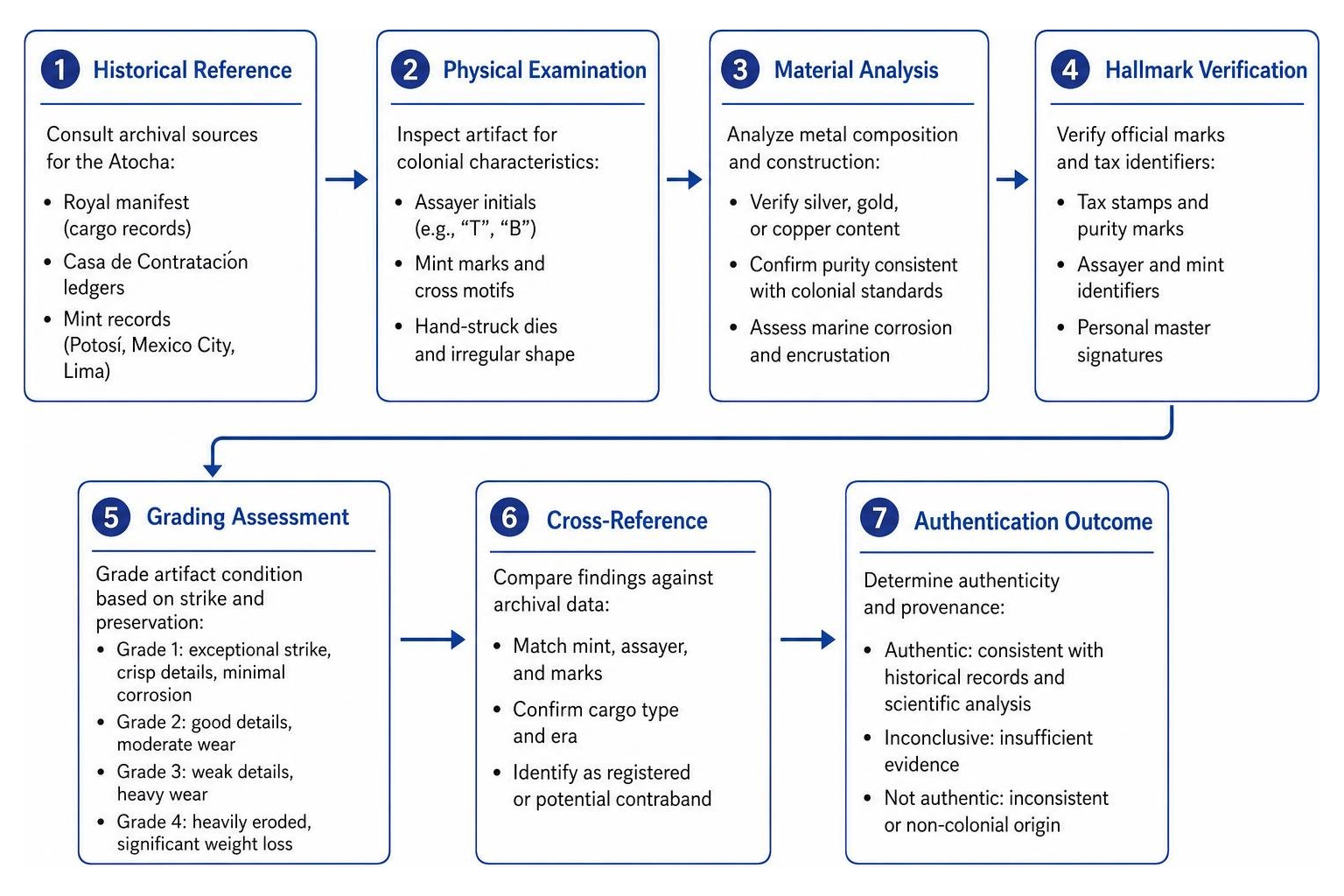
When authenticating Spanish colonial artifacts, specialists look for specific physical and chemical indicators:
- Assayer and Mint Identifiers: Examining official letters stamped into the metal face, such as the assayer mark “T” for Juan Ximenez de Tapia or “B” for standard Potosí assayers.
- Grading Classifications: Recovered cobs are categorized on a scale from Grade 1 (exceptional strike with crisp mint details and minimal marine corrosion) down to Grade 4 (heavily eroded planchets with significant weight loss from seawater leaching).
- Hallmark Verification: Identifying verified tax stamps, purity marks, and personal master signatures by decoding antique metal hallmarks on religious chalices, chains, and jewelry mountings.
- Non-Destructive Spectrometry: Utilizing non-destructive XRF elemental testing to establish exact alloy compositions without scraping, cutting, or damaging the historic patina.
- Geochemical Provenance: Employing advanced lead isotope analysis for ore sourcing to match trace lead impurities in silver bars back to the original mines of Upper Peru or New Spain.
The Multi-Decade Search, Recovery, and Legal Battles
Shortly after the disaster in 1622, the Spanish Crown launched salvage missions to retrieve the sunken wealth. Using primitive equipment, including a brass diving bell fitted with a small viewing window, Spanish authorities recovered a few cannons and scattered items before a secondary hurricane shifted the seabed and obliterated the wreck markers. For 363 years, the main cargo remained buried beneath deep sand and mud.
The modern quest to find the lost galleon began in 1969 under the leadership of treasure hunter Mel Fisher and his team at Treasure Salvors, Inc. Searching the vast waters off Key West, the expedition faced 16.5 years of technical hurdles, false leads, and personal tragedy. In 1975, Mel’s eldest son, Dirk Fisher, alongside his wife Angel and diver Rick Gage, lost their lives when their salvage vessel Northwind tragically capsized at night.
Despite the heartbreak, the team pressed forward, developing novel underwater salvage tools such as the “mailbox”—a specialized prop-wash deflector mounted to salvage boats to blast clean surface sand away from bedrock. They systematically surveyed miles of ocean floor using marine proton magnetometers.
Over the years, minor discoveries kept hopes alive, including gold chains, 1,500 coins in 1973, and buried bronze cannons. Finally, on July 20, 1985, the crew aboard the salvage vessel Dauntless radioed their famous breakthrough: “Put away the charts; we’ve found the main pile!”
The main deposit, nicknamed the “Bank of Spain,” revealed a literal wall of stacked silver bars, chests of silver cobs, gold ingots, ornate weaponry, and emeralds. In 2014, the Atocha salvage was officially entered into the Guinness Book of World Records as the most valuable shipwreck ever recovered. Discoveries continue to this day: divers recovered an antique emerald ring valued at $500,000 in June 2011, and in June 2026, salvage divers recovered an additional pristine silver bullion ingot valued between $50,000 and $100,000.
Legal Battles and U.S. Supreme Court Ruling
The historic find initiated a fierce ten-year legal confrontation over title and ownership. Following the initial recoveries, the State of Florida claimed ownership of the wreck site under state salvage statutes, demanding a 25% share of all recovered artifacts.
Treasure Salvors, Inc. filed federal admiralty claims asserting rights of discovery and maritime salvage. The dispute ascended through federal courts, ultimately reaching the highest bench in the country. On July 1, 1982, the U.S. Supreme Court ruled definitively in favor of Treasure Salvors, Inc. (Florida Dept. of State v. Treasure Salvors, Inc.), holding that Florida had no legal jurisdiction over shipwrecks lying in federal waters outside state boundaries. The landmark ruling established enduring precedents in American admiralty law and secured the salvors’ legal rights to the treasure.
Frequently Asked Questions About the Atocha Galleon
What caused the Atocha to sink in 1622?
The Atocha was caught in a severe hurricane on September 6, 1622, roughly two days after sailing from Havana. The gale-force winds drove the vessel against shallow coral reefs in the Florida Straits, tearing open the mahogany hull and causing her to sink in approximately 55 feet of water.
How much was the recovered treasure worth?
The primary treasure recovered from the wreck site is valued at more than $450 million in modern currency. The haul included over 1,000 silver ingots, hundreds of thousands of silver coins, gold bars, rare navigational instruments, and tens of pounds of Colombian emeralds.
What makes the Atocha coins so valuable today?
Atocha coins are prized due to their direct historical provenance, distinct colonial mint marks (such as Potosí and Mexico City), hand-struck irregular cob shapes, and verified assayer stamps. High-grade specimens (Grade 1 and Grade 2) that escaped severe saltwater corrosion command substantial premiums among collectors and historians.
Conclusion
The saga of the Nuestra Señora de Atocha remains an unmatched chapter in maritime history. From its ill-fated 1622 voyage carrying royal bullion to the 16.5-year salvage effort led by Mel Fisher, the galleon bridges colonial history, legal precedent, and modern underwater recovery.
Beyond the sheer romance of gold and emeralds, authenticating and preserving artifacts recovered from marine environments demands absolute analytical precision. At Elemental Analysis Inc., located in Lexington, Kentucky, we specialize in high-precision trace element identification, metallurgical alloy characterization, and non-destructive testing. As a pioneer in commercial Particle Induced X-ray Emission (PIXE) and advanced elemental analysis, our laboratory assists researchers, collectors, and institutions in verifying metallic compositions, discovering ore origins, and preserving precious historical artifacts without altering their physical integrity.
To dive deeper into the metallurgical history and archival records of this famous galleon, explore our detailed analysis of the wreck of the Nuestra Señora de Atocha.