
Find an Empirical Formula from Composition Data
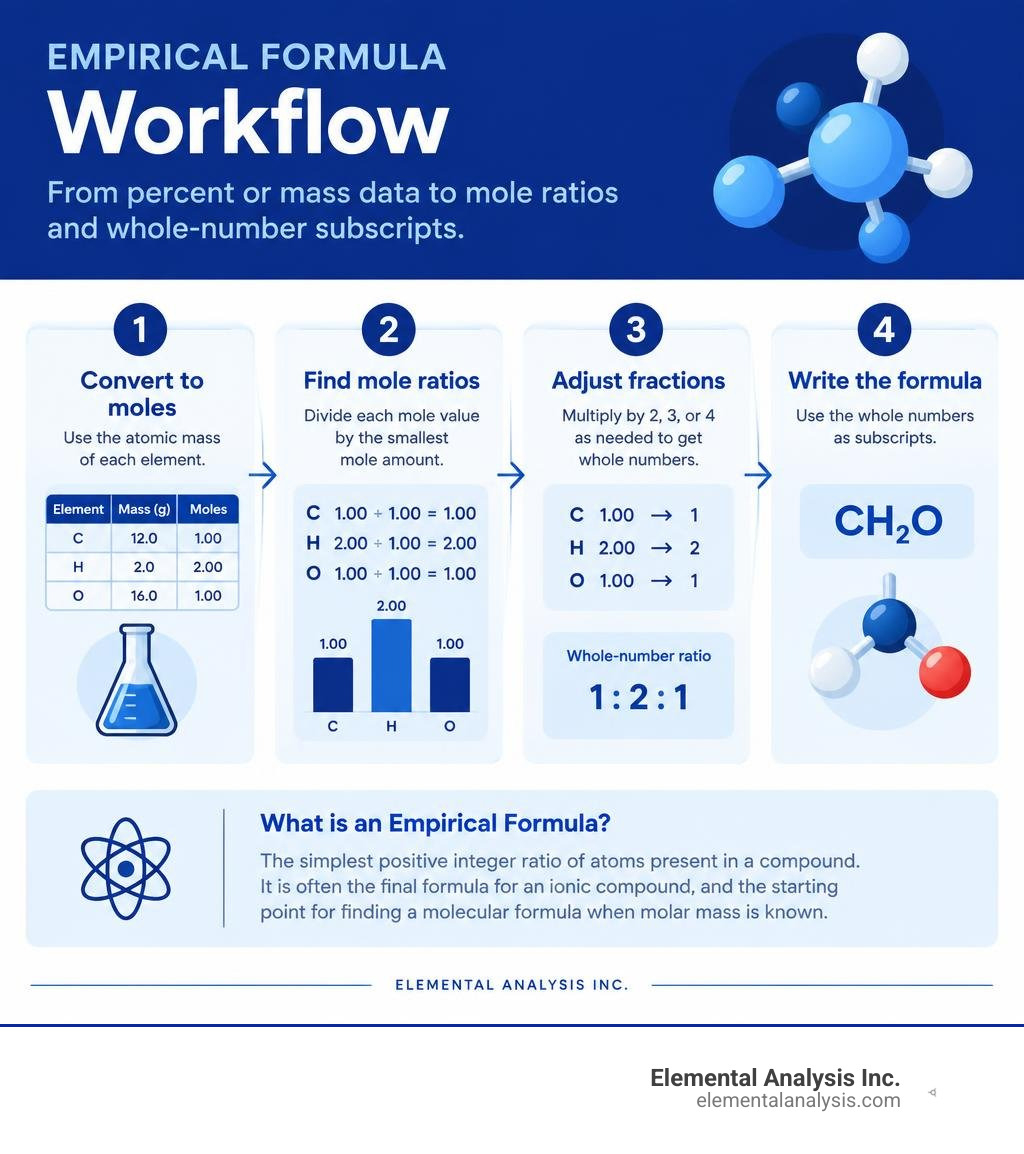
To find an empirical formula, convert each element’s mass or percent composition to moles, divide every mole value by the smallest result, then adjust any remaining fractions to the smallest whole-number ratio. Use those whole numbers as subscripts in the formula.
For percent data, assume a 100 g sample. That makes each percentage equal to grams, so the calculation is faster:
- Convert grams to moles using each element’s atomic mass.
- Divide all mole amounts by the smallest mole amount.
- Multiply ratios such as 1.5, 1.33, or 1.25 by 2, 3, or 4 as needed.
- Write the simplest ratio of atoms.
An empirical formula shows the lowest whole-number ratio of elements in a compound. It is often the final formula for an ionic compound, and it is the starting point for finding a molecular formula when molar mass is known. For lab teams, this calculation turns elemental-analysis results into a clear, checkable composition.
Empirical Formula vs. Molecular Formula: Core Definitions
Understanding the distinction between an empirical formula and a molecular formula is fundamental to stoichiometry and quantitative chemical characterization.
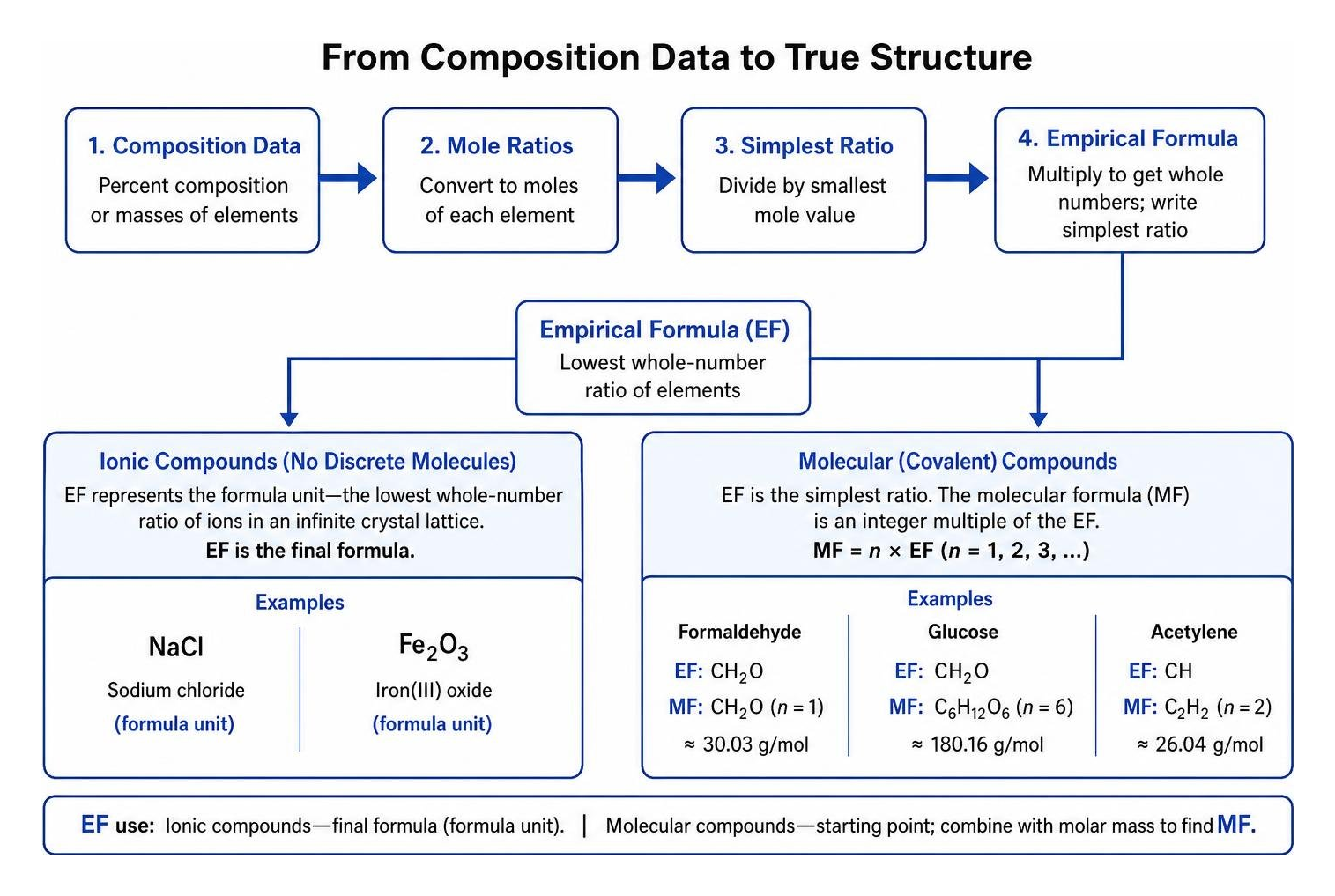
- Empirical Formula: The simplest positive integer ratio of atoms present in a chemical compound. It does not necessarily represent the actual number of atoms within an individual discrete molecule; rather, it reflects relative proportions established by quantitative measurement.
- Molecular Formula: The exact representation of the actual number and types of atoms bonded together in a single discrete molecule of a covalent substance.
For many substances, the empirical formula and the molecular formula are identical. Water ($H2O$), carbon dioxide ($CO2$), and methane ($CH_4$) cannot be reduced to smaller whole-number ratios. However, for many organic and inorganic compounds, the molecular formula is an integer multiple ($n = 1, 2, 3, \dots$) of its empirical building block.
For instance, both formaldehyde and glucose share the empirical formula $CH2O$ (a 1:2:1 ratio of carbon, hydrogen, and oxygen). Formaldehyde has a molecular formula of $CH2O$ ($n = 1$, molar mass $\approx 30.03\text{ g/mol}$), whereas glucose has a molecular formula of $C6H{12}O_6$ ($n = 6$, molar mass $\approx 180.16\text{ g/mol}$).
For ionic materials—such as sodium chloride ($NaCl$) or iron(III) oxide ($Fe2O3$)—discrete individual molecules do not exist. Instead, these substances form continuous, three-dimensional crystalline lattice networks of alternating cations and anions. Consequently, the chemical formulas cited for ionic compounds are virtually always empirical formulas (formula units) describing the lowest whole-number ionic ratio within the infinite lattice, as explained in this OpenStax guide on determining empirical and molecular formulas.
| Property / Feature | Empirical Formula | Molecular Formula |
|---|---|---|
| Primary Definition | Simplest whole-number ratio of elements | Actual count of each atom in a molecule |
| Applicability | Both ionic networks and molecular compounds | Discrete covalent/molecular compounds only |
| Molar Mass Requirement | Can be calculated solely from mass/% composition | Requires both empirical formula and molar mass |
| Example: Acetylene | $CH$ | $C2H2$ |
| Example: Benzene | $CH$ | $C6H6$ |
| Example: Glucose | $CH_2O$ | $C6H{12}O_6$ |
| Example: Table Salt | $NaCl$ (crystal lattice formula unit) | Not applicable (no discrete $NaCl$ molecules) |
Core Method: How to Find Empirical Formula from Mass and Percent Data
When working with analytical data generated in an elemental testing laboratory, researchers receive elemental assays expressed either as discrete absolute masses (e.g., grams or milligrams) or as mass percentages ($w/w\%$).

Because chemical compounds combine in stoichiometric ratios dictated by atom counts rather than gross weights, converting raw mass into chemical moles using standard atomic weights ($A_r$) is the pivotal step.
The universal strategy for handling percentage composition data involves the 100-gram assumption. Because percentage values naturally sum to $100\%$, establishing a hypothetical baseline sample size of exactly $100.0\text{ g}$ permits a direct, 1:1 numerical substitution of percent values into mass values in grams:
$$\text{Mass of Element (g)} = \text{Percentage Value (\%)} \times \frac{100.0\text{ g sample}}{100\%}$$
For example, a compound containing $40.00\%\text{ C}$, $6.71\%\text{ H}$, and $53.29\%\text{ O}$ by mass translates directly into $40.00\text{ g of C}$, $6.71\text{ g of H}$, and $53.29\text{ g of O}$ in a $100.0\text{ g}$ sample.
Step-by-Step 4-Stage Calculation Algorithm
To determine the empirical formula accurately from any laboratory assay or textbook problem, execute this sequential 4-stage algorithm, which mirrors the standard protocol outlined in The Physics Classroom tutorial on empirical formulae:
Stage 1: Establish Mass Quantities ($m_i$)
If percentages are provided, apply the $100\text{ g}$ sample baseline to convert them into grams. If absolute masses are provided from direct gravimetric measurements, use those figures directly. Ensure all quantities share identical mass units.Stage 2: Convert Masses to Moles ($n_i$)
Divide the mass of each constituent element by its standard atomic molar mass from a modern periodic table: $$n_i = \frac{mi}{Mi}$$ Maintain at least 4 significant figures during this intermediate calculation to avoid premature rounding skew.Stage 3: Calculate Relative Molar Ratios by Normalizing to the Smallest Value
Identify the element with the lowest calculated mole value ($n_{\text{min}}$). Divide the mole value of every element by this single minimum divisor: $$\text{Ratio}i = \frac{ni}{n_{\text{min}}}$$ This step sets the baseline subscript for the least abundant element to exactly $1.00$.Stage 4: Convert Normalized Ratios to Smallest Integers
If all resulting values are within $\pm 0.05$ of an integer, round them directly to that nearest whole number. If one or more values contain recognized fractional decimal components (such as $.50, .33, .25$), multiply every ratio across the board by the smallest common integer multiplier that resolves all decimals into whole numbers.
Comprehensive Worked Example: Iron Oxide
An assay reveals an iron oxide mineral sample containing $69.94\%\text{ Fe}$ and $30.06\%\text{ O}$ by mass.
Stage 1 (Masses in 100 g):
$$\text{Mass of Fe} = 69.94\text{ g}$$ $$\text{Mass of O} = 30.06\text{ g}$$Stage 2 (Convert to Moles):
$$n_{\text{Fe}} = \frac{69.94\text{ g}}{55.845\text{ g/mol}} = 1.2524\text{ mol}$$ $$n_{\text{O}} = \frac{30.06\text{ g}}{15.999\text{ g/mol}} = 1.8789\text{ mol}$$Stage 3 (Normalize to Smallest Mole Value):
$$\text{Ratio Fe} = \frac{1.2524}{1.2524} = 1.00$$ $$\text{Ratio O} = \frac{1.8789}{1.2524} = 1.50$$Stage 4 (Clear Decimals via Multiplier):
Because the oxygen ratio contains a $.50$ fraction, multiply both relative ratios by $2$: $$\text{Subscript Fe} = 1.00 \times 2 = 2$$ $$\text{Subscript O} = 1.50 \times 2 = 3$$ Resulting Empirical Formula: $\mathbf{Fe2O3}$ (Iron(III) oxide / Hematite)
How to Find Empirical Formula with Decimal Multipliers
A common pitfall during formula derivation is improperly rounding fractional mole ratios to the nearest whole integer. For example, rounding a calculated ratio of $1.50$ down to $1$ or up to $2$ introduces substantial stoichiometric error, transforming what should be $Fe2O3$ into nonexistent or incorrect species like $FeO$ or $FeO_2$.
When normalized mole ratios yield distinct decimal values, apply standard stoichiometric scaling multipliers to all elements in the compound:
| Calculated Decimal Ending | Recognized Rational Fraction | Required Scaling Multiplier | Example Transformation |
|---|---|---|---|
| .50 | $1/2$ | $\times 2$ | $1.50 \times 2 = 3$ |
| .33 or .67 | $1/3$ or $2/3$ | $\times 3$ | $1.33 \times 3 = 4$ |
| .25 or .75 | $1/4$ or $3/4$ | $\times 4$ | $1.25 \times 4 = 5$ |
| .20, .40, .60, .80 | $1/5, 2/5, 3/5, 4/5$ | $\times 5$ | $1.40 \times 5 = 7$ |
| .125, .375, .625, .875 | $1/8, 3/8, 5/8, 7/8$ | $\times 8$ | $1.125 \times 8 = 9$ |
Rule of Thumb: Only round directly to a whole number if the calculated ratio is within $\pm 0.05$ of an integer (e.g., $2.97 \approx 3$, or $1.03 \approx 1$). If the decimal represents an analytical fraction, scale all elements simultaneously.
Advanced Calculations: Combustion Data, Hydrates, and Missing Elements
In practical analytical applications, elements are rarely measured in isolation. Instead, laboratories rely on automated instrumental decomposition techniques.

Techniques like classical CHNS combustion carbon and sulfur analysis involve combusting organic matrices in pure oxygen to yield gaseous oxides ($CO2, H2O, SO2, NO2$), which are then quantified gravimetrically or by thermal conductivity detection.
How to Find Empirical Formula from Combustion Analysis
During organic combustion analysis of a compound composed of Carbon ($C$), Hydrogen ($H$), and optionally Oxygen ($O$):
- All carbon in the original sample oxidizes into Carbon Dioxide ($CO_2$).
- All hydrogen in the original sample oxidizes into Water ($H_2O$).
- Any oxygen present in the starting sample cannot be directly measured from the combustion gases because external $O_2$ was added to sustain the burn. Therefore, oxygen mass must be determined by subtraction (mass balance).
Combustion Step-by-Step Procedure:
- Find Mass of Carbon: $$\text{Mass C} = \text{Mass } CO2 \times \left( \frac{12.011\text{ g/mol C}}{44.01\text{ g/mol } CO2} \right)$$
- Find Mass of Hydrogen: $$\text{Mass H} = \text{Mass } H2O \times \left( \frac{2 \times 1.008\text{ g/mol H}}{18.015\text{ g/mol } H2O} \right)$$
- Find Mass of Oxygen (by difference): $$\text{Mass O} = \text{Total Sample Mass} – (\text{Mass C} + \text{Mass H})$$
- Convert individual masses of $C$, $H$, and $O$ to moles and compute the simplest whole-number ratio using the standard 4-stage algorithm.
Worked Combustion Analysis Example: Isopropyl Alcohol
A $0.255\text{ g}$ sample of an unknown organic solvent containing only $C$, $H$, and $O$ is combusted completely, yielding $0.561\text{ g of } CO2$ and $0.306\text{ g of } H2O$.
Step 1: Calculate Mass of Carbon: $$\text{Mass C} = 0.561\text{ g } CO_2 \times \frac{12.011}{44.01} = 0.1531\text{ g C}$$
Step 2: Calculate Mass of Hydrogen: $$\text{Mass H} = 0.306\text{ g } H_2O \times \frac{2.016}{18.015} = 0.0342\text{ g H}$$
Step 3: Calculate Mass of Oxygen by Difference: $$\text{Mass O} = 0.255\text{ g} – (0.1531\text{ g} + 0.0342\text{ g}) = 0.0677\text{ g O}$$
Step 4: Convert to Molar Quantities: $$n_{\text{C}} = \frac{0.1531\text{ g}}{12.011\text{ g/mol}} = 0.01275\text{ mol}$$ $$n_{\text{H}} = \frac{0.0342\text{ g}}{1.008\text{ g/mol}} = 0.03393\text{ mol}$$ $$n_{\text{O}} = \frac{0.0677\text{ g}}{15.999\text{ g/mol}} = 0.00423\text{ mol}$$
Step 5: Divide by Minimum Molar Value ($n_{\text{O}} = 0.00423$): $$\text{Ratio C} = \frac{0.01275}{0.00423} = 3.01 \approx 3$$ $$\text{Ratio H} = \frac{0.03393}{0.00423} = 8.02 \approx 8$$ $$\text{Ratio O} = \frac{0.00423}{0.00423} = 1.00 = 1$$ Empirical Formula: $\mathbf{C3H8O}$
Determining Formulas of Hydrated Salts
Hydrated salts contain structurally bound water molecules trapped within their ionic matrix in fixed stoichiometric ratios, denoted as $\text{Anhydrous Salt} \cdot xH_2O$. Determining the empirical formula of a hydrate requires finding the integer coefficient $x$ (the water of crystallization).
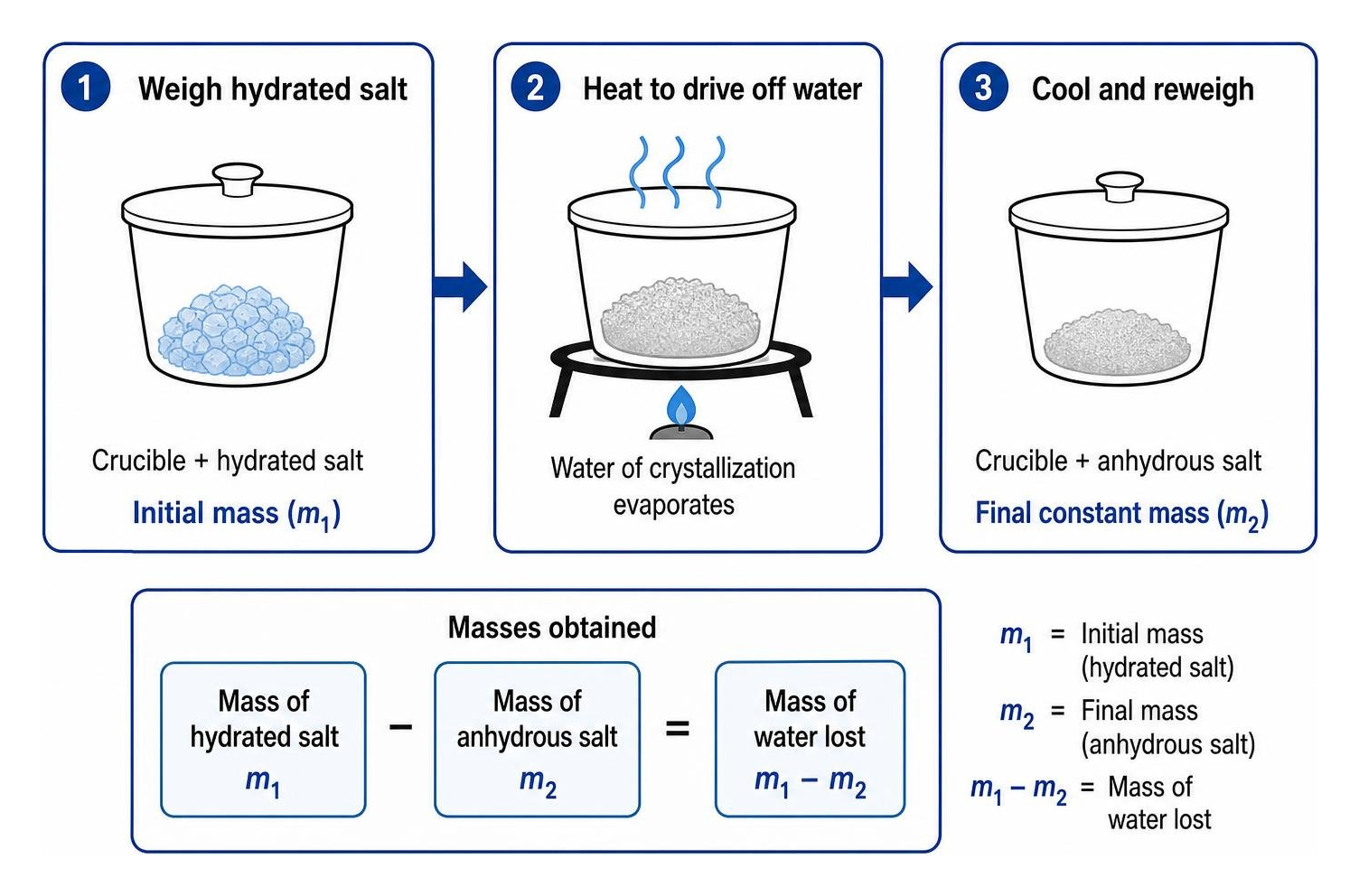
Experimentally, a hydrated sample is weighed in a crucible, heated until all volatile water evaporates, and re-weighed as an anhydrous residue:
- Mass of Hydrated Salt = Initial sample weight.
- Mass of Anhydrous Salt = Final constant weight after heating.
- Mass of Water Lost = $\text{Initial Hydrated Mass} – \text{Final Anhydrous Mass}$.
To find $x$, calculate the mole ratio of water to the anhydrous salt: $$x = \frac{\text{Moles of } H2O}{\text{Moles of Anhydrous Salt}} = \frac{\text{Mass } H2O / 18.015\text{ g/mol}}{\text{Mass Anhydrous Salt} / M_{\text{anhydrous}}}$$
Worked Hydrate Example: Copper(II) Sulfate Hydrate
A student heats $4.99\text{ g}$ of blue copper sulfate hydrate. After thorough heating, $3.19\text{ g}$ of white anhydrous copper(II) sulfate ($CuSO_4$) remains.
- Mass of Water Released: $$\text{Mass } H_2O = 4.99\text{ g} – 3.19\text{ g} = 1.80\text{ g}$$
- Molar Masses: $$M(CuSO4) = 63.55 + 32.06 + (4 \times 16.00) = 159.61\text{ g/mol}$$ $$M(H2O) = 18.015\text{ g/mol}$$
- Convert Masses to Moles: $$n(CuSO4) = \frac{3.19\text{ g}}{159.61\text{ g/mol}} = 0.01998\text{ mol}$$ $$n(H2O) = \frac{1.80\text{ g}}{18.015\text{ g/mol}} = 0.09992\text{ mol}$$
- Determine Ratio $x$: $$x = \frac{0.09992}{0.01998} = 5.00$$ Hydrate Empirical Formula: $\mathbf{CuSO4 \cdot 5H2O}$ (Copper(II) sulfate pentahydrate)
Converting Empirical Formulas to Molecular Formulas Using Molar Mass
The empirical formula provides the relative stoichiometric architecture of a compound, but determining its true molecular formula requires knowing the experimental molecular weight ($M_r$), typically obtained through mass spectrometry or colligative property determinations.
As highlighted in our quick start guide to elemental analysis, the relationship between the empirical formula and the molecular formula is governed by a scaling integer multiplier, $n$:
$$\text{Molecular Formula} = (\text{Empirical Formula})_n$$
$$n = \frac{\text{Experimental Molar Mass (g/mol)}}{\text{Empirical Formula Mass (g/mol)}}$$
Once the scaling multiplier $n$ is calculated (and rounded to the nearest integer), multiply every subscript in the empirical formula by $n$.
Step-by-Step Example: Glucose vs. Formaldehyde
An analytical chemist isolates an unknown carbohydrate with an empirical formula calculated as $CH_2O$. Subsequent mass spectrometry establishes a molecular weight of $180.16\text{ g/mol}$.
Calculate the Empirical Formula Mass ($M_{\text{empirical}}$): $$M_{\text{empirical}} = 12.011 (\text{C}) + 2(1.008) (\text{H}) + 15.999 (\text{O}) = 30.026\text{ g/mol}$$
Compute Integer Multiplier $n$: $$n = \frac{180.16\text{ g/mol}}{30.026\text{ g/mol}} = 5.9999 \approx 6$$
Scale Subscripts: $$(CH2O)6 = \mathbf{C6H{12}O_6}$$ The compound is identified as glucose (or an isomer such as fructose or galactose).
Common Calculation Mistakes and How to Avoid Them
Even seasoned students and laboratory technicians can make simple calculation errors when solving empirical formulas. Keep these practical considerations in mind:
- Premature Intermediate Rounding: Rounding off intermediate mole values too early (such as rounding $0.133$ to $0.1$ or $1.25$ to $1.3$) introduces severe compound errors that distort the final integer ratio. Maintain at least four significant digits throughout all intermediate steps.
- Using Diatomic Molecular Masses Instead of Atomic Weights: When converting elemental masses of diatomic elements ($H2, N2, O2, F2, Cl2, Br2, I2$) into moles, always use the single-atom atomic molar mass ($Ar$). For instance, divide oxygen mass by $16.00\text{ g/mol}$, never by $32.00\text{ g/mol}$.
- Inadvertently Forgetting Missing Oxygen: In combustion analysis and percentage assays, if the listed percentages or component masses do not sum to $100\%$ or match the total sample mass, account for unlisted elements—most commonly oxygen—by subtracting the known sum from the total.
- Rounding Analytical Fractions Directly to Integers: Never round numbers like $1.33$ down to $1$ or $2.50$ up to $3$. Always identify the rational fractional component and multiply all molar ratios by the corresponding integer (e.g., multiply by $3$ or $2$).
- Inverting the Division in Ratio Calculations: When normalizing mole ratios, always divide each element’s mole value by the smallest mole value ($ni / n{\text{min}}$), ensuring the smallest element subscript equals $1$. Dividing the smallest number by larger numbers results in confusing decimals below $1.0$.
Frequently Asked Questions About Empirical Formulas
What should you do if mole ratios result in fractions like 1.33 or 1.5?
When normalized mole values produce non-integer fractions, do not round them to whole numbers. Instead, multiply all element ratios in the compound by the smallest common integer denominator:
- If a ratio ends in .50 ($1/2$), multiply every ratio by 2.
- If a ratio ends in .33 or .67 ($1/3$ or $2/3$), multiply every ratio by 3.
- If a ratio ends in .25 or .75 ($1/4$ or $3/4$), multiply every ratio by 4.
- If a ratio ends in .20, .40, .60, or .80 ($1/5$ to $4/5$), multiply every ratio by 5.
Why are ionic compound formulas almost always empirical formulas?
Ionic compounds do not form distinct, isolated molecular units. Instead, they crystallize into extensive three-dimensional lattices composed of alternating positive and negative ions held together by electrostatic forces. Because the size of an ionic crystal varies depending on the physical sample size, chemical convention represents ionic compounds using their simplest repeating whole-number stoichiometric ratio (formula unit), which is by definition an empirical formula (e.g., $NaCl, CaCl2, Al2O_3$).
How do you find the empirical formula when oxygen percentage is missing?
If an elemental analysis problem specifies that a compound contains carbon, hydrogen, and oxygen, but only provides percentages or combustion masses for carbon and hydrogen:
- For percent data: Add the known percentages together and subtract from $100\%$: $$\%\text{ Oxygen} = 100\% – (\%\text{ Carbon} + \%\text{ Hydrogen} + \dots)$$
- For combustion mass data: Calculate the absolute masses of carbon and hydrogen from $CO2$ and $H2O$, then subtract their sum from the original initial sample mass: $$\text{Mass Oxygen} = \text{Initial Sample Mass} – (\text{Mass Carbon} + \text{Mass Hydrogen})$$
Conclusion
Determining the empirical formula of a chemical compound is a core analytical procedure that translates raw experimental masses into clear, stoichiometric ratios. Whether working from gravimetric mass data, percent composition, combustion products, or hydrated salts, the underlying process remains constant: convert masses to moles, normalize by the smallest value, and clear fractions using integer multipliers.
When precise quantification and characterization are critical for your materials, research, or regulatory compliance, partner with our team in Lexington, Kentucky. Elemental Analysis Inc. provides fast, accurate testing across a broad range of industries. Explore our professional CHNO elemental analysis services to discover how our specialized capabilities can support your analytical workflows.