
Can Modern Mass Spectrometry Solve Our Hidden Drinking Water Contamination Crisis?
Why Water Quality ICP-MS Matters for Drinking Water Safety
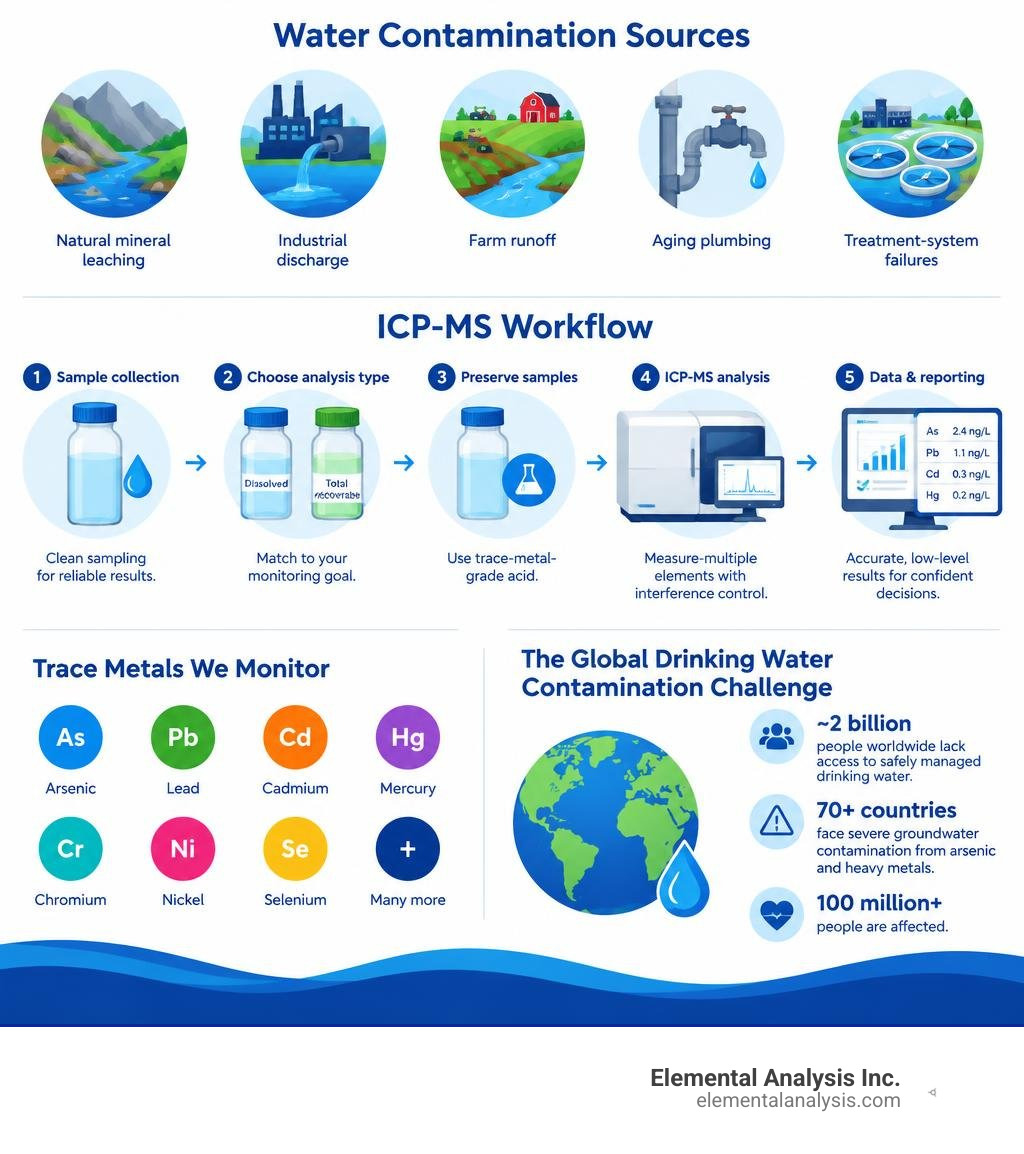
Water quality ICP-MS gives laboratories a practical way to find toxic metals before they become a larger public-health problem. Start with clean sampling, choose dissolved or total-recoverable metals based on the monitoring goal, preserve samples with trace-metal-grade acid, and use ICP-MS with appropriate interference control to measure arsenic, lead, cadmium, mercury, and many other elements in one sequence.
This matters because contamination can come from natural mineral leaching, industrial discharge, farm runoff, aging plumbing, and treatment-system failures. Some risks occur at concentrations far below what older routine methods can reliably measure. ICP-MS can reach low ng/L, or parts-per-trillion, detection limits for many priority metals while also handling higher-level major elements.
For a lab supervisor, the value is simple: faster multi-element data, lower reporting limits, and a clearer basis for compliance decisions. It is especially important for arsenic, where the U.S. drinking-water maximum contaminant level is 10 ug/L (10 ppb) and interference-free measurement is essential.
This guide explains how to build a dependable water testing workflow, from sample collection and ultrapure-water blanks to collision-cell interference removal, daily QC, and advanced species-specific analysis.
The Global Drinking Water Contamination Challenge and Regulated Pollutants
Clean water is fundamental to human life, yet access to uncontaminated drinking water remains an urgent global challenge. The World Health Organization (WHO) estimates that approximately 2 billion people worldwide lack access to safely managed drinking water. Over 70 countries face severe groundwater contamination from arsenic and heavy metals alone, threatening the health of more than 100 million individuals.
Because metals do not degrade over time, identifying and screening toxic heavy metals requires sensitive analytical tools capable of detecting contaminants at the parts-per-billion (ppb) and parts-per-trillion (ppt) levels.
Sources of Potable Water Contamination: Natural Leaching vs. Industrial Runoff
Contaminants enter water systems through both natural geochemical processes and anthropogenic activities:
- Natural Leaching: Bedrock weathering, mineral dissolution, and aquifer depth dictate the background elemental profile of groundwater. Deep aquifers with long residence times often accumulate elevated levels of dissolved geogenic elements such as arsenic, fluoride, uranium, and boron.
- Industrial Discharge: Manufacturing facilities, electroplating operations, mining runoff, and fossil fuel combustion release toxic heavy metals like cadmium, chromium, and nickel into surface waters and shallow aquifers.
- Agricultural Runoff: Pesticides, chemical fertilizers, and livestock waste introduce trace elements and nitrates into watershed systems, altering natural pH levels and mobilizing bound minerals in soils.
- Distribution Infrastructure: Aging distribution plumbing, lead service lines, and brass fixtures can leach lead and copper directly into treated drinking water at the point of consumption.
Critical Regulated Elements: Arsenic, Lead, Cadmium, and Mercury Limits
Regulatory agencies establish Maximum Contaminant Levels (MCLs) for toxic trace elements to safeguard public health against acute toxicity, neurodevelopmental harm, and chronic carcinogenicity.
Achieving high data integrity across broad element suites is essential for municipal and industrial compliance. A peer-reviewed study on the Validation and measurement uncertainty of 24 elements in drinking water demonstrated that modern quadrupole ICP-MS systems achieve linear calibration curves ($R^2 \ge 0.9994$), spike recoveries between 94% and 104%, and precision (%RSD) between 0.10% and 2.31% across drinking water matrices.
Evaluating Water Quality ICP MS Performance Against Legacy Methods
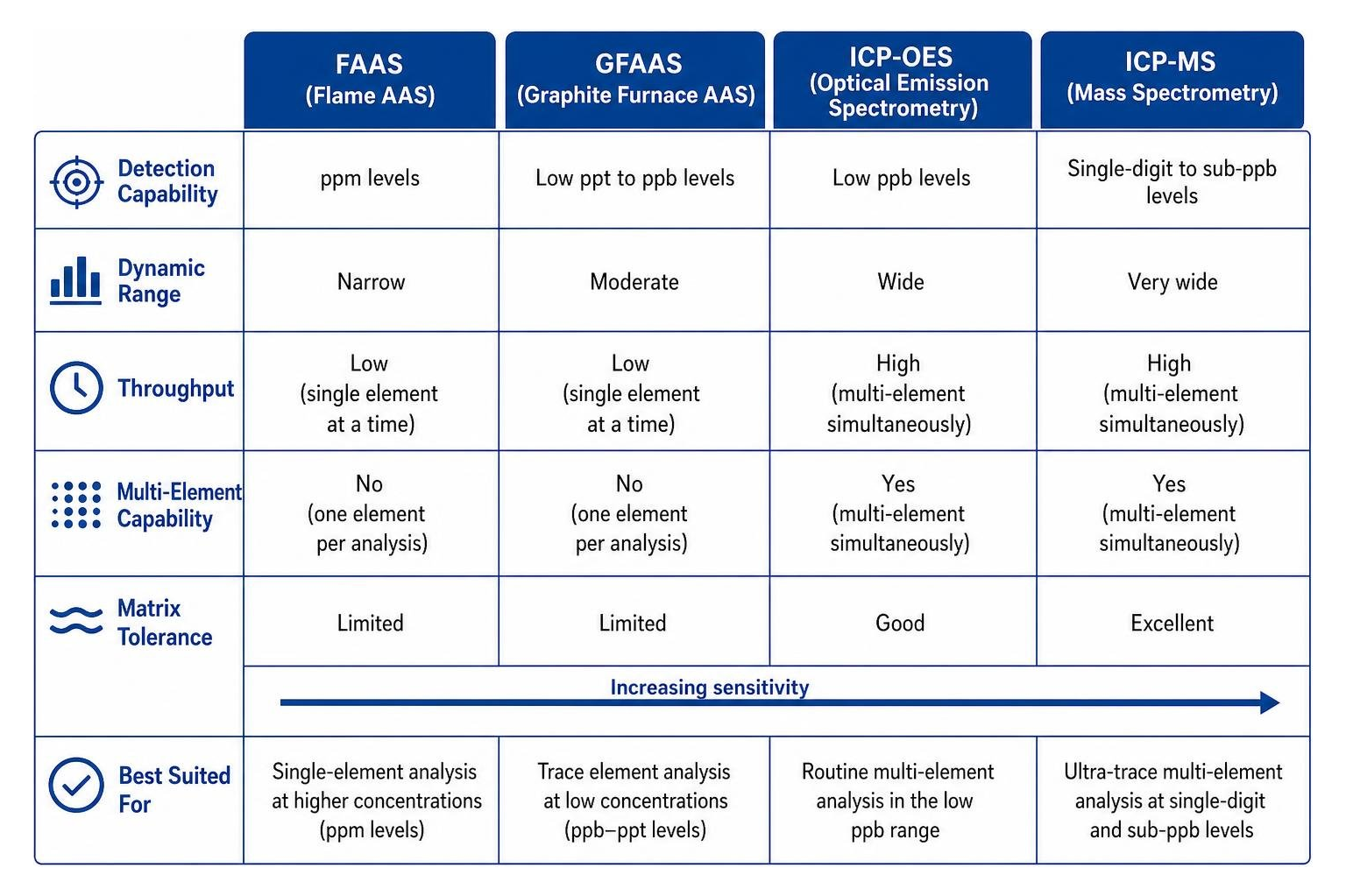
Historically, water laboratories relied on Flame Atomic Absorption Spectrometry (FAAS), Graphite Furnace Atomic Absorption Spectrometry (GFAAS), and Inductively Coupled Plasma Optical Emission Spectrometry (ICP-OES). While these techniques served the industry well for decades, the tightening of environmental regulations has pushed them toward their physical detection limits. Modern heavy metals testing in drinking water requires single-digit and sub-ppb quantification that legacy methods struggle to deliver efficiently.
ICP-MS vs. ICP-OES, FAAS, and GFAAS: Sensitivity and Dynamic Range
Comparing atomic spectroscopy methods highlights distinct trade-offs in detection capabilities, analytical speed, and matrix tolerance:
- FAAS (Flame AAS): Excellent for single-element analysis at parts-per-million (ppm) levels. However, it lacks the sensitivity required for trace toxic metals and requires manual lamp changes for each analyte.
- GFAAS (Graphite Furnace AAS): Capable of low-ppb detection limits for toxic metals, but it remains a slow, single-element technique with cycle times of 2 to 3 minutes per element per sample.
- ICP-OES: An effective multielement technique with high matrix tolerance and high sample throughput. However, its method detection limits (typically 1–10 ppb) are insufficient for key contaminants like arsenic, antimony, cadmium, and lead without extensive pre-concentration.
- ICP-MS: Combines high-temperature argon plasma ionization (6,000–10,000 K) with mass-to-charge ($m/z$) separation. It provides sub-ppt detection limits, high speed, and a dynamic working range spanning up to 9 orders of magnitude.
When evaluating ICP-OES vs. ICP-MS instrumentation, laboratories analyzing regulated drinking water choose ICP-MS because it measures trace toxins (e.g., arsenic, lead, thallium) at sub-ppb levels and major mineral cations (e.g., calcium, magnesium, sodium) at ppm levels within a single analytical run.
Regulatory Standards: EPA Method 200.8 and ISO 17294-2 Compliance
To ensure analytical comparability, environmental monitoring relies on standardized protocols:
- EPA Method 200.8: Standard method for the determination of trace elements in waters and wastes by ICP-MS. Specifies quality control criteria, including initial demonstration of capability (IDC), daily tuning limits (oxide ratios $< 2\%$, double-charged ions $< 3\%$), calibration verification within 90–110%, and continuing calibration verification (CCV) recoveries within 85–115%.
- ISO 17294-2: International standard specifying the application of ICP-MS for the determination of 62 selected elements in water samples (drinking, surface, ground, and wastewater).
As discussed in technical analyses of ICP source spectrometry techniques in regulated water analysis, when the U.S. EPA lowered the arsenic MCL from 50 ppb to 10 ppb, ICP-OES approval was withdrawn for compliance reporting due to inadequate method detection limits. ICP-MS remains the sole multielement platform approved for measuring compliance-level arsenic alongside full trace-metal suites in drinking water.
Resolving Technical Analytical Roadblocks in Mass Spectrometry

Despite its sensitivity, ICP-MS is subject to physical, matrix, and spectral interferences that require systematic laboratory management. Establishing comprehensive ICP-MS water analysis workflows allows testing facilities to eliminate analytical artifacts and maintain stable measurement baselines.
Mitigating Polyatomic Interferences Using Collision/Reaction Cell Technology
Polyatomic interferences occur when plasma gas components (argon, oxygen, hydrogen, nitrogen) combine with matrix elements (chlorine, carbon, sulfur, sodium) to form ions with the same nominal mass-to-charge ratio as target analytes.
Collision/Reaction Cells (CRC) resolve these overlaps:
- Helium Collision Mode (KED): Helium gas is introduced into the cell. Polyatomic ions, having larger ionic cross-sections than monoatomic analytes of identical mass, undergo more frequent collisions with helium atoms. This selectively reduces the kinetic energy of the polyatomic ions. A Kinetic Energy Discrimination (KED) energy barrier at the cell exit filters out the low-energy polyatomic ions, allowing analyte ions to pass to the quadrupole analyzer.
- Reaction Cell Mode (Chemical Shift): Reactive gases such as oxygen ($\text{O}_2$), hydrogen ($\text{H}_2$), or ammonia ($\text{NH}_3$) react chemically with either the interfering ion or the target analyte. For example, oxygen reacts with $^{75}\text{As}^+$ to form $^{75}\text{As}^{16}\text{O}^+$ at $m/z\ 91$, shifting the analyte away from the $^{40}\text{Ar}^{35}\text{Cl}^+$ interference at $m/z\ 75$.
Sample Preparation and Ultrapure Water Standards in Water Quality ICP MS
Sample integrity during preparation is critical when measuring contaminants at parts-per-trillion levels. Standard protocols follow two distinct pathways depending on regulatory definitions:
- Dissolved Metals: Samples are filtered in the field or immediately upon receipt through a 0.45 $\mu\text{m}$ membrane filter, then acidified to $\text{pH} < 2$ using high-purity, trace-metal-grade nitric acid ($\text{HNO}_3$, typically $1\text{--}2\%\ \text{v/v}$).
- Total Recoverable Metals: Samples are un按filtered, preserved with $\text{HNO}_3$, and subjected to hot-block or microwave acid digestion to dissolve particulate-bound metals and break down matrix complexes.
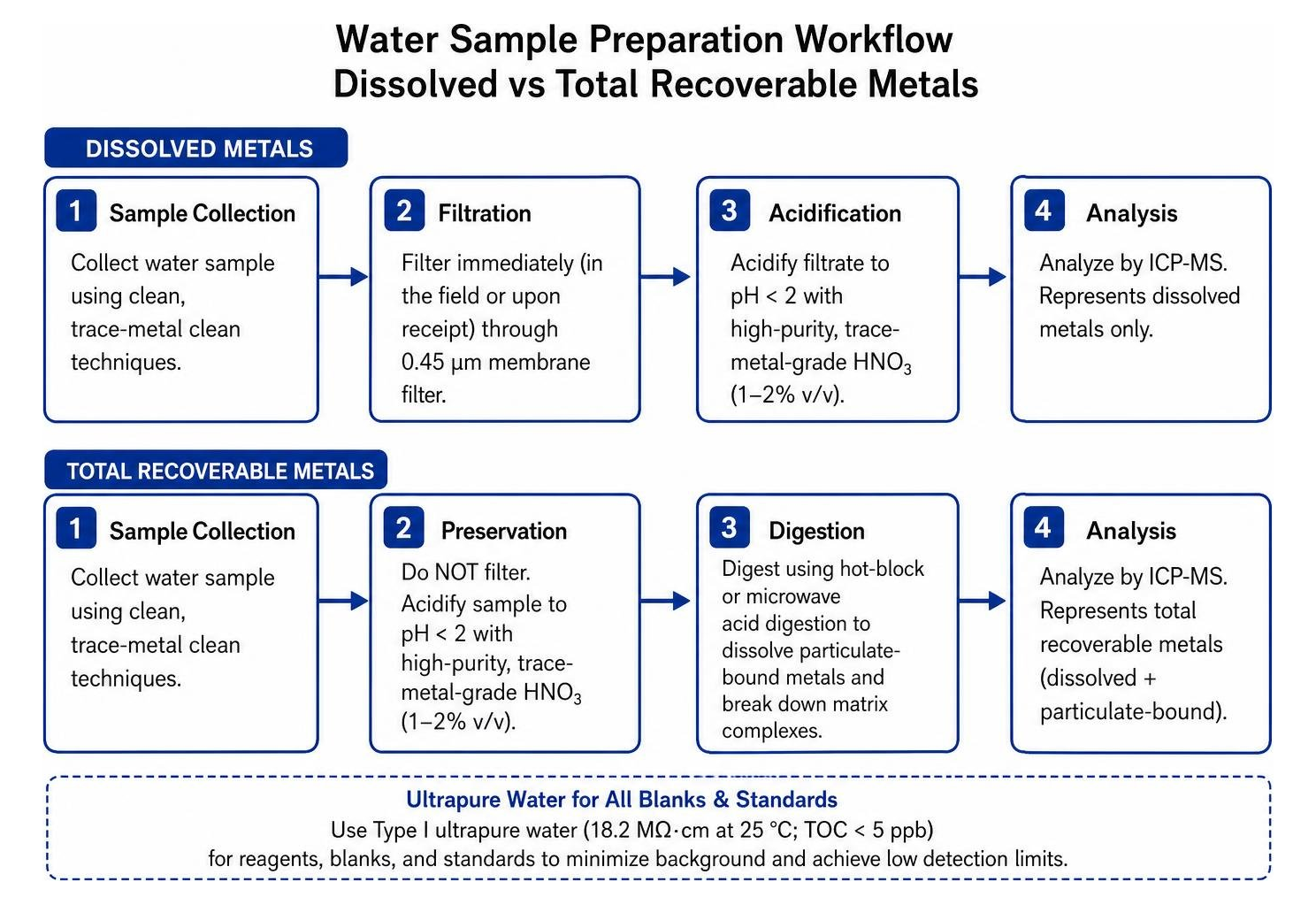
Water purity is equally critical for reagent preparation and procedural blanks. As highlighted in our trace element testing laboratory guide, analytical blanks must use Type I ultrapure water with a resistivity of $18.2\ \text{M}\Omega\cdot\text{cm}$ at $25^\circ\text{C}$ and Total Organic Carbon (TOC) levels below 5 ppb. Using lower-grade water elevates background equivalent concentrations (BECs), obscuring low-level analyte peaks and compromising method detection limits.
Advanced Configurations, Speciation, and Future Potable Water Testing
Environmental analytical chemistry continues to evolve beyond bulk elemental totals toward chemical speciation, isotope ratio diagnostics, and automated high-throughput configurations.
Optimizing Water Quality ICP MS Workflows for Municipal Testing
High-volume compliance laboratories require stable, unattended operations. Routine operational protocols include:
- Automated Discrete Sampling: Rapid valve-switching injection systems reduce sample-to-sample cycle times from 3 minutes down to 45–60 seconds, minimizing matrix exposure to the interface cones.
- Argon Gas Dilution (AGD): For samples with high total dissolved solids (TDS) like brackish water, aerosol dilution with inert argon prevents salt deposition on the sampler and skimmer cones without requiring manual liquid dilution.
- Internal Standardization: Continuous in-line addition of internal standards (e.g., $^{6}\text{Li}$, $^{45}\text{Sc}$, $^{89}\text{Y}$, $^{115}\text{In}$, $^{159}\text{Tb}$, $^{209}\text{Bi}$) corrects for physical matrix suppression and instrument drift. Internal standard recoveries must remain within 70–130% throughout the run.
- Daily Tuning Protocols: Daily verification of instrument performance using a multielement tuning solution to maintain sensitivity, mass calibration, resolution ($0.75 \pm 0.1\ \text{u}$ at $10\%$ peak height), and low oxide formation ratios ($\text{CeO}^+/\text{Ce}^+ < 1.5\text{--}2.0\%$).
Elemental Speciation and High-Resolution ICP-MS Configurations
Total metal concentration does not always correlate with toxicological risk. The toxicity of an element depends heavily on its chemical and oxidation state:
- Arsenic Speciation: Inorganic arsenic forms—arsenite ($\text{As}^{\text{III}}$) and arsenate ($\text{As}^{\text{V}}$)—are highly toxic and carcinogenic, whereas organic forms like arsenobetaine and arsenocholine (found in seafood) are non-toxic. Coupling High-Performance Liquid Chromatography to ICP-MS (HPLC-ICP-MS) separates these species prior to mass detection.
- Chromium Speciation: Hexavalent chromium ($\text{Cr}^{\text{VI}}$) is a potent carcinogen and mutagen, while trivalent chromium ($\text{Cr}^{\text{III}}$) is an essential nutrient with low toxicity. Ion chromatography coupled with ICP-MS enables speciation at sub-ppb levels.
- Mercury Speciation: Methylmercury ($\text{CH}_3\text{Hg}^+$) bioaccumulates and poses severe neurological risks compared to inorganic divalent mercury ($\text{Hg}^{2+}$).
When managing complex isobaric and polyatomic overlaps, advanced instrument designs provide distinct performance capabilities:
- Triple Quadrupole ICP-MS (ICP-MS/MS): Uses a tandem mass filter configuration ($\text{Q}_1\text{-Cell-Q}_2$) to isolate target analyte masses in the first quadrupole, react them with collision/reaction gases in the cell, and measure product ions in the second quadrupole. This eliminates spectral interferences, achieving sub-ppt limits of detection for challenging elements like $^{32}\text{S}$, $^{31}\text{P}$, $^{75}\text{As}$, and $^{80}\text{Se}$.
- Sector Field High-Resolution ICP-MS (HR-ICP-MS): Uses magnetic and electrostatic sector fields to achieve mass resolution up to $m/\Delta m > 10,000$. As demonstrated in a Comparative analysis of sector field and quadrupole instruments, Sector Field ICP-MS physically separates analyte peaks from polyatomic overlaps without reaction gases, yielding precision values below $2\%\ \text{RSD}$ for toxic elements like $\text{As}$, $\text{Pb}$, $\text{Cu}$, $\text{Cd}$, and $\text{U}$.
Frequently Asked Questions About Trace Metal Testing in Potable Water
What makes ICP-MS uniquely suitable for measuring arsenic at the 10 ppb standard?
ICP-MS provides method detection limits for arsenic in the low parts-per-trillion range (typically $0.05\text{–}0.2\ \mu\text{g/L}$), well below the 10 ppb regulatory threshold. Because the EPA requires analytical methods to have quantitation limits substantially lower than the actual MCL to ensure data confidence, older multielement techniques like ICP-OES were decertified for compliance arsenic testing, leaving ICP-MS as the only approved multielement method.
How do collision and reaction cells eliminate argon chloride interferences on arsenic?
In chlorinated drinking water, $^{40}\text{Ar}^{35}\text{Cl}^+$ forms in the plasma and shares the nominal mass $m/z\ 75$ with $^{75}\text{As}^+$. In helium collision mode, the larger $\text{ArCl}^+$ polyatomic ion collides repeatedly with helium atoms, losing kinetic energy more rapidly than the smaller, compact $\text{As}^+$ ion. A kinetic energy barrier at the exit of the cell repels the low-energy $\text{ArCl}^+$ ions, allowing the arsenic analyte to reach the detector without background interference.
Why is 18.2 MΩ·cm ultrapure water mandatory for sub-ppt elemental analysis?
Ultrapure water with a resistivity of $18.2\ \text{M}\Omega\cdot\text{cm}$ ($25^\circ\text{C}$) and $< 5\ \text{ppb}$ TOC ensures that procedural blanks, standard diluents, and carrier solutions do not introduce background elemental contamination. Because ICP-MS detects metals at parts-per-trillion levels, lower-grade distilled or deionized water introduces background signals that raise limits of detection and cause false-positive readings.
Conclusion: The Path Forward for Securing Clean Water Resources
Addressing the challenges of water safety requires analytical platforms capable of detecting trace contaminants with speed, precision, and accuracy. Water quality ICP-MS provides the sensitivity required to quantify trace heavy metals, differentiate between toxic chemical species, and comply with strict international regulatory standards.
At Elemental Analysis Inc., located in Lexington, KY, our laboratory team provides trace element identification, quantification, and speciation services across industrial, environmental, and municipal applications. Operating as the first commercial PIXE laboratory, we deliver destructive and non-destructive testing with rapid turnaround times and competitive pricing.
For more technical information on implementing mass spectrometry for elemental quantification, review our definitive guide to ICP mass spectrometry or contact our team in Lexington to discuss your water testing requirements.