
XRF Lead-Based Paint Testing Explained for Concerned Parents
Why XRF Testing for Lead Matters in Older Homes
XRF testing for lead is a fast, non-destructive method that uses X-ray fluorescence technology to detect lead in painted surfaces — without damaging walls, trim, or other materials. It’s the primary field method recognized by the EPA and HUD for lead-based paint inspections.
Here’s what you need to know at a glance:
- What it detects: Lead content in paint layers, measured in mg/cm²
- Action level: Any reading at or above 1.0 mg/cm² is classified as lead-based paint under EPA and HUD standards
- How fast: Results in as little as 3–10 seconds per surface
- Is it safe? Yes — radiation exposure is lower than a single dental X-ray
- Who needs it: Owners of pre-1978 homes, parents of young children, landlords, and anyone planning renovation work
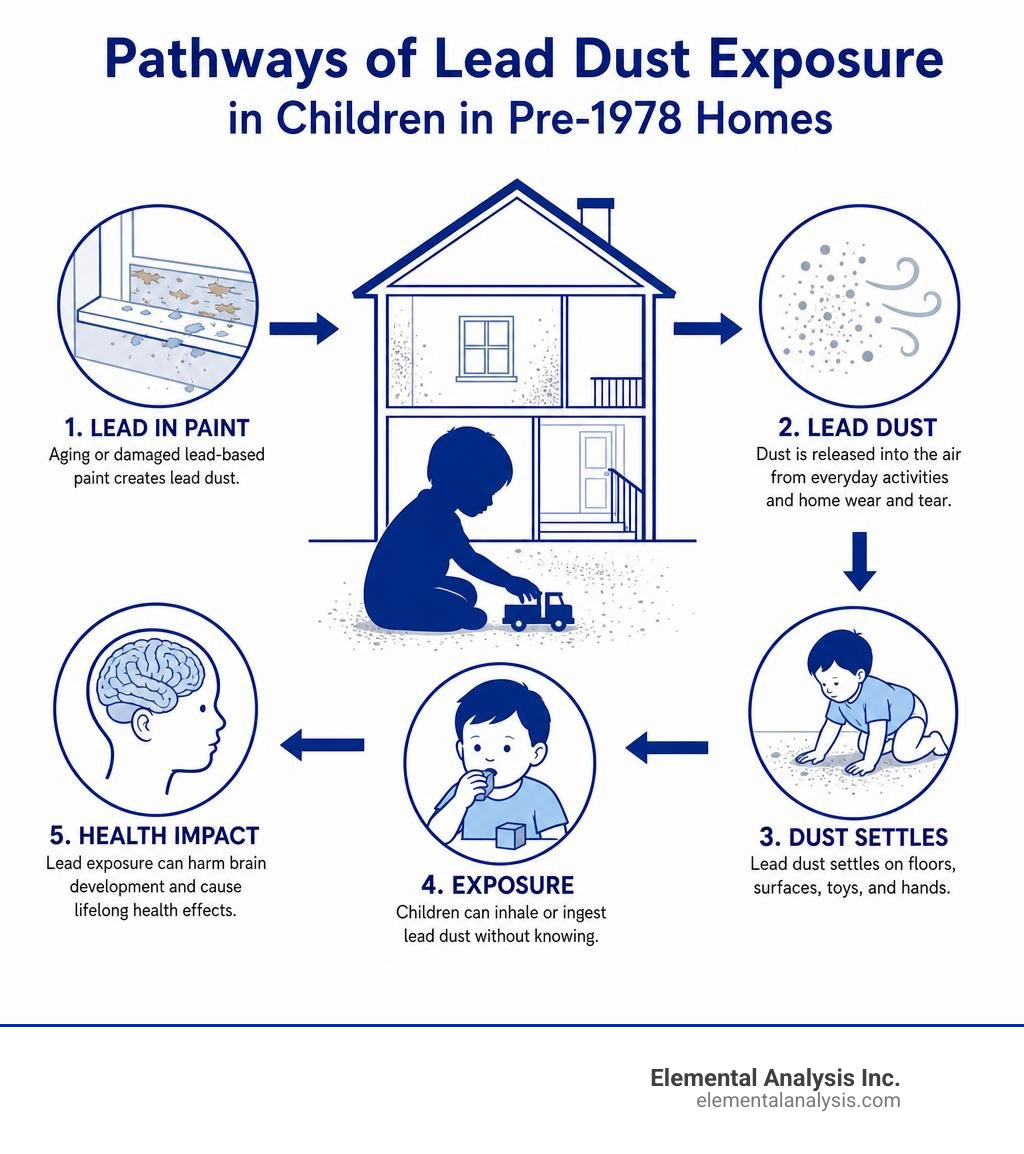
If your home was built before 1978, lead paint may be present under layers of newer paint — completely invisible to the naked eye. Children are especially vulnerable. Lead exposure can cause lasting damage to brain development, leading to learning disabilities and behavioral problems.
The concern isn’t just peeling paint. Everyday wear and tear — opening windows, sanding floors, or disturbing walls during a renovation — can release microscopic lead dust that children inhale or ingest without anyone noticing.
That’s exactly why professional testing matters before any work begins.
What is XRF Testing for Lead and How Does It Work?
For many parents, the term “X-ray Fluorescence” sounds like something straight out of a science fiction film. In reality, it is one of the most practical, safe, and widely used analytical methods in the world.
When we perform xrf testing for lead, we use a specialized, handheld device often referred to as an “XRF gun.” The primary advantage of this technology is that it provides non-destructive testing. In the past, the only way to know if a wall contained lead was to physically scrape off a sample and send it to a laboratory. If you had twenty different areas of concern, that meant twenty different scraped, damaged spots on your beautiful walls.
XRF changes all of that. By simply placing the nose of the analyzer against a painted surface and pulling the trigger, we can determine the elemental composition of the paint layers underneath within seconds. The device scans right through multiple layers of newer, non-lead latex paint to find the older, lead-based coats hiding beneath. If you want to dive deeper into how this process works across different industries, you can read our guide on X-Ray Fluorescence Spectrometry Explained Simply.
The Science Behind XRF Testing for Lead
To understand how the analyzer reads through paint, we have to look at what happens at the atomic level. Inside the handheld XRF device is a miniature x-ray tube. When the device is activated, it emits a controlled beam of primary X-rays into the painted surface.
This beam targets the electrons orbiting the nuclei of the atoms in the paint. When a primary X-ray hits an electron in the inner shell of a lead atom, it knocks that electron out of its orbit. This leaves an unstable vacancy. To regain stability, an electron from a higher-energy outer shell drops down to fill the gap.
Because outer-shell electrons have more energy than inner-shell electrons, the electron must release its excess energy to make the jump. This released energy is emitted in the form of a secondary, “characteristic” X-ray.
Every element on the periodic table has a completely unique atomic structure. This means the energy emitted during this electron transition acts like a chemical fingerprint. The detector inside the XRF gun measures the exact energy level of these returning waves. It instantly identifies them as lead and calculates the mass of lead present per unit area.
The device then displays this concentration on its screen in milligrams per square centimeter ($\text{mg/cm}^2$). It does all of this in less than ten seconds, giving you immediate, on-the-spot answers. For a beginner-friendly breakdown of this atomic dance, check out our Beginner’s Guide to X-Ray Fluorescence.
Understanding EPA Standards and the 1.0 mg/cm² Threshold
Once the XRF device displays a reading, what does that number actually mean for your family?
The Environmental Protection Agency (EPA) and the Department of Housing and Urban Development (HUD) have established clear, strict regulatory thresholds to define lead-based paint. Under these federal standards, any painted surface that yields an XRF reading of 1.0 $\text{mg/cm}^2$ or higher is legally classified as lead-based paint.
It is important to understand that modern, professional-grade XRF analyzers are incredibly sensitive. They can detect lead concentrations as low as 0.1 $\text{mg/cm}^2$, which is well below the federal action level. This high level of sensitivity is incredibly helpful. Even if a reading comes back at 0.4 $\text{mg/cm}^2$—meaning it is technically below the legal definition of lead-based paint—it still tells us that lead is present. For parents, knowing that any amount of lead exists in a play area or bedroom allows you to take extra precautions during future painting or repair projects.
In Kentucky, local health departments and environmental agencies utilize these exact thresholds to protect children from exposure. If you suspect your child has been exposed, or if you want to understand state-specific resources and programs, you can consult the Environmental Lead Program – Cabinet for Health and Family Services. They provide excellent oversight and guidance for families living in pre-1978 housing across the Commonwealth.
XRF vs. Traditional Lab Analysis: Which is Best for Your Home?
When deciding how to test your home for lead, you generally have two professional paths: on-site XRF testing or traditional laboratory analysis (which involves collecting physical paint chips). Both methods have their place, but they differ significantly in terms of speed, cost, and impact on your home.
| Feature | Handheld XRF Testing | Traditional Paint Chip Lab Analysis |
|---|---|---|
| Damage to Home | None (Completely non-destructive) | Destructive (Requires scraping paint down to the substrate) |
| Speed of Results | Instant (3 to 10 seconds per reading) | Days to weeks (Requires shipping and laboratory processing) |
| Cost-Effectiveness | Highly cost-effective for whole-house testing | Expensive when testing multiple surfaces individually |
| Accuracy | Extremely high (>95% for lead in paint) | Definitive (Measures exact weight percentage) |
| EPA/HUD Approved | Yes, by certified inspectors | Yes |
While laboratory analysis is highly accurate, XRF has become the industry standard for residential inspections because it allows us to test dozens of surfaces in a single visit without leaving your home looking like a construction zone. To see how XRF is used in other practical scenarios beyond home paint, explore The Ultimate List of Practical XRF Applications.
Comparing XRF Testing for Lead to Paint Chip Sampling
To understand why XRF is so highly favored for residential properties, let’s look at what paint chip sampling actually entails.
To perform a proper paint chip sample, an inspector must physically cut and scrape a small square (usually about two inches by two inches) of paint off your wall, door frame, or window sill. Crucially, they must scrape all the way down to the underlying substrate (the wood, plaster, or drywall). This is because the oldest, lead-containing paint layers are almost always the very first layers applied to the raw building material.
This scraping process creates several problems:
- It damages your home: You are left with unsightly, bare patches that must be patched and repainted.
- It can create hazards: The act of scraping and cutting paint can release the very lead dust you are trying to avoid.
- It takes time: Those chips must be carefully packaged, documented, and mailed to an analytical laboratory, where they are dissolved in acid and analyzed. You may wait a week or more for the results.
Additionally, laboratory standards like the F2853 Standard Test Method for Determination of Lead in Paint Layers and Similar Coatings or in Substrates and Homogenous Materials by Energy Dispersive X-Ray Fluorescence Spectrometry Using Multiple Monochromatic Excitation Beams outline the rigorous, highly technical processes required to analyze these samples.
While lab testing is invaluable for resolving inconclusive XRF readings or verifying complex industrial materials, it is rarely the most practical first step for a family home. XRF provides the same regulatory-grade confidence in seconds, keeping your walls intact and your stress levels low.
Safety, Accuracy, and Limitations of XRF Lead Paint Testing
Understandably, parents often have questions about the safety and accuracy of bringing a device that emits X-rays into their living spaces. Let’s address those concerns directly.
First, regarding accuracy: modern XRF analyzers are incredibly precise. When operated by a trained, certified professional, these devices boast an accuracy rate typically above 95%.
To maintain this high level of accuracy, inspectors must follow strict quality control protocols. This includes performing regular calibration verification checks using reference materials certified by the National Institute of Standards and Technology (NIST).
Furthermore, the inspector must account for “substrate correction.” Different underlying materials—such as brick, concrete, wood, or plaster—can reflect X-rays differently. This reflection is known as Compton scattering. Experienced inspectors know how to calibrate the device to subtract the substrate’s natural interference, ensuring that the final reading represents only the lead in the paint itself. If you are curious about the technical advancements that make these modern devices so reliable, you can read about The Best X-Ray Fluorescence Equipment to Upgrade Your Analysis.
Is X-Ray Fluorescence Safe for Your Family?
The short answer is yes, absolutely.
It is completely natural to feel a bit apprehensive when you hear the word “radiation.” However, the radiation exposure associated with a professional XRF home inspection is exceptionally low. In fact, the total radiation emitted during an entire home inspection is less than what you would receive from a standard dental X-ray.
Here are a few safety facts to keep in mind:
- No Residual Radiation: X-rays are a form of electromagnetic energy, just like light. Once the inspector releases the trigger on the XRF device, the X-ray tube turns off, and the radiation ceases instantly. There is absolutely no “residual” radiation left behind in your air, on your furniture, or on your walls.
- Directional Beam: The primary X-ray beam is highly directional and only travels a very short distance directly out of the front window of the device. It is designed to penetrate only the thin layers of paint.
- Safety Interlocks: Modern XRF devices are equipped with proximity sensors. They will not emit X-rays unless the face of the device is pressed firmly against a solid surface, preventing accidental exposure.
According to safety guidelines like the XRF Usage Protocol, as long as the operator has completed basic radiation safety training and keeps pets and family members in another room while taking readings, the process poses zero risk to your household.
The OSHA Compliance Misconception
While XRF is the gold standard for identifying lead-based paint in residential settings, there is a common misconception regarding how these results can be used in commercial or construction settings.
Some contractors and property owners assume that if an XRF reading comes back below the EPA’s 1.0 $\text{mg/cm}^2$ threshold, they are completely exempt from worker safety regulations during demolition or remodeling. This is a costly mistake.
The Occupational Safety and Health Administration (OSHA) has issued formal letters of interpretation stating that XRF analysis results cannot be used to bypass compliance with the OSHA Lead Standard. Why? Because OSHA is concerned with airborne exposure. Even if paint has a very low concentration of lead (well below the 1.0 $\text{mg/cm}^2$ residential threshold, or even below the XRF detection limit of 0.1 $\text{mg/cm}^2$), aggressive actions like sanding, grinding, torch-cutting, or dry-scraping can still create dangerous levels of airborne lead dust.
For occupational safety, air monitoring and personal exposure assessments are still required to ensure workers are not breathing in toxic dust. To explore this regulatory nuance further, you can read XRF Lead Testing: How It Works & When You Need It.
When to Schedule an Inspection and How to Prepare
Knowing when to test and how to prepare can make the entire inspection process smooth and stress-free.
When Should Parents Consider an Inspection?
You should strongly consider scheduling a professional XRF lead inspection if:
- You own or rent a pre-1978 home: Especially if you have children under the age of six or are planning to become pregnant.
- You are planning a renovation or remodel: Disturbing old paint is the number one cause of accidental lead poisoning in children. Testing beforehand allows you to hire a Lead-Safe Certified contractor who will use proper containment measures.
- Your child has an elevated blood lead level: If a pediatrician detects lead in your child’s blood, finding and eliminating the source in your home is an urgent priority.
- You are buying a home: Real estate transactions for older homes typically include a 10-day window for lead inspections.
How to Prepare Your Home for an XRF Inspection
Preparing your home for an inspector is simple, but taking a few steps beforehand will ensure they can work quickly and thoroughly:
- Clear the Baseboards and Trim: Lead paint was frequently used on high-wear surfaces like baseboards, window sills, and door frames. Make sure these areas are easily accessible.
- Move Furniture Away from Walls: The inspector will need to place the nose of the XRF gun flat against various walls. Moving heavy couches or bookshelves a few inches away from the wall is incredibly helpful.
- Secure Your Pets: While the radiation risk is minimal, we want to keep curious dogs and cats out of the work area so the inspector can focus on taking accurate readings.
- Identify Areas of Concern: If you have noticed peeling, chipping, or cracking paint—especially around windows or doors—point these out to your inspector when they arrive.
Frequently Asked Questions About XRF Testing for Lead
Can I use a DIY home lead test kit instead of professional XRF?
While DIY chemical swab kits (which turn red or pink in the presence of lead) are cheap and readily available at hardware stores, they are highly unreliable for comprehensive safety decisions.
These swabs only test the very top layer of paint unless you physically cut into the wall to expose older layers. Furthermore, they are notorious for producing false negatives and false positives. They also cannot tell you the concentration of lead present.
For professional consumer safety standards, especially when assessing products or toys, agencies rely on highly controlled laboratory methods like the Test Method: CPSC-CH-E1002-08.2: Standard Operating Procedure for Determining Total Lead (Pb) in Nonmetal Children’s Products, Revision, April 10, 2012. A professional XRF inspection provides this same level of scientific rigor right in your living room, giving you definitive answers that a $10 chemical swab simply cannot match.
How long does a professional XRF lead inspection take?
Because individual readings take only 3 to 10 seconds, the process is incredibly fast. A typical inspection of a standard three-bedroom, single-family home usually takes between 1 to 3 hours. The inspector will systematically test representative surfaces in every room, including walls, doors, windows, baseboards, and closets.
What happens if the XRF analyzer detects lead-based paint?
If the inspection reveals lead-based paint, there is no need to panic. The presence of lead paint does not mean your home is unsafe; lead paint that is in good condition (not chipping, peeling, or chalking) and is not on a friction surface (like a window sash) is generally not a hazard.
If the paint is damaged, or if you plan to renovate, you can manage it safely through:
- Interim Controls: Painting over the lead paint with specialized sealants (encapsulants) or repairing damaged areas using lead-safe work practices.
- Lead-Safe Remodeling: Ensuring any future contractors are certified under the EPA’s Renovation, Repair, and Painting (RRP) Rule.
- Abatement: Permanently removing or enclosing the lead hazards using certified lead abatement professionals.
Conclusion
Protecting your children from the invisible threat of lead dust doesn’t have to involve destructive testing, guesswork, or stressful weeks of waiting for laboratory results. With modern xrf testing for lead, you can get rapid, highly accurate, and completely non-destructive answers about the safety of your home’s painted surfaces in seconds.
At Elemental Analysis Inc., we are proud to serve families and businesses from our state-of-the-art laboratory in Lexington, Kentucky. As the nation’s very first commercial PIXE laboratory, our legacy is built on pioneering trace element identification, quantification, and speciation. We combine this deep scientific expertise with a warm, personal approach to help our neighbors navigate environmental safety with ease.
Whether you need advanced laboratory analysis or want to explore our non-destructive testing capabilities, we offer fast turnaround times and competitive pricing to give you total peace of mind.
Have questions about lead testing or other elemental analysis services? Learn more about our advanced testing capabilities on our XRF page, or get in touch with our Lexington-based team today!