
The Best X-Ray Fluorescence Equipment to Upgrade Your Analysis
The Right X-Ray Fluorescence Equipment Can Transform Your Lab’s Elemental Analysis
X-ray fluorescence equipment is one of the fastest, most versatile tools available for non-destructive elemental analysis — spanning everything from handheld field units to high-powered floor-model spectrometers.
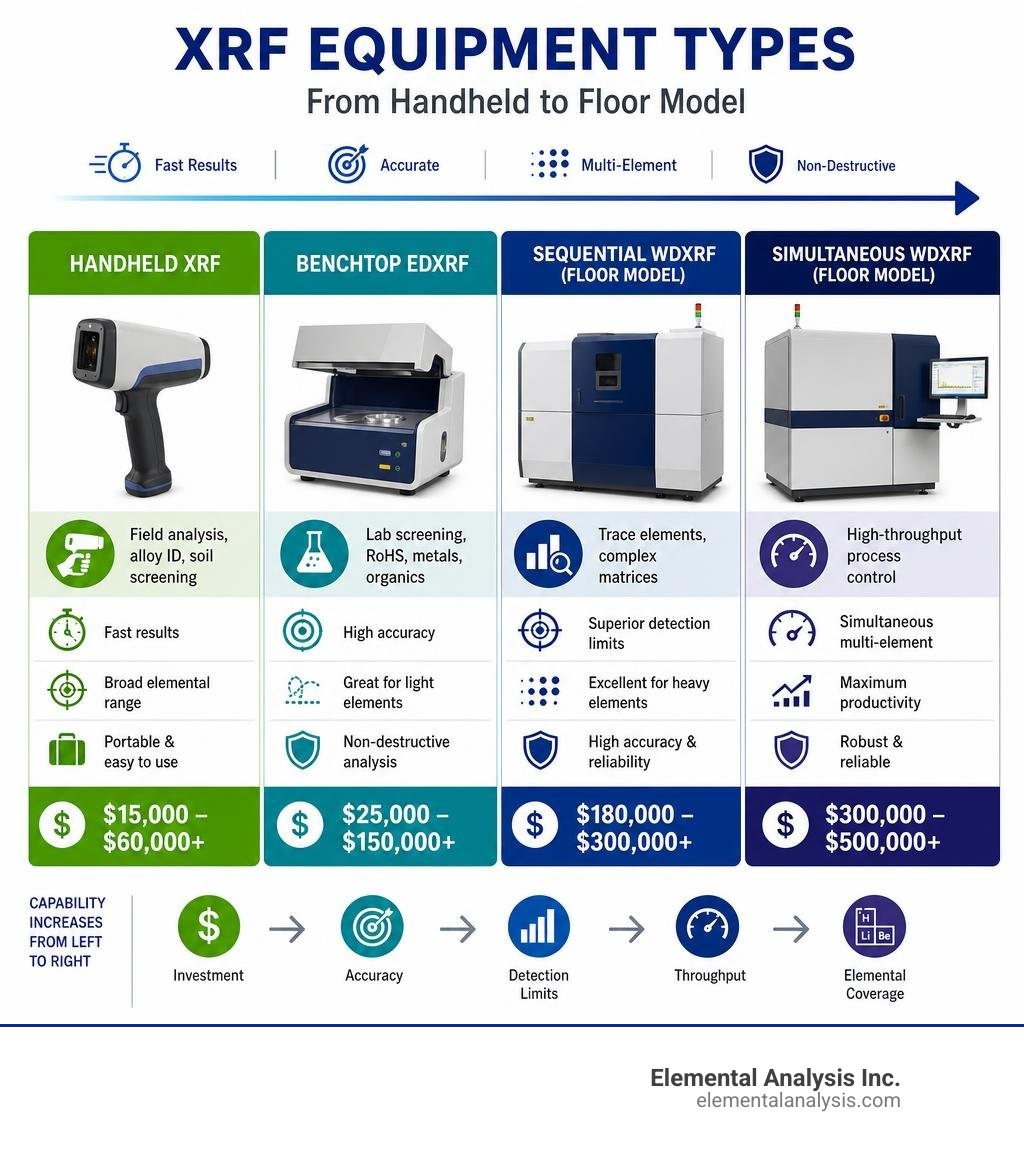
If you need a quick answer on which type fits your needs:
| Equipment Type | Best For | Typical Price Range |
|---|---|---|
| Handheld XRF | Field analysis, alloy ID, soil screening | $15,000 – $60,000+ |
| Benchtop EDXRF | Lab screening, RoHS, metals, organics | $25,000 – $150,000+ |
| Sequential WDXRF (floor) | Trace elements, complex matrices | $180,000 – $300,000+ |
| Simultaneous WDXRF (floor) | High-throughput process control | $300,000 – $500,000+ |
For most lab supervisors and technical managers, the core challenge is the same: you need fast, accurate, multi-element results — with detection limits in the low ppm range — without sending samples to an outside lab and waiting days for a report.
XRF delivers exactly that. Modern systems can quantify elements across most of the periodic table, from trace concentrations up to 100%, often in under 60 seconds per sample and with little to no sample preparation.
But not all XRF analyzers are built the same. The gap between an entry-level handheld and a premium wavelength-dispersive floor model is enormous — in price, detection limits, elemental range, and throughput. Choosing the wrong system means either overspending or getting results that don’t meet your method requirements.
This guide walks you through every major category of XRF equipment available in 2026, what separates them technically, and how to match the right system to your specific application and budget.
Understanding X-Ray Fluorescence Technology
To select the ideal x ray fluorescence equipment, it helps to understand the underlying physics. At its core, XRF is an atomic emission method.
The process begins when a primary radiation source—typically a high-performance X-ray tube operating between 20 and 60 kV—shoots a beam of high-energy X-rays at your sample. This primary beam hits the atoms in the sample, knocking out tightly bound electrons from the inner shells (such as the K or L shell).
This leaves the atom in an unstable, highly excited state. To regain stability, an electron from a higher-energy outer shell drops down to fill the vacancy. As it falls into the lower-energy shell, it releases a burst of energy in the form of a secondary X-ray photon.
Because the energy difference between the two shells is unique to each specific element, this emitted photon acts as an elemental fingerprint. This emitted secondary radiation is known as “characteristic radiation.”
By measuring the exact energy or wavelength of these emitted photons, we can identify which elements are present (qualitative analysis). By counting the number of photons emitted over a set period, we can calculate how much of each element is in the sample (quantitative analysis).
To capture these signals, modern spectrometers rely on highly sensitive detectors. The industry standard has shifted heavily toward Silicon Drift Detectors (SDDs), which offer exceptional count rates and spectral energy resolution (often $\le 145$ eV) without requiring liquid nitrogen cooling. For a deeper dive into how this physics translates to practical lab results, you can explore our detailed breakdown of XRF Technology and Sample Preparation | Elemental Analysis Inc..
Elemental Detection Limits and Sample Preparation
In theory, XRF can analyze almost the entire periodic table, from beryllium ($Z = 4$) to uranium ($Z = 92$) and beyond. In practice, however, analyzing very light elements (below sodium, $Z = 11$) is challenging. Light elements emit low-energy X-rays that are easily absorbed by air, the detector window, or even the sample matrix itself.
To overcome this, high-end benchtop and floor-model systems use a vacuum chamber (operating at around 10 Pa residual pressure) or a helium purge gas path to prevent the attenuation of these delicate, low-energy X-rays.
Detection limits vary widely based on the equipment type and the element being measured:
- Trace-level sensitivity: High-power laboratory systems can reach limits of detection below 1 part per million (ppm) by weight for heavy metals.
- Field portability: Modern handheld units can achieve limits of detection on the order of 2 ppm for lead in pure sand in about 30 to 60 seconds.
One of the greatest operational advantages of XRF is its flexible sample preparation. Unlike techniques like ICP-OES or ICP-MS, which require dissolving samples in hot acids, XRF can analyze solids, liquids, and powders with virtually no preparation.
For routine screenings, you can analyze samples “as-is.” However, for high-precision laboratory quantitative work, sample preparation is critical to eliminate particle size effects and mineralogical variations. The two most common methods are:
- Pressed Powder Pellets: The sample is ground to a fine powder, mixed with a binder, and compressed under high pressure to create a flat, uniform disc.
- Fusion Beads: The sample is melted with a lithium borate flux at high temperatures (typically $1000^\circ\text{C}$ to $1100^\circ\text{C}$) and cast into a flat glass disc. This method completely eliminates mineralogical matrix effects and is the gold standard for geological and cement analysis.
To find out more about preparing your samples for optimal results, refer to our comprehensive guide on XRF or review specialized preparation systems at XRF Scientific.
Accuracy, Precision, and Analytical Limitations
While XRF is an incredibly robust tool, it is not without its limitations. The two primary obstacles to absolute accuracy are spectral overlaps and matrix effects.
- Spectral Overlaps: This occurs when two different elements emit X-rays of very similar energies. For example, the K-alpha emission line of arsenic is very close to the L-alpha line of lead. Advanced deconvolution algorithms in modern software are required to separate these overlapping peaks.
- Matrix Effects: The elements surrounding your target analyte can either absorb the emitted X-rays (reducing the measured signal) or fluoresce themselves, exciting your target element further (enhancing the signal).
To correct for these matrix effects, labs use either empirical calibration curves built with certified reference materials (CRMs) or Fundamental Parameter (FP) mathematical models. Standardless FP software allows for the rapid quantification of completely unknown samples by calculating physical matrix corrections on the fly.
Compared to destructive wet chemistry techniques, XRF keeps your samples completely intact, which is invaluable when dealing with forensic evidence, expensive alloys, or rare archaeological artifacts.
However, if your application requires sub-part-per-billion (ppb) detection limits or isotopic speciation, XRF must be paired with other techniques. For example, we frequently utilize Proton Induced X-ray Emission (PIXE) and specialized mass spectrometry at our Lexington, Kentucky facility to reach sensitivity thresholds that standard benchtop XRF equipment simply cannot touch.
Main Types of X-Ray Fluorescence Equipment
When shopping for x ray fluorescence equipment, you will find that instruments fall into three main physical categories: handheld, benchtop, and floor-model. Underlying these form factors are two distinct optical technologies: Energy Dispersive (EDXRF) and Wavelength Dispersive (WDXRF). To understand how these physical and optical designs impact performance, you can read the classic Guide to X-Ray Fluorescence Spectrometry | SERC.
Handheld vs. Benchtop X-Ray Fluorescence Equipment
Handheld XRF analyzers have revolutionized field testing. Weighing less than 2 kg, these battery-powered units put lab-quality qualitative screening directly into the palm of your hand. They are designed for rugged, on-the-spot measurements—such as verifying alloy grades on a scrap metal yard or profiling heavy metal contamination in soils in under a minute.
However, because they rely on low-power X-ray tubes (typically 4W to 5W) and compact geometries, they cannot match the sensitivity or light-element performance of stationary systems.
Benchtop XRF analyzers bridge the gap between portable field units and massive floor-model systems. These instruments operate at higher tube wattages (typically 12W to 100W) and feature larger sample chambers that can accommodate vacuum or helium environments.
Benchtops are highly versatile, often equipped with motorized collimators for small-spot analysis and automated sample changers (ranging from 12 to 16 positions) to enable overnight, high-throughput runs.
- If you need to test structural steel on a construction site or analyze soils across a wide field site, a handheld unit is your only practical choice.
- If you are running routine quality control on liquids, powders, or small parts in a laboratory setting, a benchtop system provides the stability, precision, and light-element detection you need.
Energy Dispersive (EDXRF) vs. Wavelength Dispersive (WDXRF) Systems
The technical divide between EDXRF and WDXRF comes down to how the system separates and measures the incoming X-ray energies.
- EDXRF (Energy Dispersive): The detector collects all emitted X-rays from the sample simultaneously. The detector and its connected electronics then sort these photons by their energy levels. EDXRF systems have fewer moving parts, are more compact, and are significantly more affordable. They are ideal for routine screening and major-to-minor element quantification.
- WDXRF (Wavelength Dispersive): Instead of sending all X-rays straight to the detector, WDXRF uses physical crystal monochromators to diffract the X-rays. By rotating the crystal and the detector, the system isolates specific wavelengths according to Bragg’s Law. This physical separation dramatically improves energy resolution, virtually eliminates spectral overlaps, and lowers the background noise, resulting in unmatched trace-element sensitivity.
WDXRF systems are further divided into sequential and simultaneous designs. Sequential systems use a scanning goniometer to measure one element at a time, providing incredible flexibility for research labs.
Simultaneous systems utilize multiple fixed, dedicated elemental channels to measure up to 40 elements at the exact same time. These high-powered simultaneous systems (often utilizing 3 kW to 4 kW tubes) can complete high-precision analyses in under 30 seconds, making them the ultimate tool for industrial process control.
| Feature | EDXRF Systems | WDXRF Systems |
|---|---|---|
| Primary Advantage | Lower cost, simpler design, simultaneous multi-element detection | Exceptional resolution, superior light-element sensitivity, minimal spectral overlaps |
| X-ray Tube Power | 4W to 100W | 200W to 4,000W (4 kW) |
| Resolution | ~130 eV to 150 eV | ~5 eV to 20 eV |
| Light Element Range | Sodium ($Z=11$) to Uranium ($Z=92$) | Beryllium ($Z=4$) to Uranium ($Z=92$) |
| Typical Footprint | Handheld or compact benchtop | Large benchtop to heavy floor-model (~600+ kg) |
Selecting the Right X-Ray Fluorescence Equipment for Your Lab
Selecting the right hardware configuration is entirely dependent on your workflow, throughput requirements, and the regulatory standards of your industry. For a complete look at how different sectors apply these technologies, check out The Ultimate List of Practical XRF Applications.
Industrial and Environmental Applications
- Mining and Exploration: Geologists use portable EDXRF units directly in the field for real-time geochemical mapping and anomaly identification. Back in the laboratory, high-throughput WDXRF systems analyze pressed powders or fusion beads to quantify ore grades with absolute precision.
- Scrap Metal and PMI (Positive Material Identification): Handheld XRF is the gold standard for verifying alloy grades in seconds. Fabricators and scrap processors rely on these systems to distinguish between similar stainless steel grades (such as 304 vs. 316) based on minor molybdenum or nickel variations.
- RoHS and Halogen Screening: Electronics manufacturers use benchtop EDXRF systems to screen components for restricted substances like lead, mercury, cadmium, and hexavalent chromium to ensure compliance with RoHS and WEEE directives.
- Cement and slag process control: Cement plants operate 24/7. They require high-power WDXRF systems to constantly monitor the ratio of calcium, silicon, aluminum, and iron in raw meal to ensure product quality and kiln efficiency.
Financial Considerations and Cost Breakdown
Purchasing an XRF spectrometer is a significant capital expenditure. Understanding the true cost of ownership requires looking past the initial sticker price to evaluate installation requirements, consumables, and maintenance contracts. For a detailed breakdown of laboratory budgeting, refer to our guide on XRF Analysis Cost and Budgeting | Elemental Analysis Inc..
Cost Factors for X-Ray Fluorescence Equipment
The price of x ray fluorescence equipment is driven by three main factors: the optical technology (EDXRF vs. WDXRF), the power of the X-ray tube, and the type of detector.
- Entry-Level Handhelds ($15,000 – $30,000): Typically equipped with PIN-diode detectors. They are excellent for basic metal sorting and lead screening but have limited sensitivity for light elements.
- Mid-to-High-End Handhelds ($30,000 – $60,000+): Feature high-resolution Silicon Drift Detectors (SDDs) and optimized X-ray tubes. They can rapidly quantify light elements like magnesium, aluminum, and silicon.
- Benchtop EDXRF ($25,000 – $150,000+): Entry-level benchtops start around $25,000. Premium configurations with vacuum chambers, helium purge systems, automated sample changers, and high-power tubes can easily exceed $100,000.
- Floor-Model WDXRF ($180,000 – $500,000+): High-end sequential and simultaneous systems designed for heavy industrial use represent the pinnacle of analytical performance. Their pricing scales with the number of fixed channels and automation integrations.
To compare current market options and find detailed pricing analyses, you can read Rigaku’s guide on XRF costs.
Ongoing Maintenance and Consumables
The cost of owning an XRF system does not stop at the purchase price. To keep your system running reliably, you must budget for several ongoing expenses:
- Consumables (5% to 10% of analyzer cost annually): If you are analyzing liquids or loose powders, you will go through thousands of disposable plastic sample cups and thin-film window materials (such as Mylar, Prolene, or Kapton).
- Helium Purge Gas: If your benchtop system does not use a vacuum, analyzing light elements in liquids will require a constant stream of high-purity helium gas, which can represent a substantial monthly cost.
- Service Contracts (10% to 15% of analyzer price annually): An annual preventative maintenance contract is highly recommended. Replacing a blown X-ray tube or a damaged SDD detector out-of-pocket can easily cost $10,000 to $20,000.
- Operator Training and Licensing: Because XRF instruments contain X-ray tubes, they are regulated devices. Depending on your state, you may need to register the equipment, perform regular radiation leakage tests, and ensure your staff completes formal safety training. For operations within Kentucky, you can review the specific regulatory framework outlined in the [PDF] Guide for Preparation of Radioactive Material Applications for Use of … .
Frequently Asked Questions about XRF Equipment
What is the difference between EDXRF and WDXRF?
EDXRF (Energy Dispersive) systems collect all emitted X-ray wavelengths at once and sort them electronically at the detector level. They are compact, cost-effective, and excellent for routine screening.
WDXRF (Wavelength Dispersive) systems use physical crystals to diffract and isolate specific wavelengths before they reach the detector. This physical separation provides vastly superior energy resolution, reduces spectral overlaps, and delivers much lower limits of detection, particularly for light elements.
What are the safety requirements for operating XRF equipment?
Modern benchtop and floor-model XRF instruments are “closed-beam” systems. They feature heavy cabinet shielding and mechanical interlocks that instantly shut off the X-ray tube if the sample chamber is opened, making them incredibly safe to operate.
Handheld units are “open-beam” devices. Operators must receive formal radiation safety training, never point the analyzer at themselves or others, and wear personal dosimeter badges to monitor exposure levels in accordance with local regulations.
Can XRF analyze liquids and light elements?
Yes, but with specific hardware configurations. Liquids cannot be analyzed under a vacuum because they will boil off and damage the instrument’s optics. Instead, the sample chamber must be flushed with helium gas to allow the detection of light elements (like sodium, magnesium, and aluminum) without air interference. Special leak-proof sample cups with ultra-thin film windows are required to hold liquid samples safely.
Conclusion
Upgrading your analytical capabilities with modern x ray fluorescence equipment is an excellent way to secure rapid, non-destructive, and highly reliable elemental data on-site. Whether you deploy a handheld unit for immediate field screening or install a high-power benchtop EDXRF in your quality control laboratory, the return on investment in time saved and process control is immediate.
However, purchasing and maintaining high-end XRF hardware is not the only path to obtaining world-class elemental data. If your testing volume does not justify the capital expense, or if you require specialized trace-level sensitivities that standard XRF cannot achieve, we are here to help.
At Elemental Analysis Inc., located in Lexington, Kentucky, we operate as a premier analytical chemistry laboratory. As the first commercial Proton Induced X-ray Emission (PIXE) laboratory in the country, we offer an unmatched suite of non-destructive and destructive testing services. From trace element identification and quantification to complex chemical speciation, we deliver rapid turnaround times and highly competitive pricing.
Let us handle the complexity of your elemental analysis. Contact our team of experts today to discuss your testing requirements, or learn more about our advanced capabilities by visiting our XRF services page.