
Is Lithium a Rare Earth Metal? What EV Owners Should Know
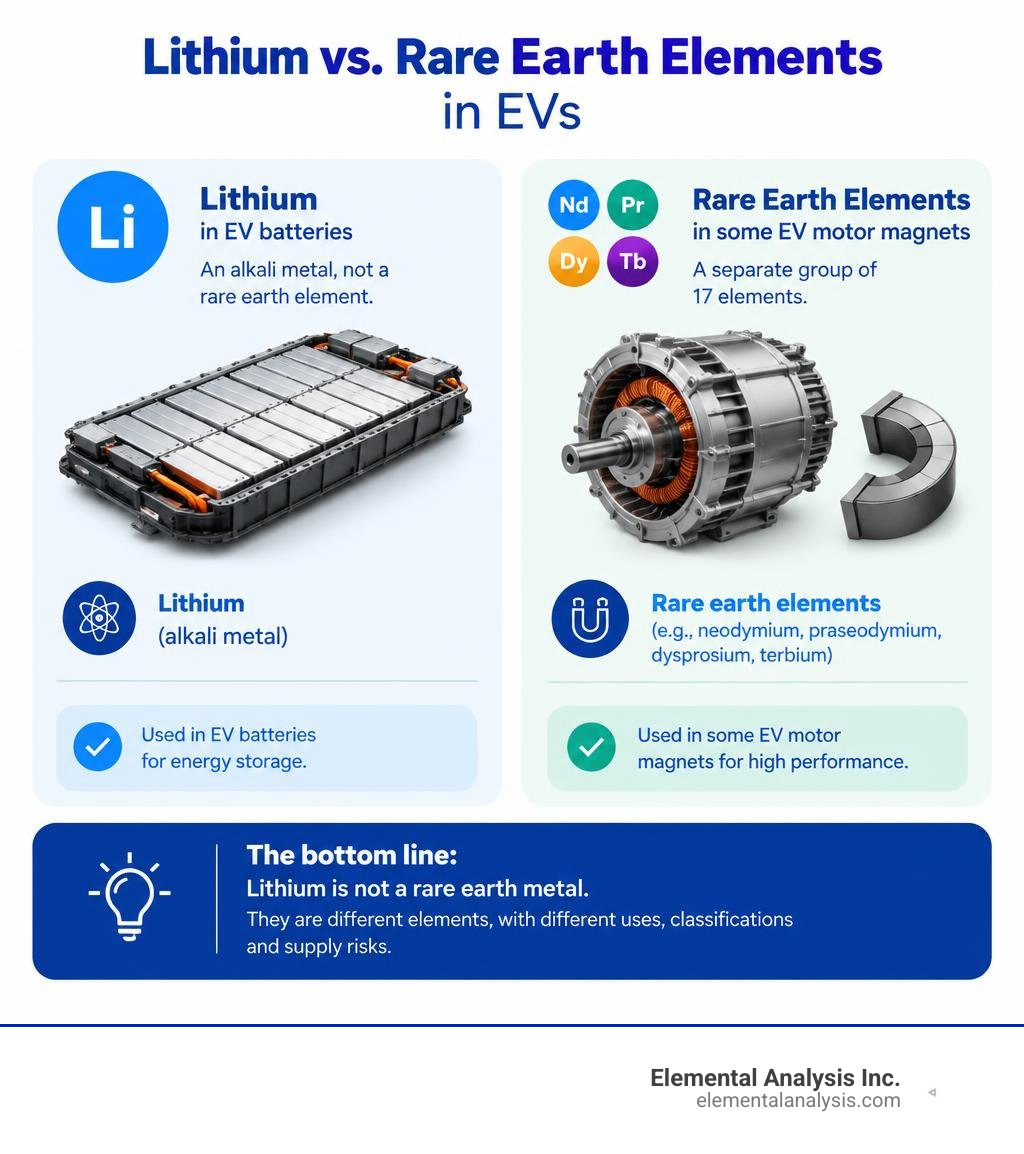
Is lithium a rare earth metal? No. Lithium is an alkali metal used in EV batteries. Rare earth elements are a separate group of 17 elements. Some EV motors use rare earth magnets, but that does not make lithium a rare earth element.
The distinction matters because chemical classification and supply risk are different questions. Lithium can be hard to source and process at the scale battery makers need, even though it is not a rare earth metal.
Is lithium a rare earth metal further reading:
Is Lithium a Rare Earth Metal? The Chemical and Geological Truth
To clear up the confusion once and for all, we must look at chemistry and geology. In modern automotive engineering, clean energy discussions often lump critical battery minerals and specialized motor elements together under one broad umbrella. However, strictly speaking according to standard elemental taxonomy, lithium does not belong to the rare earth group.
The International Union of Pure and Applied Chemistry (IUPAC) defines elements based on atomic structure, electron configuration, and position on the periodic table. When evaluating the Periodic Table of Elements, lithium sits right near the top in Group 1, while rare earth elements belong to an entirely different segment comprising Group 3 and the separate f-block series.
| Property | Lithium (Li) | True Rare Earth Elements (REEs) |
|---|---|---|
| Periodic Table Group | Group 1 (Alkali Metals, s-block) | Group 3 / Lanthanide Series (f-block) |
| Atomic Number(s) | 3 | 21, 39, and 57 through 71 |
| Crustal Abundance | 20 to 70 parts per million (ppm) | Cerium: 68 ppm; Lutetium: 0.5 ppm |
| Valence Configuration | Single s-orbital electron | Partially filled 4f electron subshells |
| Primary EV Application | Charge-carrying ion in battery cells | High-strength permanent magnets in motors |
| Primary Extraction Source | Continental brines, pegmatite ores | Monazite, bastnäsite, ion-adsorption clays |
| Chemical Separation | Precipitation, evaporation, roasting | Complex multi-stage solvent extraction |
Chemical Properties: Is Lithium a Rare Earth Metal by Definition?
From a fundamental chemical standpoint, whether lithium qualifies as a rare earth metal comes down to its electron architecture. Lithium is an alkali metal with an atomic number of 3 and an atomic weight of 6.94 atomic mass units. It has a single valence electron orbiting two core electrons. Because it readily surrenders this outer electron, lithium possesses an exceptionally high electrochemical potential, making it the premier material for mobile electrical energy storage.
Furthermore, lithium is the lightest solid metal on Earth. It is so light that pure metallic lithium can float on water (shortly before reacting vigorously with it). In contrast, reading through our complete guide to rare earth elements and their history demonstrates that true rare earth elements have vastly distinct electronic configurations, higher densities, and completely different bonding behaviors.
The 17 True Rare Earth Elements Defined
The official IUPAC definition identifies exactly 17 rare earth elements:
- Scandium (Sc) – Atomic number 21
- Yttrium (Y) – Atomic number 39
- Lanthanum (La) – Atomic number 57
- Cerium (Ce) – Atomic number 58
- Praseodymium (Pr) – Atomic number 59
- Neodymium (Nd) – Atomic number 60
- Promethium (Pm) – Atomic number 61
- Samarium (Sm) – Atomic number 62
- Europium (Eu) – Atomic number 63
- Gadolinium (Gd) – Atomic number 64
- Terbium (Tb) – Atomic number 65
- Dysprosium (Dy) – Atomic number 66
- Holmium (Ho) – Atomic number 67
- Erbium (Er) – Atomic number 68
- Thulium (Tm) – Atomic number 69
- Ytterbium (Yb) – Atomic number 70
- Lutetium (Lu) – Atomic number 71
These elements consist of the 15 lanthanides plus scandium and yttrium, which share similar geochemical behaviors and ionic radii. The unique magnetic and optical characteristics of these elements stem from their filling 4f electron subshells. To explore how the heavier members of this group enable advanced technologies, see our review of the properties of heavy rare earth metals.
Why Lithium Is Frequently Mislabeled as a Rare Earth Element
If chemistry places lithium and rare earths in completely separate categories, why are they frequently grouped together in public discussions? The confusion is primarily driven by how these materials are framed during the global transition away from fossil fuels.
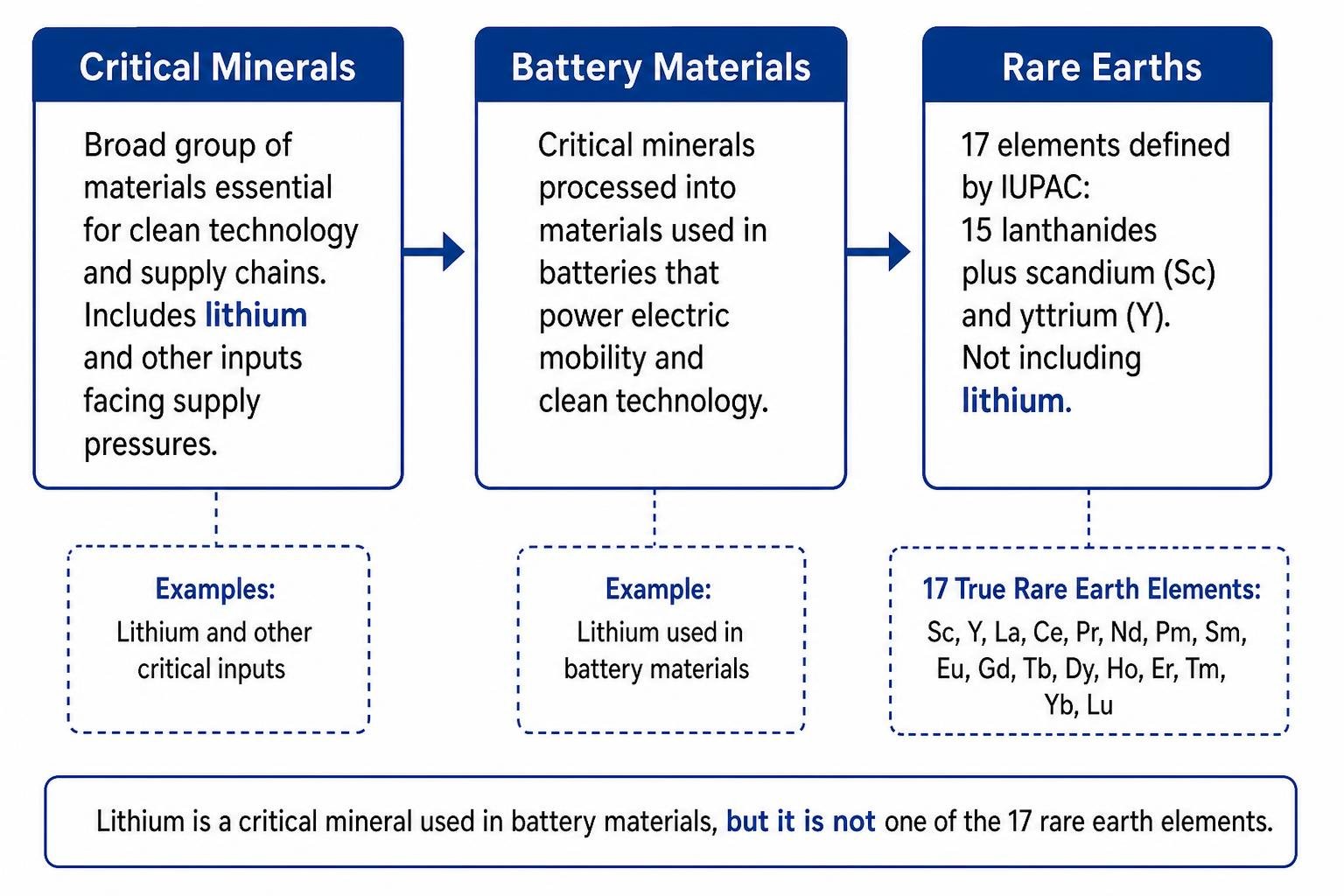
As electric mobility has scaled rapidly, automotive supply chain reporting has surged. Journalists, market commentators, and general industry observers often lump all critical inputs needed for clean technology into one collective phrase: “rare earths.” The urgent geologic search for clean energy lithium sources highlights supply chain vulnerabilities, leading casual readers to assume that any raw material facing supply pressures must be a rare earth metal.
Media and Market Confusion: Why Is Lithium a Rare Earth Metal in Popular Culture?
In financial reporting and public media, lithium has earned nicknames like “white gold.” Investment funds frequently create thematic exchange-traded funds (ETFs) that bundle critical resources into single baskets labeled “Rare Earth and Strategic Metals.”
When an investment portfolio contains both neodymium mining firms and lithium brine extractors, casual observers naturally assume both assets belong to the same geological family. Over time, headline simplification has cemented the mistaken belief that lithium is simply another rare earth element powering electric vehicles.
Critical Minerals vs. Rare Earths: Understanding Government Classifications
Government agencies categorize natural resources differently than academic chemists. Geological surveys and energy departments focus on supply security and economic importance rather than atomic structure.
- Critical Minerals: Broad designations that include any non-fuel mineral essential to the economic or national security of a nation and susceptible to supply disruption (for example: lithium, cobalt, nickel, graphite, and rare earth elements).
- Strategic Minerals: A subset of minerals vital for defense and industrial infrastructure during national emergencies.
- Rare Earth Elements: A precise chemical family consisting strictly of the 17 identified lanthanides, scandium, and yttrium.
Initiatives like federal advanced processing initiatives for critical minerals support both lithium and rare earth supply chains, but they do so while recognizing their separate metallurgical identities.
Lithium vs. Rare Earths: Crustal Abundance, Mining, and Refining
Another persistent myth is that both lithium and rare earth elements are scarce within Earth’s crust. In reality, neither group is truly rare in terms of overall crustal abundance. The difficulty lies entirely in finding deposits rich enough to mine economically and separating the target elements efficiently.
Navigating the high-stakes world of rare earth mining and processing involves different chemical separation steps than processing lithium from brine or hard-rock ore.
Geological Occurrence: Brines, Pegmatites, and Clays
Lithium occurs throughout Earth’s crust at concentrations between 20 and 70 parts per million (ppm), ranking it roughly 33rd in elemental abundance. It concentrates in three primary geological environments:
- Continental Salar Brines: Massive subterranean saltwater reserves located primarily in the “Lithium Triangle” across Chile, Argentina, and Bolivia.
- Hard-Rock Pegmatites: Igneous rock formations containing spodumene minerals, mined heavily in Australia, China, and North America.
- Sedimentary Volcanic Clays: Emerging geological formations, such as those found in ancient volcanic calderas, that hold extensive lithium concentrations bound in clay matrixes.
Rare earth elements, by contrast, are dispersed widely across common igneous and metamorphic rocks. Rather than forming concentrated native veins or simple salts, they substitute into standard mineral lattices such as bastnäsite, monazite, and xenotime.
Extraction Complexities and Chemical Separation
The commercial differences between lithium and rare earth elements become clearest during extraction and refining:
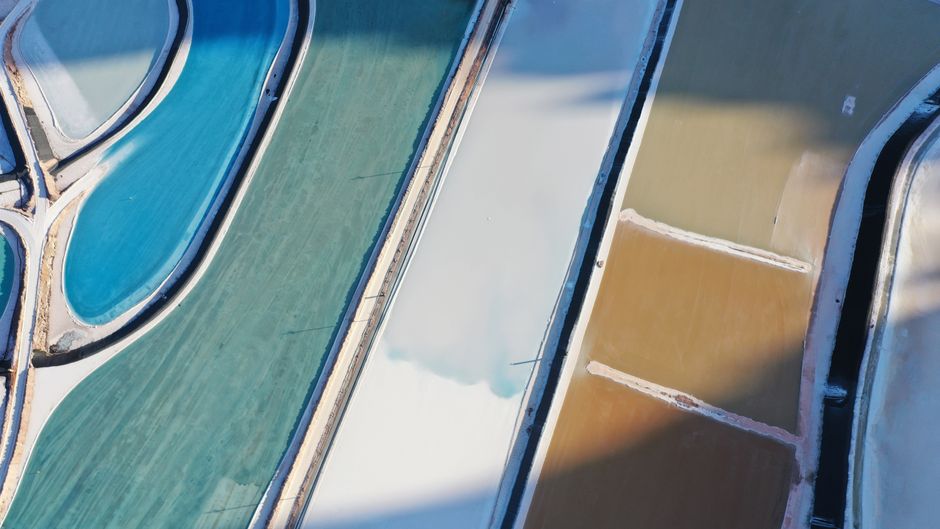
- Lithium Processing: Brines are pumped into expansive solar evaporation ponds where sunlight concentrates the salts over 12 to 18 months before chemical precipitation produces lithium carbonate or lithium hydroxide. Hard-rock spodumene ore is crushed, roasted at high temperatures, and treated with acid to isolate pure battery-grade compounds.
- Rare Earth Processing: Because all 14 natural lanthanides share nearly identical chemical charges and ionic radii, separating one from another requires hundreds of sequential liquid-liquid solvent extraction stages or fractional crystallization cycles.
At our laboratory in Lexington, Kentucky, our testing specialists assist mining and processing operations in verifying raw materials. Accurate evaluation using mineral security testing and elemental analysis ensures that lithium feeds and rare earth concentrates meet strict purity thresholds without unwanted cross-contamination.
Supply Chain Realities: Lithium Availability vs. Cobalt and REE Bottlenecks

When analyzing electric vehicle manufacturing in 2026, the real bottlenecks are not about theoretical element scarcity in the Earth’s crust. They are driven by refining capacity, geographic concentration, and political stability across supply corridors.
True Supply Constraints Facing Lithium Production
Lithium itself is plentiful, but building out battery-grade refining capacity takes years. The primary challenges include:
- Long Mine Lead Times: Developing a new lithium extraction operation—from initial discovery to commercial delivery—often takes 7 to 10 years due to environmental assessments and permitting.
- Water Consumption Concerns: Evaporation methods in arid salar regions consume significant local water, driving the development of Direct Lithium Extraction (DLE) systems that reinject brine underground.
- Refining Concentration: While raw spodumene is extracted globally, a significant portion of chemical refining into battery-ready lithium hydroxide and carbonate remains concentrated in specific Asian industrial hubs.
Cobalt Accessibility and Geopolitical Risk Compared to Lithium
The supply risks associated with lithium are distinct from those surrounding cobalt or rare earths. Cobalt production is tied heavily to copper and nickel mining as a secondary byproduct, with over 70% of global output originating from the Democratic Republic of the Congo (DRC).
By comparison, lithium extraction is geographically distributed across South America, Australia, North America, and Asia. Furthermore, the rapid adoption of Lithium Iron Phosphate (LFP) battery chemistries allows many modern EVs to operate entirely without cobalt, while lithium remains an indispensable carrier of electrochemical charge across all commercial lithium-based cells.
Frequently Asked Questions About Lithium and Rare Earth Metals
Is lithium rarer than true rare earth elements like cerium?
No, lithium is not rarer than every rare earth element, but it is less abundant in Earth’s crust than some of them. For instance, cerium is the 25th most abundant element in the crust at roughly 68 ppm—making it more common than copper (around 60 ppm). Lithium averages between 20 and 70 ppm. However, cerium rarely concentrates in rich, easily accessible ore deposits, whereas lithium forms concentrated brines that can be pumped and processed economically.
What components in an electric vehicle actually use rare earth metals?
While lithium is located inside the battery cells, rare earth elements are used primarily in the electric drivetrain. High-efficiency permanent magnet synchronous motors utilize neodymium, praseodymium, dysprosium, and terbium to create powerful magnetic fields that deliver high torque and efficient regenerative braking. Rare earths may also appear in small quantities within onboard electronics, sensors, and specialized glass coatings.
Can EV batteries function without rare earth elements?
Yes. Standard lithium-ion batteries do not contain any rare earth elements. Common EV battery chemistries—such as Nickel-Manganese-Cobalt (NMC), Nickel-Cobalt-Aluminum (NCA), and Lithium Iron Phosphate (LFP)—rely on transition metals, alkali metals, and graphite. None of the 17 rare earth elements are used in standard production EV battery cells.
Conclusion
Understanding the difference between lithium and rare earth elements helps bring clarity to discussions about the clean energy transition. Lithium is an alkali metal that serves as the charge carrier in modern electric vehicle batteries. Rare earth elements are a distinct family of 17 metals essential for powerful permanent magnets, high-tech optics, and specialized industrial catalysts.
While both material groups face processing hurdles and geopolitical scrutiny, their chemistry, geological formation, and supply chain dynamics are fundamentally different. Navigating these supply landscapes requires precise material verification.
At Elemental Analysis Inc., we operate out of Lexington, Kentucky, as a trace element testing laboratory and the first commercial Particle-Induced X-Ray Emission (PIXE) facility. We provide rapid, non-destructive and destructive quantitative testing, speciation, and purity verification for advanced energy materials, mining operations, and manufacturers across the globe.
To learn more about elemental classifications and critical mineral science, explore our comprehensive rare earth element guide or contact our team to discuss your analytical testing needs.