
Is Your Road Heavy Metal? Guide to Asphalt Metal Content
What’s Really Inside Your Asphalt? A Guide to Metal Content in Roads and Roofing
Asphalt metal content is a critical but often overlooked factor that affects road durability, environmental safety, and roofing performance. Whether you are evaluating pavement materials, roofing options, or industrial byproducts, the trace metals locked inside asphalt directly influence how it ages, how it leaches into the environment, and how safely it can be recycled or disposed of.
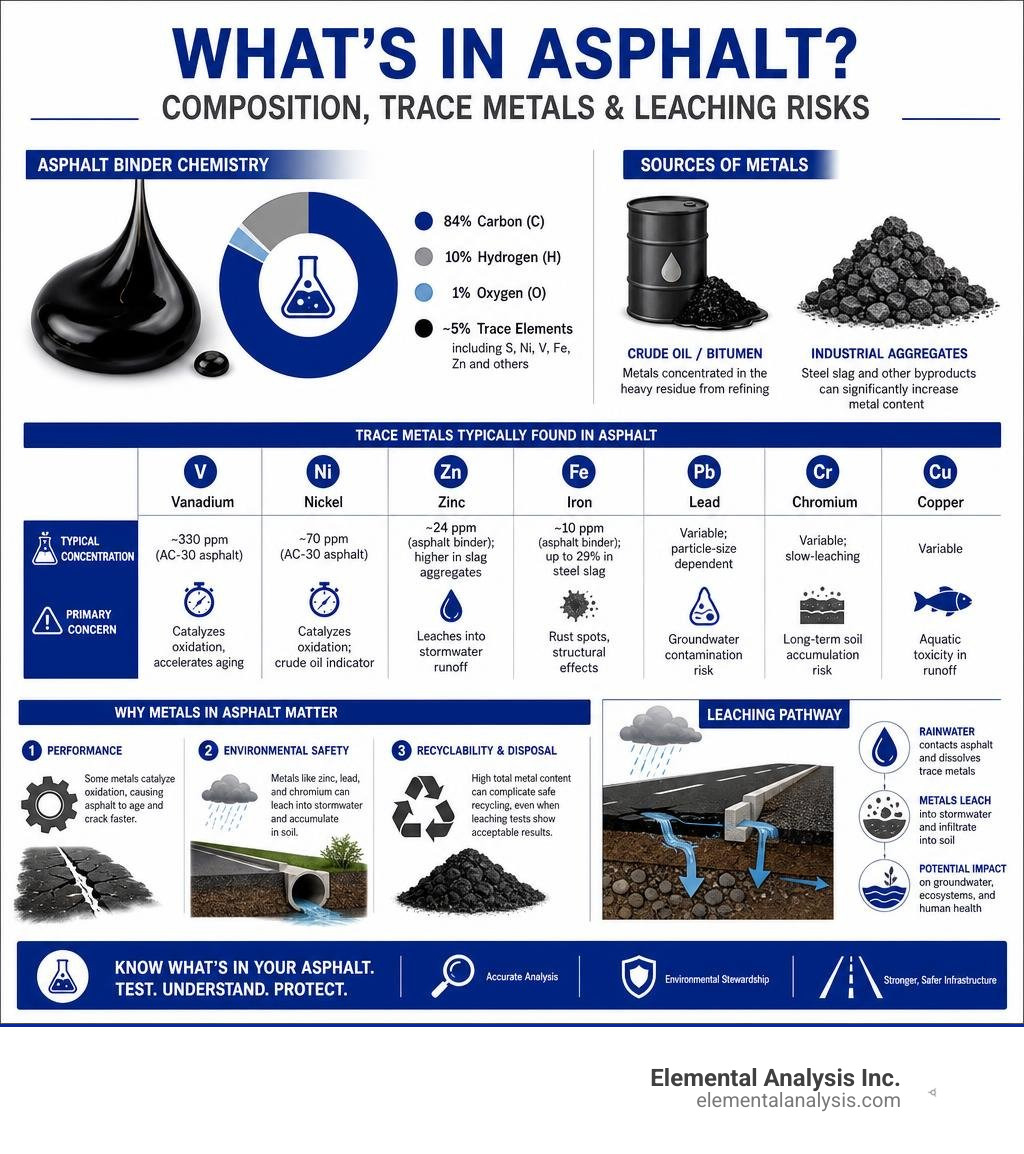
Quick answer — key metals found in asphalt and their significance:
| Metal | Typical Concentration | Primary Concern |
|---|---|---|
| Vanadium (V) | ~330 ppm (AC-30 asphalt) | Catalyzes oxidation, accelerates aging |
| Nickel (Ni) | ~70 ppm (AC-30 asphalt) | Catalyzes oxidation; crude oil indicator |
| Zinc (Zn) | ~24 ppm (asphalt binder); higher in slag aggregates | Leaches into stormwater runoff |
| Iron (Fe) | ~10 ppm (asphalt binder); up to 29% in steel slag | Rust spots, structural effects |
| Lead (Pb) | Variable; particle-size dependent | Groundwater contamination risk |
| Chromium (Cr) | Variable; slow-leaching | Long-term soil accumulation risk |
| Copper (Cu) | Variable | Aquatic toxicity in runoff |
Asphalt is not just tar and gravel. The binder itself is roughly 84% carbon, 10% hydrogen, 1% oxygen, and about 5% trace elements — including sulfur, nickel, vanadium, and iron — whose concentrations vary depending on the crude oil source. Add industrial aggregates like steel furnace slag, and the metal content can rise dramatically.
These metals matter for three reasons:
- Performance — Some metals catalyze oxidation, causing asphalt to age and crack faster.
- Environmental safety — Metals like zinc, lead, and chromium can leach into stormwater and accumulate in soil.
- Recyclability and disposal — High total metal content can complicate safe recycling, even when leaching tests show acceptable results.
For lab supervisors and technical managers, accurately characterizing this metal content requires validated analytical methods — and choosing the wrong method can mean missed detections or regulatory blind spots.
Understanding Asphalt Metal Content: Composition and Sources
To understand the impact of asphalt metal content, we must first look at the raw material: bitumen. Bitumen is the heavy, sticky residue left over from the petroleum refining process. Because it is the “bottom of the barrel,” it naturally concentrates the heavy metals and trace elements that were present in the original crude oil source.
While the majority of asphalt binder consists of carbon and hydrogen, the remaining fraction contains a complex mixture of heteroatoms and metals. The most abundant trace elements found in natural bitumen are sulfur, nickel, vanadium, and iron. Depending on where the crude oil was extracted, the geological fingerprint of these metals changes. For example, testing of AC-30 asphalt has revealed high concentrations of vanadium (around 330 ppm) and nickel (around 70 ppm), alongside lower levels of zinc (24 ppm) and iron (10 ppm).
To read more about how scientists identify these base elements, check out our elemental testing lab guide.
The scientific community has spent decades analyzing these chemical fingerprints. Detailed research, such as the Quantification of V, Ni, Zn and Fe in Asphalt by Atomic Absorption Spectroscopy, demonstrates that quantifying these specific metals is not just an academic exercise—it is a vital step in predicting how a batch of asphalt will perform in the real world.
Catalytic Effects of Asphalt Metal Content on Oxidation
Why do we care if there are a few hundred parts per million of vanadium or nickel in our roads? Because these trace metals do not just sit there quietly. They act as active catalysts.
Vanadium and nickel, in particular, accelerate the chemical process of oxidation. When asphalt is exposed to oxygen and sunlight, these metals catalyze the formation of polar compounds (such as asphaltenes). This chemical shift leads to:
- Faster aging and hardening of the binder.
- A loss of viscoelastic properties (the asphalt becomes brittle).
- Accelerated pavement degradation and cracking.
High asphalt metal content shortens the overall asphalt lifespan, turning what should be a flexible, durable road into a cracked, high-maintenance headache.
Industrial Aggregates and Steel Slag in Asphalt Concrete
The binder is only part of the story. Asphalt concrete is mostly aggregate (crushed stone, sand, or gravel). To build more sustainable, circular-economy roads, engineers frequently turn to industrial byproducts as aggregate replacements. One of the most common materials used is steel furnace slag.
Steel furnace slag comes primarily from two processes:
- Basic Oxygen Furnace (BOF) slag: Typically contains about 20% iron oxide ($Fe2O3$) and 40% calcium oxide (CaO).
- Electric Arc Furnace (EAF) slag: Can contain up to 29% iron oxide ($Fe2O3$) and 35% calcium oxide (CaO).
While using steel slag as a premium aggregate provides exceptional skid resistance and durability, it introduces massive amounts of metals and metal oxides into the pavement. If the slag is not processed correctly, the high calcium oxide (free lime) content can react with water, causing volumetric expansion and structural cracking. Furthermore, the high iron content can lead to unsightly rust spots on the road surface, which can easily be mistaken for contractor error or natural pyrite oxidation.
To understand how to safely utilize and identify these materials, refer to the industry standard A Guide to the Use of Steel Furnace Slag in Asphalt and Thin Bituminous Surfacings. When disputes arise over whether a road’s cosmetic rust spots are caused by unauthorized industrial slag or natural geological minerals, laboratories must use precise extraction and testing workflows, as outlined in the research on Determining the content of steel furnace slag in asphalt concrete.
Environmental Risks: Heavy Metal Leaching and Runoff
As rain falls on our highways and roofs, stormwater runoff slowly wears away the asphalt surface. This wear and tear can cause heavy metal leaching, transporting trace elements into surrounding soil, groundwater, and local waterways.
When we introduce recycled industrial waste—such as municipal solid waste incineration bottom ash aggregate (MSWI-BAA)—into permeable pavements, the potential environmental risk increases. Permeable asphalt is a fantastic low-impact development tool for restoring natural hydrological cycles, but we must ensure it does not turn into a source of toxic runoff.
Studies like the one on Metals Leaching in Permeable Asphalt Pavement with Municipal Solid Waste Ash Aggregate show that while incorporating recycled ash aggregate slightly increases the concentration of certain metals in the water, the levels generally remain within safe limits for agricultural irrigation. However, to guarantee environmental safety, rigorous testing is required. You can learn more about how laboratories screen for these toxins in our guide to heavy metal analysis by ICP-MS.
Leaching Risks of Zinc, Lead, Copper, and Chromium
The specific metals of concern in environmental runoff include zinc, lead, copper, and chromium. The rate at which these metals leach from asphalt mixtures is heavily dependent on physical factors, particularly aggregate particle size.
Research indicates that:
- Smaller aggregate particles (which have a higher surface-area-to-volume ratio) release higher concentrations of zinc, lead, and copper.
- Larger aggregate particles can sometimes release higher concentrations of chromium under specific conditions.
To accurately detect these shifting concentrations in stormwater samples, laboratories must choose the right analytical instruments. For a breakdown of how to choose the best method for your needs, read our comparison guide on ICP-OES vs. ICP-MS.
Total Metal Accumulation vs. Leaching Limits
There is a critical regulatory gap that every environmental manager should understand: the difference between leaching limits and total metal accumulation.
Standard environmental tests, such as the Toxicity Characteristic Leaching Procedure (TCLP), only measure the concentration of metals that dissolve into a liquid solution under simulated landfill conditions. Because bitumen is highly lipophilic (oil-loving) and hydrophobic (water-repelling), it does an excellent job of locking metals in place. As a result, asphalt mixtures almost always pass TCLP leaching tests with flying colors.
However, over decades of service, physical friction, UV exposure, and tire wear grind the asphalt into microparticles. This physical degradation releases the encapsulated metals into the soil. If you perform a microwave-assisted aqua-regia digestion to measure the total metal content of the material, you may find that elements like copper and chromium far exceed local soil quality standards.
This is where asphalt film thickness plays a heroic role. An optimal asphalt film thickness (ideally between 6 and 10 μm) thoroughly coats and encapsulates metallic aggregates, shielding them from the air and moisture that drive oxidation, expansion, and subsequent leaching. This relationship is explored in depth in the study Evaluation of Asphalt Film Thickness and Metallic Material Leaching of Oxidizing Slag used as Aggregates in Dense-Graded Asphalt Concrete.
Asphalt Shingles vs. Metal Roofing: Performance, Cost, and Longevity
The conversation around asphalt and metal content is not limited to roads. For homeowners and commercial property managers, the choice between traditional asphalt composition shingles and modern metal-based alternatives is a major financial and practical decision.
To help visualize the trade-offs, let’s compare traditional asphalt shingles with stone-coated steel and stamped metal options:
| Feature | Asphalt Composition Shingles | Stone-Coated Steel Shingles | Stamped Metal Shingles |
|---|---|---|---|
| Primary Material | Fiberglass mat, petroleum-based asphalt, ceramic granules | Structural steel core, aluminum-zinc alloy coating, stone granules | Aluminum, copper, or steel alloy panels |
| Average Lifespan | 15 to 30 years (often less in harsh climates) | 50+ years | 50 to 70 years |
| Upfront Cost | Low ($6 to $10 per sq. ft. installed) | Moderate to High | High ($12 to $20+ per sq. ft. installed) |
| Recyclability | Limited; contributes to landfill waste | 100% recyclable | 100% recyclable |
| Maintenance | Moderate (susceptible to wind blow-offs and mold) | Very Low | Very Low |
| Wind Resistance | Standard | High (Class 4 impact-rated) | High (Excellent wind uplift ratings) |
Durability, Lifespan, and Wind Uplift Ratings
While traditional asphalt shingles remain the most common choice due to their low upfront cost, their lifespan is highly vulnerable to weather extremes. In areas with intense freeze-thaw cycles, lake-effect snow, or blistering summer heat, asphalt shingles can degrade rapidly, often lasting only 15 to 25 years.
In contrast, stone-coated steel and stamped metal shingles are engineered to withstand severe weather. These systems offer:
- Class A Fire Ratings: Noncombustible performance when paired with the proper underlayment.
- Superior Wind Resistance: Interlocking metal panels resist wind uplift far better than individual asphalt tabs.
- Accommodation for Thermal Expansion: High-quality metal roofing designs allow panels to expand and contract without warping or generating structural noise.
Energy Efficiency and Solar Reflectivity
The metal content in roofing materials also plays a massive role in household energy efficiency. Traditional dark asphalt shingles act as thermal sponges, absorbing solar radiation and transferring heat directly into the home’s attic. This drives up cooling costs during the summer.
Metal roofs—especially those coated with highly reflective painted finishes—reflect the majority of the sun’s rays. In hot climates, a light-colored metal roof can keep attics up to 40 degrees cooler than traditional asphalt roofs, dramatically slashing energy bills. Furthermore, metal roofs shed snow quickly, preventing the thermal shock and ice dams that can lift and curl asphalt shingle edges in the winter.
Characterizing and Quantifying Metals in Bituminous Materials
Whether you are testing road-grade asphalt binder, recycled steel slag, or roofing runoff, getting accurate data starts in the laboratory. Bituminous materials are notoriously difficult to analyze because the sticky, organic matrix of the bitumen can easily clog sensitive laboratory instruments.
To prepare asphalt samples for elemental analysis, chemists typically follow a rigorous sample preparation protocol:
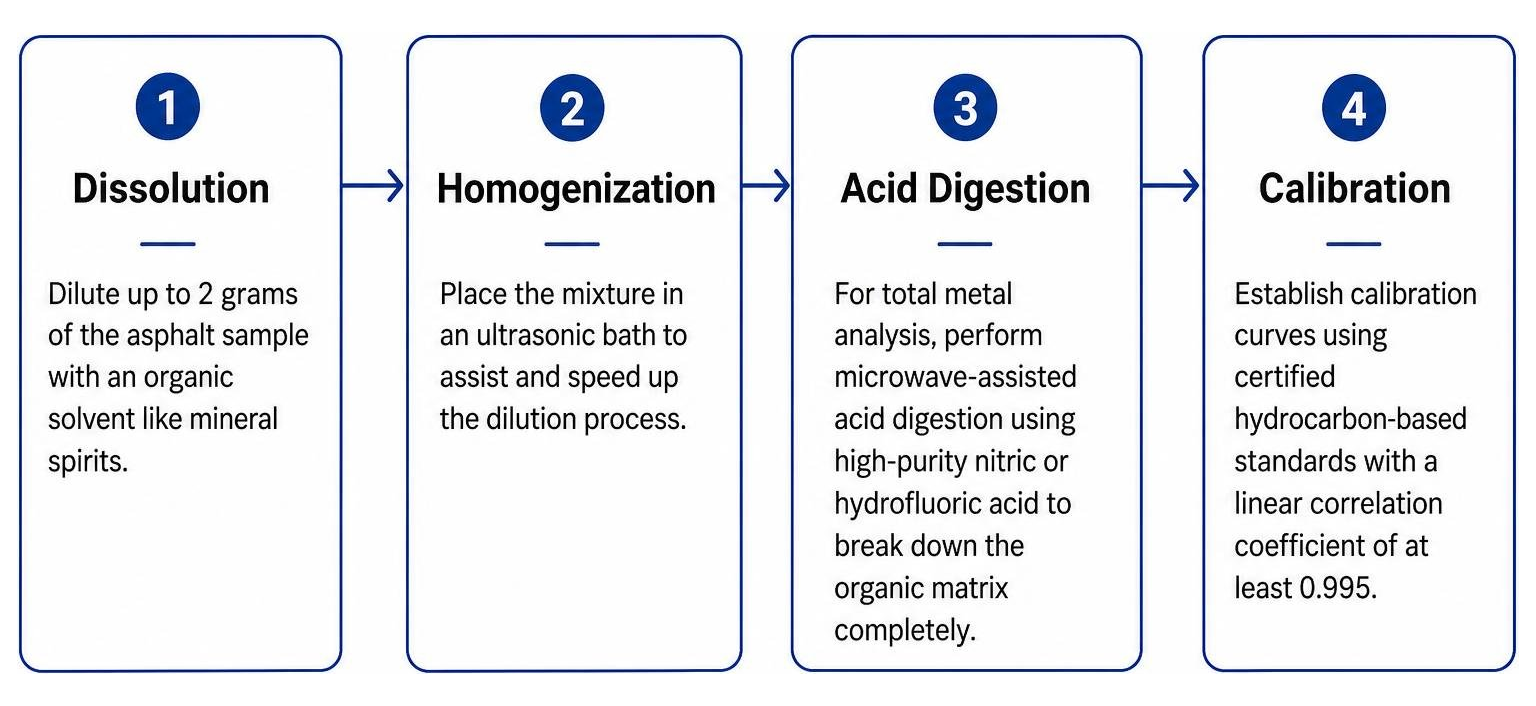
- Dissolution: Dilute up to 2 grams of the asphalt sample with an organic solvent like mineral spirits.
- Homogenization: Place the mixture in an ultrasonic bath to assist and speed up the dilution process.
- Acid Digestion: For total metal analysis, perform microwave-assisted acid digestion using high-purity nitric or hydrofluoric acid to break down the organic matrix completely.
- Calibration: Establish calibration curves using certified hydrocarbon-based standards with a linear correlation coefficient of at least 0.995.
To learn more about the science behind these preparation steps, take a look at our comprehensive guide to ICP metal analysis.
Advanced Laboratory Testing for Asphalt Metal Content
Once the sample is prepared, several advanced analytical chemistry techniques can be used to identify and quantify the metals present:
- Atomic Absorption Spectroscopy (AAS): A reliable, cost-effective method for measuring specific target elements like nickel, vanadium, zinc, and iron.
- ICP-OES and ICP-MS: Inductively Coupled Plasma instruments allow for rapid, multi-element screening of trace metals down to parts-per-billion (ppb) levels.
- PIXE (Proton-Induced X-ray Emission): A highly specialized, non-destructive testing method that can analyze the surface chemistry of solid samples without complex acid digestion.
These advanced methods are not just used for quality control; they are also essential for environmental risk assessments and exploring resource recovery. For example, solid natural asphaltites and their ashes can contain extremely high concentrations of valuable metals.
As detailed in the study Environmental Risk Assessment and Resource Recovery Potential of Asphaltite Ash in Şırnak (Türkiye): A Geochemical and Machine Learning Approach, advanced testing of asphaltite ash revealed concentrations of zinc and molybdenum so high that the ash had an estimated secondary raw material recovery value of approximately $323 per ton. By using advanced testing, industries can turn environmental hazards into lucrative circular-economy opportunities.
Frequently Asked Questions about Asphalt and Metal Roofing
What is the typical lifespan of asphalt shingles compared to metal roofs?
Traditional asphalt shingles typically last between 15 and 30 years, depending on the climate and maintenance. Metal roofing systems, including stone-coated steel and stamped metal shingles, are far more durable and can easily last 50 to 70 years with minimal maintenance.
Can heavy metals leach from asphalt shingles into rainwater?
Yes. Over time, weathering and physical wear can cause trace amounts of zinc and copper (often added to shingles as algae-resistant agents) to leach into stormwater runoff. While these concentrations are generally low, testing is recommended if you plan to collect rainwater for organic gardening or sensitive environmental applications.
How does metal content affect the recyclability of roofing materials?
Metal roofing is highly prized in the circular economy because it is 100% recyclable without any degradation of material quality, keeping millions of tons of waste out of landfills. Asphalt shingles, being petroleum-based and contaminated with fiberglass and ceramic granules, have limited recyclability and contribute roughly 12 million tons of landfill waste annually in the United States.
Conclusion
Understanding asphalt metal content is essential for optimizing the lifespan of our roads, protecting our water resources, and making informed decisions about the roofs over our heads. Whether you are dealing with catalytic oxidation in binder chemistry, evaluating the leaching risks of recycled aggregates, or comparing the long-term value of roofing materials, precise elemental data is the key to success.
At Elemental Analysis Inc., based in Lexington, Kentucky, we specialize in helping industrial, environmental, and civil engineering clients solve their toughest material challenges. As the first commercial PIXE laboratory, we offer a unique blend of destructive and non-destructive testing, rapid turnaround times, and highly competitive pricing.
Need to verify the elemental composition, metal content, or environmental safety of your asphalt materials? Request a free estimate or testing services from our expert team today!