
Neutron Activation Environmental Monitoring and the Quest for Cleaner Air
Why Neutron Activation Environmental Monitoring Matters for Trace Pollutant Detection
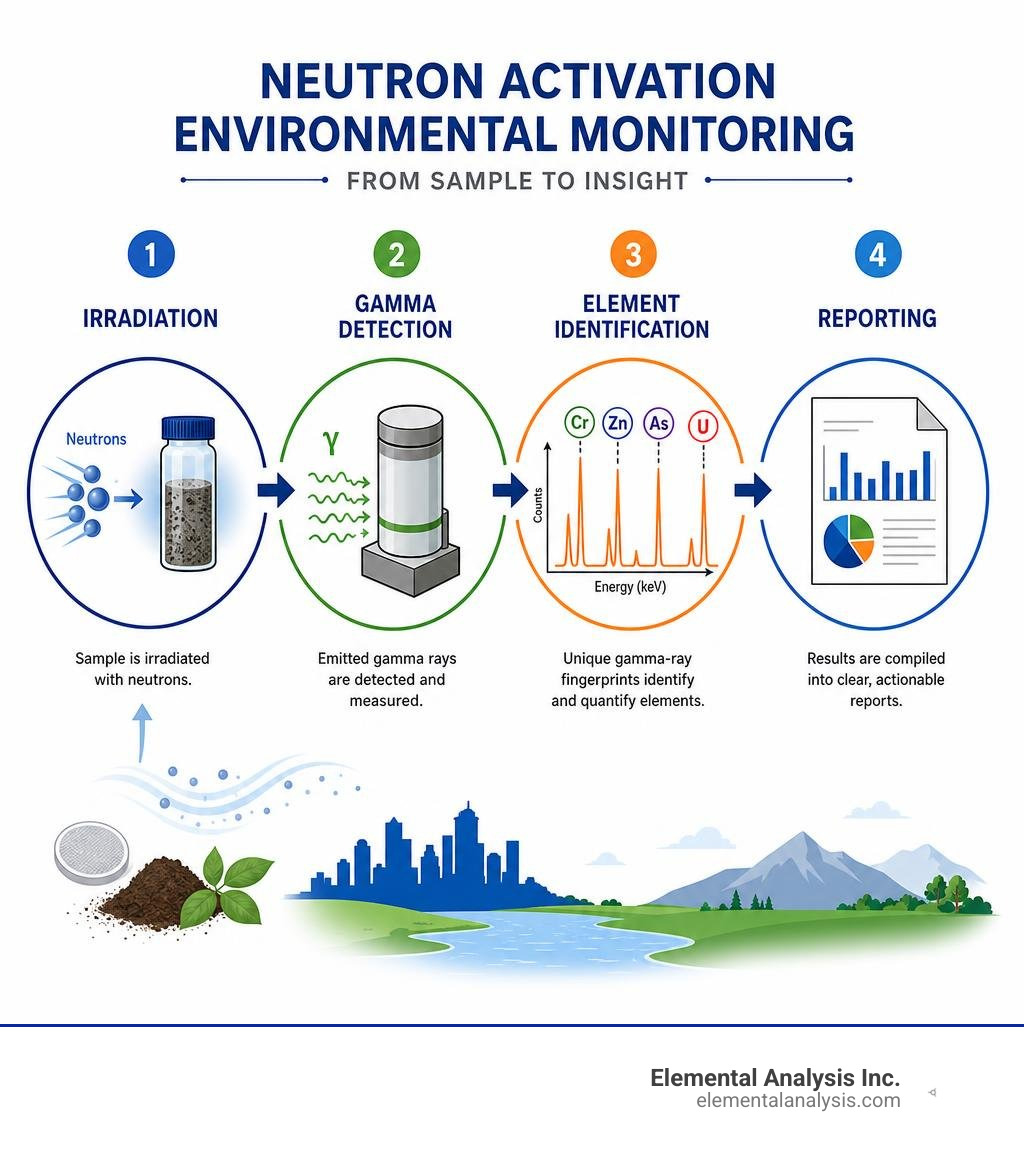
Neutron activation environmental monitoring is a nuclear-based analytical method that detects and quantifies trace elements in environmental samples — such as air particulates, sediments, and biological tissues — by irradiating them with neutrons and measuring the gamma rays they emit.
Here is a quick summary of what it offers:
- What it does: Simultaneously identifies up to 74 elements in a single sample, at concentrations as low as 10⁻¹⁵ g/g
- How it works: Neutron irradiation converts stable atoms into radioactive isotopes; each isotope emits a unique gamma-ray “fingerprint”
- What it analyzes: Air filters, river sediments, mosses, marine organisms, soils, and more
- Key advantage: Completely non-destructive — no chemical digestion needed, so there is zero risk of reagent contamination
- Who uses it: Environmental regulators, research labs, and industrial testing facilities needing high-sensitivity, multi-element data
The scale of what this technique can reveal is striking. A single instrumental analysis of bottom sediment can detect over 40 elements simultaneously, including arsenic, chromium, mercury, and rare earth elements — all from one unaltered sample.
For lab supervisors managing environmental compliance or pollution source investigations, that kind of multi-element efficiency from a single irradiation run is difficult to match with conventional wet-chemistry methods.
But the real power of this technique shows up in the field. Researchers have mounted mosses on tree trunks in urban areas for 20 weeks, then used neutron activation analysis to detect elevated chromium, uranium, and rare earth elements traced back to nearby roads and industrial facilities. Nature, it turns out, can be a surprisingly precise pollution sensor — when paired with the right nuclear instrumentation.
This guide covers how the method works, what it can detect, and how to apply it across the most common environmental matrices.
What is Neutron Activation Environmental Monitoring?
At its core, Neutron activation environmental monitoring is a highly sensitive, non-destructive analytical technique used to determine the concentration of trace elements in a vast array of environmental materials. Unlike traditional chemical testing methods that rely on dissolving a sample in strong acids, this approach looks directly at the atomic nucleus.
By exposing an environmental sample to a dense cloud of thermal neutrons (slow-moving neutrons that are highly likely to be captured by atomic nuclei), we trigger targeted nuclear reactions. When a stable nucleus absorbs one of these neutrons, it transforms into an excited, radioactive isotope of the same element. To return to a stable, comfortable state, this newly formed radioisotope undergoes radioactive decay, emitting characteristic gamma rays in the process.
Because every single element has a unique nuclear structure, each one emits a highly specific “fingerprint” of gamma-ray energies during decay. By using high-precision gamma spectrometry, we can read these isotopic signatures to identify and quantify exactly which elements are present, and in what amounts. This makes it an incredibly powerful tool for mapping the movement of heavy metals and rare earth elements through our ecosystems. To understand how these principles fit into the broader landscape of nuclear science, check out A Comprehensive Guide to Neutron Activation Analysis.
Core Principles of Neutron Activation Environmental Monitoring
To understand how we can identify ultra-trace pollutants in a clump of river mud or a tiny air filter, we have to look at the three-step dance of nuclear physics:
- Neutron Capture: The sample is placed inside a neutron source (often the core of a research reactor). Stable target nuclei absorb thermal neutrons, creating unstable, excited isotopes.
- Radioactive Decay: Once removed from the neutron flux, these unstable isotopes begin to decay. The rate at which they decay is governed by their half-life, which can range from fractions of a second to many years.
- Gamma Spectrometry: As the isotopes decay, they release excess energy in the form of gamma-ray photons. A solid-state detector measures the precise gamma-ray energy (which tells us what element it is) and the intensity of the emissions (which tells us how much of the element is there).
Because this process targets the nucleus rather than outer-shell electrons, it is completely independent of the sample’s chemical state or physical form. Whether an arsenic atom is bound in an organic compound or locked in an inorganic crystal lattice, its nuclear cross-section remains identical. This fundamental matrix independence is what gives the technique its legendary reliability. For a deeper look at the physics of neutron capture and decay equations, explore Neutron Activation Analysis (NAA): A Deep Dive into Nuclear Elemental Analysis.
Comparing Instrumental, Radiochemical, Prompt, and Delayed NAA
Depending on the target pollutants and the environmental matrix, we can tailor the analysis using different methodology variations. The primary choices lie between Instrumental vs. Radiochemical NAA, and Prompt vs. Delayed gamma-ray measurements.
- Instrumental Neutron Activation Analysis (INAA): The gold standard for non-destructive testing. The sample is irradiated and counted directly without any chemical separation. This is the preferred method for routine environmental monitoring because it keeps the sample completely intact and eliminates reagent contamination.
- Radiochemical Neutron Activation Analysis (RNAA): If a target element is masked by a highly radioactive background matrix (such as high sodium or bromine concentrations in seawater), we perform a chemical separation after irradiation. This isolates the target radioisotope, allowing us to achieve ultra-low detection limits, though it does sacrifice the non-destructive nature of the test.
- Prompt Gamma Neutron Activation Analysis (PGNAA): Gamma rays are measured during the actual irradiation process. This is ideal for elements that capture neutrons but decay too rapidly for delayed measurement, or those that produce stable isotopes (like boron, cadmium, and sulfur).
- Delayed Gamma Neutron Activation Analysis (DGNAA): The standard approach where counting occurs hours, days, or even weeks after irradiation. This delay allows short-lived, interfering radionuclides (like sodium-24) to decay away, leaving a clean, low-background window to measure long-lived toxic metals.
| Methodology | Timing of Measurement | Chemical Processing | Ideal Target Elements | Key Environmental Use Case |
|---|---|---|---|---|
| INAA | Delayed (post-irradiation) | None (Non-destructive) | As, Cr, Co, Fe, Sb, Se, Zn, Rare Earths | Soil, sediments, and air filters |
| RNAA | Delayed (post-irradiation) | Post-irradiation separation | Hg, Cu, Cd (in high-interference matrices) | Seawater and biological tissues |
| PGNAA | Prompt (during irradiation) | None (Non-destructive) | B, Cd, Gd, H, S | Bulk materials, real-time coal/ore analysis |
| DGNAA | Delayed (post-irradiation) | None (Non-destructive) | Th, U, Cs, Rb, Ba | Geological mapping, long-term monitoring |
Environmental Matrices and Target Pollutants
Our natural world is a complex web of overlapping systems. Pollutants don’t stay in one place; they cycle through the atmosphere, wash into our waterways, settle into bottom sediments, and accumulate in living tissues.

Because of its broad multi-element capabilities, nuclear-based monitoring is uniquely suited for tracking these pathways. It can simultaneously quantify major elements, minor trace metals, and rare earth elements (REEs) across highly diverse sample types. To understand how we push the boundaries of sensitivity for these complex matrices, take a look at our In-depth Guide to Low Detection Limits.
Air Quality and Particulate Matter Analysis
Suspended particulate matter (SPM) in the air is a major driver of respiratory and cardiovascular disease. These particles generally fall into two categories: coarse particles (PM10, typically originating from mechanical abrasion, windblown soil, and mineral dust) and fine particles (PM2.5, typically originating from combustion processes and gas-to-particle conversions).
To monitor these threats, high-volume and dichotomous sampling devices draw ambient air through filter media (such as glass fiber or polycarbonate filters) to capture the dust. These filters are ideal candidates for non-destructive nuclear testing.
The EPA has long recognized this capability, establishing standardized protocols such as Method IO-3.7 – Determination of Metals in Ambient Particulate Matter Using Neutron Activation Analysis (NAA) Gamma Spectrometry. This method provides highly reliable analytical procedures for determining percent, ppm, ppb, or even ppt levels of 40 to 50 elements captured on typical air filters. Because the filter is analyzed directly without acid digestion, there is no risk of losing volatile elements like selenium or mercury during sample preparation.
Aquatic Sediments and Biological Indicators
Once pollutants enter aquatic ecosystems, they don’t simply dissolve and disappear. Bottom sediments act as massive environmental reservoirs, adsorbing heavy metals and organic pollutants over time. These sediments are not inert; biological activity can leach these toxic elements back into the water column, where they enter the food chain via microbiota and bioaccumulate in larger organisms like fish.
We can analyze bottom sediment samples to track water pollution history. INAA can easily detect up to 43 elements in bottom sediments, including:
- Al, Mg, Ti, Mn, V: Excellent indicators of natural soil erosion and mineral weathering.
- As, Cd, Cr, Co, Cu, Hg, Sb, Zn: Classic heavy metal pollutants from industrial runoff and municipal wastewater.
- La, Sm, Dy, Th, U: Rare earth and radioactive elements useful for tracing geological origins and industrial fallout.
For biological monitoring, we often turn to nature’s own sponges: epiphytic mosses. Because mosses lack root systems, they absorb all their nutrients—and airborne pollutants—directly from atmospheric deposition.
In active biomonitoring studies, researchers have suspended simple, A4-sized nylon mesh frameworks containing moss vertically on tree trunks for 20 weeks. Analyzing these mosses afterward via nuclear methods revealed significantly increased concentrations of 14 key elements, including chromium, cesium, hafnium, potassium, lutetium, molybdenum, rubidium, samarium, antimony, uranium, terbium, ytterbium, thorium, and europium. This cheap, elegant approach allows us to create high-resolution maps of urban air pollution without relying on expensive electronic monitoring stations.
For historical perspective and foundational protocols on analyzing these complex marine and freshwater systems, see the landmark paper on Neutron Activation Techniques for the Measurement of Trace Metals in Environmental Samples.
The NAA Workflow: Sample Preparation, Irradiation, and Detection
How does an environmental sample actually travel from the field to our final data report? The process requires careful coordination between the field team, sample preparation technicians, and nuclear applications engineers.

Because we are looking for elements at near-background, sub-ppm levels, preventing contamination is our absolute highest priority. For a complete look at cleanroom environments, sample handling, and laboratory safety protocols, read Elemental Testing Lab 101.
The standard workflow follows a structured path:
- Desiccation: Sediments, biological tissues, and mosses are freeze-dried or oven-dried at 105°C to remove all moisture. This prevents water from undergoing radiolysis (which builds up high gaseous pressures) during irradiation inside the reactor.
- Homogenization: Dried samples are ground into fine, uniform powders using high-purity agate mortars or ball mills to ensure the analyzed aliquot is truly representative of the bulk material.
- Encapsulation: The homogenized powder (typically 100 to 500 mg) is weighed into high-purity polyethylene vials for short irradiations, or sealed in quartz ampoules for long, high-flux irradiations.
- Irradiation: The capsule is loaded into a pneumatic transfer “rabbit” system, which shoots the sample directly into the core of a research nuclear reactor at speeds of up to 30 miles per hour. Typical thermal neutron fluxes range from $10^{11}$ to $10^{13}\text{ n/cm}^2/\text{sec}$.
- Decay and Counting: After a calculated decay period (to let short-lived background noise die down), the sample is placed in front of a High-Purity Germanium (HPGe) detector. The detector measures the emitted gamma rays, and a multi-channel analyzer (MCA) processes the electrical pulses into a digital spectrum.
Key Factors Influencing Accuracy in Neutron Activation Environmental Monitoring
Achieving high-precision results requires careful management of several physical variables:
- Neutron Flux Gradients: Reactor cores do not have perfectly uniform neutron clouds. To correct for horizontal and vertical flux variations, we irradiate small flux-monitor wires alongside our samples, normalizing all final counts back to a baseline standard.
- Optimized Decay Windows: Timing is everything. Short-lived isotopes (like vanadium-52, half-life of 3.76 minutes) must be counted immediately after a short 30-second irradiation. Long-lived isotopes (like cobalt-60, half-life of 5.27 years) are best counted after several weeks of decay, allowing the intense, early radioactivity of sodium and chlorine to fade.
- Detector Resolution: To resolve overlapping gamma-ray peaks, we utilize solid-state HPGe detectors with resolutions of 1.7 to 2.2 keV. For low-energy gamma-emitting elements like mercury (77.6 keV) or barium, we can incorporate a specialized Low-Energy Photon Detector (LEPD). LEPDs are thin germanium detectors that offer superior resolution at energies below 200 keV while remaining “blind” to high-energy background radiation, drastically reducing Compton backscatter.
- Spectral Interferences: Sometimes, two different isotopes emit gamma rays of nearly identical energies. For example, the 511 keV annihilation peak can interfere with copper quantitation if short-lived isotopes are allowed to decay too long. Advanced computerized spectral analysis software is essential to resolve these overlaps and apply mathematical corrections.
Advantages, Limitations, and Quality Control in Environmental NAA
When deciding on an analytical approach for a major environmental monitoring program, it helps to weigh the unique benefits of nuclear methods against their practical limitations.

Key Advantages
- Completely Non-Destructive (for INAA): Because the sample is not dissolved in acids, the physical matrix remains completely intact. After the radioactivity decays back to background levels, the exact same sample can be archived or analyzed by other techniques.
- No Reagent Contamination: Traditional ICP-MS or Atomic Absorption requires digesting samples in concentrated nitric or hydrofluoric acids. Even trace impurities in these acids can skew results when measuring ppt-level pollutants. NAA bypasses chemical digestion entirely, eliminating this risk.
- Matrix Independence: The nuclear cross-section of an atom is unaffected by its chemical bonds, physical state, or surrounding matrix. This makes calibration straightforward and highly reliable across wildly different matrices (e.g., comparing dry soil to organic moss).
- Simultaneous Multi-Element Analysis: A single irradiation and counting sequence can easily quantify 30 to 40+ elements in duplicate, making it highly cost-effective for large-scale baseline studies.
Limitations and Challenges
- Access to Nuclear Reactors: Performing NAA requires a nearby research reactor or a reliable pneumatic transport link. Because nuclear reactors are specialized facilities, shipping logistics and radioactive materials licensing must be managed carefully.
- Turnaround Times: While short-lived isotopes can be analyzed in minutes, quantifying long-lived toxic heavy metals can require decay times of 2 to 4 weeks before final counting, which may not suit projects requiring immediate, same-day results.
- Insensitive Elements: A few elements of high environmental interest—most notably lead (Pb) and tin (Sn)—have very low neutron capture cross-sections, meaning they cannot be measured sensitively with standard NAA. These are better analyzed using alternative techniques like PIXE or ICP-MS.
Quality Control Measures
To ensure our data stands up to regulatory scrutiny, we implement a rigorous quality assurance program:
- Standard Reference Materials (SRMs): Every irradiation run includes certified reference materials (such as NIST orchard leaves, EPA fly ash, or marine sediment standards) to validate our calibration curves and prove analytical accuracy.
- Reagent and Filter Blanks: We run empty sample containers and unexposed filter media through the exact same workflow to subtract any background trace signatures.
- Geometry Matching: Samples and standards are packed to identical heights and volumes inside our counting vials, ensuring uniform detector efficiency and eliminating geometric measurement errors.
Frequently Asked Questions about Environmental NAA
What are the typical detection limits for elements analyzed via NAA?
Depending on the specific element and the sample matrix, Neutron activation environmental monitoring can achieve incredibly low detection limits. For highly sensitive elements (like gold, samarium, and lutetium), detection limits can reach down to $10^{-12}$ or even $10^{-15}$ grams per gram (parts per trillion).
For standard environmental heavy metals and toxic elements in typical sediment or air filter matrices, typical detection limits range from:
- 0.01 to 0.1 ppm: Arsenic, antimony, cobalt, mercury, selenium, and uranium.
- 1 to 10 ppm: Chromium, copper, zinc, and barium.
- Percent levels: Major matrix elements like aluminum, iron, sodium, and potassium.
Why are mosses used as active biomonitors in air quality studies?
Mosses act as nature’s low-tech, continuous air samplers. Because they lack a vascular root system, they cannot absorb nutrients or minerals from the soil. Instead, they derive all their water and nutrients directly from wet and dry atmospheric deposition.
Their cellular structure is highly efficient at capturing and holding onto heavy metals through ion exchange. By suspending standardized, vital moss samples in nylon nets on tree trunks, we can capture a highly representative, integrated record of local air pollution over several months. This bypasses the need for active power, pumps, or expensive electronic equipment, making regional air quality mapping highly accessible and cost-effective.
Can low-flux neutron sources like Californium-252 be used for environmental monitoring?
Yes! While high-flux nuclear reactors are necessary for achieving the absolute lowest detection limits, compact, low-flux isotopic neutron sources like Californium-252 ($^{252}\text{Cf}$) offer a highly practical, localized alternative.
A bench-scale $^{252}\text{Cf}$ facility can provide a stable thermal neutron flux of approximately $6 \times 10^7\text{ n/cm}^2/\text{sec}$. While this is lower than a reactor core, it is more than sufficient to detect over 40 elements at low- to sub-ppm levels.
This approach is highly cost-effective for solid waste monitoring, industrial chlorine tracking, and determining radiochemical yields (such as using a stable strontium carrier to monitor strontium-90 recovery without introducing radioactive tracers). For a detailed technical look at how low-flux isotopic systems are designed and operated, see WSRC-MS-98-00726.
Conclusion
Neutron activation environmental monitoring remains one of the most powerful, reliable, and scientifically elegant tools in our quest for cleaner air, safer waterways, and healthier soil. By looking directly at the atomic nucleus, it bypasses the chemical preparation hurdles that limit traditional wet-chemistry methods, offering unparalleled multi-element sensitivity from completely unaltered samples.
At Elemental Analysis Inc., based in Lexington, Kentucky, we combine this deep nuclear expertise with our status as the pioneer of commercial PIXE (Proton Induced X-ray Emission) testing. Whether you are conducting regional air quality biomonitoring, tracking industrial heavy metal runoff in river sediments, or establishing baseline environmental compliance, we deliver high-precision elemental identification, quantification, and speciation.
By offering both non-destructive and destructive testing suites, we tailor our analytical approach to your exact project demands—ensuring the fastest possible turnaround times and highly competitive pricing.
Ready to unlock the chemical secrets of your environmental samples with unmatched precision? Partner with our team of nuclear applications engineers and analytical chemists today. Learn more about our NAA services and discover how we can streamline your environmental monitoring program.