
A Comprehensive Guide to Neutron Activation Analysis
What Is Neutron Activation Analysis — and Why Does It Matter?
Neutron activation analysis is a highly sensitive nuclear technique used to identify and measure trace elements in almost any material — without destroying the sample.
Here’s a quick summary of what you need to know:
- What it does: Bombards a sample with neutrons, causing elements to emit characteristic gamma rays that reveal their identity and concentration
- How sensitive: Detects up to 74 elements at levels from parts-per-million down to parts-per-trillion
- Non-destructive: Most variants leave the sample physically intact
- Best for: Trace element analysis in aerospace materials, pharmaceuticals, environmental samples, geological specimens, and more
- Typical precision: Overall errors of 2–5% relative standard deviation for most elements
- Scale: Roughly 100,000 samples are analyzed globally each year using this method
For lab supervisors and technical managers who need fast, accurate elemental data — especially at ultra-low concentrations — few techniques can match it.
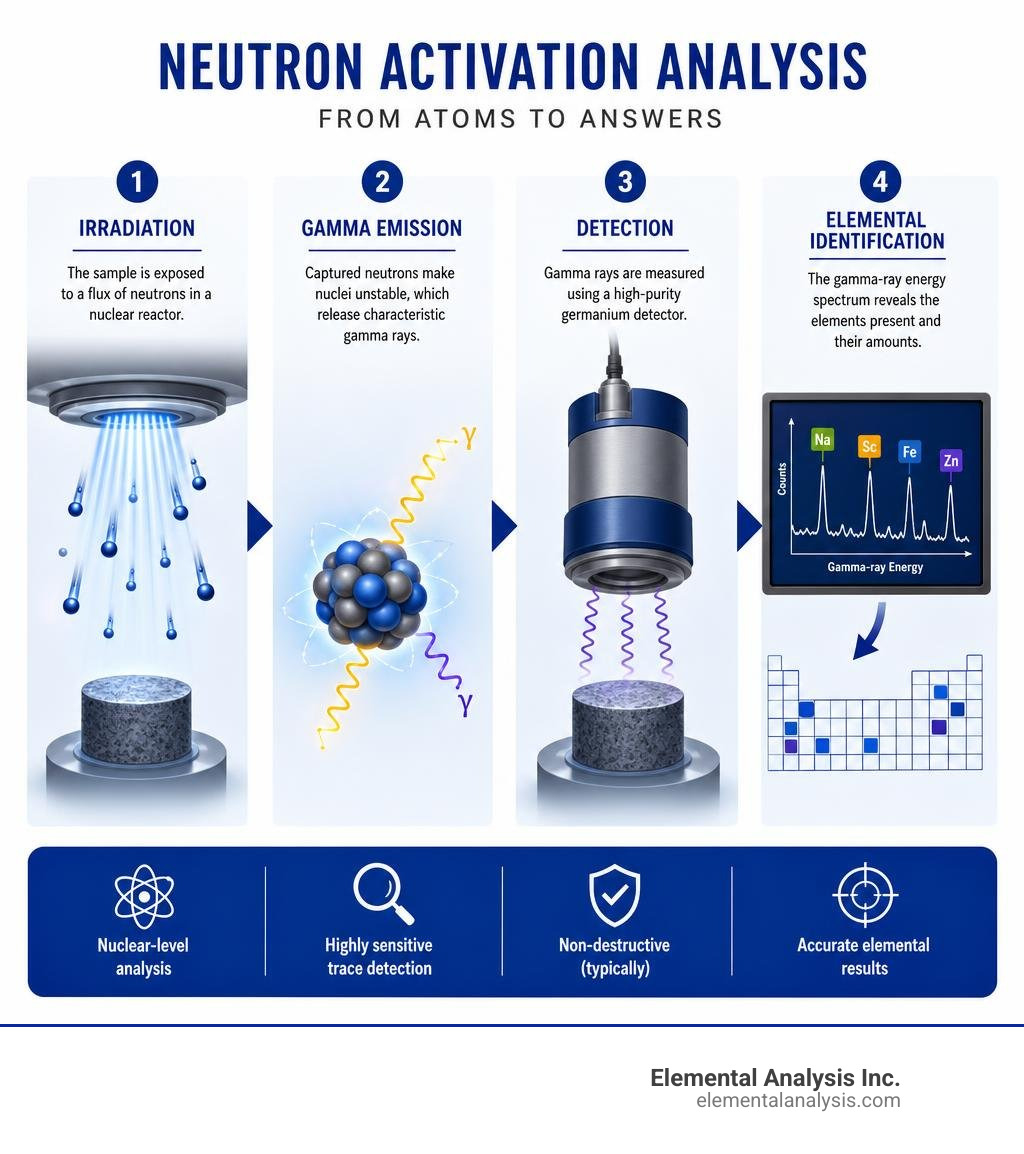
NAA works by exposing a sample to a controlled neutron flux, typically inside a nuclear research reactor. The neutrons are captured by atomic nuclei, which then decay and release gamma rays at energies that act like a fingerprint for each element. Measure those gamma rays, and you know exactly what’s in your sample and how much.
What makes it especially valuable is its matrix independence. Unlike many wet-chemistry or mass-spectrometry methods, NAA doesn’t care about the chemical form of your sample. It reads the nucleus directly — solids, liquids, powders, even gases can be analyzed with minimal preparation.
The technique has been trusted in science and industry since its discovery in 1936, and it remains one of the most rigorous elemental analysis methods available today — often used as the referee method when other techniques disagree.
Understanding Neutron Activation Analysis: Principles and Nuclear Physics
To understand neutron activation analysis, we have to zoom past the electron cloud of the atom and look directly at the nucleus. Most traditional spectroscopic methods rely on electronic transitions—electrons jumping between energy shells. NAA, however, is a purely nuclear process.
When we irradiate a sample with neutrons, we are essentially inviting the atomic nuclei to capture these subatomic particles. Because this method bypasses the outer electrons entirely, the chemical bonding, oxidation state, and physical form of the sample have zero impact on the final measurement. This fundamental difference is why Neutron activation analysis | IAEA highlights the technique as a cornerstone of modern nuclear research applications.
The History of Neutron Activation Analysis
The story of NAA began in 1936, when Nobel laureate George de Hevesy and his colleague Hilde Levi published their groundbreaking discovery. They found that samples containing rare earth elements became highly radioactive after being exposed to a source of neutrons.
By measuring this induced radioactivity, they could identify and quantify elements that were previously invisible to chemical tests. You can read more about the early milestones and physics behind this discovery on the Neutron activation analysis Wikipedia page. Since those early days of nuclear chemistry, the technique has evolved from a scientific curiosity into a highly automated, indispensable analytical tool.
How the (n, gamma) Reaction Works
At the heart of NAA is the radiative capture reaction, commonly abbreviated as the (n, gamma) reaction. Here is how the process unfolds step-by-step:
- Neutron Capture: A stable target nucleus absorbs a free neutron (typically a low-energy “thermal” neutron with kinetic energy below 0.5 eV).
- Compound Nucleus Formation: The addition of the neutron creates an excited, highly unstable compound nucleus.
- Prompt Gamma Emission: To shed this excess excitation energy, the compound nucleus almost instantly (within $10^{-14}$ seconds) de-excites by emitting “prompt” gamma rays.
- Radioactive Decay: The remaining nucleus is now a radioactive isotope (radionuclide). Over a period ranging from fractions of a second to many years, this radionuclide decays, typically emitting beta particles accompanied by “delayed” gamma rays.
Because every radioactive isotope decays with a specific, unique half-life and emits gamma rays at precise, discrete energy levels, we can identify exactly which elements are present by measuring these emissions.
Key Advantages of Neutron Activation Analysis
So, why do technical managers choose this nuclear method over other advanced laboratory techniques? The answer lies in three key benefits:
- Matrix Independence: Because neutrons penetrate deeply into materials and gamma rays escape just as easily, the physical matrix of the sample does not interfere with the results. Whether your analyte is locked in solid volcanic rock, dissolved in water, or suspended in a biological slurry, the signal remains clean.
- Extreme Sensitivity: NAA can detect approximately 65 to 74 elements with detection limits starting as low as 0.03 nanograms.
- Non-Destructive Capability: For precious, rare, or legally sensitive samples, the ability to perform high-precision testing without dissolving or destroying the material is priceless.
At Elemental Analysis Inc., we specialize in leveraging these unique properties to solve complex testing challenges. You can explore our dedicated capabilities on our Neutron Activation Analysis service page.
Neutron Sources and Gamma-Ray Detection
To perform NAA, we need two primary pieces of hardware: a source of neutrons and a high-resolution detector.
Nuclear reactors are the premier source of neutrons, providing a high thermal neutron flux typically in the order of $10^{12}$ to $10^{14}$ neutrons $\text{cm}^{-2}\text{s}^{-1}$. While small isotopic sources (like Californium-252) or gas discharge tubes can be used for specialized, localized applications, they cannot match the sensitivity provided by a true research reactor.
Once a sample has been activated, we measure the emitted gamma rays using a high-purity germanium (HPGe) detector setup.
These semiconductor detectors are kept at liquid nitrogen temperatures to minimize thermal noise. When a gamma ray strikes the germanium crystal, it produces charge carriers proportional to the photon’s energy. This signal is processed by a multi-channel analyzer (MCA) to build a spectrum of peaks. By analyzing these peaks—where the position on the x-axis represents the energy (identifying the element) and the area under the peak represents the intensity (quantifying the concentration)—we achieve highly precise results.
Main Types and Variations of NAA
Not all neutron activation tests are performed the same way. Depending on the sample matrix, the target elements, and whether the sample can be chemically altered, we select from several distinct variations of the method.
| Technique | Acronym | Sample State Post-Analysis | Primary Strengths | Best Used For |
|---|---|---|---|---|
| Instrumental NAA | INAA | Intact (but radioactive) | Zero chemical prep; multi-element | Geology, archaeology, general plastics |
| Radiochemical NAA | RNAA | Destroyed (dissolved) | Eliminates matrix interference | Ultra-trace elements, high-purity metals |
| Prompt Gamma NAA | PGNAA | Intact | Real-time measurement during irradiation | Hydrogen, boron, sulfur, carbon |
Whether you need a non-destructive screen or an ultra-sensitive trace determination, choosing the right variation is essential. You can review the full scope of our analytical options on our Services page.
Instrumental Neutron Activation Analysis (INAA)
Instrumental Neutron Activation Analysis (INAA) is the most common form of the technique. It is entirely non-destructive. After irradiation, the sample is simply set aside for a specific decay period and then placed directly on the HPGe detector.
INAA is incredibly powerful because it allows us to measure up to 35 to 40 elements simultaneously in a single small sample (often between 5 and 100 mg). Because there is no chemical dissolution, there is no risk of losing volatile elements or introducing contamination from laboratory reagents. Facilities worldwide, including the USGS TRIGA reactor and various university research reactors, rely on INAA as their primary analytical workhorse.
Radiochemical Neutron Activation Analysis (RNAA)
Sometimes, the matrix itself becomes so radioactive after irradiation that it completely drowns out the signals from the trace elements you actually want to measure. For example, if you are looking for trace impurities in high-purity sodium or silicon, the massive activation of the target matrix creates a “flood” of background radiation.
In these cases, we turn to Radiochemical Neutron Activation Analysis (RNAA). After the sample is irradiated, it is chemically dissolved, and the elements of interest are separated from the highly radioactive matrix using precipitation, solvent extraction, or ion exchange. This eliminates the interfering background, pushing detection limits down to the parts-per-trillion range. Researchers interested in the mathematics and chemistry of these separations can find deep technical insights in the classic paper on Derivative techniques in activation analysis – Springer Nature .
Prompt Gamma-Ray Activation Analysis (PGAA)
While standard INAA measures the delayed gamma rays emitted over minutes, hours, or days after the sample is removed from the reactor, Prompt Gamma-Ray Activation Analysis (PGAA) measures the prompt gamma rays emitted during the actual neutron bombardment.
This requires placing the detector next to a neutron beam port outside the reactor core. PGAA is incredibly useful for elements that capture neutrons but decay too quickly to be measured by delayed counting, or for elements that do not form radioactive isotopes at all.
Crucially, PGAA is the gold standard for measuring light elements like hydrogen, boron, carbon, and nitrogen. For example, the cold neutron PGAA instrument at NIST operates with a thermal equivalent neutron flux of $6.5 \times 10^9\text{ cm}^{-2}\text{s}^{-1}$, allowing researchers to detect less than 1 microgram of hydrogen in most materials. You can learn more about these specialized beam capabilities directly from the Prompt Gamma-Ray Activation Analysis (PGAA) | NIST tool overview.
Sample Preparation and Error Mitigation
While NAA is remarkably robust, achieving an overall precision of 2–5% relative standard deviation requires meticulous attention to detail.
First, samples must be packaged in ultra-pure containers to prevent outside contamination. We typically use heat-sealed, high-purity linear polyethylene vials for short irradiations, or high-purity quartz ampoules for long irradiations in high-flux environments.
Second, our scientists must account for physical interferences:
- Self-Shielding: If a sample contains a high concentration of an element with an extremely large neutron capture cross-section (like cadmium, boron, or rare earths), it can absorb neutrons at the outer boundary, preventing the inner portion of the sample from receiving the same neutron flux. We mitigate this by reducing sample size or diluting the material.
- Spectral Interferences: Sometimes, two different radionuclides emit gamma rays with highly similar energies, resulting in overlapping photopeaks on our spectrum. We resolve this by using high-resolution HPGe detectors and advanced software to perform empirical corrections, or by waiting for the shorter-lived isotope to decay before taking a second measurement.
Practical Applications of NAA Across Industries
Because neutron activation analysis ignores chemical form and focuses entirely on the atomic nucleus, it has found a home in a remarkably diverse range of industries. Whether you are validating high-purity industrial polymers or exploring the history of a rare artifact, NAA delivers answers where other methods fail. For a complete list of materials we analyze, check out our A to Z Testing directory.
Archaeological Provenance and Art Preservation
In archaeology, understanding where an artifact came from is key to reconstructing ancient trade networks. Because clay and volcanic glass (obsidian) carry unique trace-element “fingerprints” characteristic of their geographic source, scientists use INAA to match artifacts to ancient quarries and clay beds.

Because INAA is non-destructive, museum curators are willing to let researchers analyze invaluable pottery sherds, figurines, and ancient coins. Organizations like the Neutron Activation Analysis – Crow Canyon Archaeological Center rely heavily on this data to map out the economic lives of ancestral cultures without destroying their physical heritage.
Forensic Science and Criminal Investigations
In the legal arena, evidence must be handled with absolute care. The non-destructive nature of INAA makes it a perfect fit for forensic investigations, as the physical evidence remains intact for presentation in a courtroom.
Forensic scientists use NAA to match trace elements in hair, fingernails, bullet fragments, and gunshot residue. Because the human body absorbs trace minerals from its local environment, analyzing a single strand of hair can help establish if a suspect was in a specific region or exposed to certain toxins. Classic forensic studies, such as those detailed in the Applications of neutron activation analysis to the study of age … paper, demonstrate how hair chemistry can assist in identifying victims or tracking historical poisonings.
Geology, Space Exploration, and Environmental Science
For geologists and cosmochemists, NAA is the premier tool for studying rare earth elements (REEs) and precious metals. Standard acid digestion methods often fail to completely dissolve highly resistant minerals like zircon or chromite, leading to underreported values in mass spectrometry. Because neutrons penetrate directly through these tough mineral matrices, NAA provides highly accurate, total-element concentrations.
This has proven invaluable for studying extraterrestrial materials, such as lunar soil samples and meteorites. Researchers looking to understand the history of our solar system frequently reference the classic NASA publication on 14 MeV neutron activation analysis of rocks and meteorites. . Back on Earth, environmental scientists use the technique to track soil contamination, monitor heavy metals in agricultural runoff, and trace air pollutants captured on cellulose filters.
Frequently Asked Questions about Elemental Testing
Navigating advanced nuclear testing can be daunting. Here are answers to some of the most common questions we receive from laboratory managers and research partners.
What elements can be detected using NAA?
NAA can detect up to 74 elements depending on the specific experimental setup. It is exceptionally sensitive to transition metals, rare earth elements, and halogen groups (such as chlorine, bromine, and iodine).
For highly activatable elements like dysprosium, europium, and gold, our detection limits reach down to the picogram level (parts-per-trillion). However, the technique is less sensitive to very light elements (like lithium and beryllium) or elements with extremely low neutron capture cross-sections (like lead and sulfur), though PGAA can successfully capture elements like hydrogen and boron.
Does the activation process destroy the sample?
No, the physical structure of the sample is not destroyed during Instrumental NAA. Your solid plastic part, geological core, or archaeological pottery fragment will remain physically intact.
However, the sample does become temporarily radioactive. Depending on the elements present and the length of the irradiation, the sample must be stored in a secure, shielded facility to allow the induced radioactivity to decay to safe, background levels before it can be returned to you or disposed of according to regulatory guidelines.
How does NAA compare to ICP-MS?
Inductively Coupled Plasma Mass Spectrometry (ICP-MS) is an excellent, widely used technique, but it has distinct limitations compared to NAA:
- No Acid Digestion: ICP-MS requires turning your solid sample into a liquid using harsh acids. If your sample is resistant to digestion (like ceramics, high-purity silica, or coal fly ash), you risk incomplete dissolution. NAA requires zero liquid digestion.
- No Nebulizer Clogging: ICP-MS can suffer from physical interferences if the dissolved solids clog the instrument’s nebulizer. NAA is entirely free of these physical matrix limitations.
- The Referee Method: Because NAA is based on direct nuclear interactions and is highly precise (often yielding relative precision better than 0.1%), it is widely used as the “referee method” to validate ICP-MS calibrations and certify Standard Reference Materials (SRMs).
Conclusion
When your project demands absolute accuracy, ultra-low detection limits, and matrix-independent analysis, neutron activation analysis stands out as one of the most reliable tools in modern analytical chemistry. From certifying high-purity industrial materials to revealing the origin of ancient artifacts, this nuclear technique bypasses chemical complexity to read the elemental truth written directly in the atomic nucleus.
At Elemental Analysis Inc., we have spent decades helping laboratories, manufacturers, and researchers navigate their most difficult testing challenges. As a leader in specialized chemical characterization, we combine deep technical expertise with a commitment to fast turnarounds and competitive pricing.
To learn more about our team and our journey as an analytical pioneer, visit our About Us page. If you are ready to discuss your next testing project, or if you have questions about how we can help you achieve your analytical goals, please Contact Us today. For detailed specifications on our nuclear testing capabilities, check out our primary Neutron Activation Analysis service portal. Let us help you find the answers hidden deep within your chemistry.