
How to Present Expert Witness Analytical Testimony Without Boring the Jury
Legal Foundations of Expert Witness Analytical Testimony
Behind every compelling courtroom presentation lies a rigid legal framework. An expert cannot simply walk into a courtroom, display a series of chromatograms or mass spectrometry charts, and offer an opinion. The court acts as a strict filter to ensure that only reliable, scientifically sound testimony reaches the trier of fact.
At the federal level—and across most state courts—the admission of scientific evidence is governed by Federal Rule of Evidence (FRE) 702. Legally, an expert witness is defined as a person possessing specialized knowledge, skill, experience, training, or education that helps the judge or jury understand the evidence or determine a fact in issue. Unlike lay witnesses, who are restricted to testifying about their direct observations, qualified experts are permitted to offer professional opinions.
To ensure that experts stick to validated science rather than speculation, trial judges serve as active “gatekeepers.” In Kentucky, where our primary operations are based, courts enforce these principles through the Kentucky Expert Witness Admissibility Rules, aligning state practice closely with federal standards to keep unreliable “junk science” out of the courtroom.
Admissibility Rules: Daubert Standard and FRE 702 Amendments
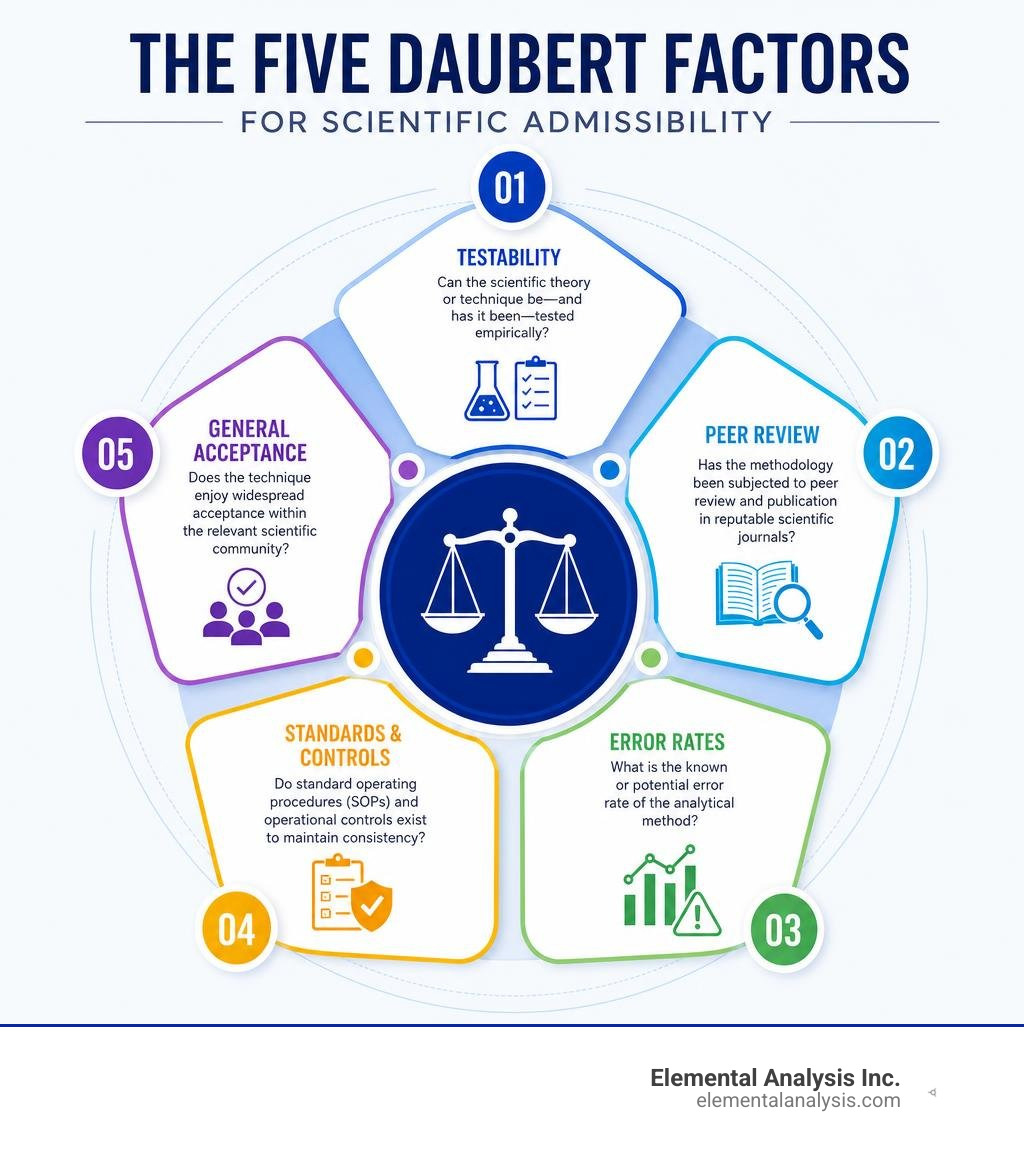
The framework for evaluating expert testimony stems from the landmark U.S. Supreme Court decision in Daubert v. Merrell Dow Pharmaceuticals, Inc. (1993). The Daubert standard established five non-exclusive factors that judges must consider when determining whether scientific evidence is admissible:
- Testability: Can the scientific theory or technique be—and has it been—tested empirical style?
- Peer Review: Has the methodology been subjected to peer review and publication in reputable scientific journals?
- Error Rates: What is the known or potential error rate of the analytical method?
- Standards & Controls: Do standard operating procedures (SOPs) and operational controls exist to maintain consistency?
- General Acceptance: Does the technique enjoy widespread acceptance within the relevant scientific community?
To remove lingering ambiguities regarding who bears the burden of proof, major amendments to FRE 702 took effect on December 1, 2023. The revised rule explicitly dictates that the proponent of the expert witness analytical testimony must demonstrate to the court, by a preponderance of the evidence, that all admissibility requirements are met before the testimony can be presented to a jury. It clarifies that questions of methodology and application are preliminary threshold matters for the judge to decide—not merely weight-of-evidence questions left for the jury to figure out later.
Testifying vs. Non-Testifying Experts Under FRCP 26(a)
Litigation teams routinely engage two distinct categories of expert witnesses, each serving a unique strategic purpose under Federal Rule of Civil Procedure (FRCP) 26(a):
- Testifying Experts: These specialists prepare formal written reports summarizing their opinions, the underlying facts and data relied upon, their qualifications, and their compensation structure. Their disclosures are fully discoverable by opposing counsel, and they are subject to depositions and live cross-examination.
- Non-Testifying (Consulting) Experts: These advisors work behind the scenes to help legal teams evaluate technical merits, craft case strategies, and audit opposing expert reports. Under FRCP 26(b)(4)(D), the work product and communications of consulting experts are protected from disclosure, except in exceptional circumstances.
Distinguishing these roles early in legal preparation ensures that sensitive internal strategy remains protected while admissible testing data is properly formatted for trial disclosure.
Translating Complex Scientific Findings into Jury-Friendly Stories
Having admissible science is only half the battle. If a jury cannot follow the narrative, the underlying data loses its impact. The most effective experts act as educators, using narrative arcs and clear visual analogies to explain technical findings without oversimplifying the rigorous science behind them.
When explaining testing procedures, framing the narrative around clear reference guidelines—such as those found in A Beginner Guide to Industry Standard Methods—gives jurors a familiar benchmark. Rather than lecturing on theoretical chemistry, the witness explains why the test was conducted, how standard protocols were followed, and what the final results mean for the dispute at hand.
Breaking Down Complex Data for Expert Witness Analytical Testimony
Analytical testing frequently involves subtle quantitative concepts that confuse non-specialists. Concepts like signal-to-noise ratios, instrument baselines, and statistical confidence levels must be explained in everyday terms.
For instance, in forensic biology, low-level DNA mixture analysis heavily relies on probabilistic genotyping software (such as STRmix or TrueAllele) to calculate Likelihood Ratios (LRs). An LR expresses how much more probable the physical evidence is under one hypothesis (e.g., the suspect contributed to the mixture) versus an alternative hypothesis (e.g., an unknown individual contributed).
Similarly, in chemistry, explaining analytical detection limits requires contextualizing how instruments differentiate true chemical signals from ambient background noise. Reviewing an In-Depth Guide to Low Detection Limits helps illuminate how sophisticated instruments isolate trace parts-per-billion (ppb) concentrations from system noise.
Interpreting Inclusions, Exclusions, and Inconclusive Results
Laboratory reports classify analytical findings into three main categories:
- Inclusion: The sample matches the known standard within validated scientific tolerances, indicating a common origin or presence of the analyte.
- Exclusion: The analytical profile differs significantly from the reference standard, definitively ruling out a common origin or source.
- Inconclusive: The data collected fails to reach the required statistical threshold to confirm either an inclusion or an exclusion.
Understanding the “inconclusive” designation is critical. Inconclusive does not mean a test failed; it means the sample signal fell within a grey zone where the risk of false positives or false negatives is unacceptably high.
In high-profile criminal litigation—such as the pre-trial proceedings in Idaho v. Bryan C. Kohberger—the interpretation of low-level DNA data highlighting analytical peak height thresholds expressed in Relative Fluorescence Units (RFU) became a central point of debate. As detailed in the State’s Notice on Inconclusive DNA Data, laboratory protocols set lower RFU thresholds (e.g., 75 RFU) to prevent instrumental noise from being misidentified as true genetic alleles. When a signal falls within an empirical inconclusive range (such as a likelihood ratio between 0.01 and 100), standard protocols prevent analysts from making definitive legal assertions.
International Models for Expert Testimony Adjudication
The United States isn’t the only country grappling with how to integrate scientific evidence into courtrooms. Comparing international approaches demonstrates how different legal systems handle expert testimony verification and judicial gatekeeping.
| Jurisdiction | Primary Adjudication Model | Key Vetting Mechanism | Key Feature / Advantage |
|---|---|---|---|
| United States | Adversarial / Judicial Gatekeeper | Daubert Standard & FRE 702 | Judge pre-screens evidence before jury presentation |
| Australia | Concurrent Evidence (“Hot Tubbing”) | Judicial-led Joint Dialogue | Opposing experts testify simultaneously in direct conversation |
| United Kingdom | Adversarial Scrutiny | Criminal/Civil Procedure Rules | Strong focus on duty to court over retaining party |
| Canada | Balanced Adversarial | Mohan Criteria | Strict pre-testimony duty of independence attestation |
| Japan | Inquisitorial / Advisory | Technical Advisory Experts | Court-appointed expert advisors assist bench trial judges |
Optimizing Expert Witness Analytical Testimony Across International Jurisdictions
Australia’s innovative concurrent evidence framework—commonly called “hot tubbing”—brings opposing expert witnesses into the witness box together. Instead of sequential cross-examinations, the experts engage in a live, peer-to-peer discussion directed by the judge. This dynamic dialogue allows technical specialists to question each other’s assumptions, rapidly narrowing the actual points of scientific disagreement.
In contrast, the United Kingdom and Canada maintain traditional adversarial structures but enforce strict preliminary codes of conduct. Under Canada’s landmark R. v. Mohan standard, experts must formally affirm under oath that their primary legal duty is to assist the court impartially, completely superseding any loyalty to the party paying their fees.
Ethical Responsibilities to the Court vs. Hiring Clients
An expert witness occupies a delicate legal position: retained and compensated by one party, yet bound by law to remain completely objective.
Courts worldwide increasingly penalize “hired guns” who alter their scientific conclusions to suit their client’s narrative. In jurisdictions like South Africa, expert testimony is evaluated through a lens of narrative integrity, where any perception of advocacy destroys the witness’s credibility. An expert’s true value lies in providing uncompromised, objective analysis that stands up to rigorous scientific scrutiny.
How Litigators Audit and Challenge Opposing Expert Witnesses
Litigation attorneys rarely accept opposing expert witness analytical testimony at face value. Preparing an effective cross-examination requires auditing the expert’s background, analytical methods, and laboratory compliance history.

Investigating Expert Credentials and Historical Testimony
Modern litigators rely on specialized legal analytics databases like LexisNexis to conduct exhaustive background checks on proposed experts. These platforms maintain profiles on over 475,000 expert witnesses and index more than 1.4 million court verdicts and settlements.
Through these databases, attorneys evaluate:
- Historical challenge records under Daubert or state equivalents
- Prior deposition and trial transcripts for contradictory statements
- Professional curriculum vitae details, academic tenure, and publication history
- Potential commercial conflicts of interest or institutional biases
A single prior ruling where an expert’s methodology was excluded under FRE 702—such as the court decisions analyzed in this Chemistry Expert Case Summary—can provide litigators with the precise roadmap needed to file a successful motion in limine.
Identifying Flaws in Analytical Thresholds and SOPs
Challenging scientific evidence often comes down to scrutinizing standard operating procedures (SOPs) and quality assurance protocols. By reviewing standard laboratory frameworks outlined in Elemental Testing Lab 101, litigators can identify subtle procedural failures that invalidate analytical results.
Key areas for technical audit include:
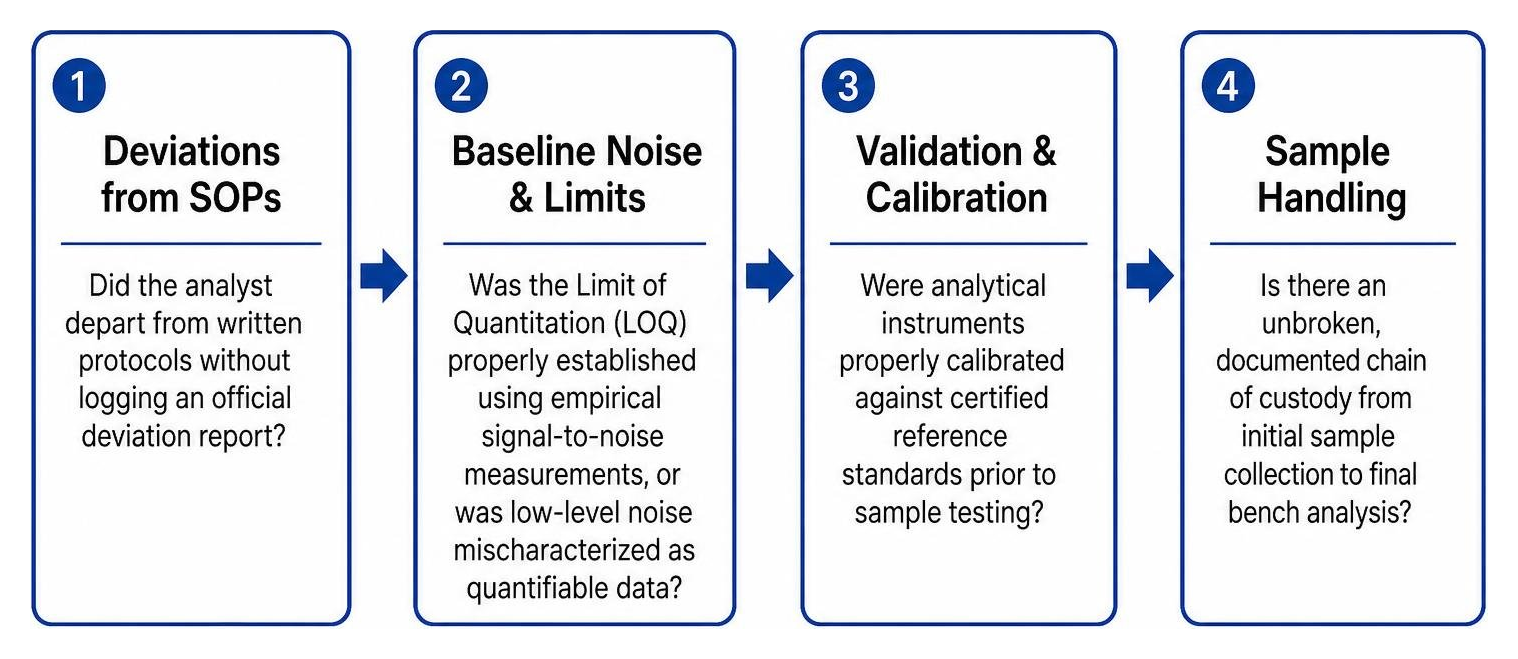
- Deviations from SOPs: Did the analyst depart from written protocols without logging an official deviation report?
- Baseline Noise & Limits: Was the Limit of Quantitation (LOQ) properly established using empirical signal-to-noise measurements, or was low-level noise mischaracterized as quantifiable data?
- Validation & Calibration: Were analytical instruments properly calibrated against certified reference standards prior to sample testing?
- Sample Handling: Is there an unbroken, documented chain of custody from initial sample collection to final bench analysis?
Frequently Asked Questions About Expert Testimony
How did the December 1, 2023 amendment to FRE 702 shift the burden of proof?
The December 1, 2023 amendment to Federal Rule of Evidence 702 explicitly placed the burden of proving admissibility squarely on the proponent of the expert testimony. Litigators presenting an expert must demonstrate to the judge—by a preponderance of the evidence—that the expert is qualified, the methodology is reliable, and the principles were correctly applied to the facts of the case before the jury ever hears the testimony.
What is Australia’s ‘hot tubbing’ technique for expert witnesses?
‘Hot tubbing’ (officially known as concurrent expert evidence) is a judicial technique used primarily in Australia. Opposing expert witnesses are sworn in together and participate in a joint panel discussion moderated by the judge. This allows experts to address technical questions simultaneously, debate methodologies in real-time, and clarify points of agreement and disagreement efficiently.
What is the difference between a testifying and a non-testifying expert witness?
A testifying expert is designated to present formal evidence and opinion in court; their reports, background, and work product are fully discoverable under FRCP Rule 26(a). A non-testifying (consulting) expert works strictly in an advisory capacity to help legal counsel prepare strategy, and their work product is generally protected from discovery under attorney work-product privilege.
Mastering Scientific Clarity in the Courtroom

Delivering impactful expert witness analytical testimony is an art balanced on scientific precision. Whether you are dealing with trace elemental profiles, complex pharmaceutical impurities, or forensic DNA interpretations, the objective remains the same: present the truth clearly, objectively, and accessibly.
By anchoring scientific analyses in rigorous laboratory SOPs, respecting the gatekeeping authority of the court under Rule 702, and crafting compelling narratives that resonate with non-technical jurors, experts bridge the gap between complex science and fair legal outcomes.
When your litigation requires uncompromised trace element identification, non-destructive sample testing, or expert analytical chemistry support, trust our team at Elemental Analysis Inc. Explore our specialized ICP Analytical Services to see how our laboratory precision supports legally defensible results.