
The Dirt on Sulfur: Comparing Sulfate and Elemental Sulfur
Why Elemental Sulfur Analysis Matters for Soil and Crop Health
Elemental sulfur analysis is the process of identifying and quantifying sulfur species — primarily elemental sulfur (S⁰) and sulfate (SO₄²⁻) — in soil, water, fertilizer, and plant tissue samples.
Here’s a quick breakdown of what you need to know:
| Question | Quick Answer |
|---|---|
| What are the two main sulfur forms? | Elemental sulfur (S⁰) and sulfate sulfur (SO₄²⁻) |
| Which form do plants use? | Sulfate only — plants cannot absorb elemental sulfur directly |
| How does S⁰ become plant-available? | Soil bacteria oxidize it to sulfate, which can take months to years |
| What methods measure elemental sulfur? | Chloroform extraction + HPLC, combustion analysis, gravimetric (CS₂ Soxhlet), XRF, EA-CF-IRMS |
| Why does this matter right now? | Median soil sulfur levels have dropped 50% over the last 15 years due to reduced atmospheric deposition |
Sulfur used to take care of itself. Atmospheric deposition from industrial emissions quietly topped up fields across North America and Europe. Farmers rarely had to think about it.
That era is over.
As emissions have cleaned up — a genuine environmental win — crops are now left short. Sulfur deficiencies are showing up in fields that were never a problem before, and the stakes are real. Arkansas wheat trials recorded yield increases of 15 to 44 bushels per acre from just 5 lbs per acre of sulfate sulfur applied at the right time.
But not all sulfur products behave the same way. Choosing the wrong form — or applying it at the wrong time — can mean your crop runs out before the growing season ends.
This guide breaks down the chemistry, the agronomy, and the lab science behind sulfur so you can make smarter decisions about testing, product selection, and application timing.
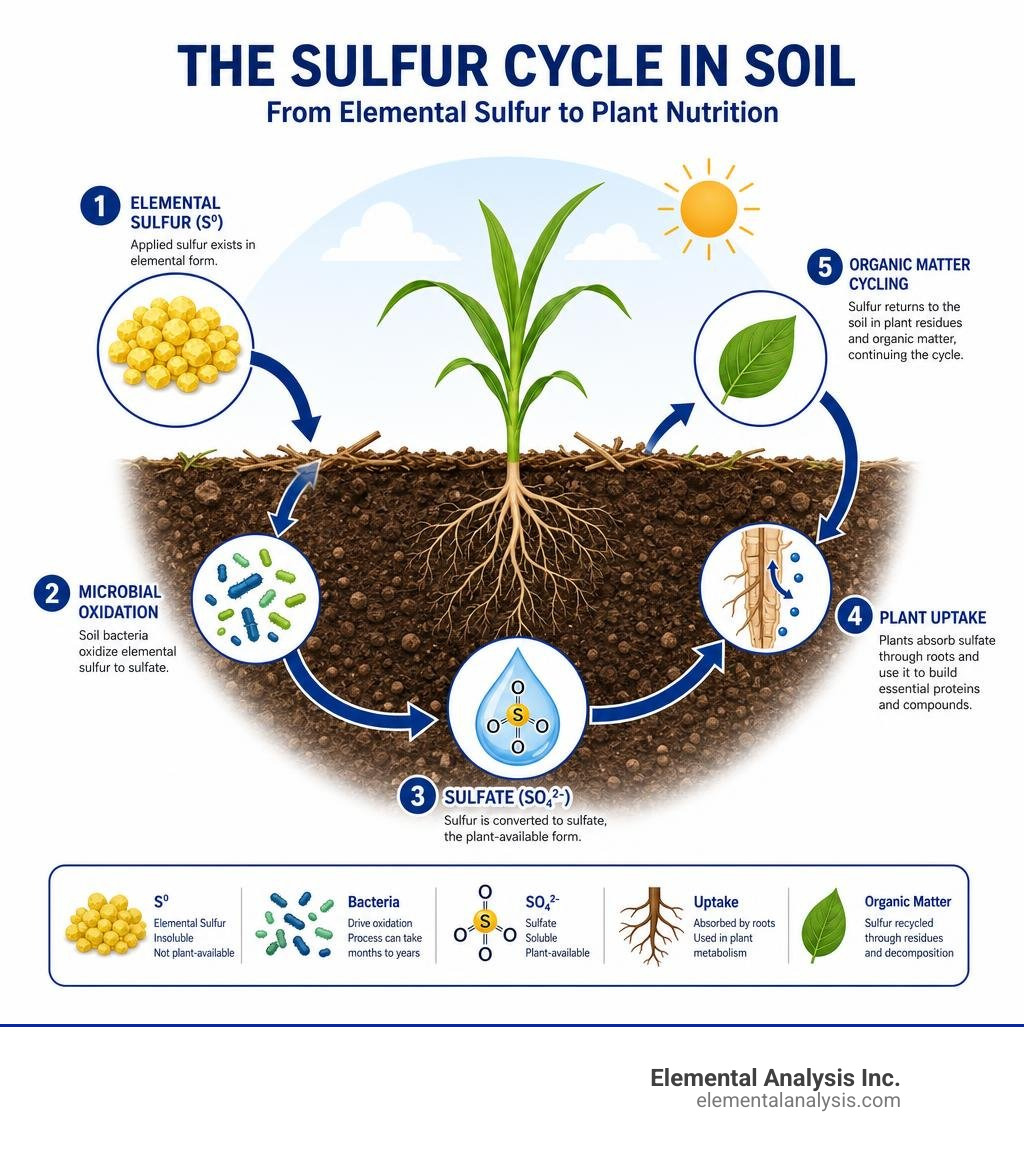
Elemental sulfur analysis terms to remember:
Sulfate vs. Elemental Sulfur: Chemical Behavior and Plant Availability
To choose the right fertilizer and timing, we must first understand the stark chemical differences between sulfate sulfur ($SO_4^{2-}$) and elemental sulfur ($S^0$). These two species behave like complete opposites in the soil environment.
Sulfate Sulfur ($SO_4^{2-}$)
Sulfate is the oxidized, plant-available form of sulfur. Because it carries a double-negative charge, it does not bind easily to negatively charged soil particles (like clay and organic matter).
- Plant Availability: Immediate. Roots can absorb sulfate dissolved in soil water right away.
- Soil Mobility: Highly mobile. Like nitrate-nitrogen, sulfate moves freely with soil moisture. In areas with high rainfall, it is prone to leaching deep into the soil profile, away from the root zone.
- Soil pH Impact: Sulfate fertilizers (such as gypsum or calcium sulfate) are generally neutral and do not acidify the soil.
Elemental Sulfur ($S^0$)
Elemental sulfur is a pure, hydrophobic solid. It is completely insoluble in water and cannot be directly utilized by crops.
- Plant Availability: Delayed. It must undergo microbial oxidation to convert into plant-available sulfate.
- Soil Mobility: Immobile. Because it does not dissolve in water, $S^0$ remains exactly where it is applied until it is converted, making it completely safe from leaching.
- Soil pH Impact: Highly acidifying. The biological oxidation process releases hydrogen ions ($H^+$) into the soil, which naturally lowers soil pH. This makes it a popular amendment for alkaline soils.

| Property | Sulfate Sulfur ($SO_4^{2-}$) | Elemental Sulfur ($S^0$) |
|---|---|---|
| Chemical Formula | $SO_4^{2-}$ | $S^0$ (often $S_8$ rings) |
| Water Solubility | High | Insoluble (hydrophobic) |
| Plant Uptake | Immediate | Requires microbial oxidation first |
| Leaching Risk | High (moves with water) | None (immobile in soil) |
| Effect on Soil pH | Neutral (no acidification) | Highly acidifying (releases $H^+$) |
| Typical Products | Ammonium Sulfate, Gypsum, Potassium Sulfate | Bentonite-Sulfur pastilles, pure sulfur dust |
For a deeper dive into how these forms behave in the field, check out Sulfate Sulfur vs. Elemental Sulfur Part I: There’s a Difference and Comparing SO4 and Elemental Sulfur – Calcium Products .
Agronomic Best Practices: Building a Soil Sulfate Bank
Because more than half of the total sulfur uptake in crops like corn and soybeans occurs after they transition from vegetative to reproductive stages, a season-long supply of sulfate is critical.
While quick-release sulfate sources like ammonium sulfate (AMS) work beautifully for early-season demands, relying solely on them can lead to late-season deficiencies due to leaching. This is where degradable elemental sulfur products (such as bentonite-sulfur pastilles) come into play.
Factors Controlling the Oxidation Rate
The conversion of $S^0$ to $S O_4^{2-}$ is entirely biological, driven by soil microbes like Thiobacillus. To optimize this conversion, several environmental factors must align:
- Moisture: Bentonite-sulfur pastilles rely on clay to absorb moisture and swell. This physical swelling breaks the compacted pastille down into tiny particles (ranging from 1 to 180 microns). Smaller particles maximize the surface area exposed to soil microbes, accelerating oxidation.
- Temperature: Soil microbes are highly temperature-dependent. Biological oxidation is virtually non-existent in cold soils and peaks when soil temperatures reach 75°F to 105°F (24°C to 40°C) during mid-to-late summer.
- Microbial Population: The more elemental sulfur applied over time, the larger the local population of sulfur-oxidizing bacteria grows.
The Five-Year “Sulfate Bank” Strategy
If you apply elemental sulfur for the first time in the spring, it is highly unlikely to supply enough sulfate for that season’s crop because the microbial populations are low and the oxidation process takes time.
However, we can design a highly effective long-term program to build a self-sustaining sulfate bank in the soil.

By applying degradable elemental sulfur annually (often post-harvest in the fall), you gradually build up the microbial population and create a staggered release cycle. Research shows that after five consecutive years of annual elemental sulfur application, the yearly sulfate-sulfur supply becomes almost equal to the added sulfur rate.
At this point, the soil has a steady, self-sustaining release of plant-available sulfate throughout the growing season, potentially reducing or completely eliminating the need for immediate, high-cost starter sulfate sources like AMS.
To monitor this transition, we recommend combining annual soil testing (measuring both sulfate and total sulfur) with in-season tissue analysis to ensure your crops are receiving a steady supply of nutrients.
Analytical Methods for Elemental Sulfur Analysis in Soil and Water
To manage sulfur fertility or monitor industrial bioreactors, we need highly accurate laboratory methods. Measuring total sulfur is one thing, but isolating and quantifying the specific elemental sulfur fraction in complex matrices (aqueous, soil, and solid) requires specialized techniques.
Several standard methods exist for elemental sulfur extraction and quantification:
- Soxhlet Extraction and Gravimetry: Standardized methods like SIST EN 16032:2012 – Fertilizers Elemental Sulfur Extraction and outline the extraction of elemental sulfur using carbon disulfide ($CS_2$) followed by gravimetric determination and sublimation to verify purity.
- Combustion Analysis: High-temperature combustion systems (such as LECO analyzers) operate at temperatures like 1350°C to convert all solid sulfur forms into $SO_2$ gas, which is then quantified using infrared detectors. While excellent for total sulfur, combustion must be paired with selective extraction to isolate the elemental fraction.
- X-ray Fluorescence (XRF): Wavelength Dispersive X-ray Fluorescence (WDXRF) spectrometers provide rapid, non-destructive total sulfur measurements (often used for petroleum products under D2622 Standard Test Method for Sulfur in Petroleum Products by Wavelength Dispersive X-ray Fluorescence Spectrometry ).
Sample Preparation and Extraction for Elemental Sulfur Analysis
The accuracy of any elemental sulfur analysis depends heavily on the sample preparation step. When analyzing soil or aqueous samples, other sulfur species — such as dissolved sulfides ($S^{2-}$) or sulfates ($SO_4^{2-}$) — can cause significant analytical interferences if they are co-extracted or chemically converted during preparation.
Selecting the right solvent is critical:
- Ethanol: Often used in basic extractions, but it produces highly erroneous results when dissolved sulfides are present in the matrix.
- Petroleum Ether: Performs poorly and yields low recoveries when extracting elemental sulfur from pure aqueous or deionized water matrices.
- Chloroform: The gold standard. Chloroform extraction achieves an extraction efficiency greater than 90% across all tested matrices (including complex aqueous bioreactor suspensions and wet soils). Furthermore, chloroform extraction is highly linear for aqueous elemental sulfur concentrations up to 200 mg/L, making it the ideal preparation method prior to High-Performance Liquid Chromatography (HPLC) quantification.
Quality Control and Reference Standards in Elemental Sulfur Analysis
Ensuring reproducible results in research and commercial testing requires strict Quality Assurance and Quality Control (QA/QC) protocols. This is especially true when performing stable isotope measurements, such as determining the stable sulfur isotope ratio ($\delta^{34}S$) of total sulfur in solids.
For high-precision isotopic work, laboratories utilize Elemental Analyzer-Continuous Flow-Isotope Ratio Mass Spectrometry (EA-CF-IRMS). This process involves dynamic flash combustion at ~1800°C to convert solid sulfur into $SO_2$ gas without isotopic fractionation.
Key QC requirements for this standard operating procedure include:
- Minimum Sample Size: Routine high-precision analysis requires a minimum of 40 micrograms ($\mu g$) of sulfur in a maximum of 40 milligrams ($mg$) of solid sample. The system can analyze samples as small as 19 $\mu g$ of sulfur, though with slightly reduced precision.
- Isotopic Calibration: Daily correction factors are calculated using a multi-point calibration with international reference materials (such as IAEA-S-1, IAEA-SO-5, IAEA-SO-6, and NBS 127) relative to the Vienna Cañon Diablo Troilite (VCDT) scale.
- Oxygen Buffering: To prevent oxygen isotope variations ($\delta^{18}O$) from interfering with the $m/z$ 66/64 ratio of $SO2$ gas, vanadium pentoxide ($V2O_5$) is added to the sample capsules to buffer the oxygen composition.
- Uncertainty: The estimated expanded uncertainty of $\delta^{34}S$ measurement results is typically $\pm0.4$ ‰ (with routine run-to-run precision often achieving $\pm0.2$ ‰).
For detailed laboratory protocols on isotopic sulfur work, refer to Determination of the δ and USGS Techniques and Methods 10–C4: Determination of the δ34S of Total Sulfur in Solids; RSIL Lab Code 1800 .
Frequently Asked Questions about Sulfur Fertilizers
How long does it take for elemental sulfur to become plant-available?
Because it relies entirely on microbial oxidation, the timeline varies from a few weeks to several months or even years. In warm (75°F–105°F), moist, well-aerated soils with high microbial activity, oxidation occurs rapidly. In cold or saturated soils, the process stops entirely.
Can elemental sulfur completely replace ammonium sulfate (AMS)?
Yes, but not immediately. If you are starting a new field program, you should combine elemental sulfur with a soluble sulfate source (like AMS) to meet immediate early-season crop needs. Over a five-year period of annual applications, you will build up a “sulfate bank” and a robust microbial population, allowing elemental sulfur to eventually serve as your primary sulfur source.
Why are soil test sulfur levels declining?
The primary driver is the dramatic reduction in atmospheric sulfur deposition over the last few decades due to environmental regulations and cleaner industrial emissions. Because crops are no longer receiving “free” sulfur from rainfall, soil reserves are being depleted, leading to widespread deficiencies.
Conclusion
Managing crop nutrition and soil health in modern agriculture requires a clear understanding of sulfur speciation. Soluble sulfate provides the immediate fuel your crops need to thrive early in the season, while elemental sulfur offers a stable, non-leaching, long-term nutrient source when managed as part of a multi-year program.
However, building a successful fertility strategy is impossible without precise data. Accurate laboratory testing — distinguishing elemental sulfur from sulfates and sulfides through robust extraction and quantification methods — is the only way to know exactly what is happening in your soil.
At Elemental Analysis Inc., based in Lexington, Kentucky, we specialize in high-precision trace element identification, quantification, and speciation. As the first commercial PIXE (Particle Induced X-ray Emission) laboratory, we offer both destructive and non-destructive testing services with fast turnaround times and competitive pricing to help agricultural, environmental, and industrial clients get the precise data they need.

Ready to take the guesswork out of your sulfur management?
Learn more about our elemental analysis services and discover how our state-of-the-art laboratory testing can optimize your soil health and crop yields.