
From H2O to Heavy Metals: A Guide to ICP MS Water Analysis
Why ICP-MS Water Analysis Is the Gold Standard for Trace Element Testing
ICP-MS water analysis is the most sensitive multi-element technique available for detecting heavy metals and trace elements in water — from drinking water compliance testing to environmental monitoring and pharmaceutical-grade purity checks.
Quick answer: What is ICP-MS water analysis?
- What it does: Detects and quantifies 30–70+ elements simultaneously in a single water sample
- How sensitive: Detection limits range from 0.005 µg/L (mercury) down to parts-per-trillion (ppt) for many elements
- Sample volume needed: As little as 1–4 mL per sample
- Key regulated method: U.S. EPA Method 200.8, ISO 17294-2, ASTM D5673
- Common water types analyzed: Drinking water, groundwater, surface water, wastewater, ultrapure water
- Why it matters: It is the only EPA-approved multi-element technique for arsenic compliance monitoring at the 10 µg/L maximum contaminant level
Water is everywhere in your process — as a raw material, a reagent diluent, a discharge stream, and a finished product check. And trace metals hide in all of it.
Lead as low as 100 µg/L can cause neurological harm in children. Arsenic at just 10 µg/L triggers regulatory action. Mercury, cadmium, and uranium each have limits measured in fractions of a microgram per liter. Traditional methods like flame atomic absorption (FAAS) or even ICP-OES simply cannot reach those levels reliably across a broad element panel in a single run.
That is exactly why ICP-MS has become the technique of choice for labs that need speed, sensitivity, and breadth — all at once.
This guide walks through how ICP-MS works for water, how to handle different sample matrices, which regulatory methods apply, and how to get the most out of your results.
Icp ms water analysis basics:
The Core Principles of ICP MS Water Analysis
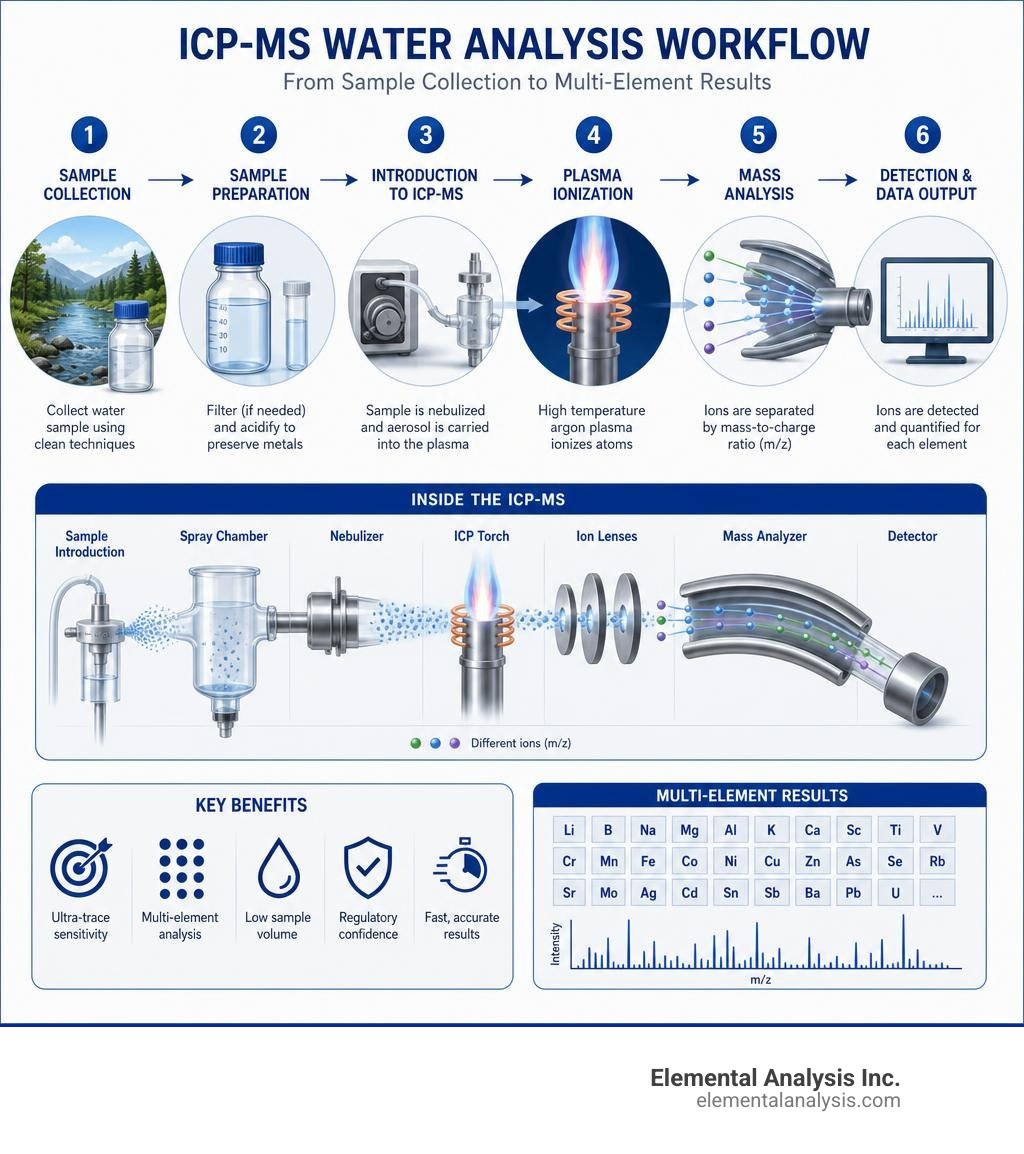
To understand why icp ms water analysis is so uniquely powerful, it helps to look inside the instrument. The process is a combination of two distinct technologies: an Inductively Coupled Plasma (ICP) source, which acts as an ultra-high-temperature ionizer, and a Mass Spectrometer (MS), which acts as a highly selective scale to weigh and count individual elements.
The analysis follows a precise sequence:
- Sample Introduction & Nebulization: The liquid water sample is drawn into the instrument, where a nebulizer mixes it with argon gas to convert the liquid into a fine aerosol mist.
- Plasma Ionization: This mist is swept into an argon plasma torch. Sustained by radiofrequency (RF) energy, this plasma burns at temperatures between 6,000 K and 10,000 K—hotter than the surface of the sun. At these extreme temperatures, the water molecule is instantly vaporized, and the dissolved elements are atomized and stripped of an electron to become positively charged, single-charged ions.
- The Interface Region: The ions are drawn from the atmospheric-pressure plasma into the high-vacuum mass spectrometer through a pair of metal cones (the sampler and skimmer cones).
- Ion Optics & Mass Separation: Once inside the vacuum, the ion beam is focused by electrostatic lenses (ion optics) and directed into the mass analyzer—most commonly a quadrupole mass filter. The quadrupole uses rapidly changing AC and DC voltages to allow only ions of a specific mass-to-charge ratio ($m/z$) to pass through to the detector at any given millisecond.
- Detection: The detector counts the individual ions hitting it, converting the physical impact of an ion into an electrical pulse. By comparing the intensity of these pulses against a known calibration curve, we can calculate the exact concentration of the elements in the original water sample.
How Traditional Sequential Systems Compare to Simultaneous MH-ICP-MS
Most standard commercial ICP-MS systems are sequential. They utilize a fast-scanning quadrupole mass filter that rapidly switches from one element’s mass to the next. While this happens in milliseconds, it still means the instrument only looks at one isotope at a time. This is called a scanning duty cycle.
In contrast, simultaneous Mattauch-Herzog ICP-MS (MH-ICP-MS) represents a major paradigm shift in inorganic analysis. Utilizing a unique optical geometry with a permanent magnet, MH-ICP-MS physically disperses all ions across a focal plane based on their mass-to-charge ratio, much like a prism splits white light into a rainbow. A specialized, high-resolution semiconductor detector (often containing thousands of individual pixels) sits at this focal plane, reading the entire inorganic mass range at once.
This simultaneous detection allows for the rapid Quantification of 71 detected elements from Li to U for aqueous samples by simultaneous-inductively coupled plasma-mass spectrometry – RSC Advances (RSC Publishing) DOI:10.1039/C8RA07070A. Because the instrument records the entire spectrum at once, it requires incredibly small sample volumes (as little as 1 to 4 mL) and completes a full-spectrum characterization in seconds. This eliminates the risk of missing unexpected contaminants and makes it an invaluable tool for comprehensive water fingerprinting.
Overcoming Spectral Interferences in ICP MS Water Analysis
No analytical technique is completely free of challenges. In icp ms water analysis, the primary hurdle comes in the form of spectral interferences. These occur when an unwanted ion has the same nominal mass-to-charge ratio as the analyte we are trying to measure. These interferences fall into two main categories:
- Isobaric Interferences: Caused by isotopes of different elements that share the same mass (such as iron-58 and nickel-58). These are easily resolved by choosing an alternative isotope for measurement (e.g., measuring nickel at mass 60 or iron at mass 56) or applying mathematical correction equations.
- Polyatomic Interferences: These are molecular ions formed in the plasma or the interface region from a combination of plasma gases (argon, oxygen, hydrogen) and matrix elements (such as chlorine, carbon, sodium, and sulfur).
A classic example of a polyatomic interference is the formation of argon chloride ($^{40}\text{Ar}^{35}\text{Cl}^{+}$) at mass 75. Because arsenic only has one stable isotope ($^{75}\text{As}$), the presence of chloride in a water sample (common in brackish waters, coastal groundwater, or chlorinated drinking water) can artificially inflate the arsenic reading, leading to false regulatory failures.
To combat this, modern instruments use Collision/Reaction Cell (CRC) technology. The cell is positioned before the main mass analyzer and is filled with a gas:
- Helium Collision Mode: Helium is an inert gas. It is introduced into the cell where it collides with ions. Because polyatomic ions ($^{40}\text{Ar}^{35}\text{Cl}^{+}$) are physically larger than atomic ions ($^{75}\text{As}^{+}$), they collide with the helium atoms much more frequently. With each collision, they lose kinetic energy. A simple electrostatic barrier at the exit of the cell (known as Kinetic Energy Discrimination, or KED) prevents these lower-energy polyatomic ions from passing, while the higher-energy atomic analyte ions sail through to the detector.
- Reaction Mode: Reactive gases like hydrogen ($H2$), oxygen ($O2$), or ammonia ($NH_3$) are introduced to react chemically with either the analyte or the interferent. For example, oxygen can react with arsenic to form $^{91}\text{AsO}^{+}$, shifting the measurement to a clean mass window free of the original chlorine-based interferences.
Key Advantages of ICP-MS Over Other Spectrometric Techniques
When building or updating a municipal, industrial, or research testing workflow, choosing the right spectrometer is critical. The primary competitors in inorganic water testing are Flame Atomic Absorption Spectroscopy (FAAS), Graphite Furnace Atomic Absorption Spectroscopy (GFAAS), Inductively Coupled Plasma Optical Emission Spectroscopy (ICP-OES), and Inductively Coupled Plasma Mass Spectrometry (ICP-MS).
| Feature / Metric | FAAS | GFAAS | ICP-OES | ICP-MS |
|---|---|---|---|---|
| Typical Detection Limits | ppm to high ppb (1–100 µg/L) | ppb to sub-ppb (0.1–1 µg/L) | ppb (0.5–10 µg/L) | ppt to sub-ppt (0.001–0.1 µg/L) |
| Dynamic Range | 10^3 | 10^2 | 10^6 | 10^9 to 10^{10} |
| Sample Throughput | Slow (1 element at a time) | Very Slow (minutes per element) | Fast (minutes per sample, multi-element) | Extremely Fast (seconds per sample, multi-element) |
| Sample Volume Required | High (>5 mL per element) | Low (20–50 µL) | High (5–10 mL) | Very Low (1–4 mL) |
| Interference Management | Chemical / Spectral | Matrix modifiers | Spectral overlaps | Collision/Reaction Cell (CRC) |
As shown in our guide on Induced Coupled Plasma: Finding the Perfect Match for Your Lab, ICP-MS stands out as the ultimate multi-element tool. It combines the rapid throughput of ICP-OES with detection limits that are far superior to GFAAS, all while offering an enormous dynamic range that allows us to measure parts-per-trillion trace toxins and parts-per-million minerals (like calcium and sodium) in the very same analytical run.
Choosing Between ICP-MS and ICP-OES for Environmental Samples
A common question we face in our Lexington, KY facility is whether a laboratory should invest in ICP-MS or ICP-OES. The answer usually boils down to two factors: matrix tolerance and regulatory limits of interest.
ICP-OES is highly robust. It can easily tolerate samples with high Total Dissolved Solids (TDS)—up to 30% dissolved salts—without clogging the interface or drifting in sensitivity. This makes ICP-OES excellent for heavily polluted industrial wastewater, soil digests, and agricultural runoff. However, ICP-OES lacks the sensitivity required for modern drinking water regulations.
As discussed in the landmark paper on ICP Source Spectrometry Techniques in Regulated Water Analysis, ICP-OES detection limits are borderline or insufficient for critical elements like silver, arsenic, beryllium, antimony, and mercury under current EPA drinking water standards. ICP-MS, on the other hand, provides a massive “sensitivity overhead,” allowing analysts to comfortably measure trace elements at fractions of the regulatory limit, ensuring long-term compliance even if future regulatory thresholds are lowered.
Sample Preparation and Matrix Effects Across Water Types
The old analytical adage “garbage in, garbage out” is incredibly true for mass spectrometry. While ICP-MS is remarkably powerful, proper sample preparation is the key to obtaining accurate, stable, and reproducible results.

Sample preparation for water analysis generally follows a structured protocol:
- Preservation: To keep dissolved metals from adsorbing onto the walls of the plastic sample container, samples should be acidified to a pH of less than 2 using high-purity nitric acid ($HNO_3$), typically at a concentration of 1% to 2% v/v.
- Filtration: If you are analyzing “dissolved metals,” the sample must be filtered through a high-purity 0.45 µm membrane filter prior to acidification. If you are analyzing “total recoverable metals,” the sample is acidified first and may undergo a mild acid digestion process to dissolve any suspended particulate matter.
- Internal Standardization: To correct for physical matrix effects (such as changes in sample viscosity or surface tension) and minor instrument drift, we add an internal standard mix online during analysis. Common internal standards include lithium-6, scandium, rhodium, indium, terbium, and bismuth, spanning the entire mass range.
For more details on handling heavy metal samples safely and effectively, see our comprehensive guide on Testing the Waters: A Complete Guide to the Analysis of Heavy Metals in Water.
Handling Ultrapure, Drinking, and Wastewater Matrices
Different water matrices require distinct analytical strategies:
- Ultrapure Water (UPW): Used heavily in the pharmaceutical and semiconductor industries, ultrapure water has virtually no dissolved minerals. The primary challenge here is preventing external contamination. The background equivalent concentration (BEC) of your reagent water must be kept at the single-digit parts-per-trillion level. Even the air in the lab or the plastic of a low-quality pipette tip can introduce more contamination than is present in the sample.
- Drinking Water: Generally clean, but contains moderate levels of hardness minerals (calcium, magnesium) and sodium. The primary focus is meeting strict regulatory detection limits while ensuring that high levels of minerals do not suppress the signal of trace toxins.
- Wastewater: High organic carbon, high salts, and suspended solids can cause severe matrix suppression and physical deposition on the sampler and skimmer cones. These samples require robust digestion (often using closed-vessel microwave heating with nitric and hydrochloric acids) and dilution (typically 2-fold to 10-fold) in high-purity acid before analysis.
Understanding these matrix-specific challenges is essential to ensuring the integrity of your inorganic data, as detailed in our guide Elemental My Dear Watson: A Guide to ICP Metal Analysis.
Regulatory Standards and Method Validation
For any laboratory performing environmental or public health testing, compliance with standardized regulatory frameworks is mandatory. Method validation is the formal process used to prove that an ICP-MS system is fit for its intended purpose.
A robust validation protocol must evaluate several core performance metrics:
- Method Detection Limits (MDLs): The minimum concentration of a substance that can be measured and reported with 99% confidence that the analyte concentration is greater than zero. This is determined by analyzing at least seven replicate spiked blanks.
- Accuracy: Verified by analyzing Certified Reference Materials (CRMs) and performing matrix spike recoveries. Most regulatory methods require spike recoveries to fall strictly within 90% to 110% of the target value.
- Precision: Evaluated by measuring replicate samples to ensure the Relative Standard Deviation (%RSD) remains below 3% to 5%.
- Long-Term Stability: Demonstrated by running Continuing Calibration Verification (CCV) standards every 10 samples throughout an analytical sequence. The instrument must maintain a normalized recovery of 80% to 120% over extended runs (often 5 to 10 hours of continuous operation).
- Calibration Linearity: Calibration curves must achieve a correlation coefficient ($r$) of 0.999 or higher across the entire analytical range.
Regulatory Compliance and Validation in ICP MS Water Analysis
When performing regulatory testing in the United States, laboratories must adhere to specific standardized methodologies:
- U.S. EPA Method 200.8: This is the primary method approved for the determination of trace elements in groundwaters, surface waters, drinking waters, and wastewaters by ICP-MS. It specifies strict quality control protocols, including the use of specific internal standards, interference correction equations, and daily performance checks.
- ASTM D5673: Standardized by the American Society for Testing and Materials, ASTM D5673-16R24E01 – Standard Test Method for Elements in Water by Inductively Coupled Plasma—Mass Spectrometry provides a highly standardized, consensus-driven protocol for multi-element water testing.
- ISO 17294-2: Globally, the International Organization for Standardization outlines the application of ICP-MS for water quality testing. The latest edition, ISO 17294-2:2023 – Water quality — Application of inductively coupled plasma mass spectrometry (ICP-MS) — Part 2: Determination of selected elements including uranium isotopes, provides a validated framework for determining over 60 elements, including uranium isotopes, in drinking, surface, ground, and waste waters.
For labs seeking detailed instrumentation setups and step-by-step validation protocols, industry leaders provide extensive application guides, such as the Drinking Water Analysis – PerkinElmer resource, the practical tips found in ICP-MS for Drinking Water Analysis: A Complete Guide – Lab Manager, and the application notes detailed in Drinking water analysis, EPA method 200.8 by 7850 ICP-MS | Agilent.
Water Fingerprinting: Distinguishing Sources and Contamination Patterns
Beyond simple regulatory “pass/fail” testing, the multi-element capabilities of ICP-MS open up a fascinating field: water fingerprinting.
Because groundwater and surface water interact continuously with local bedrock geology, they absorb a unique inorganic “signature.” The ratios of trace alkaline earth metals (like strontium and barium), transition metals, and rare earth elements reflect the specific geological formations the water has traveled through.
By analyzing these multi-element patterns, we can:
- Track Pollution Sources: If a river shows a sudden spike in heavy metals, fingerprinting can trace the ratio of contaminants back to a specific industrial discharge or agricultural runoff source.
- Distinguish Water Sources: Determine if a municipal well is pulling water from a shallow alluvial aquifer or a deep limestone aquifer.
- Support Environmental Health & Nutrition Studies: Map trace element deficiencies or toxicities in local water supplies to study their long-term impacts on agricultural productivity and human health.
To explore how this advanced inorganic profiling can be applied to your projects, read our technical deep-dive on Unlocking the Elements with ICP Laboratory Analysis.
Frequently Asked Questions about ICP-MS Water Testing
What elements can be detected by ICP-MS in water and what are their typical LOQs?
ICP-MS is capable of detecting over 70 elements from lithium to uranium in a single run. The typical Limits of Quantification (LOQ) for clean water matrices are incredibly low, often falling between 0.002 µg/L and 1.0 µg/L for most elements.
For highly toxic heavy metals of primary concern, typical LOQs are:
- Mercury (Hg): 0.005 µg/L (5 parts-per-trillion)
- Cadmium (Cd): 0.02 µg/L
- Lead (Pb): 0.05 µg/L
- Arsenic (As): 0.1 µg/L
- Uranium (U): 0.1 µg/L
In contrast, major minerals like calcium, potassium, magnesium, and sodium are typically quantified at higher LOQs (up to 50 µg/L) to prevent detector saturation.
Why was ICP-OES withdrawn for arsenic compliance monitoring in drinking water?
In 2006, the U.S. EPA officially reduced the Maximum Contaminant Level (MCL) for arsenic in drinking water from 50 ppb (µg/L) down to 10 ppb (µg/L) to protect public health against long-term carcinogenic risks.
Under the EPA’s strict guidelines, an analytical method must have a Method Detection Limit (MDL) that is significantly below the regulatory level of interest to ensure reliable quantification. Because standard ICP-OES (EPA Method 200.7) has an arsenic detection limit that is borderline or insufficient to confidently monitor at the 10 ppb level, its approval was withdrawn for regulated arsenic compliance testing. ICP-MS (EPA Method 200.8) became the primary multi-element method capable of meeting this stringent requirement.
How do syringe filters affect trace metal contamination during sample preparation?
When analyzing elements at parts-per-billion and parts-per-trillion levels, every single consumable that touches the sample is a potential source of contamination. Syringe filters, commonly used to remove suspended solids from water samples, are no exception.
Fortunately, extensive testing of high-quality syringe filters (such as those utilizing Polyethersulfone [PES], Cellulose Acetate [CA], or Regenerated Cellulose [RC] membranes) shows that they introduce negligible trace metal contamination. For example, blank extractions typically show heavy metal leachables (like lead, copper, and cadmium) well below the 0.1 µg/L detection limit, which is orders of magnitude below WHO and EPA regulatory limits. However, it is always best practice to flush the filter with 1–2 mL of the sample to waste before collecting the filtrate for analysis.
Conclusion
From protecting municipal drinking water supplies to ensuring the purity of pharmaceutical ingredients, icp ms water analysis is the ultimate tool for trace element detection. Its unmatched sensitivity, speed, and massive multi-element capabilities make it an indispensable asset in modern analytical chemistry.
At Elemental Analysis Inc., based in Lexington, Kentucky, we combine decades of analytical expertise with state-of-the-art testing capabilities. As a pioneer in both destructive and non-destructive testing, we provide fast turnaround times, competitive pricing, and highly accurate results tailored to your regulatory and research needs.
Whether you need routine compliance testing, matrix-specific validation, or advanced water fingerprinting, our team is here to help you unlock the secrets of your samples.
Learn more about our ICP analysis services or contact us today to request a custom quote.