
What is Laser Ablation ICP-MS and How Does It Work
What Laser Ablation Mass Spectrometry Actually Is (And Why It Matters for Your Lab)
Laser ablation mass spectrometry is a technique that fires a focused laser beam directly onto a solid sample, converts a tiny amount of it into an aerosol, and feeds that aerosol into a mass spectrometer for rapid, highly sensitive elemental and isotopic analysis — no acid digestion required.
Here’s the quick version for anyone who needs it now:
- What it does: Measures trace elements and isotopes directly in solid materials, down to parts-per-billion (ppb) or parts-per-trillion (ppt) levels
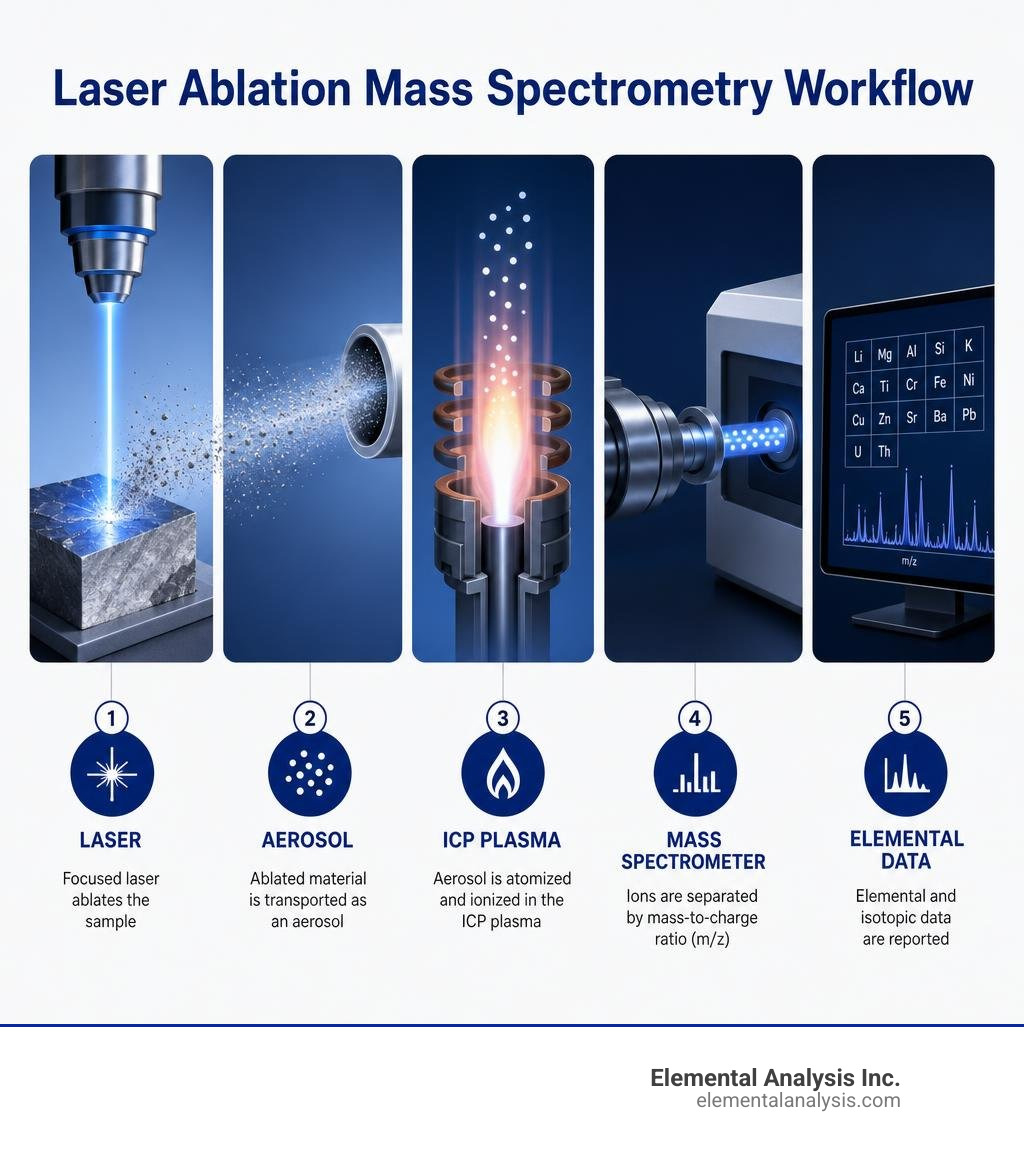
- How it works: Laser pulse → aerosol → plasma ionization → mass spectrometer detection
- Key advantage: Skips wet chemistry sample prep, reducing contamination risk and turnaround time
- Spatial resolution: Laser spot sizes as small as 2–5 µm, with depth resolution of 0.1–1 µm
- Element coverage: 60+ elements from lithium to uranium in a single analysis session
- Precision: Quantification accuracy typically better than 10% for most elements
If you’re managing trace-element testing in aerospace alloys, pharmaceutical materials, or environmental samples, this technique can consolidate what used to require multiple methods into one fast, precise workflow.
What makes LA-MS so compelling isn’t just its sensitivity — it’s the combination of speed, minimal sample destruction, and spatial information that no solution-based method can match. You can analyze a polished metal coupon, a geological thin section, or a paraffin-embedded tissue biopsy with the same instrument, often within minutes of loading the sample.
What is Laser Ablation Mass Spectrometry (LA-MS)?
To understand laser ablation mass spectrometry, we have to break it down into two distinct acts: the laser ablation part (which gets the sample ready) and the mass spectrometry part (which actually measures the elements).
In traditional analytical chemistry, if you want to analyze a solid sample—say, a piece of industrial ceramic or an alloy—you usually have to dissolve it first. This process, known as acid digestion, is slow, messy, and uses hazardous chemicals. With LA-MS, we skip the acid entirely. Instead, we use a high-powered, focused laser beam to perform direct micro-scale sampling.
The process begins inside a sealed ablation chamber. When the laser pulses strike the surface of the solid sample, they instantly heat, vaporize, and erode a microscopic volume of material. This process of removing material with a laser is called laser ablation.
Once the laser generates this tiny cloud of micro- and nano-particles—collectively called an aerosol—we must transport it to the mass spectrometer. This is where carrier gases come into play. We typically use helium as the primary carrier gas because it is highly efficient at sweeping the ablated aerosol out of the chamber with minimal sample loss. Just before the aerosol reaches the mass spectrometer, we mix it with an argon buffer gas to stabilize the high-temperature plasma source.
The aerosol is then swept into an Inductively Coupled Plasma (ICP) torch. At temperatures reaching nearly 10,000 Kelvin (hotter than the surface of the sun), the plasma vaporizes, atomizes, and ionizes the aerosol particles. These newly formed ions are then extracted into the mass spectrometer, where they are separated and measured based on their mass-to-charge ratio.
For a deeper dive into how plasma ionization works under the hood, you can read our guide on Unlocking the Elements with ICP Laboratory Analysis. If you want to explore the historical and technical evolution of this process, the academic community has compiled an excellent Review of the State-of-the-Art of Laser Ablation Inductively Coupled Plasma Mass Spectrometry, which highlights how this technology became the gold standard for direct solid analysis.
Key Instrumentation and Laser Technologies
An LA-MS system is a marriage of two complex instruments: a laser ablation system and a mass spectrometer.
The performance of the entire system depends heavily on the laser’s characteristics. The three primary parameters we adjust are:
- Spot size: The diameter of the laser beam on the sample surface (typically ranging from 5 to 200 µm).
- Fluence: The energy delivered per unit of area (measured in Joules per square centimeter).
- Repetition rate: How many times the laser fires per second (usually between 1 and 20 Hz, though some systems go much higher).
The laser’s wavelength is also critical. Solid-state lasers (like Nd:YAG lasers) commonly operate at ultraviolet (UV) wavelengths such as 266 nm or 213 nm. Gas-source excimer lasers, operating at 193 nm, are widely favored for transparent materials like quartz or carbonates because UV wavelengths are absorbed much more efficiently by most solids than infrared or visible light.
Nanosecond vs. Femtosecond Laser Ablation Mass Spectrometry
The duration of the laser pulse—known as pulse width—plays a massive role in how the laser interacts with the sample.
For many years, nanosecond (ns) lasers (with pulse widths of 4 to 20 nanoseconds) were the industry standard. However, nanosecond pulses are long enough to cause thermal effects. The target material absorbs the laser energy, heats up, and melts around the edges of the ablation crater. This melting can cause “fractionation,” where elements with lower melting points vaporize faster than elements with higher melting points. This makes it difficult to get a representative, stoichiometric sample of the material.
Enter femtosecond (fs) lasers. Operating with ultra-short pulses (150 to 350 femtoseconds), these lasers deliver energy so quickly that the target material is converted directly into an aerosol before heat has time to conduct into the surrounding sample. This “cold ablation” minimizes thermal damage, dramatically reduces elemental fractionation, and yields a highly uniform aerosol particle size distribution.
If you are analyzing complex metals, semiconductors, or multi-layered coatings, femtosecond systems offer superior depth profiling and far more reliable quantification. To explore the physics of this transition, you can read the comprehensive review on Femtosecond laser ablation elemental mass spectrometry.
Comparing LA-ICP-MS and LA-TOF-MS Systems
Once the aerosol is ionized, it must be analyzed. The type of mass spectrometer coupled to the laser determines what kind of data you can extract:
- LA-ICP-MS (Quadrupole or Triple Quadrupole): These systems use a quadrupole mass filter to scan through elements sequentially. They are highly sensitive, excellent for routine trace-element screening, and can easily measure 60+ elements. Triple-quadrupole systems add an extra layer of filtration to remove spectral interferences, making them ideal for ultra-trace detection.
- LA-TOF-MS (Time-of-Flight): Instead of scanning elements one by one, a TOF mass analyzer measures all masses simultaneously by timing how long ions take to travel down a flight tube. This is incredibly advantageous for tracking the highly rapid, “transient” signals produced by single laser pulses.
For high-speed elemental mapping or single-particle analysis, the combination of laser ablation and time-of-flight mass spectrometry is exceptionally powerful. You can learn more about this pairing in the article Laser Ablation and Inductively Coupled Plasma–Time-of-Flight ….
Analytical Performance: Detection Limits, Spatial Resolution, and Calibration
To help you evaluate whether LA-MS is the right fit for your project, let’s look at how its core performance metrics stack up against traditional solution-based ICP-MS:
| Performance Metric | Laser Ablation ICP-MS (LA-ICP-MS) | Solution-Based ICP-MS |
|---|---|---|
| Sample State | Direct Solid | Liquid (requires acid dissolution) |
| Detection Limits | Tens of ppb (down to ppt for transition metals & REEs) | Parts-per-trillion (ppt) to parts-per-quadrillion (ppq) |
| Typical Spot Size | 2 µm to 200 µm | Bulk sample (no spatial resolution) |
| Depth Resolution | 0.1 µm to 1 µm | Bulk sample (no depth profiling) |
| Sample Consumption | Picograms to femtograms | Milligrams to grams |
| Turnaround Time | Fast (minutes per sample) | Slow (hours of chemical preparation) |
As the table shows, while solution-based ICP-MS can achieve slightly lower absolute detection limits because the sample is fully homogenized in liquid, LA-ICP-MS matches it closely while preserving spatial details. It can easily provide major and trace element compositions down to parts-per-billion detection limits using only picograms of sample material.
Calibration Strategies in Quantitative Laser Ablation Mass Spectrometry
Getting qualitative data (what elements are present) is easy with LA-MS. Getting fully quantitative data (exactly how much of each element is present) requires careful calibration. Because the ablation rate varies depending on how well a material absorbs laser energy, we cannot rely on simple liquid standards.
Instead, we use several advanced calibration strategies:
- Matrix-Matched Standards: We use solid reference materials that share a similar physical and chemical composition to our sample. For example, we use synthetic silicate glasses (like NIST SRM 610, 612, or 614) for geological samples, and certified metal alloys for metallurgical testing.
- Internal Standardization: We select a known element within the sample matrix (such as Calcium in bones, or Silicon in glass) to act as an internal standard. This allows us to correct for any natural fluctuations in the amount of material ablated from shot to shot.
- Relative Sensitivity Coefficients (RSCs): In systems where matrix-matched standards do not exist, we calculate RSCs to adjust for the different ionization efficiencies of various elements.
To understand the fundamental rules of trace element quantification, check out our guide, Elemental My Dear Watson: A Guide to ICP Metal Analysis.
Key Applications of LA-MS Across Industries
The versatility of direct solid sampling has made laser ablation mass spectrometry indispensable across several fields.
Geology and Geochronology
Geologists use LA-ICP-MS to analyze trace elements in minerals and determine the ages of rocks. By targeting individual mineral grains (like zircons) with a 15 µm laser spot, researchers can measure uranium and lead isotopes to date geological formations with incredible precision.
Archaeology and Provenance
Because LA-MS is virtually non-destructive—leaving ablation pits only a few micrometers deep—it is the ideal tool for analyzing valuable artifacts. Researchers use it to analyze glazes, paints, and clay compositions on ancient ceramics, or to trace the geographic origin of gemstones and obsidian tools.
Biomedicine and Tissue Imaging
In medicine, LA-ICP-MS is used for elemental bio-imaging. For example, scientists can map the distribution of metals in thin-sectioned tissues to study metabolic disorders. In a clinical study comparing LA-ICP-MS to traditional chemical staining, the laser method successfully mapped iron and copper distribution in human liver biopsies with a lateral resolution of 5 µm, detecting trace metal changes long before they were visible under a standard microscope.
If you want to understand how these mass spec techniques are applied in clinical research, you can explore the work being done at the Mass Spectrometry | University of Kentucky College of Medicine in Lexington, KY.
Planetary Science and In Situ Space Exploration
One of the most exciting frontiers for LA-MS is outer space. Traditional wet chemistry instruments are far too heavy, consume too much power, and require too many liquid reagents to be practical on a spacecraft.
Miniaturized laser ablation time-of-flight mass spectrometers (LMS) solve these problems. These ultra-compact instruments require zero liquid chemicals, do not need sample preparation, and can be mounted directly on planetary rovers to analyze regolith (soil) and rocks in situ.
Researchers have demonstrated that these miniature systems can perform high-resolution, three-dimensional elemental and mineralogical mapping of highly heterogeneous rocks. This capability is vital for identifying biosignatures or selecting promising drilling locations on Mars and airless bodies like the Moon.
To see how these space-bound instruments are designed and tested, you can read about the LMS Instrument – Space Research & Planetary Sciences (WP). Additionally, research on Coupling of LMS with a fs-laser ablation ion source shows how coupling these miniature instruments with femtosecond lasers achieves highly accurate isotope measurements. You can also review the technical validation of these systems on complex, heterogeneous earth minerals in this detailed mineralogical study.
Advantages, Limitations, and Sample Preparation
Every analytical technique has its trade-offs. Understanding where LA-MS shines—and where it struggles—is key to choosing the right tool for your laboratory needs.
The Advantages
- Minimal Sample Prep: No acids, no hazardous waste, and no dilution of your sample.
- Spatial Control: You can target specific mineral phases, inclusions, or layers.
- Depth Profiling: By firing the laser repeatedly in the same spot, you can analyze coatings or layers from 0.1 µm down to several micrometers deep.
- Speed: A single measurement can take less than a minute.
The Limitations
- Matrix Effects: Because physical properties affect how materials ablate, you must have appropriate reference standards for accurate quantification.
- Spectral Interferences: High-temperature plasma can create molecular interferences (such as argon oxide interfering with iron measurements) that require collision/reaction cell systems to resolve.
- Elemental Fractionation: If using older nanosecond lasers, thermal heating can skew your elemental ratios.
For a broader look at how to pair these advantages with your specific laboratory requirements, check out our guide on Induced Coupled Plasma: Finding the Perfect Match for Your Lab.
Frequently Asked Questions about Laser Ablation Mass Spectrometry
What is the typical spatial resolution of modern LA-MS?
For most commercial systems, the minimum laser spot size is approximately 2 to 5 µm. This defines your lateral (surface) resolution. For depth profiling, the system can achieve a resolution of 0.1 to 1 µm per laser pulse, allowing you to map elemental changes as you drill into a sample.
How does sample preparation for LA-MS compare to traditional ICP-MS?
Traditional ICP-MS requires complete sample dissolution in strong acids, which can introduce contaminants and dilutes your sample. LA-MS requires almost no preparation. Samples simply need to be dry, stable at room temperature, free of surface liquids, and small enough to fit inside the ablation chamber (typically up to 10 cm² in surface area). They can be analyzed as polished resin blocks, thin sections, or even unprepared solid pieces.
What are the main limitations of laser ablation mass spectrometry?
The main challenges are managing matrix effects and finding suitable matrix-matched calibration standards. Because different materials absorb laser energy differently, calibrating the instrument to get precise quantitative data requires specialized standards (like NIST glasses). Additionally, older nanosecond lasers can cause elemental fractionation due to thermal melting at the ablation site.
Conclusion
Whether you are mapping trace metals in biological tissues, fingerprinting forensic glass samples, or analyzing advanced aerospace coatings, laser ablation mass spectrometry delivers a level of spatial detail and speed that traditional liquid digestion simply cannot match. By eliminating hazardous wet chemistry, it streamlines workflows while preserving the physical context of your samples.
At Elemental Analysis Inc., based in Lexington, Kentucky, we specialize in helping laboratories and industrial partners navigate complex elemental testing. As the nation’s premier commercial testing laboratory, we combine advanced analytical capabilities with competitive pricing and fast turnaround times to deliver clear, actionable results.
Would you like to learn more about how to integrate laser ablation or other plasma-based testing into your quality control or research workflow? Reach out to us today to discuss our ICP Services and let our team of experts help you find the perfect analytical match for your materials.