
How to Find Commercial PIXE Laboratory Services
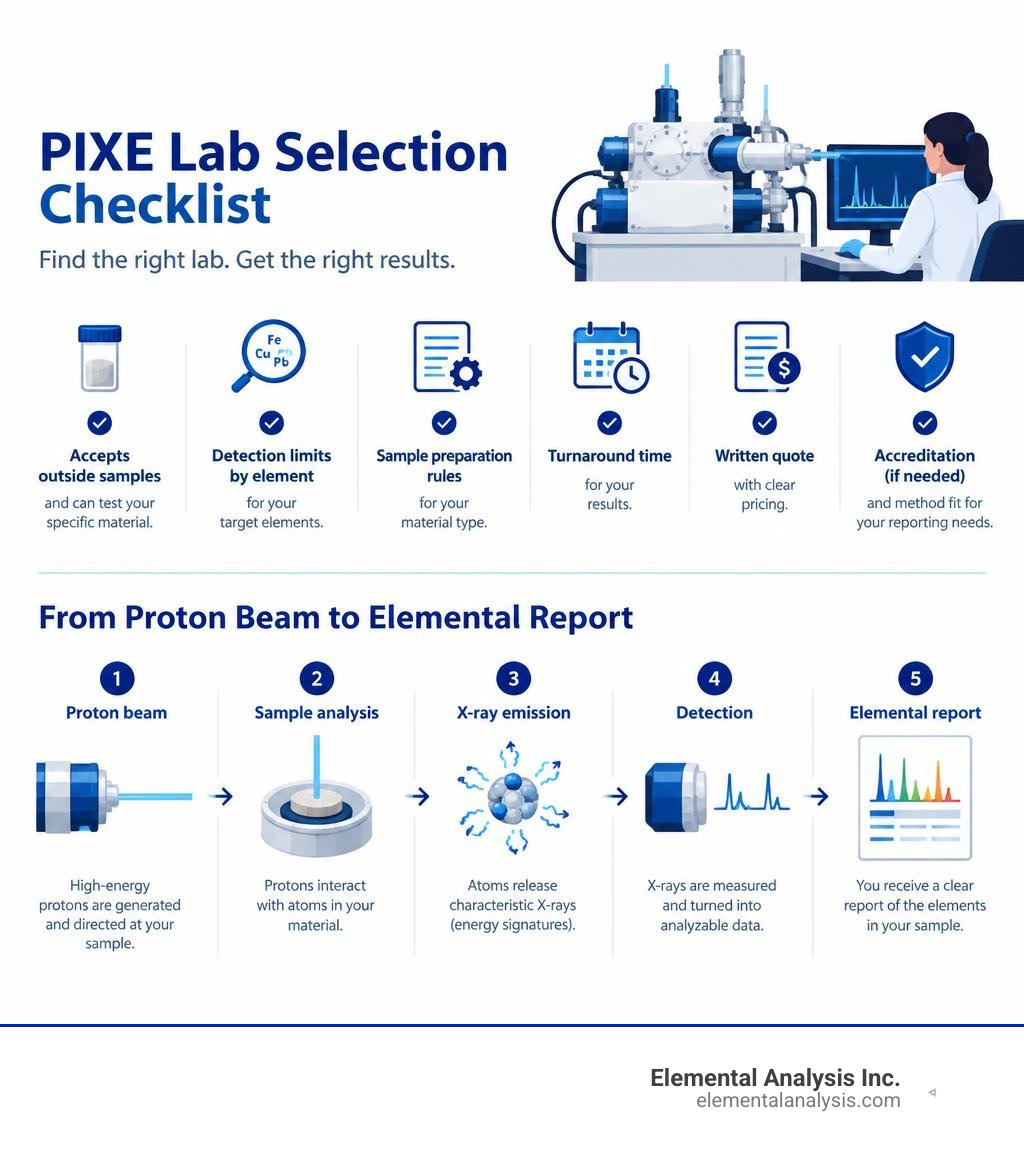
Looking for a PIXE testing lab? Start with a provider that accepts outside samples and can test your specific material. Ask for detection limits by element, sample preparation rules, turnaround time, and a written quote. If you need results for regulatory use, confirm the lab’s accreditation and whether its PIXE method meets your reporting needs.
PIXE uses a proton beam to measure many elements from one sample, often with little material removed. That makes it useful for trace-element work on filters, industrial materials, and valuable objects. Water samples need special preparation, so check the lab’s collection instructions before you ship them.
What Are Commercial PIXE Laboratory Services and How Do They Work?
When you need rapid, high-sensitivity elemental profiling without destroying a unique specimen, finding the right analytical approach matters. Particle-Induced X-Ray Emission is a high-energy physics technique that operates as a practical, high-throughput commercial testing tool. At its core, the technique relies on small nuclear particle accelerators to generate a beam of high-energy protons. When directed at your target material, these protons interact with atoms at the sub-atomic scale.
If you are exploring the underlying mechanics, our comprehensive guide to particle induced X-ray emission details how particle accelerators interact with physical matter to reveal hidden trace compositions.
Principles of Proton-Induced X-Ray Emission
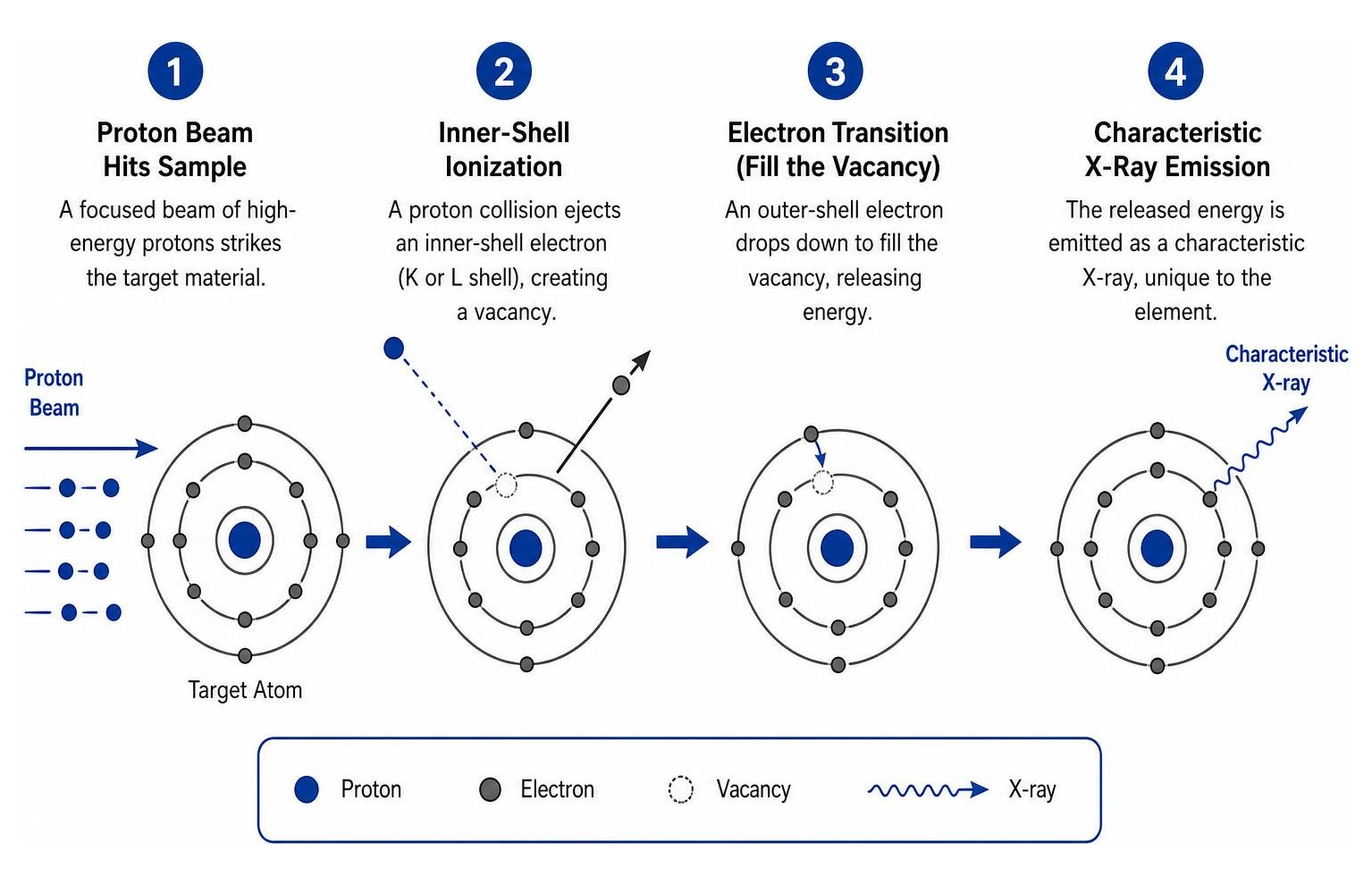
The physical mechanism behind this method is straightforward. When a focused beam of protons strikes a target sample, these accelerated particles collide with inner-shell electrons within the target atoms, ejecting them from their orbits. This process—known as inner-shell ionization—leaves vacancies in the inner electron shells (typically the K or L shells).
To regain stability, outer-shell electrons immediately drop down to fill these vacancies. As they transition, they release excess energy in the form of characteristic X-rays. Because the electron binding energies of every element on the periodic table are unique, the energy of each emitted X-ray serves as an unambiguous elemental fingerprint.
High-purity semiconductor detectors capture these emitted X-rays simultaneously, sorting them into an energy-dispersive spectrum. By evaluating the peaks on this spectrum, we determine exactly which elements are present and in what concentrations. You can read more about the specialized hardware powering this process on our PIXE page.
Core Capabilities of Commercial PIXE Laboratory Services
What sets this method apart in routine testing is its simultaneous multielement detection capacity. In a single measurement cycle lasting just a few minutes, our instruments can quantify up to 76 elements simultaneously (spanning from aluminum through uranium).
PIXE produces a clean spectral baseline that supports sensitive trace-element measurement across suitable solid, filter, and prepared sample matrices. This clean spectral baseline translates directly into low parts-per-billion (ppb) detection limits for aqueous samples and parts-per-million (ppm) sensitivity for solid matrices. Meeting these rigorous benchmarks requires an advanced analytical setup that follows established elemental testing lab standards.
PIXE Sensitivity, Sample Integrity, and Matrix Considerations
PIXE is particularly useful when trace-element measurement must preserve the sample and minimize preparation. The method supports solid materials, filters, and prepared residues across a range of elemental analysis methods.
Sensitivity and Matrix Considerations
For suitable samples, PIXE provides sensitive trace-element measurement while preserving the material and avoiding extensive preparation.
Key Industries and Applications for PIXE Testing
Because proton beams analyze solids, aerosols, and dried residues with minimal preparation, a broad range of industries rely on our testing services for rapid, multielemental screening.
Environmental and Drinking Water Monitoring
Air quality monitoring networks routinely deposit particulate matter (PM2.5 and PM10) onto Teflon, polycarbonate, or quartz membrane filters. We place these thin air filters directly into the accelerator target chamber, measuring heavy metal pollutants, sulfur, and crustal dust elements simultaneously without damaging the filter substrate.
For drinking water, specialized vapor filtration techniques allow trace metals to deposit evenly onto thin membranes under a mild vacuum (maintaining chamber pressures below 4 Torr). This concentrates aqueous trace elements from 0.1 to 100 ppb without chemical extraction, protecting local ecosystems and ensuring regulatory compliance. These green laboratory workflows are part of our commitment to supporting sustainable laboratory operations.
Cultural Heritage and Historic Preservation Testing
In the field of cultural heritage, destruction is never an option. Historical curators, conservators, and archaeologists rely on non-destructive ion beams to analyze:
- Historic Pigments: Identifying mineral elements to authenticate Renaissance paintings or detect modern restorations.
- Ancient Coins and Alloys: Revealing trade routes and metallurgical practices without stripping patinas.
- Manuscripts and Inks: Quantifying trace impurities in iron gall inks, as seen in our work on Gutenberg Bible ink analysis.
- Ceramic Shards: Classifying trace clays to determine provenance and kiln origins.
Because the proton beam can operate within an external helium-purged environment (“in-air PIXE”), even oversized canvases, antique firearms, and delicate sculptures can be scanned without placing the object in a vacuum chamber.
Advanced Materials and Industrial Quality Control
From quality-control inspections of aerospace coatings to micro-contaminant screening on silicon wafers, industrial manufacturers use proton beams to verify thin-film uniformity. Modern commercial testing facilities in the Commonwealth have expanded their analytical capabilities as state development initiatives continue to attract advanced laboratory infrastructure investments. Whether you are analyzing catalyst beds, battery anodes, or core geological samples, proton excitation characterizes layered structures quickly and reliably.
Cost, Turnaround, and Practical Sample Preparation Workflows
Commercial testing laboratories design their sample workflows to eliminate unnecessary delays. Whether you need single-sample research analysis or routine industrial monitoring, our A to Z testing options provide clear pathways from sample receipt to finalized reporting.
Sample Preparation and Submission Guidelines
Proper sample preparation ensures reliable, reproducible data:
- Solid Samples: Flat specimens (coins, metal coupons, wafers) should measure between 5 mm and 50 mm in diameter. Surfaces must be free from oils, adhesives, and fingerprints.
- Powders and Particulates: Powders can be pressed into pellets or dusted as a uniform thin layer onto ultra-pure, trace-clean adhesive backings.
- Liquid and Water Samples: For aqueous trace metals, collect at least 50 to 100 mL of sample. Acidify to pH < 2 using high-purity nitric acid if preserving for total metals. If you are using our vapor-filtration drying service, please provide unacidified parallel aliquots as instructed.
- Aerosol Membrane Filters: Handle filters (polycarbonate, Teflon) exclusively with clean Teflon-coated or plastic tweezers. Store and ship filters flat inside sterile PetriSlide containers to prevent particulate loss.
Commercial Pricing Structures and High-Volume Efficiencies
Dedicated commercial laboratories can offer predictable, per-sample pricing for PIXE analysis.
In routine testing, baseline commercial screening costs between $35 and $75 per sample for standard solid or filter matrices. When processing high-volume sample batches—such as multi-thousand-sample environmental water surveys—automated target changers and computerized data acquisition reduce sample processing costs by up to 50 percent. Standard commercial turnaround ranges from 5 to 10 business days, with expedited 24- to 48-hour rush options available for urgent industrial needs.
How to Choose a Dedicated Commercial Testing Partner
Because running an ion beam facility requires nuclear physics expertise and complex accelerator hardware, choosing the right lab partner is critical. For guidance on vetting trace-level testing partners, read our guide on choosing a heavy metal testing laboratory.

Key Criteria for Evaluating Commercial PIXE Laboratory Services
When evaluating a testing partner, consider these foundational criteria:
- Commercial Accelerator Uptime: Ensure the facility operates dedicated commercial beamlines rather than relying on shared academic physics calendars.
- Detector Technology: Confirm the laboratory uses modern Silicon Drift Detectors (SDD) capable of handling high count rates with low dead-time.
- Matrix-Specific Expertise: Verify the laboratory has experience handling your exact matrix—whether delicate archaeological artifacts, aerosol membranes, or industrial polymers.
- Reporting Transparency: Ensure certificates of analysis include explicit detection limits, calibration curves, and analytical uncertainties for every detected element.
Quality Assurance, Calibration Stability, and Spectral Interpretation
Accurate quantification requires rigorous calibration protocols. Commercial laboratories benchmark their beamlines against certified reference standards from the National Institute of Standards and Technology (NIST), such as NIST SRMs for thin films, geological matrices, and trace metals on air filters.
Raw spectra undergo sophisticated deconvolution using industry-standard software codes (such as GUPIX). This processing accurately subtracts continuous background radiation, separates overlapping spectral peaks (like the lead L-alpha and arsenic K-alpha lines), and corrects for matrix-absorption effects. The result is traceable, quantitative elemental data you can rely on.
Frequently Asked Questions about PIXE Testing
What elements can be detected in a single PIXE run?
A single measurement detects up to 76 elements simultaneously, covering all elements from aluminum (atomic number 13) through uranium (atomic number 92). Lighter elements (such as carbon, nitrogen, and oxygen) emit low-energy X-rays that are absorbed by chamber windows and detector filters, making them better suited for complementary nuclear techniques like Particle-Induced Gamma-Ray Emission (PIGE) or standard combustion testing.
Is PIXE analysis truly non-destructive for delicate samples?
Yes. For solid, stable materials, proton irradiation causes no physical alteration, ablation, or mechanical damage. For heat-sensitive cultural artifacts (such as ancient parchment, textiles, or oil paintings), we use lower beam currents and external beamlines (“in-air” mode with helium cooling) to eliminate thermal stress and sample degradation.
What detection limits can commercial PIXE testing achieve?
For thin samples (such as aerosol filters or water residue dried onto ultra-thin membranes), detection limits typically range from 0.1 to 100 parts-per-billion (ppb). For thick, solid targets (such as geological cores or metal alloys), detection limits sit between 1 and 10 parts-per-million (ppm) for most transition and heavy metals.
Conclusion
From monitoring trace heavy metals in public water supplies to authenticating historical artifacts without leaving a mark, Particle-Induced X-Ray Emission remains one of the most versatile tools in modern analytical chemistry. Operating as a dedicated commercial testing facility based in Lexington, Kentucky, Elemental Analysis Inc. delivers rapid turnaround times, high sensitivity, and comprehensive multielement testing tailored to your project.
Reach out to our technical team today to discuss your PIXE testing requirements, request a quote, or schedule your next sample batch.