
Heavy Metal Chemistry: A Beginner’s Guide to Elemental Analysis of Metals
Why Elemental Analysis of Metals Matters for Your Lab
Elemental analysis of metals is the process of identifying and measuring every element present in a metal or alloy sample — from major components down to trace-level impurities.
Here’s a quick overview of the most common methods and what they’re best for:
| Technique | Best For | Destructive? | Detection Level |
|---|---|---|---|
| ICP-OES/MS | Trace elements, dissolved samples | Yes | ppm to ppt |
| Spark-OES | Bulk alloy composition, steels | Yes (surface) | ~100 µg/g |
| XRF (ED/WD) | Fast multi-element screening | No | ~10 ppm–1% |
| LIBS | Field use, rapid sorting | Minimal | ppm range |
| LECO combustion | C, S, N, O, H in metals | Yes | wt% level |
Whether you’re verifying a material cert, investigating a part failure, or sorting recycled scrap — the right technique depends on your sample type, the elements you need to quantify, and how low your detection limits need to go.
Getting it wrong is costly. Using the wrong method can mean missed impurities, failed audits, or parts that don’t meet aerospace or medical device specifications.
The good news: modern analytical techniques can detect most elements across a huge concentration range — from bulk constituents down to parts-per-trillion in some cases. And with the right lab partner, you can get accurate, consolidated results without juggling multiple vendors.
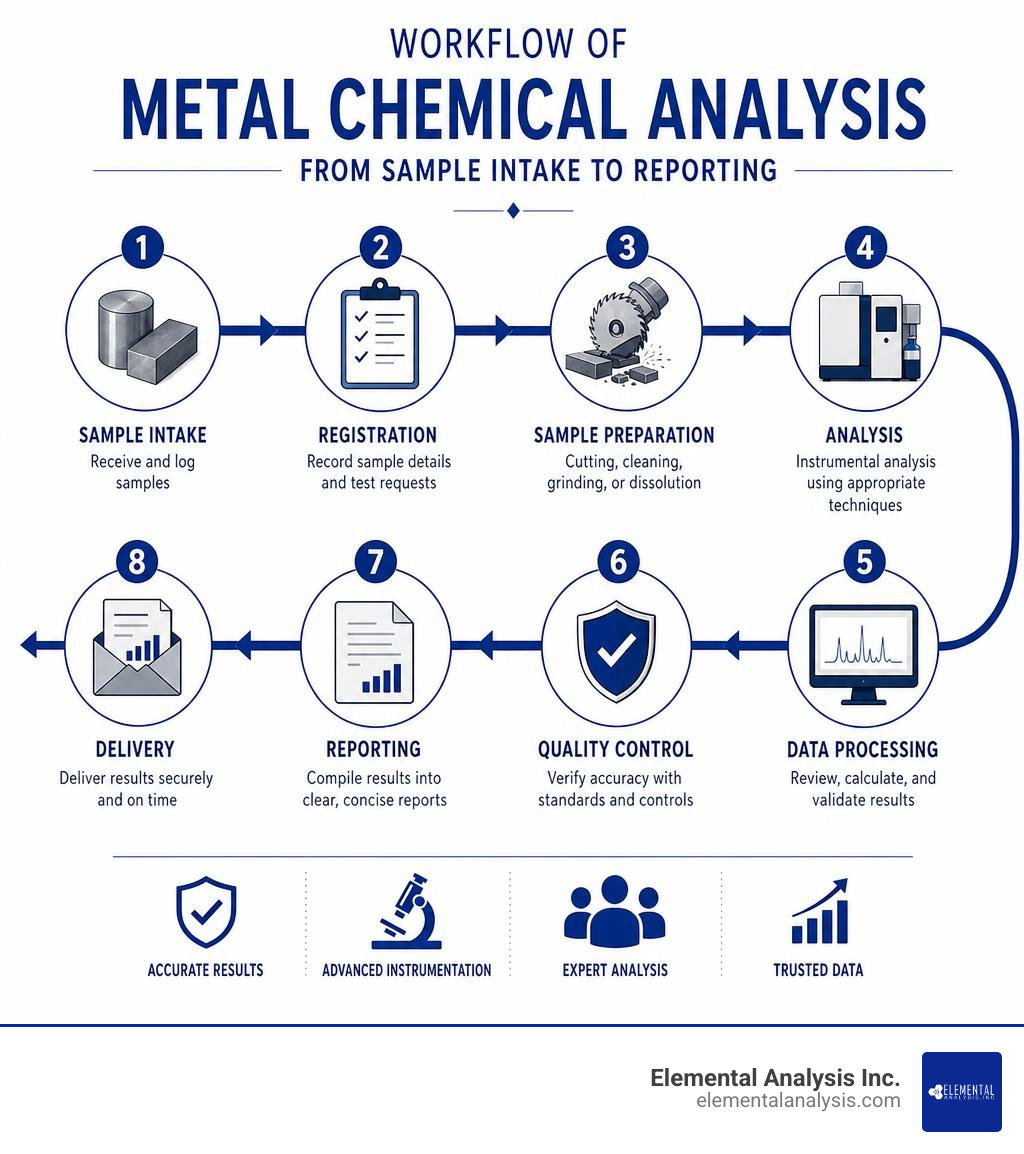
Core Techniques for the Elemental Analysis of Metals
When we look at the periodic table, metals present unique analytical challenges. They can be incredibly tough, highly resistant to chemical dissolution, or complex mixtures of major, minor, and trace elements. To tackle these challenges, analytical chemists rely on a suite of core techniques, each with its own sweet spot.
To help you navigate these options, let’s explore how these techniques compare in sensitivity, accuracy, and practical applicability. For a deeper dive into how these methods match up in real-world scenarios, you can read the Comparison of Elemental Analysis Techniques for the Characterization of Commercial Alloys.
Inductively Coupled Plasma (ICP) Techniques
ICP-based techniques are the gold standard for trace and ultra-trace analysis. By introducing a liquid sample into an argon plasma torch burning at temperatures up to 10,000 K, the sample is atomized and ionized.
- ICP-OES (Optical Emission Spectrometry): Measures the light emitted by excited atoms at element-specific wavelengths. It is highly versatile, has a wide dynamic range, and excels at measuring both major and trace elements simultaneously.
- ICP-MS (Mass Spectrometry): Instead of measuring light, it directs the ions into a mass spectrometer. This yields incredible sensitivity, allowing us to detect trace elements at parts-per-million (ppm), parts-per-billion (ppb), and even parts-per-trillion (ppt) levels.
- ICP-SFMS (Sector Field Mass Spectrometry): Offers even higher resolution and sensitivity, making it the ultimate tool for resolving complex spectral overlaps in high-purity metals.
To learn more about our robust wet chemistry capabilities, explore our ICP services.
Spark Optical Emission Spectrometry (Spark-OES)
If you work in a foundry or steel warehouse, Spark-OES is likely your daily driver. It uses an electrical spark generated between an electrode and the flat surface of your metal sample to vaporize and excite the material. It is exceptionally fast (taking about 15 seconds per measurement point) and highly accurate for routine bulk alloy verification. However, it requires a flat, conductive surface and leaves a small burn mark on the sample.
X-ray Fluorescence (XRF)
XRF is a non-destructive method that bombards a sample with primary X-rays, causing the elements within to emit secondary (fluorescent) X-rays characteristic of their atomic structure. It is commonly used for detecting elements from fluorine to uranium.
- EDXRF (Energy-Dispersive XRF): Cheaper, more compact, and commonly found in portable handheld devices.
- WDXRF (Wavelength-Dispersive XRF): Offers higher resolution and lower detection limits by physically separating the fluorescent X-rays using analyzing crystals, making it ideal for demanding laboratory environments.
For non-destructive bulk screening, check out our XRF capabilities.
Laser-Induced Breakdown Spectroscopy (LIBS)
LIBS uses a highly focused laser pulse to create a tiny plasma plume on the sample surface. The light emitted from this plasma is analyzed to determine the material’s composition. It requires virtually no sample preparation and can analyze almost any material, including non-conductive metals and light elements like lithium and beryllium.
Particle Induced X-ray Emission (PIXE)
As the operators of the first commercial PIXE laboratory, we hold a special place in our hearts for this incredibly powerful technique. PIXE uses an ion beam (typically protons) generated by a particle accelerator to excite the atoms in a sample, which then emit characteristic X-rays.
The beauty of PIXE lies in its non-destructive nature and its ability to provide rapid, multi-element analysis across a broad range of elements simultaneously. It is highly sensitive and ideal for precious, unique, or fragile samples that cannot be altered or destroyed. Read more about this specialized method on our PIXE page.
Neutron Activation Analysis (NAA)
NAA is a highly sensitive nuclear process used to determine the concentrations of elements in a vast range of materials. By bombarding a sample with neutrons in a nuclear reactor, the target elements become radioactive and begin to emit gamma rays. Because gamma rays easily escape the sample, NAA is virtually immune to physical and chemical matrix effects, making it an excellent referee method for validating other techniques. Learn more about how we utilize this nuclear method on our NAA page.
| Technique | Typical Detection Limits | Primary Strengths | Major Limitations |
|---|---|---|---|
| ICP-OES / MS | ppm to ppt | Unmatched sensitivity; excellent for trace impurities | Requires complete sample dissolution (destructive) |
| Spark-OES | ~100 µg/g (ppm) | Rapid bulk analysis; great for carbon/low-alloy steels | Requires flat, conductive surface; slightly destructive |
| XRF (ED / WD) | 10 ppm to 1 at.% | Non-destructive; rapid multi-element screening | Limited sensitivity for light elements (below fluorine) |
| LIBS | tens of ppm | Portable; no sample prep; measures light elements | Lower precision; matrix-sensitive |
| PIXE | low ppm | 100% non-destructive; high spatial resolution | Requires vacuum chamber for light elements |
| NAA | ppb to ppm | Matrix-independent; highly accurate bulk analysis | Requires access to a nuclear reactor; slow turnaround |
Laboratory-Based Elemental Analysis of Metals
When extreme accuracy, ultra-low detection limits, or strict regulatory compliance are non-negotiable, laboratory-based systems are the clear choice. In our controlled laboratory environment in Lexington, Kentucky, we can employ high-end instrumentation like WDXRF and ICP-SFMS to eliminate spectral interferences and measure trace elements at levels that portable devices simply cannot reach.
Furthermore, laboratory-based spark-OES remains the benchmark validation method for certified reference alloys. While it does require cutting a small test piece and grinding the surface flat, the precision it offers for routine quality control of steels and copper alloys is exceptional. For specialized laboratory testing across a wide range of matrices, we invite you to browse our comprehensive Elemental Analysis Services.
Portable Solutions for Field-Based Elemental Analysis of Metals
In the environments of metal recycling yards, scrap sorting facilities, and incoming warehouse inspections, waiting days for laboratory results isn’t always practical. This is where portable and field-deployable instruments shine.
Handheld energy-dispersive XRF (pXRF) spectrometers have become an industry staple. Weighing around 1.5 kg, these devices offer impressive multianalyte measurement capabilities and accuracy within a matter of seconds. For instance, a quick 60-second pXRF scan (split into 30-second frames for light and heavy elements) can instantly identify alloy grades and sort post-consumer scrap, preventing costly downcycling.
Similarly, handheld LIBS units have revolutionized field analysis by providing rapid carbon and light element measurements without the need for radioactive sources or heavy X-ray shielding. Emerging advancements, such as femtosecond laser-ablation spark-induced breakdown spectroscopy (fs-LA-SIBS) combined with machine learning models, are paving the way for real-time, highly accurate field identification of complex alloys like magnesium matrices.
To learn more about these developments, you can read the research paper on Quantitative analysis and identification of magnesium alloys using fs-LA-SIBS combined with machine learning methods.
Sample Preparation and Matrix Interferences

A wise chemist once said, “Your analytical result is only as good as your sample preparation.” (Okay, maybe we said that, but it’s absolutely true!). For metals, sample preparation directly impacts the accuracy of your data.
For solid-state techniques like spark-OES, LIBS, and XRF, surface condition is everything. For example, a low-alloy carbon steel like 42CrMo4 requires thorough surface grinding to remove oxide scales, rust, and surface decarburization before analysis. If you skip this step, your spark-OES system will analyze the oxide layer instead of the bulk metal, leading to wildly inaccurate carbon and iron readings.
When dealing with liquid-based techniques like ICP-OES and ICP-MS, the challenge shifts to sample dissolution. Metals must be completely dissolved in strong acids (such as nitric, hydrochloric, or hydrofluoric acids) without losing volatile elements or leaving undissolved residues.
Alternatively, for metals in solution (such as industrial wastewater or leaching solutions from recycled magnets), we can bypass expensive ICP setups by utilizing cellulose pelletization. By pipetting the liquid sample onto 500 mg of cellulose, adding ethanol to aid homogenization, drying it at 50 °C, and cold-pressing it into a 13 mm pellet at 7000 kgf for one minute, we create a solid specimen perfectly suited for fast, low-cost ED-XRF analysis.
To explore our diverse array of preparation and testing capabilities, take a look at our A to Z Testing directory.
Navigating Matrix Effects and Inter-Element Interferences
No matter how pristine your sample prep is, you must still contend with the physics of the elements themselves. Matrix effects occur when the physical or chemical properties of the sample matrix alter the analytical signal. For example, the dense iron matrix in low-alloy steels can suppress or enhance the signals of lighter trace elements.
Furthermore, spectral overlaps (inter-element interferences) can easily fool an inexperienced analyst. In spark-OES, analyzing mercury in aluminum alloys is notoriously difficult because intense iron emission lines interfere with the mercury signal, potentially leading to false positives. In XRF, the L-alpha emission line of praseodymium (Pr) directly overlaps with the L-alpha line of neodymium (Nd).
To overcome these challenges, we utilize advanced mathematical corrections, such as empirical alpha corrections in XRF and fundamental parameter (FP) models, alongside robust calibration curves built from certified reference materials. Local geologic and mineralogical testing resources, such as those at the Analytical and Lab – Kentucky Geological Survey, also highlight the critical importance of matching matrix calibrations to achieve reliable quantitative results.
Industrial Applications and Regulatory Standards
From the deep-sea pipelines of the oil and gas sector to the high-temperature turbines of the aerospace industry, knowing the exact chemistry of your metals is a matter of safety and compliance. Elemental analysis supports several crucial business functions:
- Quality Control: Ensuring that incoming raw materials match their mill test reports (MTRs) and contain no out-of-specification impurities.
- Reverse Engineering: Determining the exact alloy composition of a competitor’s component or a legacy part that lacks original blueprints.
- Failure Investigations: Identifying if a component failed due to the presence of embrittling trace impurities (such as excessive phosphorus or sulfur in steel) or because the wrong alloy grade was inadvertently used during manufacturing.
To ensure consistency, global industries rely on highly rigorous consensus standards. For ferrous metals, the European standard BS EN 10351:2011 outlines routine ICP-OES methods for determining elements like manganese, phosphorus, copper, and nickel in unalloyed and low-alloy steels.
For high-temperature, electrical, or magnetic alloys containing iron, nickel, and cobalt, laboratories adhere to the newly updated ASTM E0354-25 standard, which provides precise chemical analysis methods across broad concentration ranges (such as chromium from 0.10% to 33.00% and nickel up to 84.0%).
For carbon and low-alloy steel production control, the E415 Standard Test Method for Atomic Emission Vacuum Spectrometric Analysis of Carbon and Low-Alloy Steel is widely used to simultaneously measure 20 alloying and residual elements. Meanwhile, aluminum alloy manufacturers rely on E1251 Standard Test Method for Analysis of Aluminum and Aluminum Alloys by Spark Atomic Emission Spectrometry to control trace impurities and alloying additions, ensuring their products achieve the precise metallurgical properties required by customers.
At Elemental Analysis Inc., we maintain a robust quality system aligned with these industry standards. You can read more about our accreditations and testing scopes on our A to Z Testing page.
Frequently Asked Questions about Metal Analysis
How do you choose between destructive and non-destructive testing?
The choice depends entirely on the value and size of your sample, as well as your analytical goals. If you have a finished, high-value component (like an aerospace turbine blade or a rare museum artifact) that must remain entirely intact, non-destructive methods like PIXE or portable XRF are mandatory.
However, if you need to measure ultra-low trace impurities or light elements with maximum precision, destructive testing via acid dissolution and ICP-MS is often necessary. To explore our non-destructive proton-beam capabilities, read more about PIXE testing.
What is type standardization in metal spectrometry?
Type standardization is a calibration technique used in spectrometry (such as spark-OES or XRF) to temporarily modify a general-purpose calibration curve using a certified reference material of the exact same alloy type.
Because general calibrations have to accommodate a wide range of compositions, they can introduce minor systematic errors for specific alloy grades. By introducing a highly similar reference standard immediately before analyzing your unknown sample, you “fine-tune” the instrument’s calibration model, resulting in significantly higher accuracy for that specific material type. This process is currently being formalized under the proposed ASTM standard guide WK69595.
How do matrix effects impact trace element quantification?
Matrix effects occur when the bulk elements in your sample alter how the instrument detects the target trace elements. In ICP-MS, a heavy matrix (like high concentrations of iron or nickel) can cause physical interferences in the nebulizer or suppress the ionization of trace elements in the plasma.
In XRF, matrix elements can absorb the fluorescent X-rays of your target trace element before they reach the detector, or they can emit secondary radiation that artificially enhances the signal. We correct for these effects by using matrix-matched calibration standards, internal standards (such as adding a known amount of yttrium or indium to liquid samples), and advanced mathematical correction algorithms.
Conclusion
Navigating elemental analysis of metals doesn’t have to be overwhelming. Whether you are verifying a batch of structural steel, identifying trace contaminants in aerospace components, or trying to recover rare earth elements from recycled electronics, selecting the right analytical tool is key to obtaining reliable, cost-effective data.
At Elemental Analysis Inc., located in Lexington, Kentucky, we combine decades of analytical expertise with cutting-edge technology. As the first commercial PIXE laboratory, we are uniquely positioned to offer both completely non-destructive testing and highly sensitive destructive wet chemistry services. We are dedicated to providing our clients with fast turnaround times, competitive pricing, and unmatched technical support.
Ready to get started on your next project, or have questions about which method is right for your metal samples? Visit our Elemental Analysis Services page or learn more about our team on our About Us page to connect with one of our specialists today!