
Neutron Activation Analysis NAA: A Deep Dive into Nuclear Elemental Analysis
The Analytical Technique That Reads the Atomic Fingerprint of Almost Any Material
Neutron activation analysis (NAA) is a nuclear-based analytical technique used to determine the concentration of elements in a wide range of materials — without destroying the sample.
Here’s the short version of what you need to know:
- What it does: Bombards a sample with neutrons, causing stable atoms to become radioactive. The gamma rays those atoms emit are measured to identify and quantify elements present.
- How sensitive: Detection limits range from 0.03 nanograms to 4 micrograms depending on the element — reaching parts-per-billion or better for many elements.
- How many elements: Up to 74 elements can be detected in a single analysis run.
- Is it destructive? In most cases, no. The sample’s physical and chemical form is preserved.
- Accuracy: Overall errors of 2–5% relative standard deviation are routinely achievable.
- Who uses it: Labs in archaeology, forensics, geology, environmental science, pharmaceuticals, and semiconductor manufacturing.
NAA has been in use since 1936, when scientists Georg Hevesy and Hilde Levi first demonstrated the technique using rare earth elements. Since then, it has become one of the most trusted multi-element analytical methods in the world — often called the “referee method” when other analytical techniques produce conflicting results.
Today, an estimated 100,000 samples are analyzed by NAA worldwide every year. It remains the benchmark for accuracy when sub-parts-per-million sensitivity and non-destructive analysis both matter.
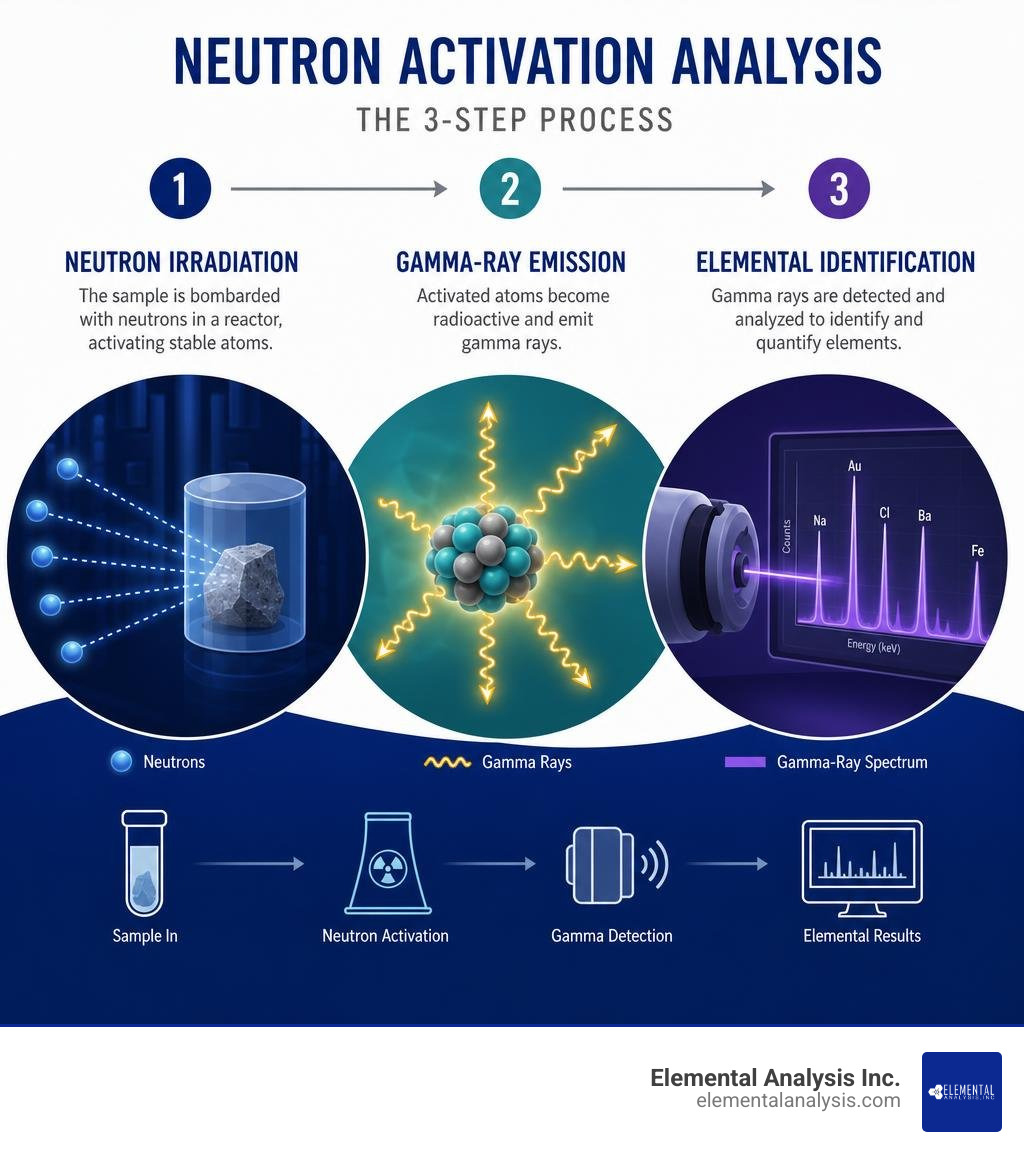
What is Neutron Activation Analysis NAA and How Does It Work?

To understand how neutron activation analysis naa works, we have to look past the electrons orbiting an atom and focus entirely on the atomic nucleus. While most chemical analysis methods rely on electronic transitions (how electrons move between energy levels), NAA is a nuclear process. It doesn’t care about the chemical bonds, oxidation states, or physical form of your sample; it only cares about the atomic nuclei.
At its core, the process relies on a simple, elegant sequence of nuclear physics:
- Neutron Capture: We place the sample inside a high-neutron flux environment (usually a nuclear research reactor). The stable target nuclei in the sample absorb or “capture” these incoming neutrons.
- Compound Nucleus Formation: When a nucleus captures a neutron, it gains mass and binding energy, forming a highly excited “compound nucleus.”
- Prompt Gamma Emission: To release this excess energy, the compound nucleus almost instantly (within $10^{-14}$ seconds) de-excites by emitting “prompt” gamma rays.
- Radioactive Decay: The resulting nucleus is typically a radioactive isotope (radionuclide). This unstable isotope decays over time, emitting “delayed” gamma rays at specific energies and rates characterized by its half-life.
- Gamma-Ray Spectroscopy: By measuring the energies of these emitted gamma rays, we can identify which elements are present (qualitative analysis). By measuring the rate of gamma-ray emission, we can calculate exactly how much of each element is in the sample (quantitative analysis).
To dive deeper into the mathematical and physics equations behind these reactions, you can read the NAA Technical Overview. At Elemental Analysis Inc., we utilize these exact principles to deliver highly accurate Neutron Activation Analysis services for our clients across various industries.
The Physics of Neutron Activation Analysis NAA
When we bombard a sample, we use neutrons of varying energy levels. The energy of these neutrons dramatically changes how they interact with different target nuclei. We categorize these neutrons into three primary groups:
- Thermal Neutrons: These are low-energy neutrons (below 0.5 eV) that are in thermal equilibrium with the surrounding medium. They make up about 90% to 95% of the neutron flux in a typical nuclear reactor. Most elements have their highest capture cross-section (the probability that a nucleus will capture a neutron) at thermal energies.
- Epithermal Neutrons: Neutrons with energies between 0.5 eV and 0.1 MeV. In some variations, known as Epithermal NAA (ENAA), we use cadmium or boron shields to block thermal neutrons, allowing only epithermal neutrons to strike the sample. This is incredibly useful for suppressing background noise from highly active thermal-neutron-absorbing elements like sodium.
- Fast Neutrons: High-energy neutrons (above 0.1 MeV) that can induce reactions like $(n, p)$ or $(n, \alpha)$ rather than simple capture $(n, \gamma)$. This is utilized in Fast Neutron Activation Analysis (FNAA).
Because we are targeting the nucleus rather than the outer electron shells, NAA completely bypasses matrix effects caused by chemical compounds. Whether your arsenic is bound in an organic pesticide or locked inside an inorganic geological matrix, the nuclear response remains identical.
Prompt vs. Delayed Gamma-Ray Neutron Activation Analysis NAA
Depending on when we measure the gamma rays, the technique is split into two main branches:
1. Prompt Gamma-Ray Neutron Activation Analysis (PGNAA)
In PGNAA, we measure the “prompt” gamma rays emitted during the irradiation process itself. Because the measurement must happen while the sample is being bombarded, the detectors are positioned near a beam port outside the reactor core.
- When it’s used: PGNAA is ideal for elements that have extremely high neutron capture cross-sections (like boron, cadmium, samarium, and gadolinium) or elements that decay into stable isotopes too quickly to be measured after removal from the reactor.
2. Delayed Gamma-Ray Neutron Activation Analysis (DGNAA)
DGNAA is the more common method. Here, we irradiate the sample, remove it from the reactor, and allow a specific “decay time” to pass before placing it on a gamma-ray detector.
- When it’s used: This method is perfect for elements that produce radioactive isotopes with half-lives ranging from a few seconds to several years. By waiting for short-lived, highly radioactive isotopes (like Sodium-24) to decay, we can clearly see the weaker signals of long-lived trace elements without spectral interference.
Methodological Variations and Instrumentation

To get the most out of neutron activation analysis naa, scientists have developed several specialized approaches. The instrumentation required is highly sophisticated, combining nuclear reactors with state-of-the-art semiconductor detectors. For a comprehensive look at the engineering behind these systems, refer to the detailed guide on the Concepts, Instrumentation and Techniques of Neutron Activation Analysis.
Instrumental vs. Radiochemical NAA
We generally divide delayed NAA into two operational methodologies based on whether we chemically alter the sample after irradiation:
Instrumental Neutron Activation Analysis (INAA)
INAA is a completely non-destructive testing method. The sample is packaged, irradiated, allowed to decay, and counted without any chemical processing.
- Pros: No chemical reagents are used, meaning zero risk of laboratory contamination. The sample is physically preserved (though it may remain radioactive for some time).
- Cons: If the sample contains high concentrations of elements like sodium, potassium, or bromine, their intense radioactivity can mask the gamma-ray peaks of trace elements.
Radiochemical Neutron Activation Analysis (RNAA)
In RNAA, we perform chemical separations on the sample after it has been irradiated but before we count it.
- Pros: By chemically removing interfering radioactive isotopes or concentrating the elements of interest, we can lower detection limits down to the sub-parts-per-billion level.
- Cons: It is a destructive process, requires specialized hot-cell laboratory setups to handle radioactive chemistry safely, and is highly labor-intensive.
Neutron Sources and Gamma-Ray Detectors
To perform NAA, you need a reliable source of neutrons. The quality of your results depends heavily on the strength of the neutron flux.
- Nuclear Reactors: Research reactors (such as the TRIGA or PULSTAR designs) provide the highest neutron fluxes, typically in the range of $10^{12}$ to $10^{13} \text{ n cm}^{-2}\text{s}^{-1}$. This high flux is what allows NAA to achieve its legendary parts-per-billion sensitivity. You can read more about reactor-based setups on the USGS TRIGA Reactor NAA Overview.
- Isotopic Sources: Portable or laboratory-scale sources (like Californium-252 or Americium-Beryllium) offer lower neutron fluxes but are useful for specialized industrial applications where a nuclear reactor isn’t accessible.
- Neutron Generators: Gas discharge tubes or small fusors generate neutrons via fusion reactions (like Deuterium-Tritium). They can be turned on and off, making them safer and easier to manage than isotope sources, though their flux is still significantly lower than a reactor core.
Once the sample is activated, we must measure the emitted gamma rays. This requires a high-resolution detector. Today, the gold standard is the High-Purity Germanium (HPGe) detector.
HPGe detectors operate at cryogenic temperatures (77 Kelvin, cooled by liquid nitrogen) to minimize thermal noise. When a gamma-ray photon strikes the germanium crystal, it creates electron-hole pairs proportional to the photon’s energy. This signal is processed by a multichannel analyzer (MCA), which sorts the pulses to build a spectrum showing gamma-ray intensity versus energy.
Analytical Capabilities, Limits, and Sources of Error
To appreciate why NAA is held in such high regard, we have to look at its quantitative performance. It is a highly precise technique, but like all analytical methods, it has specific physical boundaries and potential sources of error.
Elements Detectable and Sensitivity Ranges
NAA is capable of simultaneously determining up to about 70 to 74 elements in a single sample matrix. However, because different nuclei have different neutron capture cross-sections and half-lives, the sensitivity of the technique varies wildly across the periodic table.
| Element Group | Typical Elements | Detection Limit Range |
|---|---|---|
| Ultra-Sensitive | Dy, Eu, In, Sm, Lu | 1 to 100 picograms |
| Highly Sensitive | Au, As, Br, Co, Cs, La, Sb, Sc, W, U | 0.1 to 10 nanograms |
| Moderately Sensitive | Al, Ca, Cu, Fe, K, Mg, Mn, Na, Zn | 10 to 1000 nanograms |
| Poorly Sensitive | Pb, S, Si, P | >10 micrograms |
For a comprehensive list of elements and their corresponding nuclear behaviors, consult the IAEA NAA Guide.
A classic example of this sensitivity in action is arsenic. Under ideal conditions, just 5 nanograms of arsenic is required for a reliable signal. To determine a concentration of 5 ppb (parts per billion) of arsenic, a 1-gram sample is sufficient. If you need to measure down to 0.5 ppb, you simply scale your sample size to 10 grams.
Key Sources of Error and Interferences
While NAA is extremely robust, it is not immune to analytical errors. The three major physical interferences we must account for are:
- Counting Statistics: Because radioactive decay is a random quantum process, the precision of our measurement is fundamentally limited by the number of counts recorded. The relative counting error is roughly equal to $\sqrt{N}/N$ (where $N$ is the net counts). For example, if we record 2,000 total counts with 1,000 net counts, our statistical counting error is approximately 4.5%.
- Self-Shielding: If a sample contains very high concentrations of elements with massive neutron capture cross-sections (like gold, cadmium, or boron), the outer layers of the sample will absorb the neutrons, preventing them from reaching the inner core. This attenuates the neutron flux inside the sample and leads to underestimating elemental concentrations.
- Spectral Interferences (Overlapping Photopeaks): Sometimes, two different radionuclides emit gamma rays with nearly identical energies. For example, the 312 keV peak of Protactinium-233 (used to measure thorium) can overlap with other complex peaks in a busy spectrum. We resolve this by using high-resolution HPGe detectors and advanced data processing algorithms to apply empirical corrections.
Key Applications Across Diverse Fields
Because neutron activation analysis naa ignores the chemical form and focuses entirely on the atomic nuclei, it has found a home in some of the most fascinating scientific disciplines.
Archaeology and Geology
In archaeology, NAA is a time machine. Because it is non-destructive, researchers can place invaluable artifacts—like ancient pottery sherds or obsidian tools—directly into the reactor.
Every clay bed and volcanic flow has a unique chemical “fingerprint” of trace elements (particularly rare earth elements). By analyzing these artifacts, archaeologists can match the chemical signature of a pottery sherd directly to the geographic source of the clay, mapping out ancient trade routes across continents. To see how these provenance studies are structured, check out the resources provided by the Archaeological Provenance Studies program.
In geology, NAA is indispensable for mapping rare earth elements (REEs) in rock samples. Because REEs behave predictably during geological processes, profiling their concentrations allows geologists to model how magma chambers cooled and how ore deposits formed.
Forensics, Medicine, and Industry
In forensic science, NAA has played a pivotal role in high-profile criminal investigations. One of its earliest famous uses was forensic hair analysis, where trace elements in individual hair strands were analyzed to determine if they came from the same person (a technique famously used in the trial of John Norman Collins).
In medicine and nutritional science, researchers use NAA to track trace elements in biological tissues. For instance, in mass balance studies, large-sample NAA allows scientists to analyze entire meals and metabolic waste products without needing to homogenize sticky or hard-to-process foods. You can read more about how this is applied in life sciences in the paper on Nutritional and Age Studies using NAA.
In the semiconductor industry, even a single atom of an impurity in a silicon wafer can ruin an entire batch of microchips. NAA is used to detect ultra-trace impurities down to the parts-per-trillion level, helping manufacturers establish contamination standards.
Safety, Regulatory Considerations, and Comparison with Other Techniques
Because NAA involves nuclear reactors and radioactive materials, safety and regulation are major parts of the workflow. Any sample that goes into a reactor core comes out radioactive.
Depending on the elements present, some samples can be handled within a few hours, while others must decay in a secure, shielded facility for weeks or even months before they can be safely returned to the client or disposed of as low-level radioactive waste. Laboratories performing NAA must operate under strict licenses from nuclear regulatory authorities, ensuring rigorous monitoring of radiation doses and secure sample tracking.
If you are looking for an analytical partner that handles complex elemental profiling with the highest standards of safety and compliance, we invite you to Explore our analytical services.
NAA vs. ICP-MS and PIXE
How does NAA stack up against other modern trace element techniques?
- ICP-MS (Inductively Coupled Plasma Mass Spectrometry): ICP-MS is incredibly fast and sensitive, but it is almost always a destructive technique. You must dissolve your sample in strong acids before analysis. If your sample is highly resistant to acid digestion (like zircon or certain ceramics), ICP-MS can struggle. NAA, on the other hand, handles solid matrices with ease.
- PIXE (Proton-Induced X-ray Emission): PIXE is another non-destructive technique that uses a proton beam to excite atoms. At Elemental Analysis Inc., we are proud to be home to the first commercial PIXE laboratory. While PIXE is exceptional for surface and near-surface analysis of thin samples, NAA is a bulk analysis technique—the neutrons penetrate deep into the core of large, dense solid samples, giving you a true representative measurement of the entire material.
Frequently Asked Questions About Neutron Activation Analysis
What is the typical sample size required for NAA?
For standard instrumental analysis, a sample size of about 50 milligrams is typical. However, we can analyze samples as small as a few micrograms. On the other end of the spectrum, Large-Sample NAA (LS-NAA) can handle samples weighing up to several kilograms, which is incredibly useful when analyzing non-homogeneous materials (like municipal waste or whole food samples) where sub-sampling would introduce massive errors.
Is neutron activation analysis completely non-destructive?
Instrumental NAA (INAA) is physically non-destructive. Your sample is not dissolved, burned, or crushed. However, it does become radioactive. While short-lived isotopes decay away in minutes, long-lived isotopes can keep the sample radioactive for months or years, meaning it cannot be immediately returned to a museum shelf or a production line.
Why is NAA often referred to as the “referee method”?
Because NAA relies on nuclear interactions rather than chemical or physical bonds, it is completely independent of the sample’s chemical matrix. It does not suffer from chemical yield errors, and its sources of systematic error are incredibly well-understood and mathematically predictable. This makes it the ultimate “referee” to settle disputes when other analytical methods yield conflicting results.
Conclusion
At Elemental Analysis Inc., located in the heart of Lexington, Kentucky, USA, we have spent decades helping industries navigate the complex world of trace element identification, quantification, and speciation. Whether you require the deep-penetrating power of neutron activation analysis naa or the rapid, non-destructive surface profiling of our industry-leading PIXE services, our team is dedicated to providing fast turnaround times and highly competitive pricing.
Have a challenging material that other labs have struggled to analyze? We would love to help you crack the code.
- Ready to get started? Contact Us today to discuss your project specifications.
- Want to know more about our journey? Read About Us to see how we became a trusted name in commercial nuclear and chemical testing.
- Explore our complete capabilities: Visit our dedicated Elemental Analysis NAA page to learn how we can bring the power of nuclear physics to your analytical challenges.