
ICP Analysis for Heavy Metals: Choosing Between ICP-OES and ICP-MS
Why ICP Analysis for Heavy Metals Is the Gold Standard in Trace Element Testing
ICP analysis for heavy metals is the most sensitive and reliable way to detect toxic elements — like lead, arsenic, cadmium, and mercury — at concentrations as low as parts per trillion (or even parts per quadrillion) in pharmaceuticals, food, and environmental samples.
If you need a quick answer, here’s what you need to know:
| Question | Quick Answer |
|---|---|
| What is ICP analysis? | A technique that uses argon plasma to ionize samples and detect heavy metals at ultra-trace levels |
| ICP-MS or ICP-OES? | ICP-MS for sub-ppb trace metals; ICP-OES for major/minor elements at ppm levels |
| Which metals are detected? | Pb, As, Cd, Hg, Cr, Ni, Se, Co, and many more — up to 70+ elements simultaneously |
| Is it regulatory-compliant? | Yes — meets USP <232>/<233>, ICH Q3D, EPA, and EU food safety standards |
| Typical recovery rates? | 85–115% across diverse matrices |
So why does this matter to you as a lab manager?
Heavy metals don’t belong in drugs, food, or the environment — even at vanishingly small concentrations they can cause serious harm. Regulatory agencies know this. That’s why the FDA, USP, and international pharmacopoeias have moved away from old colorimetric “wet chemistry” tests toward instrument-based methods that actually name the element and quantify it precisely.
The challenge is knowing which ICP technique fits your matrix, your detection limit requirements, and your reporting obligations. Choosing wrong costs time, money, and potentially your compliance status.
This guide walks you through exactly how both ICP-MS and ICP-OES work, how to choose between them, and how to get your method validation right the first time.
What is ICP Analysis for Heavy Metals?
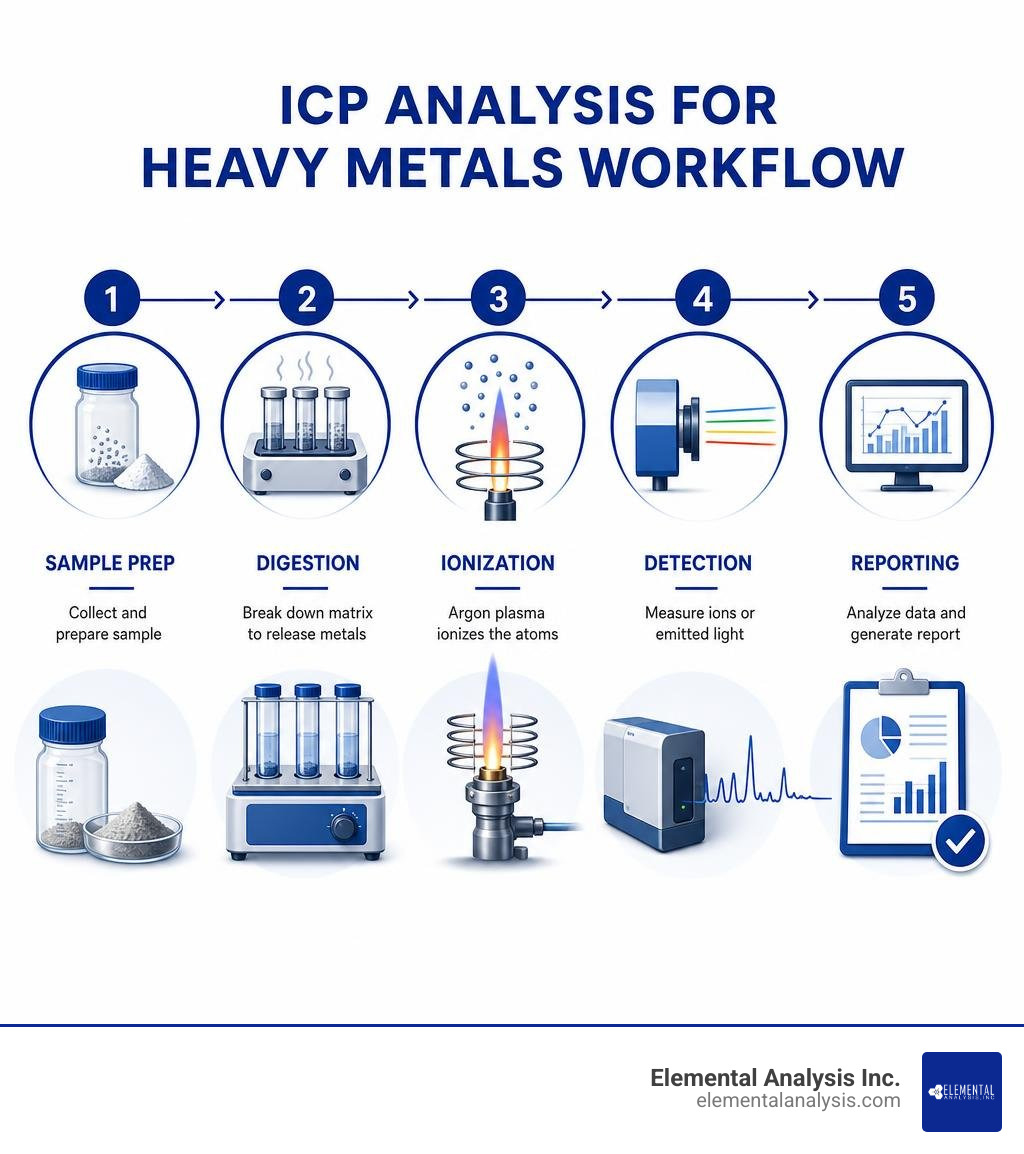
At its core, Inductively Coupled Plasma (ICP) spectroscopy is an analytical powerhouse. By utilizing an extremely hot energy source, it breaks chemical bonds, atomizes elements, and excites or ionizes them so they can be measured.
Whether we are testing a novel pharmaceutical compound, checking municipal water, or assessing the safety of consumer goods, ICP Analysis provides the specificity and dynamic range needed to ensure safety and compliance.
How ICP-MS Works for Trace ICP Analysis for Heavy Metals
Inductively Coupled Plasma Mass Spectrometry (ICP-MS) is the undisputed champion of ultra-trace analysis.
The process begins by introducing a liquid sample into a nebulizer, which turns it into a fine aerosol. This aerosol is swept into an argon plasma torch. By heating argon gas using radiofrequency (RF) energy, we generate a stable plasma at temperatures reaching a blistering 10,000 °C (which, for context, is hotter than the surface of the sun!).
At this extreme temperature, the molecules in your sample are completely ripped apart into individual atoms and then ionized (stripped of an electron to form single-charged positive ions).
These ions are then extracted from the plasma into a high-vacuum mass spectrometer. Here is how the magic happens:
- Separation: The ions pass through a mass analyzer — typically a high-precision quadrupole. By rapidly changing electrical fields, the quadrupole filters the ions based on their specific mass-to-charge (m/z) ratio.
- Detection: The filtered ions hit an electron multiplier detector, which records the impact of each individual ion.
- Quantification: Because the signal is directly proportional to the number of ions hitting the detector, we can measure elements at parts-per-billion (ppb), parts-per-trillion (ppt), and in some optimized cases, parts-per-quadrillion (ppq) levels.
To put that into perspective, detecting an element at 0.1 ppt is the analytical equivalent of finding a single drop of water (50 µL) diluted inside 200 Olympic-sized swimming pools!
The Role of ICP-OES in Elemental Analysis
Inductively Coupled Plasma Optical Emission Spectrometry (ICP-OES) — also known as ICP-AES (Atomic Emission Spectrometry) — takes a different approach to detection.
Instead of measuring the mass of the ions, ICP-OES looks at the light they emit:
- Inside the argon plasma, atoms and ions absorb energy, kicking their electrons into higher, unstable energy states.
- As these excited electrons fall back down to their stable ground states, they release energy in the form of photons (light).
- Every element emits light at highly specific, characteristic wavelengths (its unique optical “fingerprint”).
- A spectrometer separates this light into its constituent wavelengths, and a detector measures the intensity of the light at each wavelength.
ICP-OES is incredibly robust and excels at measuring major and minor elements at parts-per-million (ppm) and high parts-per-billion (ppb) levels. It handles high-dissolved-solids matrices with ease, making it a workhorse for industrial, metallurgical, and raw material testing.
Choosing the Right Technique: ICP-OES vs. ICP-MS
Selecting between these two analytical giants depends heavily on your industry, your target analytes, and your regulatory requirements. If you are analyzing trace contaminants in a pharmaceutical drug product, ICP-MS is often mandatory due to the incredibly low permissible daily exposures (PDEs). If you are profiling bulk minerals or checking waste streams for high-level metals, ICP-OES is usually the faster, more cost-effective choice.
Let’s look at how they compare side-by-side:
| Performance Metric | ICP-OES | ICP-MS |
|---|---|---|
| Typical Detection Limits | ~1 ppb – 100 ppm (ppb-ppm range) | <0.1 ppt – ppb (ppt-ppm range) |
| Linear Dynamic Range | 6 orders of magnitude | 8+ orders of magnitude |
| Sample Throughput | Very fast (30+ elements in <1 min) | Fast (20–30 elements per minute) |
| Isotope Detection | No (measures wavelength only) | Yes (can distinguish isotopes) |
| Matrix Tolerance (TDS) | Up to 10% or more | Generally <0.2% (requires dilution) |
| Capital & Operating Cost | Moderate (~$50,000 – $80,000) | High (~$150,000+) |
| User Skill Required | Moderate | High to Expert |
For labs looking for a comprehensive breakdown of trace metal capabilities, checking specialized guides on Heavy Metals, Minor, & Trace Element Analysis by ICP-MS can provide additional technical context on instrument configurations.
Regulatory Standards and the Shift from Wet Chemistry
Historically, the pharmaceutical and food industries relied on archaic, labor-intensive methods to monitor heavy metals. The most notorious of these was the classic USP <231> method.
Why Pharmacopoeias Replaced Wet Chemical Heavy Metals Tests
For over a century, USP <231> (and its equivalents in the British, Japanese, and European Pharmacopoeias) was the standard. This “wet chemistry” test relied on digesting a sample, reacting it with hydrogen sulfide, and comparing the resulting brownish-black precipitate visually against a lead standard in a Nessler cylinder.
This method had massive, undeniable flaws:
- Subjectivity: It relied entirely on the human eye to judge color intensity.
- Lack of Specificity: It yielded a single collective “heavy metals as lead” value rather than identifying individual toxic species.
- Recovery Loss: The high-temperature furnace preparation step routinely volatilized critical elements. Volatile species like mercury, tin, and selenium were lost to the atmosphere before they could ever react, leading to dangerously low recoveries.
Recognizing these vulnerabilities, regulatory bodies officially retired USP <231> on January 1, 2018. It was replaced by modern, instrument-based protocols: USP <232> (Limits), USP <233> (Procedures), and the harmonized ICH Q3D guidelines.
Meeting USP <233> and ICH Q3D Requirements with ICP-MS
Under the modern framework, elemental impurities are categorized into specific classes based on their toxicity and the likelihood of their occurrence in drug products:
- Class 1 (The “Big Four”): Arsenic (As), Cadmium (Cd), Lead (Pb), and Mercury (Hg). These are highly toxic and must be evaluated in all risk assessments.
- Class 2A: Cobalt (Co), Nickel (Ni), and Vanadium (V).
- Class 2B: Precious metals and catalysts (e.g., Palladium, Platinum, Rhodium, Ruthenium, Thallium, Gold).
- Class 3: Elements with lower toxicity but still regulated depending on the route of administration (e.g., Antimony, Barium, Copper, Lithium).
To validate an analytical method under USP <233>, labs must calculate the J-value for each target element. The J-value represents the concentration of the target element at its Permissible Daily Exposure (PDE) limit, factoring in the maximum daily dose of the drug and the dilution used during sample preparation:
$$J = \frac{PDE}{Max\ Daily\ Dose \times Dilution\ Factor}$$
Using ICP-MS, we can easily verify compliance at concentrations well below 0.5J, ensuring complete patient safety and bulletproof regulatory submissions. For an in-depth look at how dual-view ICP-OES instruments can also be validated for these impurities, you can review the technical validation data in the Analysis of Elemental Impurities in Drug Products Using the iCAP 7400 ICP-OES Duo application note.
Step-by-Step Sample Preparation and Interference Mitigation
The analytical accuracy of any icp analysis for heavy metals is only as good as the sample preparation that precedes it. If you feed a poorly prepared sample into a multi-quarter-million-dollar instrument, you will get highly precise garbage data.

Sample Preparation for Diverse Matrices
To achieve reliable quantification, samples must be completely dissolved into a stable, homogeneous aqueous solution. At Elemental Analysis Inc., we customize our preparation techniques based on the matrix, utilizing our comprehensive A to Z Testing protocols:
- Pharmaceuticals & Organics: These samples are typically subjected to closed-vessel microwave digestion using concentrated, ultra-pure nitric acid ($HNO3$) and hydrogen peroxide ($H2O_2$). The high pressure and temperature inside the Teflon vessels break down complex organic matrices without losing volatile elements like mercury.
- Environmental & Soils: Sediments and particulate matter often contain silicates ($SiO_2$) that shield heavy metals. Dissolving these requires adding hydrofluoric acid ($HF$) to break the silica bonds, followed by a boric acid neutralization step to protect the quartz components of the ICP instrument.
- Biological Tissues & Food: Samples like fish tissue, rice, or vegetables are carefully homogenized, dried, and digested using optimized acid mixtures to prevent carbon buildup on the instrument’s interface cones.
For standardized environmental protocols, analytical chemists frequently reference the Guidelines for Chemical Analysis: Determination of the Elemental Content of Environmental Samples using ICP-MS, which outlines precise preservation and handling procedures.
Mitigating Interferences in ICP Analysis for Heavy Metals
ICP-MS is incredibly sensitive, but it is susceptible to physical, chemical, and spectral interferences. Fortunately, modern technology gives us the tools to bypass these hurdles:
- Spectral & Polyatomic Interferences: These occur when combined isotopes from the plasma, reagents, or matrix share the same mass-to-charge ratio as your target analyte. A classic example is argon chloride ($^{40}Ar^{35}Cl^+$), which has a mass of 75 — exactly the same as the only stable isotope of arsenic ($^{75}As$). If you digest a sample using hydrochloric acid ($HCl$), your arsenic reading will be artificially inflated.
- Helium Collision Mode (KED): To solve this, modern ICP-MS instruments use a collision cell filled with inert helium gas. Because polyatomic molecules (like $ArCl^+$) are physically larger than monatomic ions (like $As^+$), they collide with the helium atoms more frequently, losing kinetic energy. A biased barrier grid then filters out these low-energy polyatomic interferences, leaving a clean path for the target analyte.
- Internal Standards: Physical interferences (such as viscosity differences between samples and standards) and instrument drift are corrected by adding an online internal standard. We select elements that do not naturally occur in the sample — such as rhodium ($^{103}Rh$) or yttrium ($^{89}Y$) — and monitor their signals continuously. If the internal standard signal drops by 10%, the software automatically compensates for the physical suppression across all analytes.
Method Validation and Quality Control
Before any analytical method is used for routine screening, it must undergo rigorous validation to prove its accuracy, precision, and ruggedness. This is especially true for complex biological or environmental matrices, where matrix-induced signal suppression can skew results.
For instance, studies published in Improved analytical method for analysis of toxic/heavy metals in fish by inductively coupled plasma-optical emission spectrometry (ICP-OES) – ScienceDirect demonstrate the importance of calculating matrix-spiked Method Detection Limits (MDLs) rather than relying on simple instrument blanks. Spiking your actual sample matrix ensures your validation data accounts for real-world chemical interferences.
Calibration and Recovery Targets
During a validated run, we adhere to strict quality control parameters:
- Calibration Linearity: We establish multi-point calibration curves using certified reference materials. The correlation coefficient ($r^2$) must be greater than 0.999 for all analytes.
- Spike Recovery: We spike known quantities of target heavy metals into the sample matrices prior to digestion. For a method to be considered robust, the average recovery must fall within the tight target window of 85% to 115% (often achieving 89% to 102% in high-purity pharmaceutical applications).
- Drift Monitoring: We run Continuing Calibration Verification (CCV) standards after every 10 samples to ensure the instrument’s response does not drift by more than 10% over the course of the sequence.
Frequently Asked Questions about ICP Heavy Metal Testing
What are the typical detection limits for ICP-MS vs ICP-OES?
ICP-MS provides detection limits in the parts-per-trillion (ppt) to parts-per-quadrillion (ppq) range, making it ideal for trace contaminant screening. ICP-OES operates primarily in the parts-per-billion (ppb) to parts-per-million (ppm) range, which is perfect for major nutrient profiling, mineral assays, and high-concentration industrial samples.
Which heavy metals are most commonly analyzed in food and pharmaceuticals?
In both food and pharmaceuticals, the primary targets are the “Big Four” toxic elements: lead, cadmium, arsenic, and mercury. In pharmaceuticals, we also heavily monitor residual catalysts like palladium, platinum, nickel, and ruthenium, which may carry over from chemical synthesis steps.
How does sample matrix chemistry affect ICP-MS recovery rates?
High concentrations of dissolved solids, heavy carbon loads, or high acid strengths can suppress ionization in the plasma. However, by utilizing closed-vessel microwave digestion, proper sample dilution, and robust internal standardization, we achieve excellent matrix independence with typical recoveries spanning a highly reliable 89% to 102%.
Conclusion
When it comes to icp analysis for heavy metals, there is no one-size-fits-all approach. Choosing between the ultra-trace sensitivity of ICP-MS and the high-matrix robustness of ICP-OES requires a deep understanding of your sample chemistry, your detection targets, and your industry’s regulatory landscape.
At Elemental Analysis Inc., based in Lexington, Kentucky, USA, we have spent decades helping clients navigate these analytical complexities. As the nation’s premier commercial proton-induced X-ray emission (PIXE) laboratory, we offer a unique suite of both non-destructive and destructive testing services.
Whether you need rapid-turnaround ICP-MS screening for USP compliance, robust ICP-OES analysis for industrial raw materials, or specialized elemental speciation, our team of Ph.D. chemists is here to deliver high-precision data with highly competitive pricing.
Ready to discuss your next testing project? Explore our full suite of analytical capabilities on our Services page or contact our Lexington, KY lab today to request a custom quote.