
The Ultimate Guide to Particle Induced X-Ray Emission
What PIXE Detection Is — and Why It Matters for Elemental Analysis
PIXE detection is one of the most powerful tools available for non-destructive, multi-element trace analysis — and if you need a fast answer, here it is:
What PIXE detection does, at a glance:
| Question | Quick Answer |
|---|---|
| What is it? | A technique that bombards a sample with high-energy ions to produce characteristic X-rays for elemental identification |
| What elements? | Aluminum (Al) through Uranium (U) |
| Detection limits | Down to ~1 ppm for many elements |
| Destructive? | No — samples are returned intact |
| Analysis time | Under 5 minutes for many sample types |
| Analysis depth | Top ~1–50 micrometers of the sample surface |
Think about the analytical challenges facing a busy lab: tight deadlines, trace-level detection requirements, a wide range of sample types, and a need for reliable quantitative data. PIXE addresses all of these.
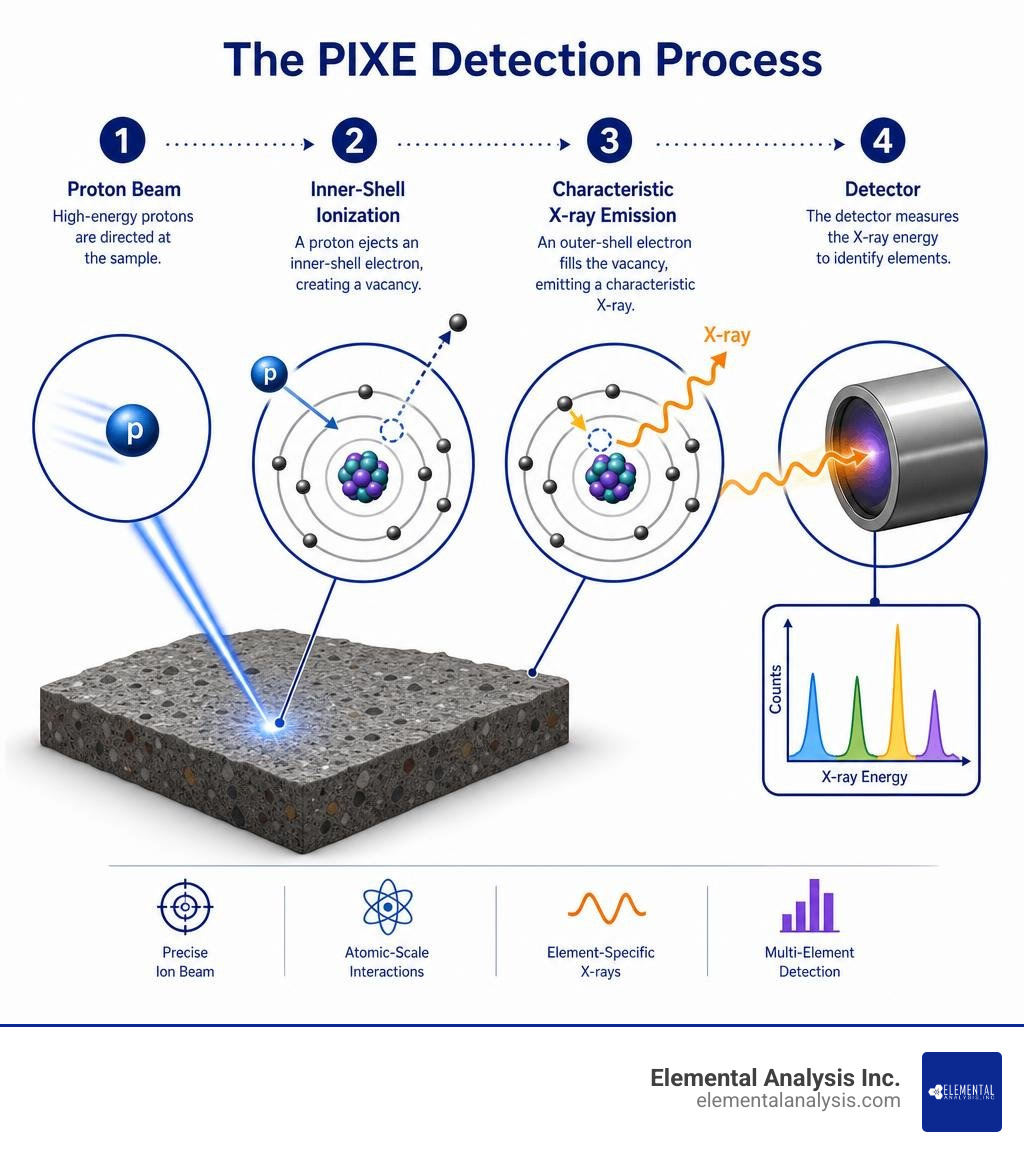
First proposed in 1970 by Sven Johansson at Lund University, PIXE works by directing a beam of high-energy ions — typically protons at around 2–3 MeV — at a sample. This causes inner-shell electrons to be ejected from atoms in the material. As outer-shell electrons drop down to fill those vacancies, they release energy in the form of X-rays. The energy of each X-ray is unique to a specific element, making it possible to identify and quantify multiple elements simultaneously from a single measurement.
The result is a fast, sensitive, and non-destructive analysis method that has found its place across environmental monitoring, aerospace materials, pharmaceutical research, geology, archaeology, and beyond.
What is PIXE and How Does It Work?
To understand how PIXE (Particle Induced X-ray Emission) operates, we have to shrink down to the atomic scale. Imagine a bustling atomic city where electrons orbit the nucleus in neatly organized neighborhoods called shells. When we shoot a high-energy proton beam at this atomic city, it acts like a microscopic bowling ball.
As these fast-moving ions penetrate the sample, they interact with the target’s atoms. A proton can collide with an electron in one of the tightly bound inner shells (usually the K or L shell), knocking it clean out of its orbit. This leaves behind an unstable vacancy—an atomic “pothole” that needs to be filled immediately.
An electron from a higher-energy outer shell quickly transitions down to fill this vacancy. Because the outer shell has a higher energy state than the inner shell, the electron must shed its excess energy to make the move. It does this by emitting a single photon of electromagnetic radiation: a characteristic X-ray.
Because the energy spacing between electron shells is a unique “fingerprint” of each specific element, measuring the energy of these emitted X-rays tells us exactly which elements are present in the sample. This fundamental process is detailed in the Scientific principles of Particle-induced X-ray emission.
One of the greatest physical advantages of PIXE is its incredibly low background noise. Unlike electron-beam methods, which suffer from a massive fog of background radiation called bremsstrahlung (braking radiation) caused by light electrons rapidly decelerating, heavy protons decelerate much more slowly. This means the bremsstrahlung background is largely absent with ion beams, giving PIXE an exceptional signal-to-background ratio.
The Physics of Ion-Sample Interactions in pixe detection
The physics governing pixe detection rely heavily on the energy of the incoming ions. Typically, researchers use 2.0 to 3.0 MeV (mega-electronvolt) protons. This energy range is the “sweet spot” because the ionization cross-section—the mathematical probability of knocking out an inner-shell electron—is maximized when the velocity of the incoming proton closely matches the orbital velocity of the target’s inner-shell electrons.
As the protons travel through the sample, they gradually lose energy through collisions with atomic electrons. This rate of energy loss determines how deep the protons can penetrate and how deep we can probe. For example:
- A 1 MeV proton in air loses energy at a rate of approximately 0.0273 keV/µm.
- A 3 MeV proton in air loses energy at about 0.0126 keV/µm.
Because the protons eventually slow down to the point where they can no longer cause inner-shell ionization, the useful analytical depth of PIXE is typically limited to the top 10 to 50 micrometers of a sample. To explore how these physical principles are applied to real-world testing, you can Learn more about PIXE services.
X-Ray Emission and Spectral Analysis
Once the characteristic X-rays are emitted, they must be captured and counted. This is where energy-dispersive detectors come into play. Historically, Silicon-Lithium [Si(Li)] detectors have been the workhorse of PIXE systems, but modern setups frequently utilize Silicon Drift Detectors (SDDs) due to their higher count rate capabilities and peltier cooling systems.
The detector measures the energy of each incoming X-ray photon and sorts them into a histogram, creating an X-ray spectrum. This spectrum displays intensity (counts) on the Y-axis and energy (usually in keV) on the X-axis.
During spectral analysis, scientists must account for several physical phenomena:
- K and L Transitions: Light elements yield K-alpha and K-beta lines, while heavier elements yield complex L-line families.
- Escape Peaks: Occurring when a characteristic X-ray excites a silicon atom in the detector itself, causing a small energy loss. For instance, the escape-peak contribution is approximately 2% for Calcium K X-rays and decreases as energy increases.
- Spectrum Fitting: Advanced software must be used to resolve overlapping peaks (such as the K-beta peak of one element overlapping with the K-alpha peak of the next element in the periodic table) to ensure precise quantification.
Key Advantages of pixe detection over Other Spectroscopy Techniques
When selecting an analytical technique, you want the best tool for the job. While there are many ways to measure the elemental makeup of a material, pixe detection offers a unique combination of speed, sensitivity, and preservation.
The primary advantage of PIXE is its extraordinary signal-to-background ratio. Because heavy protons do not generate much bremsstrahlung background, PIXE can easily identify trace elements that would be completely lost in the noise of other techniques.
Furthermore, PIXE is highly effective for analyzing insulating samples (like ceramics, glass, or geological specimens) without the need for conductive coatings, which are mandatory in electron microscopy to prevent surface charging.
| Feature / Specification | PIXE (Particle Induced X-Ray Emission) | XRF (X-Ray Fluorescence) | EDS (Energy Dispersive Spectroscopy) |
|---|---|---|---|
| Excitation Source | High-energy ion beam (e.g., 3 MeV protons) | Primary X-ray tube source | Electron beam |
| Detection Limits | ~1 ppm (trace level) | 10–100 ppm | ~1000 ppm (0.1 wt%) |
| Bremsstrahlung Background | Extremely low (high sensitivity) | Low to moderate | High (limits trace detection) |
| Sample Prep | Minimal to none; handles insulators | Minimal; solid/powder/liquid | Requires conductive coating for insulators |
| Destructive? | Strictly non-destructive | Non-destructive | Non-destructive (but vacuum-sensitive) |
| Analysis Depth | Top 10–50 µm | Millimeters (bulk analysis) | Top ~1 µm |
If you are evaluating different analytical paths for your project, you can also Explore our XRF services to see how X-ray fluorescence compares to ion beam methods.
PIXE vs. Electron-Based Methods (EDS/WDS)
Electron-based techniques like Energy Dispersive Spectroscopy (EDS) and Wavelength Dispersive Spectroscopy (WDS) are commonly coupled with Scanning Electron Microscopy (SEM). While excellent for high-resolution imaging, they fall short of PIXE in several key areas:
- Bremsstrahlung Suppression: The light mass of electrons causes them to decelerate violently when hitting a target, creating a massive continuous background spectrum. Protons are nearly 1,836 times heavier than electrons, meaning they plow through the sample with minimal lateral beam deflection and almost zero background noise.
- Trace Element Sensitivity: Because of this background suppression, PIXE can easily achieve detection limits of 1 ppm, whereas SEM-EDS is generally limited to around 1,000 ppm (0.1%).
- Insulating Samples: Electron beams quickly build up a static charge on non-conductive samples, distorting the beam and the resulting spectra. PIXE can handle insulators with ease, making it a favorite for analyzing delicate museum artifacts, historical papers, and biological tissues.
PIXE vs. XRF and ICP Techniques
X-ray Fluorescence (XRF) is another popular non-destructive technique. However, because XRF uses a primary beam of X-rays for excitation, it has a much larger probe size and penetrates much deeper into the sample, making it a bulk analysis tool. PIXE, on the other hand, provides a highly focused micro-beam capability (down to 1 micrometer in microPIXE setups) and is highly surface-sensitive, probing only the top tens of micrometers.
Inductively Coupled Plasma (ICP) techniques (like ICP-OES and ICP-MS) offer incredible sub-ppb detection limits, but they require dissolving the sample in strong acids. If you are working with a rare archaeological coin, a precious gemstone, or a limited-run forensic sample, dissolving it is out of the question! To see if wet chemistry is the right fit for your broader testing requirements, you can Compare with ICP analysis.
Instrumentation and Setup for PIXE Analysis
To perform PIXE, you cannot just plug a handheld device into the wall. It requires a sophisticated infrastructure of particle physics equipment.
At the heart of any PIXE setup is an electrostatic accelerator, such as a Van de Graaff or a tandem accelerator. Tandem accelerators are highly efficient because they charge a terminal in the center of the tank to a high positive voltage, attract negative ions from an ion source, strip away their electrons in a central gas stripper, and then repel the now-positive ions toward the target chamber, effectively doubling the acceleration energy.

Once accelerated, the ion beam passes through a series of steering magnets and collimators. The collimators (typically 3 to 8 mm in diameter, or much smaller for micro-probes) shape the beam. An antiscattering collimator is placed just before the target chamber to clean up any stray ions scattered by the edges of the main collimator, preventing them from striking the aluminum walls of the chamber and generating false background X-rays.
The target chamber itself is maintained under high vacuum—typically between $10^{-3}$ and $10^{-4}$ Pa—using high-speed turbomolecular pumps. This vacuum is vital to prevent the high-energy protons from colliding with air molecules and losing energy before they reach the sample.
Detectors and Data Acquisition Systems for pixe detection
The quality of a pixe detection system is heavily dependent on its detector and the speed of its data acquisition.
A typical Si(Li) or SDD detector has an energy resolution of 160 to 180 eV FWHM (Full Width at Half Maximum) at the Manganese K-alpha line (5.895 keV). Under highly optimized, low-count-rate conditions with long shaping times, high-end detectors can achieve resolutions near 130 eV.
However, modern pixelated detectors, such as those in the Timepix family, face unique challenges like charge sharing. When an X-ray photon strikes near the boundary of neighboring pixels in a hybrid semiconductor detector, the resulting charge cloud can split. This “charge sharing” can lead to multiple counts for a single photon event, distorting the energy spectrum.
Understanding these phenomena is crucial for accurate quantitative imaging, as explored in the Research on charge sharing in pixelated detectors.
Advanced Software and Real-Time Processing
Once the detector collects the raw pulse data, specialized software must process the spectra to extract quantitative elemental concentrations. The global gold standard for PIXE spectrum fitting is the GUPIX engine.
In recent years, software development has taken massive leaps forward. Rather than waiting for a run to finish to see the results, researchers now use dynamic processing tools:
- LivePIXE: This standalone program processes PIXE spectra dynamically every 5 seconds during the actual beam run, giving operators real-time feedback on elemental concentrations.
- TrauPIXE: A batch-processing tool that automatically processes data from multi-detector setups. If a system uses multiple detectors with different filters (e.g., a low-energy detector with no absorber and a high-energy detector with an aluminum absorber), TrauPIXE calculates the relative uncertainties for each element across all detectors and automatically selects the concentration value with the lowest statistical uncertainty.
For a deep dive into how these software tools have revolutionized the speed and accuracy of ion beam analysis, you can read the latest Advances in dynamic PIXE spectra processing.
Practical Applications and Sample Preparation
PIXE’s versatility makes it a multi-disciplinary superstar. Let’s look at some of its primary fields of play:
- Environmental Monitoring: PIXE is widely used to analyze fine particulate air pollution (PM2.5). Because PM2.5 particles are up to 50 times smaller than the width of a human hair, capturing them on thin Teflon or quartz filters and analyzing them directly via PIXE takes under 5 minutes per sample (using a 2.6 MeV proton beam at 10 nA), identifying trace heavy metals that point to specific industrial pollution sources.
- Geology: Geochemists use PIXE to analyze trace elements in mineral grains and rock standards (like diorite, basalt, and bauxite) to map geological formations and locate valuable ore deposits.
- Cultural Heritage: Because it is non-destructive, museum curators rely on PIXE to analyze ancient coins, paintings, and manuscripts without harming them.

A famous example of PIXE’s power in cultural heritage is its use in identifying the chemical makeup of ancient documents. To see this in action, you can Read about the Gutenberg Bible ink analysis.
Sample Preparation Protocols and Limitations
One of the most attractive features of PIXE is that it requires minimal sample preparation. Most solid samples can be loaded directly into the target chamber in their original state.
However, because PIXE only probes the top 10 to 50 micrometers of a sample, surface representativeness is critical. If a sample is highly inhomogeneous (like a raw soil or ceramic specimen), analyzing a single spot will give misleading results.
To overcome this:
- The sample must be ground to a fine powder with particle sizes smaller than 1 to 2 micrometers.
- The powder is mixed with approximately 20% analytical-grade carbon powder (to provide electrical conductivity and prevent charging).
- The mixture is pressed into a flat, solid pellet using a hydraulic press.
Additionally, when analyzing biological samples, researchers must avoid sulfur-containing buffers (such as HEPES, MES, or MOPS) because the sulfur in the buffer will completely mask the natural trace sulfur signals in the cells or proteins.
Complementary Ion Beam Analysis Techniques
While PIXE is outstanding for identifying elements from aluminum to uranium, it is rarely used in isolation. It is part of a suite of Ion Beam Analysis (IBA) techniques that can be run simultaneously in the same target chamber:
- RBS (Rutherford Backscattering Spectrometry): Measures the energy of backscattered protons. It is excellent for profiling light elements and calculating sample thickness, making it the perfect partner to resolve heavy elements that PIXE excels at identifying.
- PIGE (Particle-Induced Gamma-ray Emission): Measures gamma rays produced by nuclear reactions. While PIXE struggles with very light elements, PIGE easily detects elements like Lithium, Beryllium, Boron, Fluorine, and Sodium.
- ERDA (Elastic Recoil Detection Analysis): Used specifically for profiling hydrogen and other very light elements in thin films.
By combining these methods, a lab can achieve a complete elemental profile of a material across the entire periodic table. You can explore how these techniques work hand-in-hand in the Peaslee Lab research on PIXE and PIGE.
Frequently Asked Questions about PIXE Analysis
What elements can be detected using PIXE?
PIXE can reliably detect elements from Aluminum (atomic number $Z = 13$) all the way to Uranium ($Z = 92$). Very light elements (helium through neon) cannot be easily detected because their characteristic X-ray energies are so low that they are absorbed by the detector’s window before they can be counted. To detect these lighter elements, we typically pair PIXE with PIGE.
What are the typical detection limits of PIXE?
Detection limits for PIXE generally range from 0.1 to 10 atomic percent (at%) for major elements, with trace-level sensitivities down to 1 ppm (parts per million) or even 0.1 ppm for highly optimized setups. The exact limit depends on the element, the beam energy, the total collected charge, the filters used, and the detector quality.
Is PIXE completely non-destructive?
Yes, in terms of physical structure, PIXE is highly non-destructive. The sample is returned to you completely intact. However, because the sample is exposed to a high-energy ion beam, delicate organic materials or certain glasses may experience minor color changes or localized heating (beam damage). For highly sensitive cultural heritage objects, we run the beam at very low currents in an helium-atmosphere “external beam” setup to eliminate vacuum stress and minimize thermal effects.
Conclusion
Whether you are tracking down air pollution sources, validating geological reference materials, or verifying the authenticity of a priceless Renaissance painting, pixe detection provides the rapid, highly sensitive, and non-destructive answers you need.
At Elemental Analysis Inc., based in Lexington, Kentucky, we are proud to be the first commercial PIXE laboratory. We offer trace element identification, quantification, and speciation services across a wide range of industries. By combining state-of-the-art ion beam technology with expert scientific support, we deliver both non-destructive and destructive testing options with exceptionally fast turnaround times and highly competitive pricing.
Ready to unlock the atomic secrets of your samples? Contact us for professional PIXE services today, and let our team in Lexington, KY, help you achieve the precise quantitative results your project demands.