
The Ultimate List of Practical XRF Applications
What XRF Applications Cover — and Why It Matters for Your Lab
XRF applications span nearly every industry where knowing the elemental composition of a material matters — and that list is longer than most people expect.
Here’s a quick overview of the most common uses:
| Industry | Typical XRF Use |
|---|---|
| Metals & Alloys | Alloy grade verification, scrap sorting, coating thickness |
| Environmental | Heavy metals in soil, air particulates, water sediments |
| Pharmaceuticals | Elemental impurity verification per ICH-Q3D |
| Mining & Geology | Ore grade, mineral composition, raw material screening |
| Cement & Ceramics | Raw meal monitoring, clinker analysis, glass composition |
| Oil & Petrochemicals | Sulfur, vanadium, and nickel in fuels and crudes |
| Cultural Heritage | Pigment ID, forgery detection, non-invasive artifact analysis |
| Food Safety | Adulteration detection, packaging pigment screening |
| Electronics | RoHS compliance, circuit board elemental verification |
| Battery Recycling | Cathode type identification, black mass composition |
XRF can analyze solids, liquids, powders, and slurries — covering elements from beryllium to uranium, at concentrations from 100% down to sub-ppm levels. It is non-destructive and requires minimal sample preparation in most cases.
If you run a lab in aerospace, pharma, or environmental testing, XRF is likely already part of your workflow — or it should be.
The rest of this guide breaks down exactly how XRF is used across each of these fields, what it can and can’t do, and how it compares to techniques like ICP-MS and AAS.
What is X-Ray Fluorescence (XRF) Spectroscopy?
To understand why the list of xrf applications is so vast, we first need to look at the elegant physics that powers X-ray fluorescence spectroscopy.
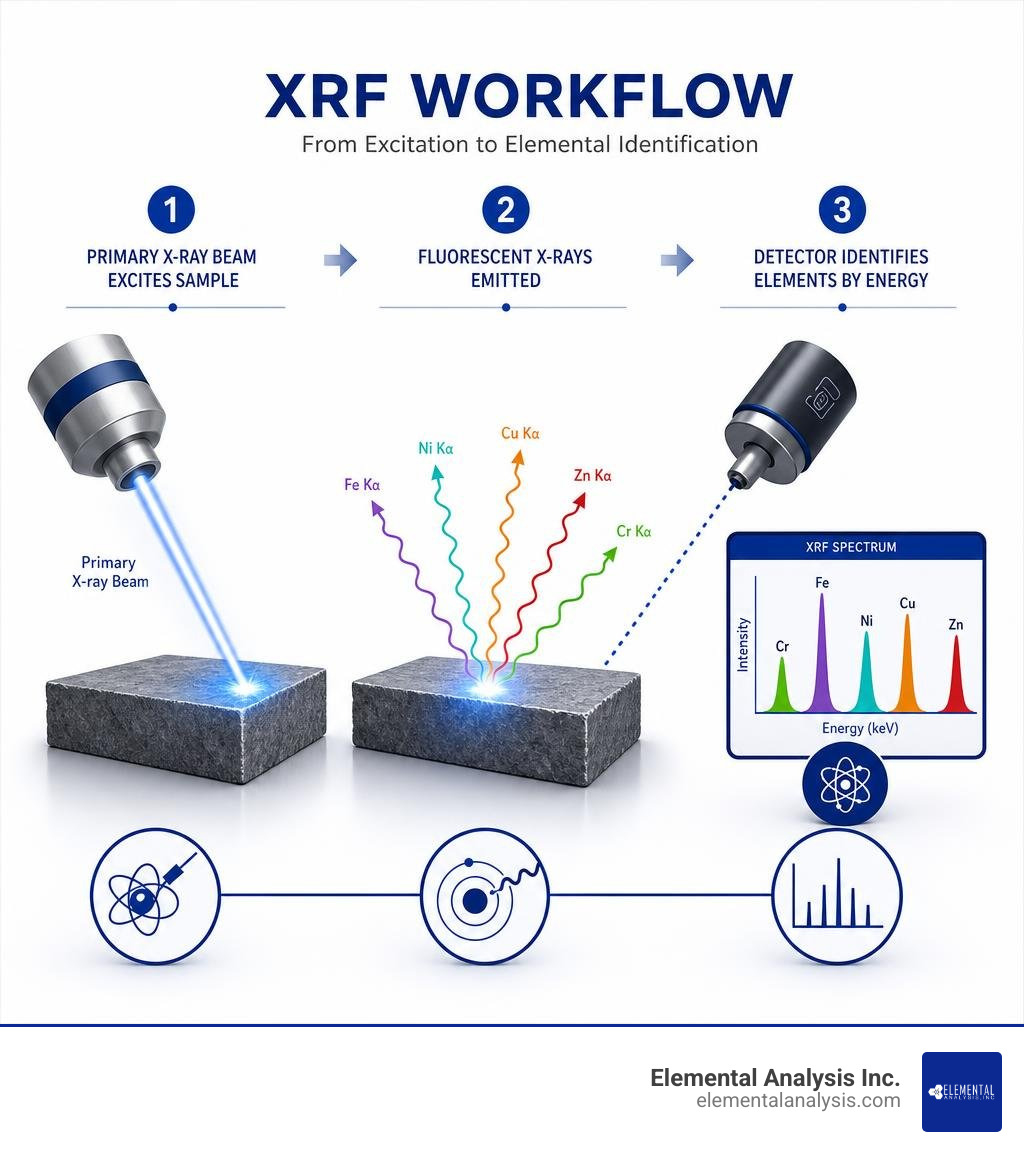
At its core, XRF is an atomic emission method. The process begins inside the instrument with an X-ray tube that generates a high-energy primary beam of X-rays. When this primary beam strikes the sample, it interacts directly with the atoms inside. If an incoming X-ray has enough energy, it knocks an inner-shell electron completely out of its orbit.
This leaves the atom in an unstable, highly excited state. To regain stability, an electron from a higher-energy outer shell immediately drops down to fill the vacancy. As it falls into the inner shell, it must release its excess energy. It does this by emitting a secondary X-ray photon.
This emitted photon is called fluorescent X-ray radiation. Because the energy difference between electron shells is fixed and unique for every single element, the emitted X-ray has a highly specific, characteristic energy. By measuring the energy (or wavelength) of these emitted photons, we can identify which elements are present (qualitative analysis). By counting the number of photons emitted at a specific energy over a set period, we can calculate how much of that element is in the sample (quantitative analysis).
XRF instruments can analyze solids, liquids, slurries, and loose powders. They are capable of detecting elements ranging from beryllium (Be) to uranium (U). Depending on the power and configuration of the instrument, detection limits range from major concentrations (100 wt%) down to parts-per-million (ppm) levels. High-power benchtop and laboratory systems can even reach sub-ppm levels (hundreds of parts-per-billion, or ppb) for certain elements under optimized conditions.
However, XRF does face challenges with light elements (typically elements below sodium, atomic number 11, or fluorine, atomic number 9). The characteristic X-rays emitted by light elements are very weak and easily absorbed by the air or the sample itself. Furthermore, XRF is subject to matrix effects, where the physical structure or other elements in the sample absorb or enhance the signal of the target element.
To overcome these challenges, XRF technology is divided into two primary types: Energy Dispersive (EDXRF) and Wavelength Dispersive (WDXRF).
| Performance Metric | Energy Dispersive XRF (EDXRF) | Wavelength Dispersive XRF (WDXRF) |
|---|---|---|
| How It Works | Measures the energy of fluorescent X-rays directly using a semiconductor detector. | Uses an analyzing crystal to diffract X-rays, separating them by wavelength before detection. |
| Energy Resolution | Moderate (typically 145 eV). | High (typically 35 eV), which minimizes spectral overlaps. |
| Elemental Range | Sodium (Na) to Uranium (U). | Beryllium (Be) to Uranium (U). |
| Detection Limits | Typically down to 10–100 ppm. | Down to sub-ppm levels (hundreds of ppb). |
| Speed & Throughput | Fast for simultaneous multi-element screening. | Extremely high throughput (up to 480 samples per day on simultaneous systems). |
| Cost & Footprint | Economical, compact, and often portable. | Larger laboratory footprint, higher initial investment. |
If you are looking to integrate this powerful technology into your workflow, we invite you to explore our specialized XRF analysis services and see how they fit into our comprehensive A to Z Testing services portfolio.
Industrial and Scientific XRF Applications
Because XRF is non-destructive, requires little to no sample preparation, and delivers rapid results, it is a cornerstone of modern industrial workflows, quality control, regulatory compliance, and academic research and development.

Metallurgy and Advanced Additive Manufacturing
In the metals industry, there is no room for guesswork. XRF is widely utilized for verifying alloy grades, identifying scrap metal, and monitoring raw materials. Whether confirming that an aircraft component is made of the exact titanium grade required or sorting tons of scrap metal by alloy chemistry, XRF provides results in seconds.
Beyond bulk metals, XRF is crucial for analyzing slags, raw materials, and the thickness and composition of industrial coatings. In the rapidly growing field of additive manufacturing (3D printing), XRF is used to examine the quality and purity of 3D printing metal powders. Even minor elemental contamination in a metal powder batch can ruin the structural integrity of a printed aerospace or medical component. XRF ensures the powder meets strict elemental specifications before production begins.
Environmental Monitoring and Geological XRF Applications
Environmental scientists and geologists rely heavily on XRF for both laboratory and field-based analyses. In soil surveys, portable XRF instruments allow researchers to map heavy metal contamination (such as lead, arsenic, and cadmium) in real time directly in the field. This is vital for forestry commissions monitoring soil health, or urban developers assessing brownfield sites.
XRF is also used to screen air samples for low concentrations of toxic airborne particulates collected on filters. In geological exploration, mining companies use XRF to determine ore grades on-site, allowing them to make immediate operational decisions. It is also an effective tool for analyzing sewage sludge and river water sediments to monitor industrial runoff.
To read more about how field-ready analytical techniques are expanding, check out this Scientific research on environmental XRF.
Art Conservation and Cultural Heritage XRF Applications
In heritage science, preserving the physical integrity of an artifact is paramount. XRF is highly valued because it is non-destructive, allowing scientists to analyze precious paintings, sculptures, and ancient metals without taking physical samples.
One of the most interesting xrf applications in art conservation is pigment identification and forgery detection. For example, titanium white pigment only became commercially available to artists around 1919. If a portable XRF scan of a painting purported to be from the 18th century detects significant amounts of titanium, it provides immediate, conclusive evidence of a modern forgery.
However, portable XRF does have limitations; it cannot identify chemical compounds directly, only elements, and it can suffer from stratigraphic ambiguity (unable to easily tell if an element is in the top paint layer or the canvas primer below). To overcome this, researchers are turning to advanced imaging.
You can read more about these non-invasive breakthroughs in the Application of a Full-Field macro-XRF imaging spectrometer to non-invasive investigation of elemental composition in three-dimensional artworks | npj Heritage Science .
For a deeper look into the practical boundaries of field-based authentication, see this Critical guide on portable XRF limitations. Additionally, researchers have successfully adapted handheld instruments into automated scanners to map pigments in real time, as detailed in this paper on Real-time handheld XRF scanning. For complex, non-planar 3D artifacts, combining X-ray diffraction with fluorescence on a single mobile platform has proven highly effective, as demonstrated in this study on Joint XRF and XRPD mobile analysis.
At Elemental Analysis Inc., we have a rich history of applying advanced physics to historical mysteries. Our team has worked on legendary cultural heritage projects, including analyzing artifacts from The Wreck of the Nuestra Senora de Atocha and evaluating structural metals for the Statue of Liberty Centennial Celebration.
Medicine, Pharmaceuticals, and Food Safety
In medicine and dentistry, XRF is used for diagnostic purposes, tissue sampling, and analyzing dental restorations. For instance, XRF can analyze metallic dental debris in oral mucosa in just a few minutes, or detect trace accumulations of toxic metals like tungsten in lung biopsies. In the pharmaceutical industry, XRF is utilized to verify drug quality and ensure compliance with strict elemental impurity standards like ICH-Q3D.
Food safety is another critical domain. XRF can detect food adulteration, such as identifying toxic lead chromate added to ground cinnamon to boost its weight and color. It is also used to screen food packaging for heavy metal pigments (like copper-based blues or titanium whites) to ensure they do not leach into food products.
Furthermore, XRF plays a vital role in the transition to green energy. During lithium-ion battery recycling, handheld XRF instruments are used to instantly sort cathode scrap films (such as NCM, LFP, or NCA chemistries) and analyze “black mass” powders. This allows recycling facilities to quickly estimate the economic value of incoming materials and direct them to the correct chemical processing lines.
For those interested in the future of laboratory-scale chemical imaging without the need for massive synchrotron facilities, explore this Hyperspectral X-ray imaging research demonstrating next-generation detector technology.
How XRF Compares to Other Elemental Analysis Techniques
While XRF is incredibly versatile, it is not the only tool in the analytical chemistry shed. Choosing the right technique depends on your detection limits, sample type, and whether you can afford to destroy the sample.
- ICP-MS (Inductively Coupled Plasma Mass Spectrometry): ICP-MS is the gold standard for trace and ultra-trace analysis, routinely reaching parts-per-trillion (ppt) detection limits. However, it is a destructive technique. Samples must be digested in strong acids, which takes time and destroys the physical sample. XRF, by contrast, is completely non-destructive and requires little to no sample preparation, though its detection limits are generally higher (ppm to sub-ppm).
- ICP-OES (Inductively Coupled Plasma Optical Emission Spectrometry): Similar to ICP-MS, ICP-OES offers excellent detection limits for a wide range of elements but requires liquid sample introduction. It is ideal for high-throughput liquid testing but lacks the ease of XRF when dealing with solid, irregular objects.
- AAS (Atomic Absorption Spectroscopy): AAS is a reliable, single-element technique with good sensitivity. However, it is slow if you need to analyze multiple elements, as you must change light sources for each element. XRF can analyze dozens of elements simultaneously in a single run.
- OES (Optical Emission Spectroscopy): OES is widely used in metallurgy for rapid alloy testing. It is incredibly fast but requires striking an electrical arc or spark against the sample surface, which leaves a small burn mark. XRF is completely non-destructive and leaves no marks.
- PIXE (Proton Induced X-ray Emission): PIXE is a highly specialized ion-beam technique that offers extraordinary sensitivity for trace elements in thin samples or surface layers. As the home of the first commercial PIXE laboratory, Elemental Analysis Inc. frequently uses PIXE alongside XRF to solve complex analytical puzzles. A famous example of this high-precision technique in action can be read in our study on the Gutenberg Bible Ink Type Analysis Using PIXE.
Frequently Asked Questions about XRF Spectroscopy
What are the main limitations of XRF analysis?
While XRF is incredibly powerful, it has a few hard physical limits:
- Light Element Sensitivity: It struggles to detect elements lighter than sodium (such as carbon, hydrogen, and lithium) because their low-energy characteristic X-rays are easily absorbed before reaching the detector.
- Chemical State: XRF only tells you which elements are present and in what quantities. It cannot tell you the oxidation state of an element or what molecular compounds it forms (for example, it can detect iron, but it cannot tell you if that iron is part of magnetite or hematite).
- Isotopes: XRF cannot distinguish between different isotopes of the same element.
- Penetration Depth: XRF is primarily a surface-sensitive technique, as the X-rays only penetrate a few micrometers to a few millimeters into the material, depending on the sample’s density.
What sample preparation is required for accurate XRF results?
One of XRF’s biggest selling points is its minimal sample preparation. However, for highly accurate, quantitative laboratory results, sample preparation is key to achieving a homogeneous representation of the material:
- Loose Powders: Can be poured directly into thin-film plastic sample cups and analyzed.
- Pressed Pellets: Finely ground powders are mixed with a binder and pressed under high pressure to create a smooth, flat pellet, which minimizes surface roughness effects.
- Fused Beads: For geological samples, the powder is melted with a borate flux at high temperatures to create a homogeneous glass disc. This completely eliminates mineralogical and grain-size matrix effects.
- Liquids: Can be analyzed directly in specialized sample cups, provided the instrument is configured to run under a helium atmosphere rather than a vacuum (which would cause the liquid to boil away).
How do EDXRF and WDXRF differ in performance?
EDXRF is generally more cost-effective, has a smaller physical footprint, and is excellent for rapid, multi-element screening in portable or benchtop configurations. WDXRF, on the other hand, provides superior energy resolution (which prevents overlapping elemental peaks), has much lower detection limits (down to sub-ppm levels), and is highly suited for high-throughput, automated industrial quality control where extreme precision is required.
Conclusion
From verifying the purity of 3D printing powders to detecting art forgeries and analyzing heavy metals in local soils, the range of xrf applications is vast. It represents the perfect balance of speed, non-destructive capability, and multi-element sensitivity.
At Elemental Analysis Inc., based in Lexington, Kentucky, we combine decades of expertise with cutting-edge analytical tools. As the first commercial PIXE laboratory, we pride ourselves on offering both non-destructive and destructive testing services, trace element identification, and speciation with fast turnaround times and highly competitive pricing.
Whether you need routine quality control or specialized research and development support, our team is ready to assist. Please visit our Elemental Analysis Services page to view our full suite of capabilities, or reach out directly to Schedule XRF Analysis for your next project.