
Decoding Hallmarks for Antique Jewelry Metal Verification
When Looks Aren’t Enough: The Case for Antique Jewelry Metal Verification
Antique jewelry metal verification is the process of confirming the true metal composition of old jewelry pieces — and it matters far more than most buyers and collectors realize.
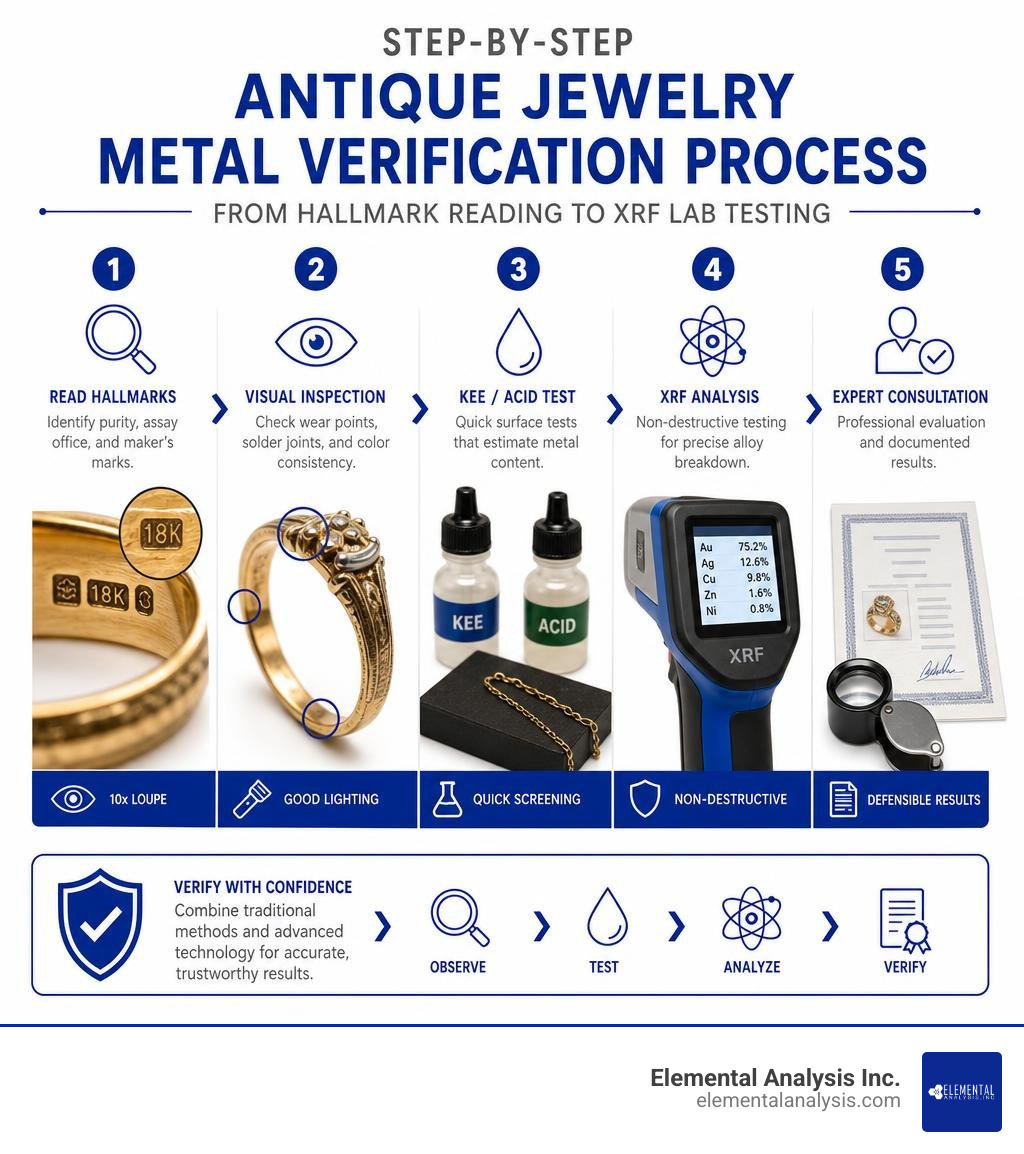
Quick answer: How do you verify antique jewelry metal?
- Check hallmarks — Look for stamped purity marks (e.g., 750, 925, 18K), assay office symbols, and maker’s marks using a 10x loupe.
- Inspect visually — Examine wear points, solder joints, and color consistency for signs of plating or repairs.
- Run a KEE or acid test — Quick surface tests that estimate metal content, best used together.
- Use XRF analysis — The gold standard for non-destructive, precise alloy breakdown including trace elements.
- Consult an expert — For high-value or unmarked pieces, professional lab testing provides documented, defensible results.
A piece stamped “18K” isn’t always 18K. A mark that looks official can be worn, forged, or misapplied. And antique jewelry — made in an era before standardized alloys and precision manufacturing — adds layers of complexity that modern testing methods were never originally designed for.
The challenge is real. Nineteenth-century jewelers hand-mixed their own alloys. Workshop recipes varied. Hallmarking tolerances were wider than today. Metals were recycled, repaired, and re-soldered across decades. The result? Even genuine antique pieces can test slightly above or below their stamped purity — not because they’re fake, but because of how they were made.
For anyone buying, selling, appraising, or insuring antique jewelry, that uncertainty has direct financial consequences.
This guide walks through every major verification method — from basic acid tests to laboratory-grade X-ray fluorescence (XRF) — and explains exactly when each one is appropriate.
Why Antique Gold and Silver Purity Varies from Stamped Marks
When testing a modern piece of gold jewelry, you expect the metallurgical results to match the stamp exactly. If a modern ring is stamped 14K, it must contain at least 58.5% pure gold. However, when performing antique jewelry metal verification, we frequently encounter pieces that test slightly above or below their official stamps.
This variation does not necessarily mean the piece is a counterfeit. Historically, precious metal purity was subject to several factors that simply do not exist in today’s highly regulated, automated manufacturing environments:
- Hand-Alloying and Workshop Recipes: Before the advent of computerized induction melters, jewelers alloyed gold and silver by hand. A master jeweler would melt pure gold alongside copper, silver, or zinc using a blowpipe or a small coal furnace. Because these workshop recipes were mixed in small batches using rudimentary scales, minor human errors were common.
- Wider Hallmarking Tolerances: Historically, assay laws allowed for a “remedy” or tolerance. In the United Kingdom and continental Europe, minor negative deviations were legally permitted to account for the limitations of hand-refining. For example, a piece of gold stamped 18K might legally pass assay even if it tested at 17.5K.
- Recycled Metals: Antique workshops constantly recycled scrap metal, old coins, and damaged jewelry. Every time gold or silver is re-melted, some of the base metals (like zinc or copper) oxidize and burn off, which can unexpectedly raise or lower the final purity of the alloy.
Historical Factors Influencing Antique Jewelry Metal Verification
Understanding the specific historical era of a piece is critical to interpreting its metal purity.
During the Georgian Era (1714–1837), gold was highly scarce. Jewelers custom-alloyed metals to achieve specific, warm color tones. Gold of 18K, 15K, and even lower purities like 9K (introduced legally in Britain in 1854) were used. Solder joints from this era often utilized lower-karat gold, which can skew overall purity readings.
In the Victorian Era (1837–1901), hand-alloying remained the standard, but the scale of production increased. The introduction of “bloomed gold”—a technique where a finished karat-gold piece was dipped in an acid bath to dissolve base-metal alloys from the surface, leaving a velvety layer of 24K pure gold—created pieces that test as pure gold on the surface but are lower-purity underneath.
It wasn’t until the late 20th century that “plumb” gold laws were strictly enforced. In the United States, for instance, the National Gold and Silver Marking Act was amended in 1981 to require that the actual purity of a gold item match the stamped mark within three parts per thousand (effectively eliminating the old historical tolerance of up to half a karat).
When evaluating these historical nuances, collectors must look beyond the stamp. For a deeper dive into how design, construction, and historical context intersect, you can consult this Guide to identifying antique jewelry marks.
Decoding the Stamps: Hallmarks, Maker’s Marks, and Assay Office Marks
For many, the first step in antique jewelry metal verification is reading the tiny stamps impressed into the metal. A complete set of antique hallmarks is a historical record, often packing a massive amount of data into a space no larger than a pinhead.
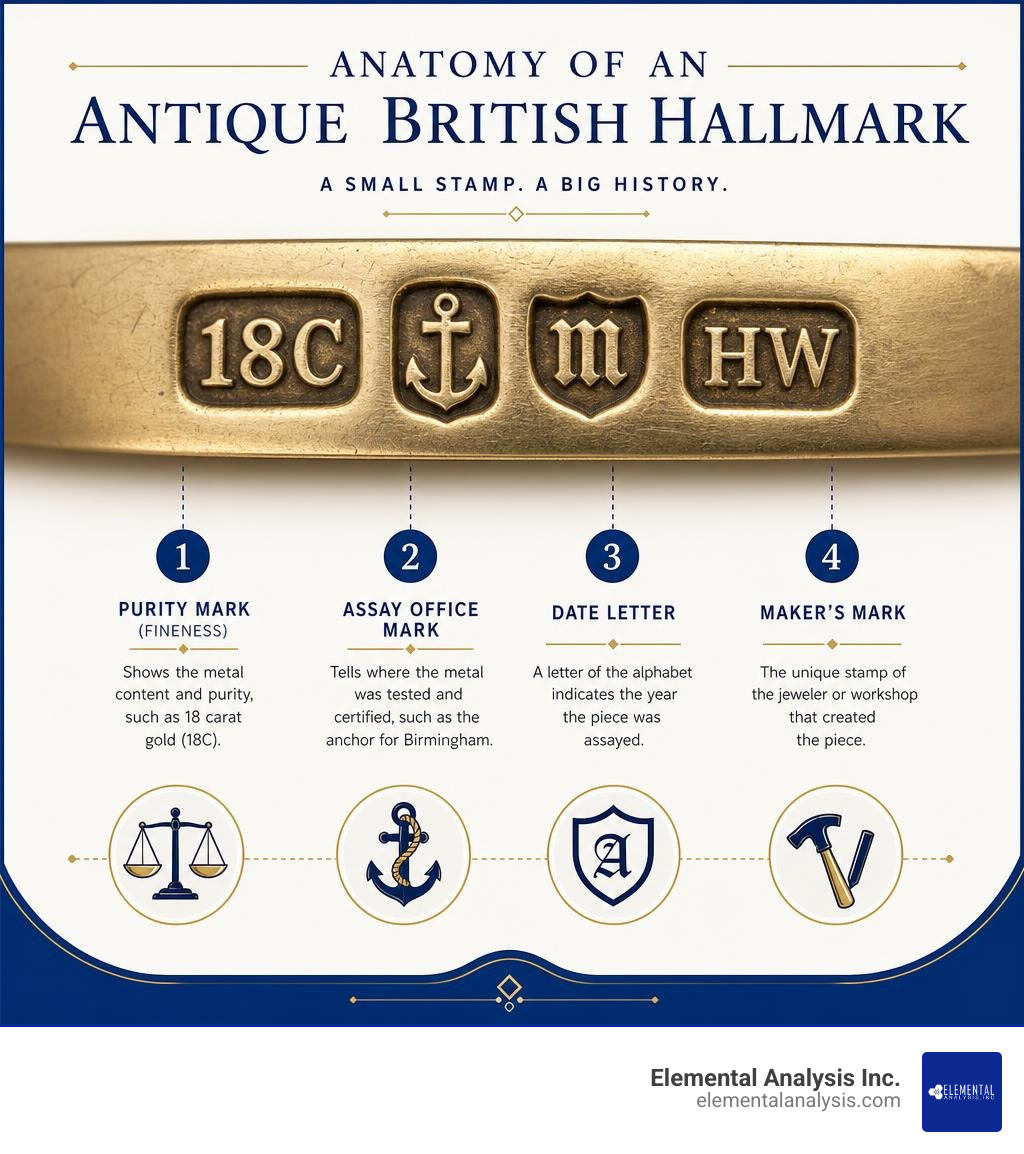
A traditional hallmark system, such as the British system, typically includes:
- The Purity Mark (Fineness): Indicates the metal content. This may be expressed in karats (e.g., 9C, 12C, 15C, 18C) or millesimal fineness (e.g., 375 for 9K, 585 for 14K, 750 for 18K, 925 for sterling silver).
- The Maker’s Mark: The unique stamp of the workshop or jeweler responsible for the piece (often initials inside a geometric shape).
- The Assay Office Mark: A symbol indicating where the metal was tested and certified (e.g., an anchor for Birmingham, a leopard’s head for London, a crown for Sheffield).
- The Date Letter: A letter of the alphabet in a specific font and shield shape that indicates the exact year the piece was assayed.
Other countries used pictorial marks. For example, France used an eagle’s head to denote 18K gold and a boar’s head or crab for silver. To understand how to read these intricate stamp configurations, refer to this Master guide to jewelry hallmarks.
What to Do When Hallmarks Are Missing or Worn
Relying solely on hallmarks is a dangerous strategy. Over decades of wear, stamps can easily become illegible or disappear entirely.
- Natural Wear Patterns: Rings are resized, which often involves cutting out the section of the band containing the hallmarks. Chains are fitted with replacement clasps, discarding the original stamped end-links.
- Polishing: Generations of enthusiastic polishing can wear down hand-stamped marks until they are nothing but faint, smooth depressions.
- Intentional Alterations: Brooches converted into pendants, or earrings made from old cuff links, frequently lose their marks during the conversion process.
When marks are missing, you must rely on visual inspection, style analysis, and physical testing. Look at the under-gallery of rings for hand-tool marks, check the style of the hinges and clasps, and evaluate the gemstone cuts. If you need to correlate design styles with specific eras to narrow down a date, you can read about Dating antique jewelry by design style.
Testing Methods for Antique Jewelry Metal Verification
When visual inspection is not enough, physical and chemical testing must be used. These methods range from 2,500-year-old techniques to cutting-edge laboratory spectroscopy.
The most common testing methods differ significantly in their accuracy, practicality, and potential to damage a delicate antique:
- Touchstone Testing: This classic method involves rubbing the jewelry piece against a dark, slightly abrasive stone (basalt) to leave a metal streak. Acid is then applied to the streak to see if it dissolves. While useful, it is highly subjective and only detects fineness within 10 to 20 parts per thousand.
- Electronic Testers (KEE): These devices measure the electrical conductivity of the metal’s surface. They are highly portable and fast, but they can be inaccurate if the surface of the jewelry has been treated, plated, or altered.
- Fire Assay: The most accurate method known (accurate to 2 to 3 parts per 10,000). However, it is destructive. It requires melting down a portion of the jewelry, making it completely unsuitable for preserving the historical value of antique pieces.
| Testing Method | Accuracy | Non-Destructive? | Best Used For | Limitations |
|---|---|---|---|---|
| KEE / Electronic | Within ~2 Karats | Yes | Quick field testing of solid gold | Surface-level only; cannot detect heavy plating |
| Acid / Touchstone | 10–20 parts per 1,000 | Minimally Destructive (requires scratching) | Low-to-mid value items; quick verification | Can damage delicate patinas; subjective color readings |
| XRF Spectroscopy | High Precision (0.01%) | Yes | High-value antiques; full alloy analysis | High equipment cost; surface/near-surface only |
KEE and Acid Testing: Practicality and Limitations
Acid and electronic (KEE) testing are the workhorses of the estate jewelry trade, but they come with severe limitations when applied to antiques.
Acid testing relies on scratching the piece against a touchstone. For a common modern ring, this is acceptable. For an irreplaceable 18th-century Georgian ring, scratching the metal can destroy a hand-applied finish or a delicate, historic patina. Furthermore, acid testing only evaluates the outermost layer of metal. If an antique item is heavily gold-filled or gold-plated, the scratch may not go deep enough, resulting in a false positive for solid gold.
Electronic testers, like the KEE tester, work by measuring the electrical resistance of a liquid contact point on the metal. While they are non-destructive and do not require harsh acids, they only perform a surface contact test. If a piece is gold-plated base metal, an electronic tester will read the gold plating and report the item as solid gold.
Advanced XRF Testing for Antique Jewelry Metal Verification
To bypass the destructive limitations of acid and the shallow surface readings of electronic testers, professional appraisers turn to X-ray Fluorescence (XRF).
XRF testing works by firing low-energy X-rays at the jewelry piece. This excites the atoms in the metal, causing them to emit secondary (fluorescent) X-rays. Because every element emits a unique energy wavelength, the XRF spectrometer can read these returning signals to produce a complete, non-destructive breakdown of the alloy’s composition.
Instead of simply telling you “14K Gold,” an XRF analyzer provides a precise breakdown:
- Gold: 58.4%
- Copper: 29.1%
- Silver: 8.2%
- Zinc: 4.1%
- Trace Elements (e.g., Nickel, Iron, Platinum): 0.2%
This level of detail is invaluable for antique jewelry metal verification. For example, if a client has a severe nickel allergy and wants to purchase a vintage white gold chain, XRF can confirm the presence of nickel down to trace levels. Additionally, because modern alloys use highly standardized, uniform ratios, an XRF reading that shows highly irregular, hand-alloyed ratios is a strong indicator of historical authenticity.
Spotting Repairs, Solder Joints, and Replaced Components
An antique jewelry piece is rarely a single, uniform block of metal. Over its long life, it may have undergone repairs, size adjustments, or component replacements.
When verifying metal, you must test multiple points on the same piece. A Victorian brooch might feature:
- An original 15K gold decorative face.
- A replaced 9K gold pin stem added during a 1920s repair.
- Solder joints made of a low-melting-point silver-copper-zinc alloy.
- A thin surface layer of “bloomed gold” or a gold wash.
Using a single point test on the pin stem would lead you to believe the entire piece is low-purity 9K gold, while testing only the front might lead you to believe it is high-purity gold.
Solder lines are particularly telling. Old gold solder used in the 19th century often appears as a slightly different shade of yellow or green along the seams. Modern solder repairs, however, will show up instantly on an XRF scan due to their modern alloy signatures (often containing higher percentages of cadmium or indium to lower the melting point). For a comprehensive guide on identifying these complex metallurgical anomalies, consult this Scientific guide to metal composition testing.
Safety, Practicality, and Destructive vs. Non-Destructive Testing
When conducting metal verification, safety and preservation must be balanced:
- Acid Handling Precautions: Nitric and hydrochloric acids are highly corrosive. They can cause severe chemical burns and ruin your work surface. If you must use acid testing, always wear protective gloves, work in a well-ventilated area, and keep a neutralizing solution (like water mixed with baking soda) nearby.
- Preserving Patina: A dark, rich patina on silver or a warm oxidation layer on low-karat gold takes centuries to form. Harsh chemicals or abrasive scratching can strip this patina instantly, reducing the collector value of the piece by up to 50%.
- Physical Screening (Heft and Magnetism): Before applying any chemical or electronic tests, perform basic physical checks. Precious metals have a high specific gravity (platinum is 21.40, gold is 19.36, and silver is 10.53). Base metals feel light and “tinny” by comparison. Furthermore, a strong neodymium magnet should never attract gold, silver, or platinum (though some antique cobalt-platinum alloys may show a very slight magnetic pull).
A Collector’s Step-by-Step Guide to Authenticating Antique Metals
If you are evaluating an antique piece at an estate sale, auction, or shop, follow this systematic approach to verify the metal with confidence:
- Examine Under 10x Magnification: Use a high-quality triplet jeweler’s loupe. Inspect the entire piece—front, back, edges, and findings. Look for worn hallmarks, maker’s marks, and signs of plating wear (such as base metal showing through on high-friction areas like clasp hinges or ring shanks).
- Conduct Physical Tests: Perform the magnet test. If the piece is unmounted, perform a specific gravity test using a digital scale and a cup of water to verify its density.
- Perform Surface Testing (If Safe): If the piece is low-to-medium value and has no delicate patina, perform a touchstone acid test on an inconspicuous area (like the inside of a ring band).
- Analyze Solder and Repairs: Look for color variations along joints. Check if the pin stems, clasps, or jump rings match the metal color and wear patterns of the main body.
- Seek Professional Analysis: For high-value, rare, or highly complex pieces, do not guess. Seek professional laboratory testing.
For a practical, hands-on breakdown of how to execute these steps on gold specifically, follow this Five-step gold testing guide.
Frequently Asked Questions about Antique Jewelry Metal Verification
What is the most accurate non-destructive method for verifying antique jewelry metals?
X-ray Fluorescence (XRF) spectroscopy is the most accurate non-destructive method. It provides a complete percentage breakdown of all metals present in an alloy without scratching, melting, or damaging the historic piece.
Why does my antique 18K gold ring test as 17K?
Historically, gold was alloyed by hand in small workshop batches, and assay laws allowed for wider purity tolerances. A minor negative variation is incredibly common in genuine antique jewelry and is often a sign of historical, hand-crafted production rather than fraud.
Can electronic gold testers detect gold-plated or gold-filled antique jewelry?
No. Electronic testers only measure the electrical conductivity of the metal’s surface where the probe makes contact. If a piece is heavily gold-plated or gold-filled, the tester will read the outer gold layer and falsely report it as solid gold.
Conclusion: Partnering with Elemental Analysis Inc.
When high-value acquisitions, legal valuations, or historical research demand absolute certainty, basic field tests are simply not enough. True peace of mind in antique jewelry metal verification requires laboratory-grade scientific analysis.
At Elemental Analysis Inc., located in Lexington, Kentucky, we specialize in advanced analytical chemistry services. As the world’s first commercial Proton-Induced X-ray Emission (PIXE) laboratory, we offer unmatched trace element identification, quantification, and speciation services across multiple industries.
Whether you need completely non-destructive testing to preserve a priceless museum artifact or fast, high-precision alloy breakdowns for commercial valuation, our state-of-the-art facilities deliver rapid turnaround times and highly competitive pricing. We help collectors, historians, and jewelers unlock the exact elemental secrets of their most valuable pieces.
Ready to verify your collection with scientific precision? Explore our More info about elemental analysis services to learn how our Lexington-based laboratory can support your authentication needs.