
How to Choose a Pesticide Residue Testing Lab
For pesticide residue testing, choose a lab that can test your specific food or product for the pesticides you need to check. Ask for its validated analyte list, reporting limits, quality controls, and sample-handling instructions. Confirm that its reporting limits are low enough for the rules in your target market. If the results will support a regulatory decision, check the lab’s accreditation and chain-of-custody process.
The instrument is only part of the test. Representative sampling, careful preparation, and reliable extraction all affect the result. This guide explains the standards and methods behind a report you can trust.
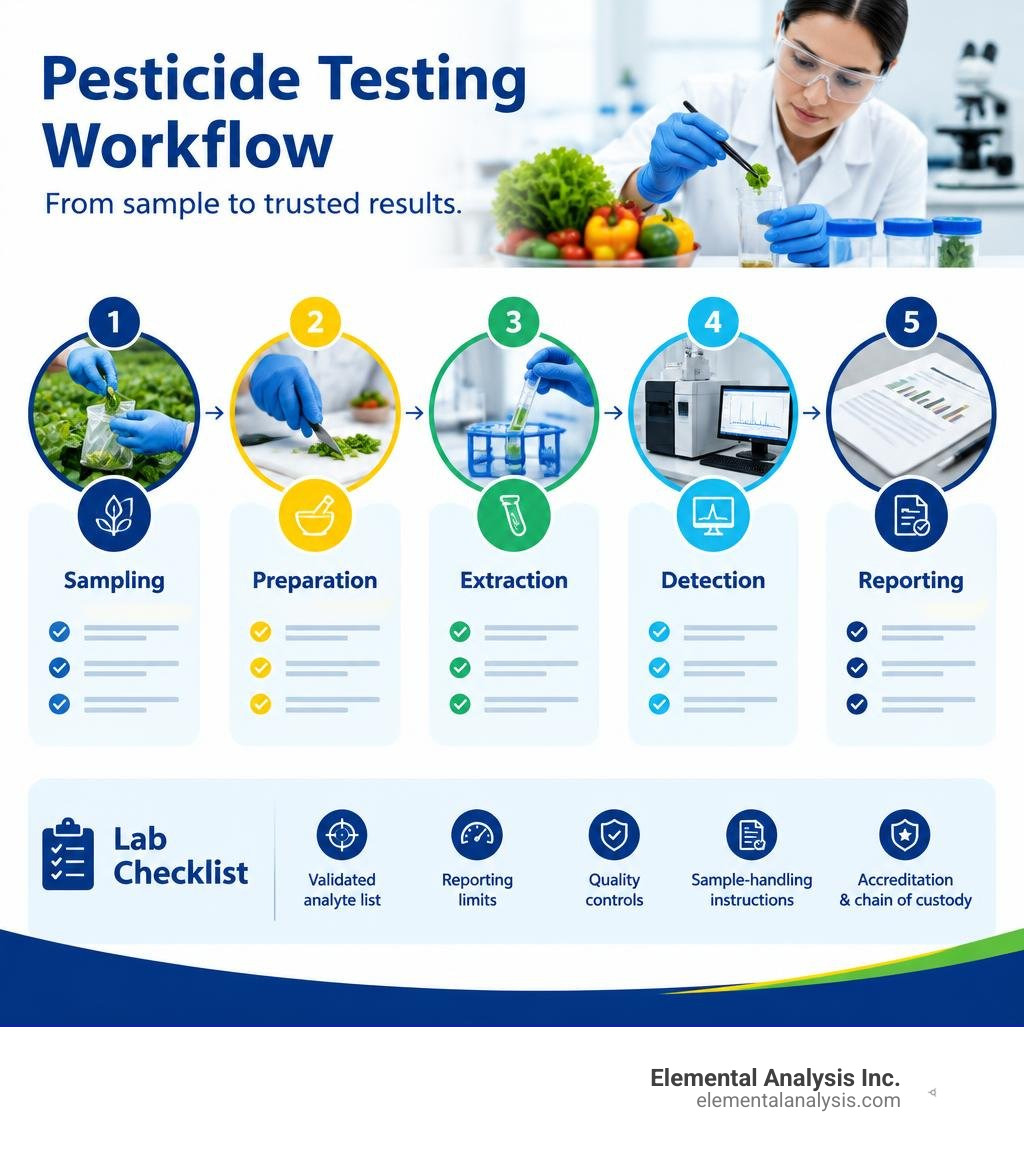
Pesticide residue testing terms at a glance:
Regulatory Frameworks and Residue Compliance Standards
Pesticide residue testing sits at the crossroads of consumer safety and global commerce. Modern agriculture uses plant protection products to protect crop yields and extend shelf life, but any lingering traces must remain within strict, legally established thresholds. When evaluating your compliance data, evaluating chemical safety through professional toxicology support provides crucial guidance to ensure raw commodities and finished products meet all safety standards.
In the United States, regulating agricultural chemical residues involves a cooperative inter-agency framework. The Environmental Protection Agency (EPA) evaluates toxicological data, environmental persistence, and dietary exposure models to establish statutory limits under Title 40 of the Code of Federal Regulations (40 CFR Part 180). Meanwhile, enforcement falls to other federal entities: the Food and Drug Administration (FDA) monitors domestic and imported foods, while the United States Department of Agriculture (USDA) oversees meat, poultry, and egg products.
Globally, regulatory agencies rely on the Codex Alimentarius Commission—jointly managed by the FAO and WHO—to harmonize international trade standards. However, national regulations often diverge significantly. A compound permitted at a specific threshold in one country might carry a zero-tolerance mandate in another. Navigating these overlapping requirements requires an understanding of regulatory terminology and compliance frameworks.
Defining Tolerances, Action Levels, and Maximum Residue Limits
Understanding residue reports requires clear distinctions between legal limits, guidance values, and international trade baselines. While these terms are frequently used interchangeably in informal discussions, they carry distinct legal definitions.
- Tolerances: In the United States, a tolerance is the maximum level of a pesticide residue legally allowed in or on a specific food or feed commodity, established by the EPA under the Federal Food, Drug, and Cosmetic Act (FFDCA). If a residue is detected on a commodity for which no tolerance exists, it represents a “no-tolerance violation,” rendering the product adulterated even at trace levels. Conversely, detecting a residue above the established limit constitutes an “over-tolerance violation.”
- Action Levels: When a formal EPA tolerance does not exist—such as when persistent environmental contaminants or historical pesticides (like DDT or dieldrin) linger in soil—the FDA may establish an action level. These non-binding guidance levels define thresholds for enforcement action, balancing dietary safety against unavoidable background contamination.
- Maximum Residue Limits (MRLs): Internationally, the term Maximum Residue Limit is the standard benchmark used by Codex Alimentarius and authorities such as the European Food Safety Authority (EFSA). An MRL is the highest concentration of a pesticide residue legally permitted in food or feed when applied according to Good Agricultural Practice (GAP).
| Regulatory Metric | Governing Body | Legal Status | Primary Purpose |
|---|---|---|---|
| Tolerance | US EPA | Statutory binding limit (40 CFR Part 180) | Enforces domestic agricultural use and market legality |
| Action Level | US FDA | Non-binding administrative guidance | Addresses unavoidable environmental residues |
| Maximum Residue Limit (MRL) | Codex Alimentarius / EFSA | Statutory or international guideline | Facilitates international trade and consumer safety |
For exporters, monitoring global MRLs through resources like USDA AMS pesticide residue monitoring guidelines is essential to prevent costly port-of-entry rejections.
Inter-Agency Jurisdiction and Monitoring Objectives
Federal and international monitoring programs operate across two primary fronts: surveillance monitoring and compliance enforcement.
The FDA conducts continuous residue monitoring across domestic and imported foods. Through its Annual Pesticide Report (APR), the agency documents violation rates, which are historically higher in imported commodities due to differing overseas pesticide registrations. Additionally, the FDA conducts the Total Diet Study (TDS), an ongoing program where market basket foods are purchased, prepared “as consumed” (table-ready), and analyzed to assess realistic dietary exposure profiles for consumers.
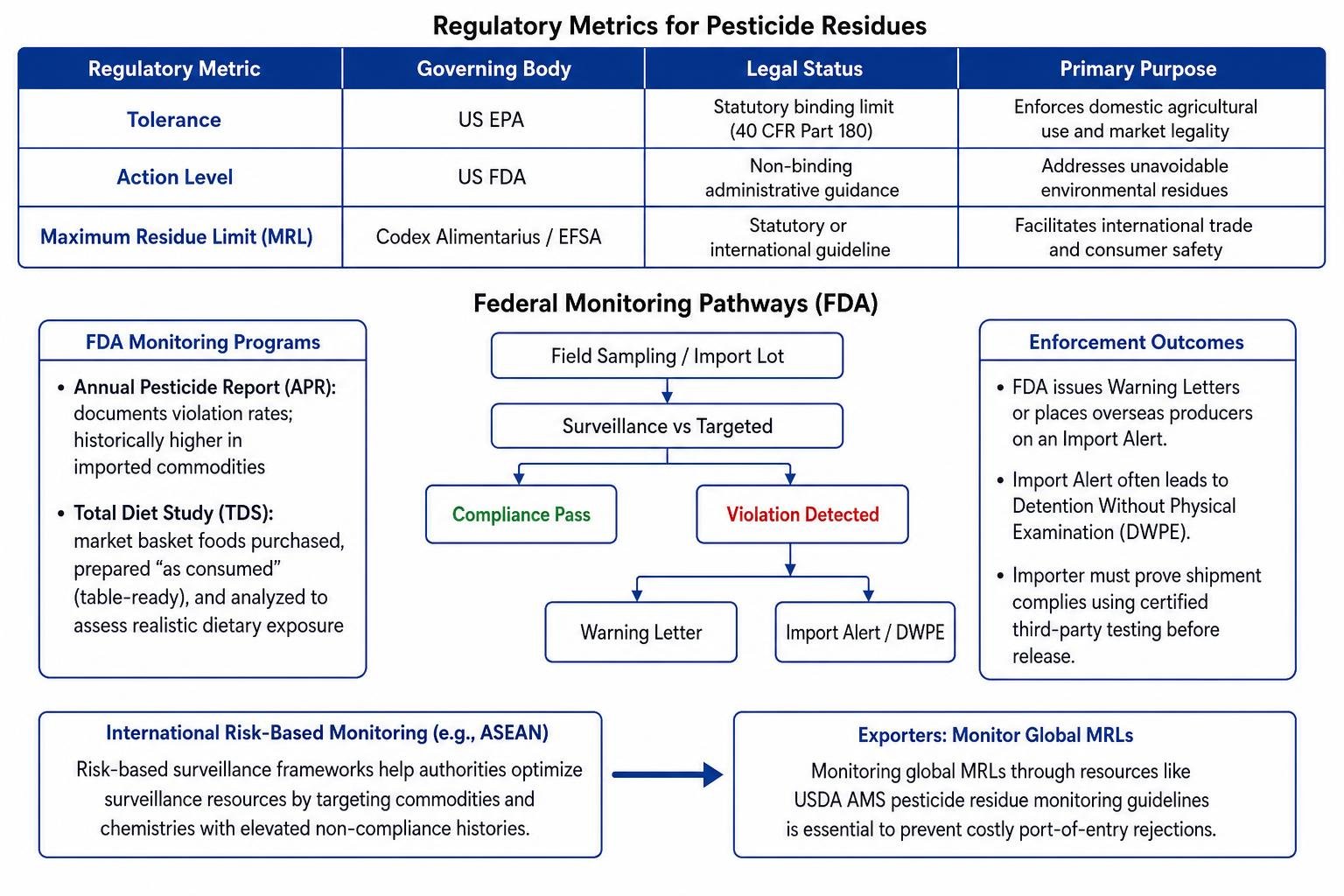
When violations occur, the FDA issues Warning Letters or places overseas producers on an Import Alert. An Import Alert often leads to Detention Without Physical Examination (DWPE), requiring the importer to prove the shipment complies using certified third-party testing before release. Internationally, risk-based surveillance frameworks, such as the ASEAN regional guide for pesticide monitoring, help authorities optimize surveillance resources by targeting commodities and chemistries with elevated non-compliance histories.
Core Methodologies in Pesticide Residue Testing
Modern analytical laboratories must identify and quantify hundreds of distinct chemical compounds, ranging from non-polar organochlorines to highly polar herbicides, often down to parts per billion (ppb) or parts per million (ppm). Achieving this level of precision requires adherence to validated industry standard methods.

Multi-Residue Methods vs. Selective Residue Methods
Residue testing divides into two primary analytical strategies depending on the chemical properties of the target analytes:
- Multi-Residue Methods (MRMs): MRMs are designed for high-throughput screening, extracting and quantifying hundreds of pesticides in a single analytical run. These methods utilize broad-spectrum organic solvents to capture non-polar, moderately polar, and semi-volatile compounds. The FDA’s routine surveillance uses MRMs covering roughly 800 active ingredients and metabolites in a single sample run.
- Selective Residue Methods (SRMs): Certain pesticides resist broad-spectrum multi-residue extraction due to their extreme polarity, ionic charge, thermal instability, or strong matrix binding. SRMs target single analytes or small chemical families requiring specialized sample prep. Examples include glyphosate, glufosinate, quaternary ammonium compounds (like paraquat and diquat), and acidic herbicides (such as 2,4-D and dicamba).
| Analytical Parameter | Multi-Residue Methods (MRMs) | Selective Residue Methods (SRMs) |
|---|---|---|
| Analyte Scope | 300 to 800+ target compounds | 1 to 10 specialized compounds |
| Primary Chemistries | Organophosphates, pyrethroids, triazoles | Glyphosate, glufosinate, paraquat, 2,4-D |
| Extraction Protocol | Standard QuEChERS (Acetonitrile/Salts) | Acidified methanol, derivatization, or ion-pairing |
| Cost & Throughput | Highly cost-effective per compound | Higher cost per analyte; labor intensive |
Standard Operating Procedures for Pesticide Residue Testing
The gold standard for multi-residue agricultural testing is the QuEChERS technique (Quick, Easy, Cheap, Effective, Rugged, and Safe), formally standardized in AOAC Official Method 2007.01 and European standard EN 15662.
The QuEChERS workflow involves:
- Sample Homogenization: The raw product is chopped and comminuted, often using cryogenic grinding with dry ice or liquid nitrogen to prevent thermal or enzymatic degradation.
- Acetonitrile Partitioning: Acetonitrile is added to the homogenate, followed by a mixture of anhydrous magnesium sulfate (MgSO4) and buffering salts (such as sodium chloride or sodium citrate). The salts induce phase separation, driving water-soluble matrix interferences into an aqueous layer while pushing target pesticides into the upper organic phase.
- Dispersive Solid-Phase Extraction (d-SPE): An aliquot of the acetonitrile layer is mixed with loose sorbents—including Primary Secondary Amine (PSA) to remove organic acids and sugars, C18 to eliminate lipids, and graphitized carbon black (GCB) to remove chlorophyll and pigments.
For regulatory sample collection preceding extraction, adhering to standardized procedures like the NOP 2610 sampling instructions ensures that the collected sample is representative of the whole agricultural lot.
Chromatographic Separation and Mass Spectrometric Detection
Once extracted and cleaned, samples are separated and quantified using coupled chromatography-mass spectrometry platforms:
- Liquid Chromatography-Tandem Mass Spectrometry (LC-MS/MS): Ideal for polar, non-volatile, and thermally labile compounds (e.g., neonicotinoids, carbamates, triazoles). Utilizing electrospray ionization (ESI) and triple quadrupole mass analyzers in Multiple Reaction Monitoring (MRM) mode, LC-MS/MS tracks specific precursor-to-product ion transitions. This enables accurate quantification down to 0.01 mg/kg or lower.
- Gas Chromatography-Tandem Mass Spectrometry (GC-MS/MS): Ideal for volatile, non-polar, and thermally stable compounds (e.g., organochlorines, organophosphates, pyrethroids). Samples are vaporized, separated across capillary columns, and ionized (typically via electron ionization) before mass analysis.
- High-Resolution Mass Spectrometry (HRMS): Instruments utilizing Orbitrap or Time-of-Flight (Q-TOF) technology allow for non-targeted retrospective screening by measuring exact mass-to-charge ratios, enabling identification of unexpected degradation products or emerging contaminants.
Quality Assurance, Measurement Uncertainty, and Complex Matrices
Generating defensible residue data requires rigorous laboratory quality assurance protocols. Trace residue measurements can be affected by sample heterogeneity, standard degradation, and instrument matrix suppression, highlighting the value of established elemental analysis methods in baseline laboratory validation (Á et al., 2023).

Pre-Analytical Error Sources and Sampling Reproducibility
Analytical instruments are exceptionally precise; modern LC-MS/MS systems exhibit an injection repeatability coefficient of variation (CV) of just 2% to 2.5%. However, total measurement uncertainty is often dominated by pre-analytical errors:
- Field Sampling Heterogeneity: Residue distributions across a single field or crop canopy can exhibit an 80-fold to 100-fold variation. Under typical growing conditions, sampling uncertainty contributes a relative uncertainty of 25% to 40% for composite sample sizes of 10 and 5 units, respectively.
- Comminution and Subsampling: Pierre Gy’s sampling theory dictates that subsampling error is inversely related to sample mass and directly proportional to the cube of the maximum particle diameter. Grinding food samples down to particle sizes of 2 mm or smaller—verified via a Petri-dish test—keeps comminution variance below 10% to 12%. Reducing the test portion size from 10 grams down to 1 gram without sufficient homogenate comminution can increase subsampling error from 12.2% to nearly 39%.
- Standard Stability: In international inter-laboratory ring tests evaluating certified pesticide reference standards, only 2 out of 33 laboratories reported accurate results for bupirimate, and 0 out of 36 succeeded for diazinon, showing standard verification is critical before running client samples.
Quality Control Protocol and Action Limits
To maintain regulatory defensibility, laboratories structure quality control around international standards such as EU SANTE 11312/2021 and ISO/IEC 17025. Every analytical batch must incorporate matrix blanks, matrix-matched calibration standards, isotopically labeled internal standards, and matrix spikes.
Selecting a Qualified Contract Testing Partner
Selecting an analytical partner requires assessing their technical scope, quality systems, and ability to meet regulatory scrutiny. Working with accredited testing laboratory services provides the data integrity needed for critical compliance decisions.
Criteria for Commercial Lab Selection in Pesticide Residue Testing
When auditing and qualifying a testing facility, consider these operational criteria:
- Scope of Accreditation: Ensure the lab holds ISO/IEC 17025 accreditation with a defined scope that explicitly covers the commodities and pesticide panels you require.
- Validated Analyte Panels: Request their complete analyte target list. A basic multi-residue screen should capture 300 to 500+ compounds, with access to specialized single-residue methods (e.g., glyphosate, diquat, chloropicrin) when required.
- Lowest Calibrated Level (LCL): Verify that the laboratory’s Limit of Quantitation (LOQ) and LCL are well below the target market’s regulatory MRLs (frequently required at or below 0.01 mg/kg or 10 ppb).
- Instrumentation and Redundancy: Ensure the laboratory maintains dual LC-MS/MS and GC-MS/MS systems to prevent turnaround delays during scheduled maintenance or peak harvest surges.
- Traceability and LIMS Support: A Laboratory Information Management System (LIMS) should provide audit trails, electronic data deliverables (EDDs), and complete chain-of-custody documentation.
Frequently Asked Questions About Chemical Residue Analysis
What is the operational difference between an MRL and an EPA tolerance?
Operationally, both set the maximum concentration of a pesticide residue allowed in food. The difference lies in jurisdiction: EPA tolerances are US statutory limits established under the FFDCA and enforced domestically by the FDA and USDA. Maximum Residue Limits (MRLs) are the international equivalents set by Codex Alimentarius or regional foreign bodies (like the European Union). Exported goods must comply with the destination country’s MRLs, which may be lower than domestic US tolerances.
Why are polar pesticides tested separately from multi-residue screens?
Standard multi-residue methods (like QuEChERS) rely on partitioning compounds into an organic acetonitrile phase. Highly polar pesticides—such as glyphosate, glufosinate, fosetyl-aluminum, and ethephon—remain partitioned in the aqueous phase and elute too early on standard C18 reverse-phase liquid chromatography columns. Consequently, they require dedicated selective extraction protocols, ion-exchange or porous graphitic carbon (PGC) columns, or specialized chemical derivatization.
What factors contribute most significantly to measurement uncertainty in residue analysis?
Field sampling heterogeneity and initial subsampling comminution contribute up to 80% of total measurement uncertainty. Variations in crop canopy spray coverage, paired with incomplete sample homogenation (particle sizes >2 mm), introduce greater variability than the final mass spectrometric determination.
Conclusion
Navigating agricultural chemical compliance requires rigorous sampling, validated multi-residue extractions, and reliable mass spectrometric quantification. At Elemental Analysis Inc., based in Lexington, Kentucky, our team provides comprehensive testing solutions tailored to your regulatory, export, and quality requirements. Explore our comprehensive analytical testing services or contact our team to discuss your testing needs.
References
Ambrus Á, Doan VVN, Szenczi-Cseh J, Szemánné-Dobrik H, Vásárhelyi A. “Quality Control of Pesticide Residue Measurements and Evaluation of Their Results..” Molecules (Basel, Switzerland), 2023. PMCID PMC9920035.