
Inductively Coupled Plasma Atomic Absorption Spectroscopy: Is It the Right Choice?
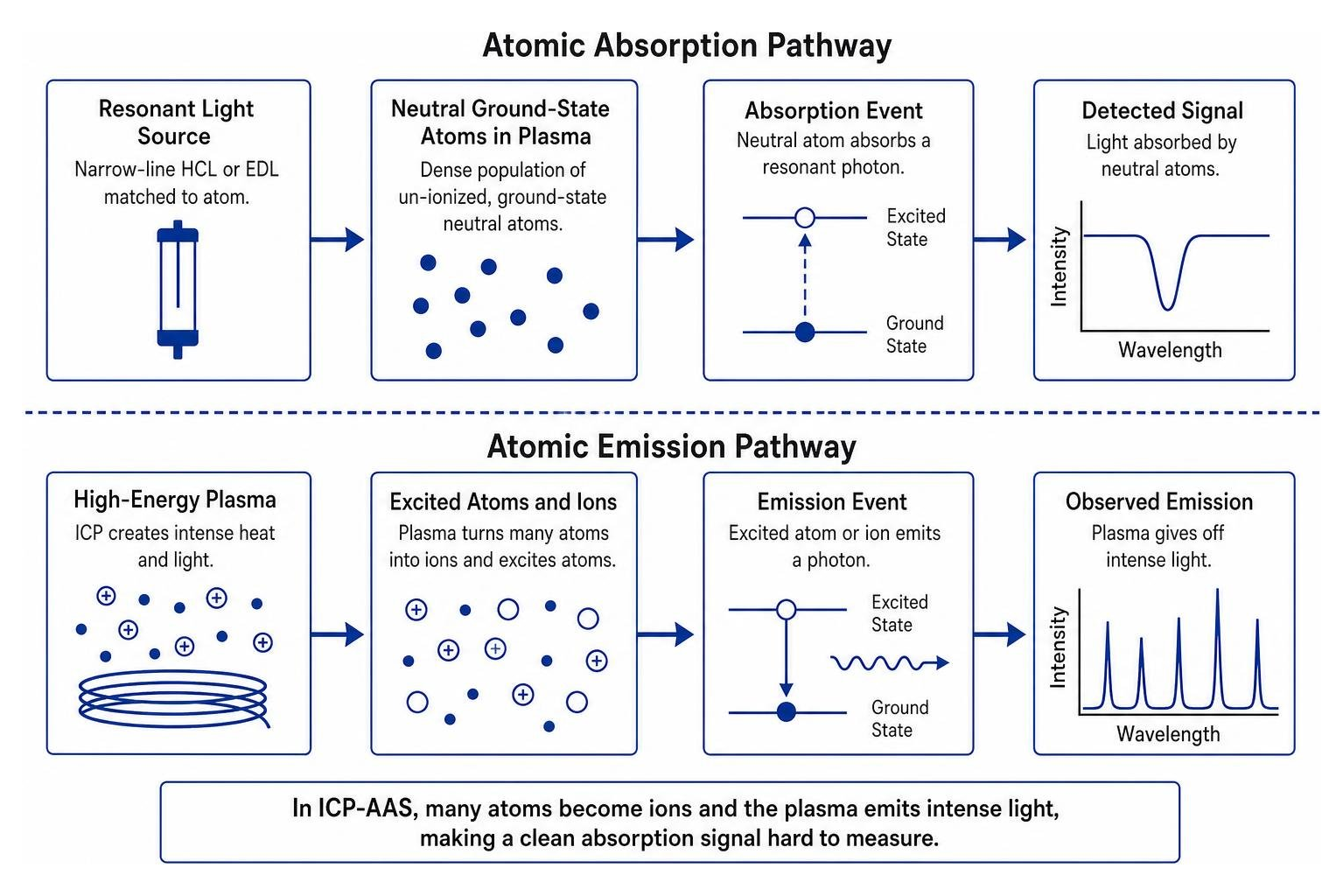
Inductively coupled plasma atomic absorption spectroscopy (ICP-AAS) is not a standard choice for trace-element testing. It would measure light absorbed by neutral atoms in a plasma. But the plasma turns many atoms into ions and gives off intense light of its own. Both make a clean absorption signal hard to measure.
For method selection, start with the result you need. Flame AAS can suit routine tests for a few elements. Graphite furnace AAS can measure lower levels in small samples. ICP-OES is useful for testing many elements at once, while ICP-MS is often the better fit when very low detection limits matter. The right choice also depends on your sample, turnaround needs, and total cost.
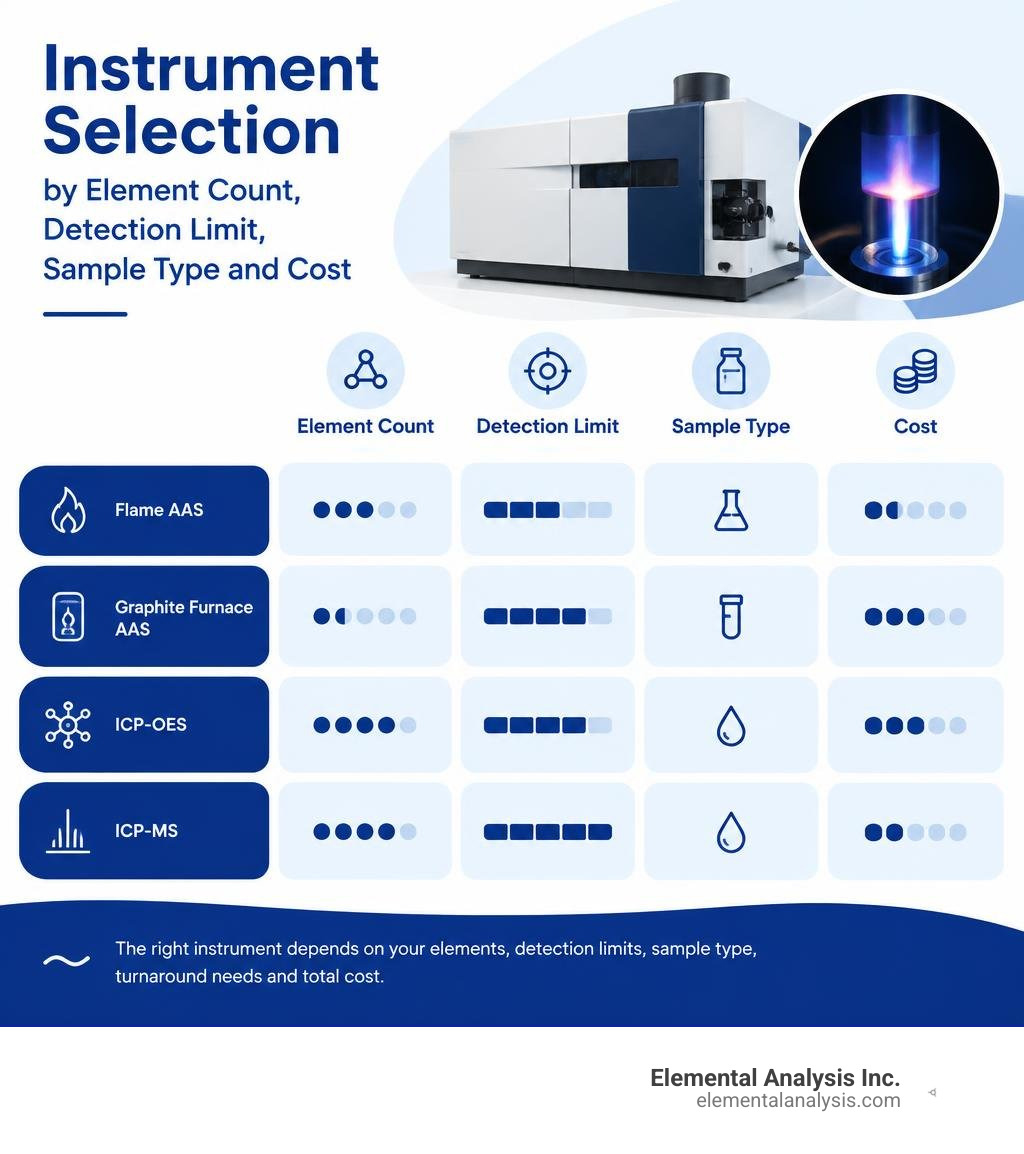
Common inductively coupled plasma atomic absorption spectroscopy vocab:
What Is Inductively Coupled Plasma Atomic Absorption Spectroscopy?
In analytical chemistry, we often classify techniques by how they probe an atom’s energy states. Standard atomic absorption spectroscopy relies on a thermal cell—such as an air-acetylene flame or an electrothermal graphite tube—to break chemical bonds and generate a cloud of free ground-state atoms. According to the Beer-Lambert law, the amount of light absorbed by these free atoms is directly proportional to their concentration in the optical path.
When researchers first recognized the power of radiofrequency (RF) discharges, some explored using an RF-sustained discharge as an atomization cell. Exploring an essential guide to inductively coupled plasma reveals how high electrical conductivity and intense magnetic fields create an extremely energetic environment. In theory, applying atomic absorption principles to an ICP would allow analysts to pass a resonant light beam directly through the discharge plume to quantify analyte concentration via attenuation.
Core Principles of Inductively Coupled Plasma Atomic Absorption Spectroscopy
The foundational physics of atomic absorption requires narrow-line light sources to match the narrow absorption profiles of free atoms. As outlined in comprehensive works on the foundations of atomic spectroscopy, atomic absorption happens when a neutral ground-state atom absorbs a resonant photon, promoting an outer-shell electron to an excited orbital.
For this measurement to deliver high sensitivity, several conditions must be met simultaneously:
- A dense population of un-ionized, ground-state neutral atoms must exist in the optical axis.
- The spectral line profile of the light source must be narrower than the absorption line of the sample atoms.
- Background emission from the atomization source must not overwhelm the detector or create unmanageable photon shot noise.
Hypothetical Instrument Architecture and Light Source Modulation
Building a functional ICP-AAS system requires combining the sample delivery of an ICP with the optical train of an absorption spectrometer:
- Light Source: An element-specific hollow cathode lamp (HCL) or electrodeless discharge lamp (EDL) aligned precisely through the plasma.
- Atomization Cell: A three-concentric-tube quartz torch powered by an RF generator (typically 27.12 MHz or 40.68 MHz) generating an argon plasma.
- Modulation System: An optical chopper or pulsed lamp power supply paired with a lock-in amplifier to isolate the modulated lamp signal from the continuous, blazing emission of the plasma.
- Wavelength Selector: A high-resolution monochromator to isolate the analytical resonance line.
- Detector: A sensitive photomultiplier tube (PMT) or solid-state charge-coupled device (CCD).
As we detail when looking inside the fiery world of inductively coupled plasma emission, managing the physical interface around an active torch requires careful alignment and thermal shielding.
The Fundamental Conflict: High Plasma Temperature vs. Atomic Ground State

The primary reason you cannot buy a commercial ICP-AAS instrument comes down to basic thermodynamics. Flame AAS operates at temperatures between 2,100 °C and 2,800 °C (roughly 2,400 K to 3,100 K). This thermal energy breaks chemical bonds without stripping away valence electrons.
In contrast, an argon ICP reaches core temperatures of 8,000 K to 10,000 K—hotter than the surface of the Sun! While this thermal energy vaporizes refractory compounds, it fundamentally works against the physics of atomic absorption.
Atomization Efficiency and the Problem of Over-Ionization
At thermodynamic equilibrium, the ratio of excited-state atoms to ground-state atoms follows the Boltzmann distribution, while the balance between neutral atoms and ions is governed by the Saha equation. In our review understanding ICP chemistry and why it matters, we explore how thermal energy dictating these balances changes analyte behavior.
In a 10,000 K plasma, elements with low or moderate first ionization potentials (such as sodium, potassium, calcium, magnesium, and most transition metals) become 90% to over 99% ionized.
Because atomic absorption relies specifically on ground-state neutral atoms, converting virtually all analyte atoms into ions strips away the very species the instrument intends to measure. Complete atomization is only helpful if the atoms remain neutral; when atomization turns into over-ionization, atomic absorption sensitivity drops drastically.
Technical Bottlenecks of Inductively Coupled Plasma Atomic Absorption Spectroscopy
Beyond ground-state depletion, pairing an ICP with an absorption detector creates serious operational hurdles:
- Massive Optical Background Noise: The plasma emits an intense continuum and line spectrum. Even with phase-sensitive detection (lock-in amplification), the photon shot noise from this optical background degrades the signal-to-noise ratio.
- Spectral Line Broadening: The high thermal velocity of atoms (Doppler broadening) combined with high electron densities (Stark and collisional broadening) widens the absorption profile, reducing peak absorbance.
- Single-Element Limitations: Traditional AAS requires a dedicated primary line source for each element. Using an expensive, gas-hungry argon plasma torch just to read one element at a time destroys the economic benefits of running an ICP.
- Complex Matrix Demands: As documented in studies on atomic spectroscopic techniques for complex matrices, heavy matrices introduce non-specific scattering and molecular background signals that require complex correction schemes.
Comparing Detection Limits: AAS, ICP-OES, and ICP-MS
To determine which elemental technique fits your project, it helps to compare established techniques against this theoretical hybrid.
| Feature / Technique | Flame AAS (FAAS) | Graphite Furnace (GFAAS) | ICP-OES | ICP-MS | Theoretical ICP-AAS |
|---|---|---|---|---|---|
| Primary Signal | Light Absorption (neutral atoms) | Light Absorption (neutral atoms) | Optical Emission (excited atoms and ions) | Mass-to-Charge Ratio (ions) | Light Absorption (neutral atoms) |
| Typical Detection Limit | 1 – 100 ppb (µg/L) | 0.01 – 1 ppb (µg/L) | 0.1 – 10 ppb (µg/L) | 0.0001 – 0.01 ppb (ppt / ng/L) | 10 – 1000 ppb (poor) |
| Linear Dynamic Range | 2 – 3 orders of magnitude | 2 orders of magnitude | 5 – 6 orders of magnitude | 8 – 12 orders of magnitude | 1 – 2 orders of magnitude |
| Sample Throughput | Single element (fast) | Single element (slow) | Multi-element (fast, 70+ elements) | Multi-element (very fast, 70+ elements) | Single element (fast) |
| Capital Instrument Cost | $20,000 – $40,000 | $40,000 – $80,000 | $80,000 – $160,000 | $150,000 – $350,000+ | High (Unfavorable ROI) |
| Running Cost | Low (Air/Acetylene) | Moderate (Argon, Tubes) | High (Argon ~15 L/min) | High (Argon, Cones, Vacuum) | Extremely High for Single Element |
When analyzing industrial samples or complex environmental matrices, our guide on ICP analysis for heavy metals: choosing between ICP-OES and ICP-MS highlights how multi-element workflows streamline laboratory turnaround.
Dynamic Range and Sensitivity Benchmarks
A major strength of modern plasma instruments is dynamic range. ICP-OES covers 5 to 6 orders of magnitude, and ICP-MS can span 8 to 12 orders of magnitude. This allows laboratories to measure major structural constituents (percentage levels) and ultra-trace contaminants (parts-per-trillion levels) in the same run.
In the ultimate guide to ICP mass spectrometry and elemental analysis, we note that ICP-MS detection limits regularly reach down to parts-per-trillion (ppt) or sub-nanomolar concentrations. In contrast, atomic absorption techniques have narrow working curves (typically 2 to 3 orders of magnitude) before light absorption flattens out, requiring frequent sample dilutions.
Spectral and Non-Spectroscopic Interference Management
Every elemental technique has to account for physical and chemical interferences:
- Total Dissolved Solids (TDS): Standard pneumatic nebulizers send only 1% to 2% of aspirated liquid into the plasma, with the rest draining to waste. For ICP-MS, maintaining a TDS below 0.2% (2 g/L) is recommended to prevent cone clogging and matrix suppression.
- Polyatomic Interferences: In mass spectrometry, recombined plasma ions (such as argon-oxygen on iron-56 or argon-chlorine on arsenic-75) can mask analyte masses. Quadrupole mass filters, which operate at a nominal resolution of 0.75 amu (mass resolution around 300) with abundance sensitivities near 10 to the power of -7, manage these using helium collision cells or reactive gases (such as hydrogen or oxygen).
- Matrix Matching: Following our ICP-MS lab guide on accurate trace testing ensures that internal standards and acid digestion matrices (such as high-purity nitric acid) compensate for physical transport effects.
Practical Spectroscopy Selection: Cost, Throughput, and Matrix Complexity

Selecting the right spectrometer comes down to balancing analytical requirements, sample volume, and operational budgets.
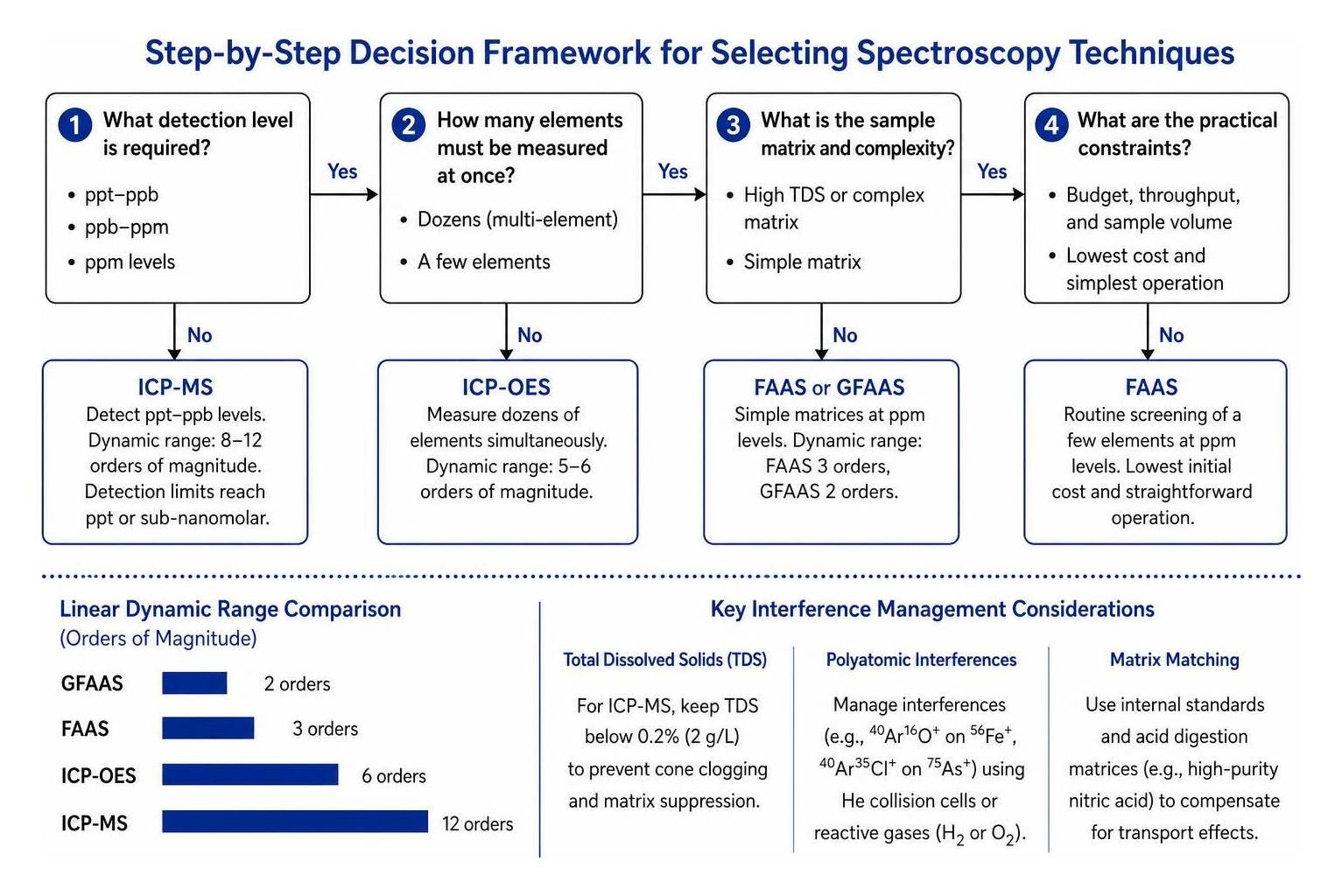
Trace Analysis Trade-Offs: FAAS, GFAAS, ICP-OES, and ICP-MS
For routine screening where only a few elements are needed at ppm levels (e.g., copper, zinc, or iron in simple solutions), Flame AAS remains a practical, cost-effective tool. As highlighted in reviews of developments in spectral analysis standards, AAS remains established in many standard test methods due to its low initial cost and straightforward operation.
However, when you need to quantify dozens of elements simultaneously across wide concentration ranges, a simple guide to ICP-AES and OES analysis explains why optical emission is often the most economical choice. When detection limits must reach parts-per-billion (ppb) or parts-per-trillion (ppt) levels—such as in pharmaceutical impurity testing or semiconductor materials analysis—ICP-MS is the gold standard.
Niche Diagnostics and Specialized Absorption Applications
While ICP-AAS is not used for routine analytical testing, specialized absorption techniques play a role in advanced plasma physics. For example, researchers use tunable diode lasers in laser absorption measurements in high-enthalpy inductively heated plasmas to study electrode-free plasma generators. By targeting specific transitions—such as metastable atomic oxygen at 777.19 nm and excited oxygen at 844.64 nm—engineers can map temperature gradients, radical number densities, and gas dynamics in simulated atmospheric re-entry conditions.
Frequently Asked Questions About ICP-AAS
Why is ICP-AAS not commercially available as a standard laboratory instrument?
An inductively coupled plasma reaches temperatures up to 10,000 K, which ionizes most elements and depletes the ground-state neutral atom population needed for absorption. Additionally, the plasma’s intense background emission creates severe optical noise. Because ICP-OES and ICP-MS use this ionization and excitation to deliver multi-element analysis with lower detection limits, ICP-AAS offers no practical commercial advantage.
Can an ICP torch ever be used as an absorption atom cell?
Yes, in specialized plasma diagnostic research. Tunable laser absorption spectroscopy (TLAS) can probe internal plasma dynamics, radical concentrations, and gas kinetics. However, these systems serve as diagnostic tools for plasma physics rather than instruments for routine trace element testing.
How does atomic absorption differ fundamentally from optical emission in an ICP?
Atomic absorption measures the drop in light intensity as ground-state atoms absorb resonant photons from an external light source. Optical emission measures the photons emitted when thermally excited atoms and ions relax back to lower energy states. Our breakdown of inductively coupled plasma mass spectroscopy explained from torch to detector illustrates how modern plasma instruments take advantage of these excited and ionized states.
Conclusion: Selecting the Ideal Elemental Analysis Workflow
Understanding how atomic absorption and plasma ionization interact clarifies why standard analytical workflows rely on Flame AAS, Graphite Furnace AAS, ICP-OES, and ICP-MS. Attempting to force an absorption measurement onto an ultra-hot plasma creates technical hurdles without analytical benefits.
At Elemental Analysis Inc., based in Lexington, KY, we help laboratories and manufacturers navigate complex testing requirements. Whether you need rapid multi-element screening, ultra-trace quantification, or specialized particle characterization, our team provides fast turnaround and dependable results. Explore our capabilities by unlocking the elements with comprehensive ICP services to find the right method for your analytical needs.