
Understanding Total XRF Testing Cost: In-House Equipment vs. Third-Party Lab Analysis
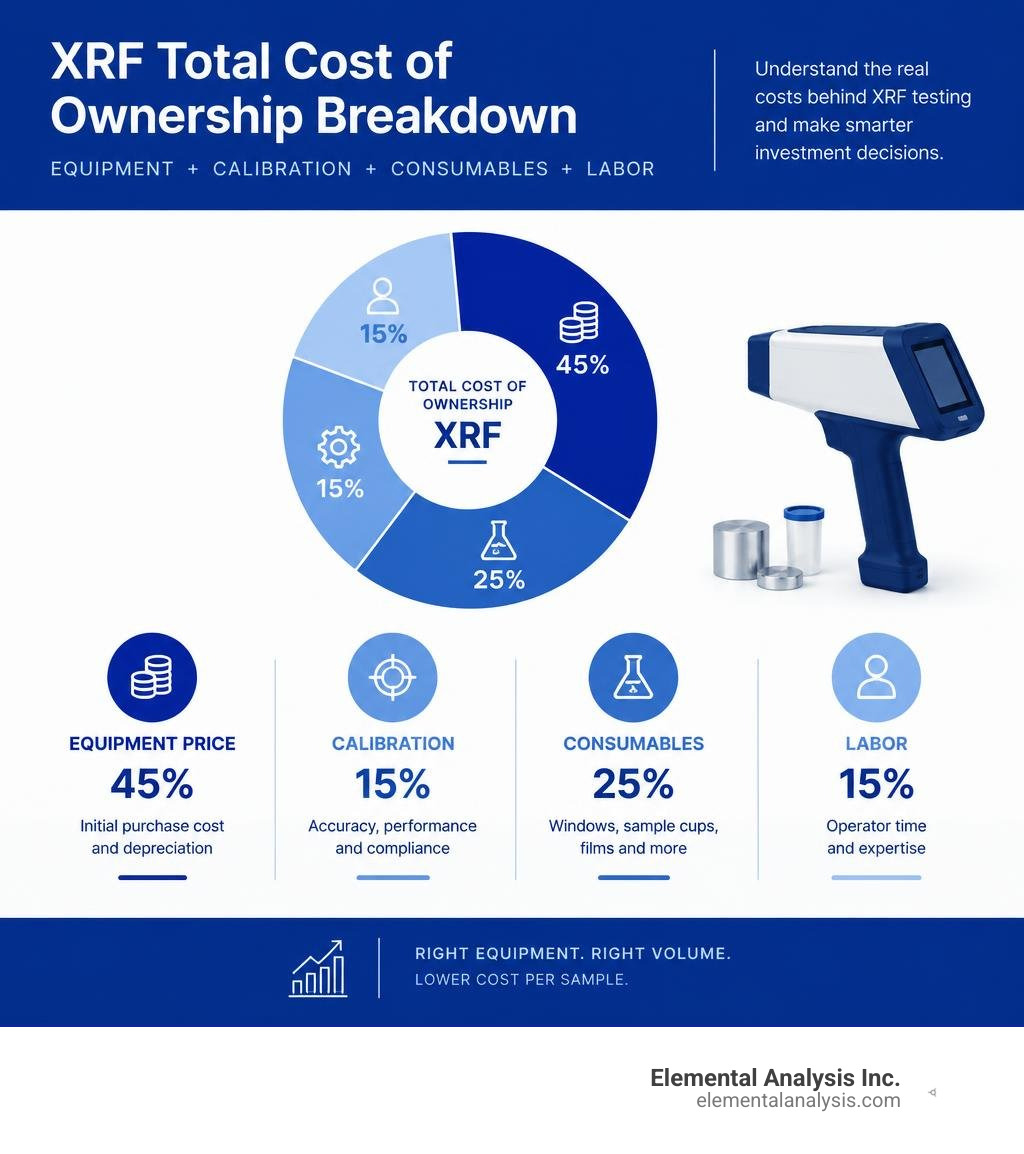
XRF testing cost typically falls into two ranges: commercial laboratory analysis generally runs $50 to $150 per sample, while purchasing an in-house handheld or benchtop analyzer ranges from $20,000 to $50,000 or more upfront, with amortized per-scan costs of $0.26 to $2.00. Evaluating the true cost of material verification requires looking beyond the sticker price of a benchtop or handheld device. Total Cost of Ownership (TCO) blends your upfront capital expenditure with routine operational expenses, operator hours, radiation compliance, and periodic maintenance. When companies weigh an instrument purchase against sending samples out, they are comparing a predictable per-sample fee to an amortized, high-volume testing infrastructure.
To determine which path makes financial sense, we have to look at how equipment amortization and daily sample volumes interact. The science behind X-ray fluorescence spectrometry allows for instantaneous, non-destructive measurements, but turning that scientific capability into positive operational cash flow requires enough consistent throughput to justify the capital outlay.
| Cost Component | Commercial Laboratory Testing | In-House Handheld / Benchtop XRF |
|---|---|---|
| Upfront Capital Outlay | $0 | $20,000 – $50,000+ |
| Direct Cost Per Sample | $50 – $150 (Standard) | $0.26 – $2.00 (Amortized labor & consumables) |
| Turnaround Time | 3 – 5 Business Days | Instant (10 – 30 seconds) |
| Rush Surcharge | +50% to +100% per sample | $0 |
| Recurring Maintenance | $0 | $2,000 – $5,000/year (Calibration & service) |
| Regulatory & Licensing | None (Lab handles compliance) | $500 – $2,500 state license + RSO oversight |
| Best Suited For | Low-to-moderate volume, trace-level limits, regulatory compliance | High-volume sorting, rapid screening, real-time quality control |
Estimating Per-Sample XRF Testing Cost in Commercial Labs
Commercial testing facilities generally price routine elemental analysis on a per-sample basis. For standard industrial alloys, scrap verification, and basic material composition checks, commercial industrial testing labs typically charge between $50 and $150 per sample. Specialized testing, such as high-precision precious metals analysis and multi-element characterization, runs from $75 to $300 per sample depending on the required precision.
Standard lab turnaround times range from 3 to 5 business days. When production schedules cannot wait a week for chemistry verification, expedited or same-day rush services carry surcharges of 50% to 100% above standard testing rates. For organizations sending batches of 20 to 30 samples monthly, relying on an accredited testing laboratory provides definitive, certified documentation without committing capital to hardware or radiation oversight programs.
In-House Analyzer TCO: Capital Investment and Consumables
When an organization brings screening hardware on-site, equipment acquisition falls into three primary pricing tiers:
- Entry-Level Hardware ($20,000 – $25,000): Built around basic silicon PIN (Si-PIN) detectors, these units handle basic alloy identification, heavy metal screening, and straightforward pass/fail checks.
- Mid-Range Analyzers ($25,000 – $35,000): Equipped with standard Silicon Drift Detectors (SDD), these units deliver faster count rates, superior energy resolution, and broader element libraries.
- Premium Configurations ($35,000 – $50,000+): High-performance SDDs paired with advanced software, integrated cameras, and optional helium purge or vacuum capabilities for measuring light elements like magnesium, aluminum, and silicon.
Beyond purchase price, daily operation incurs labor and consumable costs. If a technician earning $25 per hour spends roughly 15 seconds executing and logging a scan, operator labor works out to approximately $0.10 per test. Amortizing a $25,000 mid-range analyzer across 150 scans per day over 250 working days per year yields an equipment cost of roughly $0.11 per test.
Factoring in protective window replacements, sample cups, specialized films, and battery replacements (which average $1,500 to $4,000 annually), a high-volume facility can achieve an effective in-house xrf testing cost as low as $0.26 to $2.00 per scan.
Primary Hardware and Technology Drivers of Analyzer Pricing
Two analyzers that look identical on the outside can carry wildly different price tags. The total cost of an XRF analyzer reflects internal component physics, resolution thresholds, excitation engineering, and integrated analytical software.
State and municipal procurement records, such as government procurement specifications, illustrate that public agencies budget across these distinct hardware tiers depending on whether field teams require basic screening or multi-element quantification.
Detector Technology: Silicon Drift Detectors vs. Si-PIN
The detector is the primary hardware component influencing instrument pricing. Traditional Si-PIN (Silicon Positive-Intrinsic-Negative) photodiode detectors represent reliable, budget-friendly engineering. However, they feature lower energy resolution (typically 170–200 eV) and require longer measurement times to resolve adjacent spectral peaks.
Modern Silicon Drift Detectors (SDD) add $10,000 to $20,000 to the base price of an instrument. In return, SDDs deliver energy resolutions of 125–140 eV and process significantly higher count rates per second. This speed and sensitivity are essential for resolving light elements (magnesium, aluminum, silicon, phosphorus, and sulfur) and separating overlapping spectral lines in complex superalloys.
When your application requires rapid, non-destructive material testing without damaging critical parts, investing in an SDD configuration prevents spectral misidentifications that could compromise quality control.
Excitation Sources and Software Capabilities
The method used to excite the sample is another major price and maintenance variable:
- Miniature X-Ray Tubes: Modern handhelds utilize low-power X-ray tubes with anodes made of rhodium, tungsten, silver, or gold. Tube-based models carry higher initial manufacturing costs, but they provide an operating life of 8 to 12 years without recurring radioactive decay costs. They can also be turned completely off, simplifying transport and storage.
- Radioactive Isotope Sources: Older or specialized field units use sealed radioactive isotopes (such as Cadmium-109, Iron-55, or Cobalt-57). While the initial unit cost is lower, isotope sources decay naturally and require replacement every 15 to 24 months. Each replacement cycle costs approximately $3,500, creating an ongoing expense of $1,750 to $2,800 per year, alongside stricter regulatory tracking.
Software licensing also shapes initial and ongoing pricing. Base packages often cover fundamental Positive Material Identification (PMI) with standard alloy libraries. Unlocking empirical calibrations, geochemical packages, custom coating thickness algorithms, or automated compliance reporting tools can add $2,000 to $7,000 in specialized software licensing fees.
Financial Acquisition Models: Renting, Leasing, or Buying
Determining how to secure XRF capabilities comes down to testing frequency, workflow predictability, and capital allocation.
Industry reference standards and commercial equipment pricing guidelines outline standard price thresholds across short-term, medium-term, and capital purchase options:
- Daily & Weekly Rentals ($600 – $700/day | $1,800 – $2,500/week): Ideal for short-term audits, seasonal scrap sorting, or unexpected field investigations. Rental providers cover calibration verification, factory service, and radiation source tracking.
- Operating Leases ($1,200 – $2,500/month): Spreads cost over 12 to 36 months, often with minimal down payments ($0–$2,000). Leases frequently bundle annual servicing and calibration, keeping operational budgets predictable while avoiding major capital expenditure approvals.
- Direct Capital Purchase ($20,000 – $50,000+): Delivers the lowest long-term cost per scan for organizations with steady, daily sample volumes over a 5-to-10-year operating horizon.
Calculating Long-Term XRF Testing Cost and Payback Thresholds
The break-even point between purchasing an analyzer and relying on commercial laboratory analysis typically occurs between 150 and 500 total samples across the life of the instrument.
If your facility sends 15 metal samples per month to a third-party laboratory at an average rate of $100 per test, your annual outsourced lab expenditure is $18,000. Over two years, you spend $36,000—surpassing the purchase price of a reliable mid-range handheld analyzer.
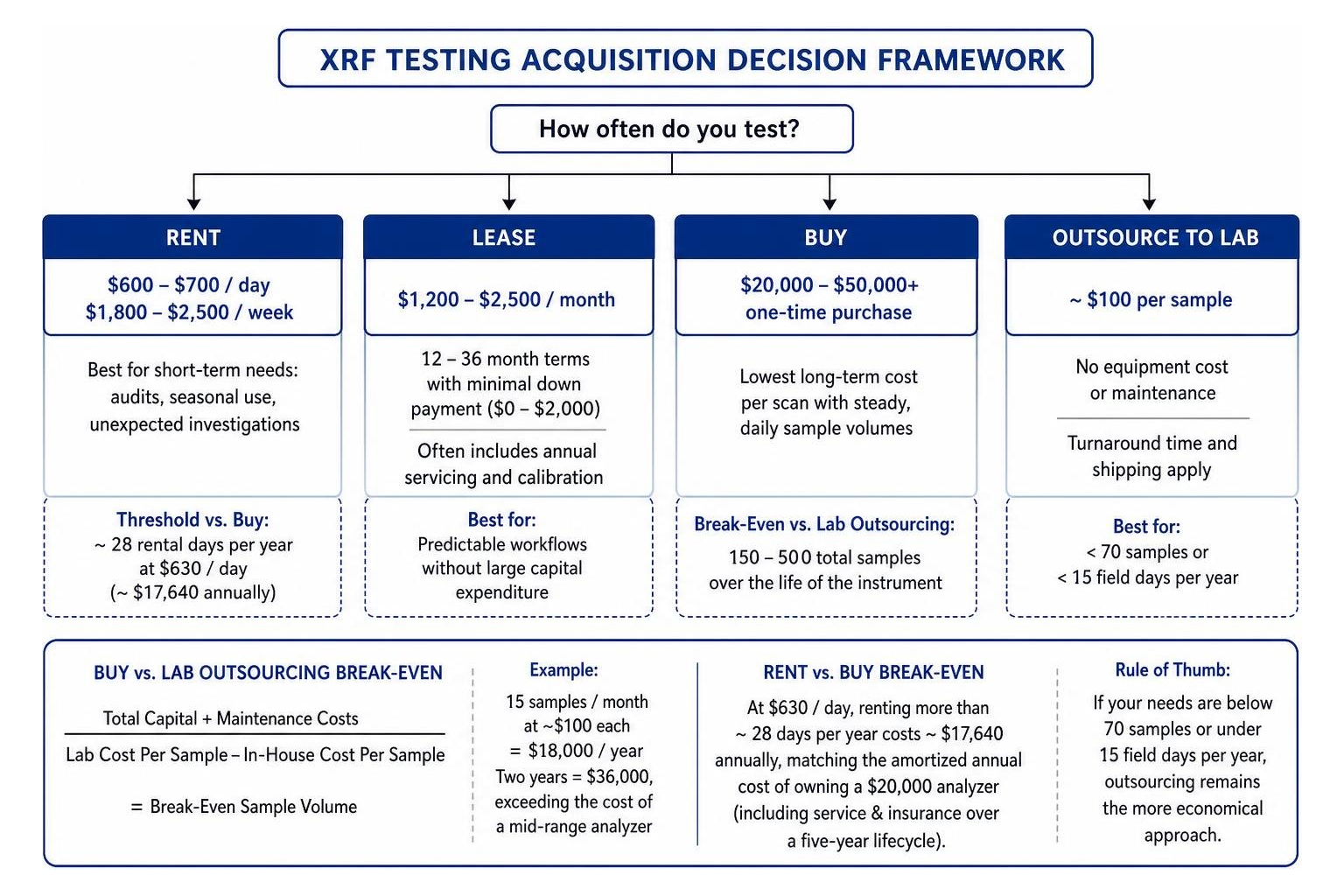
When evaluating rental versus ownership, the threshold is roughly 28 rental days per year. At a rental rate of $630 per day, renting for more than 28 days costs approximately $17,640 annually—matching the amortized annual cost of owning a $20,000 analyzer (including service and insurance over a five-year lifecycle).
If your testing needs fall below 70 samples or under 15 field days per year, outsourcing inorganic elemental analysis remains the more economical approach.
The Financial Risks of Testing Bottlenecks and Material Errors
Per-test pricing is only one part of the financial equation; production delays and material mix-ups carry substantial real-world costs. If a manufacturing line must quarantine an incoming shipment of high-temp alloy for four business days while waiting on third-party lab results, inventory holding costs accumulate and fabrication timelines slip.
More critically, consider the cost of an undetected material failure:
- Alloy Mix-Ups: Installing standard 304 stainless steel in place of 316L in a chemical processing environment can cause rapid corrosion, leading to unscheduled shutdowns that cost thousands of dollars per hour.
- Supply Chain Non-Conformance: Shipping out-of-spec structural components risks product recalls, warranty disputes, and customer penalties.
- Scrap Downgrades: Misidentifying high-value nickel or titanium scrap as basic stainless steel directly cuts your material recovery margins.
Investing in rapid screening gives your team immediate pass/fail clarity at the loading dock, mitigating the risk of costly material errors before components enter production.
Hidden Costs, Regulatory Compliance, and Specific Application Economics
Owning an XRF analyzer comes with several recurring overhead expenses that must be factored into your operational budget alongside the initial hardware purchase.

Understanding these costs across practical XRF applications ensures your business budgets accurately for ongoing ownership.
| Application Sector | Typical Device Tier | Major Regulatory & Operating Cost Drivers | Average Testing Volume Profile |
|---|---|---|---|
| Scrap Metal Recycling | Mid-to-High SDD ($28k–$38k) | High window replacement frequency, battery wear, drop insurance | 100 – 300+ scans daily |
| Manufacturing PMI | Mid-Range SDD ($25k–$35k) | Annual factory calibration verifications, safety compliance | 20 – 80 scans daily |
| Precious Metals & Jewelry | Benchtop PIN/SDD ($18k–$30k) | High-accuracy gold/silver/platinum calibration libraries | 10 – 50 scans daily |
| Lead Paint Inspection | Dedicated Tube/Isotope ($18k–$32k) | EPA licensing, state radiation registration, RSO management | Project-based batches (50+ shots/unit) |
Licensing, Safety Certifications, and Maintenance Fees
XRF analyzers emit ionizing radiation, which places them under state and federal regulatory frameworks:
- State Radioactive Materials & Device Registration: State registration fees for an analytical X-ray tube device typically range from $500 to $2,500 for initial filings, accompanied by annual renewal fees.
- Radiation Safety Officer (RSO) & Operator Training: Facilities must designate a trained RSO to manage dosimetry badges, radiation safety plans, and leak tests. Formal training programs run $600 to $3,000 depending on the course.
- Annual Calibration & Factory Maintenance: Annual calibration verification and recertification checks generally cost $400 to $800 per year. Comprehensive extended service contracts covering tube and detector warranties range from $2,000 to $4,000 annually.
- Business Liability & Equipment Insurance: Specialized inland marine and liability policies protecting against field theft, accidental detector punctures, or drop damage add $800 to $2,500 per year.
Cost Variables Across Lead Inspection, Alloy Sorting, and Precious Metals
Operational expenses also vary considerably depending on the specific analytical application:
Lead Paint Compliance
Environmental lead assessments require strict protocol compliance. Under regulations like EPA guidelines, inspectors must use instruments listed on the HUD Performance Characteristic Sheet (PCS). Operators must complete formal 24-hour Lead Inspector training courses, pass state exams, and renew credentials every three years.
While sending individual paint chips to a lab costs $30 to $75 per sample, a full residential inspection can involve 50 or more painted surfaces ($1,500 to $3,750 per unit). An in-house XRF gun pays for itself within a handful of multi-family property inspections.
Alloy Sorting and Positive Material Identification (PMI)
In high-throughput fabrication and recycling environments, speed is essential. Fast SDD detectors are required to differentiate complex alloy grades (such as Inconel 625 vs. 718, or 304 vs. 316 stainless) within 2 to 5 seconds. Consumable costs are driven primarily by punctured protective windows from sharp turnings, requiring durable Kapton or Prolene films.
Precious Metals and Karat Verification
Jewelry buyers, refiners, and pawnshops rely on specialized benchtop XRF units. These systems use targeted calibration libraries for gold (Au), silver (Ag), platinum (Pt), palladium (Pd), and common adulterants (like tungsten or copper).
Because samples sit in an enclosed test chamber, operator radiation exposure risks are minimized. However, when working with high-value, non-homogenous ores, advanced laboratory spectroscopy or working with a dedicated heavy metal testing laboratory remains necessary for definitive, settlement-grade valuation.
Frequently Asked Questions About XRF Testing Costs
How many samples per year justify purchasing an XRF analyzer?
As a rule of thumb, an organization conducting more than 150 to 500 tests per year will generally find purchasing an in-house analyzer more cost-effective than relying on commercial labs. At roughly 200 samples per year, lab testing fees ($10,000 to $30,000 annually) approach the capital cost of a mid-range instrument.
Conversely, operations running fewer than 70 verification tests per year spend less by using an accredited testing lab, avoiding equipment depreciation, licensing, and calibration overhead.
What is the typical turnaround time difference and cost impact between in-house testing and lab testing?
In-house XRF analysis yields quantitative screening results in 10 to 30 seconds, enabling immediate on-site material disposition. Commercial testing laboratories typically require 3 to 5 business days to log, prepare, test, and report findings.
When immediate confirmation is required to prevent a production halt, labs offer rush services with 50% to 100% surcharges. If material holds risk downtime costs of several thousand dollars per day, the instant turnaround of on-site equipment provides substantial operational savings.
Are there recurring regulatory or licensing expenses associated with XRF analyzers?
Yes. Owners of X-ray tube and isotope-based XRF instruments must budget for ongoing regulatory expenses. These include state radiation control device registration fees ($500 to $2,500 initial, with annual renewals), formal Radiation Safety Officer (RSO) training, annual safety audits, and periodic calibration verification certificates ($400 to $800 annually).
Isotope-based units also incur recurring source replacement expenses of approximately $3,500 every 15 to 24 months.
Conclusion
Understanding the true economics of XRF testing means balancing your total testing volume, required analytical precision, and regulatory overhead against the risk of costly material delays. For facilities managing high daily throughput—such as scrap yards, high-volume fabricators, and dedicated lead inspection firms—investing in a modern handheld or benchtop XRF analyzer provides rapid payback, driving per-test costs down to pennies.
However, when your team handles lower testing volumes, requires trace-level detection limits below handheld thresholds, or needs certified, legally defensible third-party reports, partnering with an experienced commercial laboratory remains the most cost-effective path. At Elemental Analysis Inc., located in Lexington, Kentucky, we combine extensive non-destructive and destructive analytical capabilities—including specialized PIXE and advanced spectroscopic techniques—to deliver fast, reliable, and competitively priced chemical characterization.
Contact our team today to discuss your testing requirements with our expert elemental analysis services and find the right analytical approach for your budget.