
Mechanisms and Evolution of Copper-Based Antifouling Systems
Evaluating the role and release rate of copper in antifouling paint testing centers on quantifying biocide leaching through standardized laboratory assays (such as ASTM D6442) and in situ static immersion trials. Analytical methods including XRF surface spectrometry and ICP-MS trace quantification measure whether marine coatings achieve the critical copper release rate (~$7\ \mu\text{g}\cdot\text{cm}^{-2}\cdot\text{day}^{-1}$) needed to suppress biofouling without generating excessive emissions. The fundamental physics and heavy metal chemistry of copper explain this protective capability: copper is inherently biostatic, preventing algae, bacteria, and macrofouling invertebrates from establishing footholds on submerged surfaces.
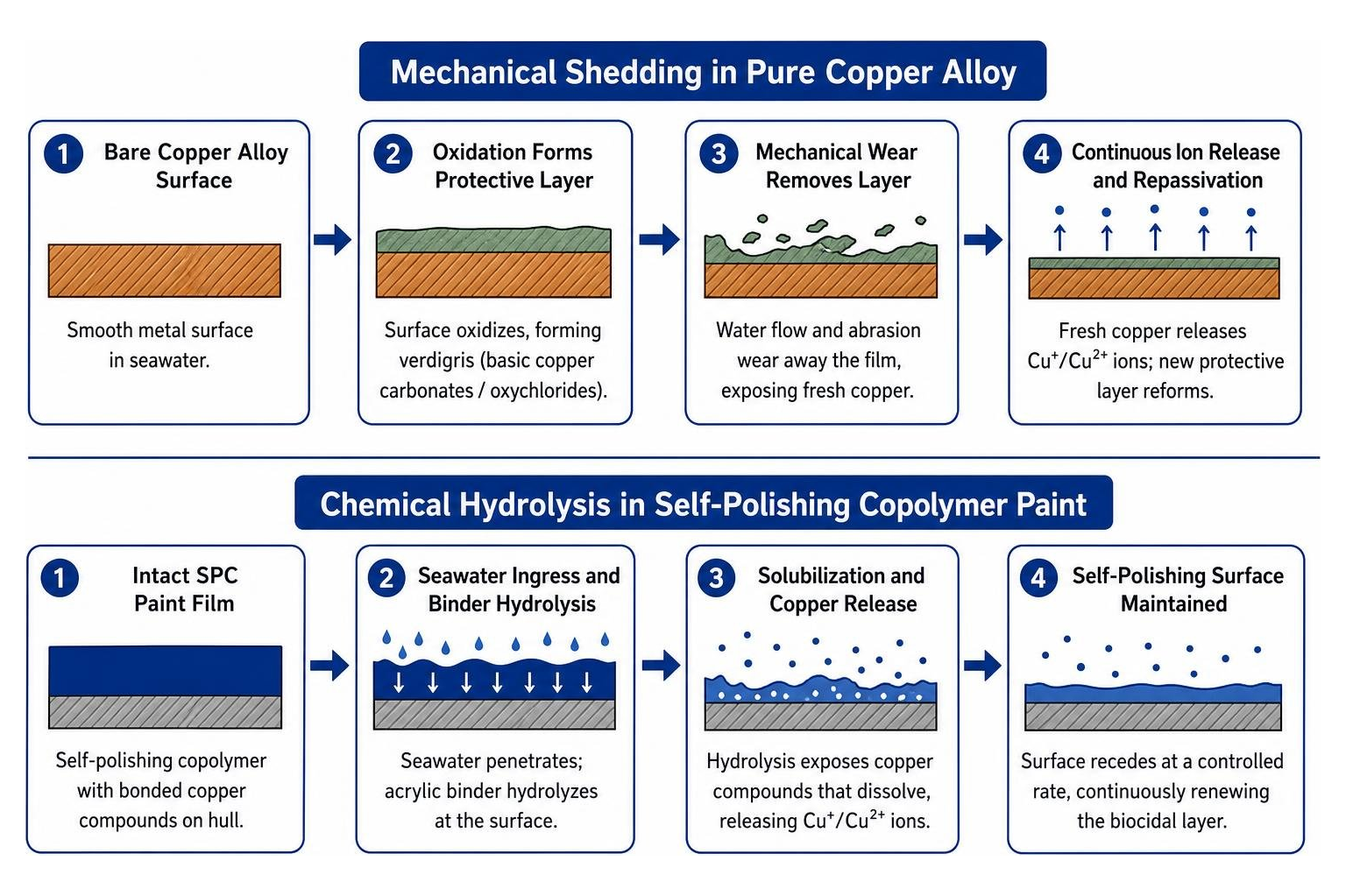
Modern antifouling systems rarely rely on pure metallic cladding. Instead, they incorporate refined active copper compounds—principally cuprous oxide ($\text{Cu}_2\text{O}$), copper thiocyanate ($\text{CuSCN}$), or metallic copper flakes—suspended within complex synthetic resin matrices. When submerged in marine environments, these active pigments undergo controlled dissolution, producing a continuous boundary layer of cuprous and cupric ions that disrupts the settlement mechanisms of settling larvae and algal spores. Over time, surface oxidation forms characteristic mineral passivations, such as basic copper carbonates and oxychlorides (often termed verdigris), which moderate the ion flux into the surrounding seawater.
| Material System | Active Form | Typical Release Mechanism | Primary Modern Applications |
|---|---|---|---|
| Pure Copper Sheet | Metallic $\text{Cu}^0$ | Uniform surface oxidation and slow ionic dissolution | Historical wooden ship cladding; specialized intake grates |
| Copper Alloys (Muntz metal, Cu-Ni) | $\text{Cu-Zn}$, $\text{Cu-Ni}$ solid solutions | Galvanic and passivating micro-corrosion layer | Aquaculture netting, sea chests, marine hardware, and seawater piping |
| Ablative / Soluble Matrix Paint | Cuprous oxide ($\text{Cu}_2\text{O}$) particles | Physical resin hydration and continuous pigment leaching | Leisure craft, moderate-speed commercial vessels |
| Self-Polishing Copolymers (SPC) | Cheated / bonded copper salts | Chemical hydrolysis of resin backbone reacting with seawater | Long-haul container shipping, deep-sea commercial fleets |
| Copper-Epoxy Suspensions | Pure copper powder in hard epoxy | Exposed particle micro-oxidation with periodic mechanical reactivation | Long-term recreational and performance hulls |
Pure Copper and Marine Alloys Versus Modern Paint Formulations
In 1761, the British Royal Navy commissioned the HMS Alarm with complete copper bottom plating, demonstrating unprecedented protection against shipworms and biofouling drag. This early milestone led to the development of Muntz metal (a 60% copper, 40% zinc brass alloy) in the nineteenth century, which provided a more cost-effective, uniform corrosion rate that continuously shed settling organisms. Later, copper-nickel alloys (such as 90-10 and 70-30 Cu-Ni) became standard structural and netting materials, particularly in modern aquaculture systems where mechanical durability and biofouling resistance are required under extreme offshore conditions.
However, the advent of steel-hulled ships made direct metallic copper cladding obsolete due to catastrophic galvanic corrosion between dissimilar metals. The maritime industry transitioned to polymer-based coatings that isolate the steel while metering active biocides into the water column. Early soluble-matrix (ablative) coatings dissolved unpredictably, often creating exhausted surface layers that trapped dead pigments. Modern Self-Polishing Copolymer (SPC) paints solve this challenge by using acrylic binders that hydrolyze at a steady, controlled rate as the vessel moves through water, continuously refreshing the active biocidal layer while minimizing spikes in total copper emissions from antifouling paint.
Oxidation, Passivation, and Biofouling Inhabitation Mechanisms
The biocidal efficacy of copper coatings depends on the chemical transformation of solid copper pigments into dissolved, bioactive ionic species at the paint-water interface:
- Pigment Dissolution: Cuprous oxide ($\text{Cu}_2\text{O}$) in the paint matrix dissolves in alkaline seawater (pH ~8.1), releasing cuprous ions ($\text{Cu}^+$) and forming soluble chloride complexes such as $\text{CuCl}_2^-$.
- Aqueous Oxidation: Dissolved cuprous complexes rapidly oxidize in oxygenated waters to divalent cupric ions ($\text{Cu}^{2+}$), yielding hydrated cupric cations $[\text{Cu}(\text{H}_2\text{O})_6]^{2+}$.
- Biological Uptake and Disruption: Free $\text{Cu}^{2+}$ ions diffuse through the outer cell walls of settling micro-algae, zoospores, and invertebrate larvae.
- Cellular Inactivation: Inside the organism, excess copper ions bind to thiol groups in essential enzymes, replace required cofactors (such as iron and zinc), and catalyze reactive oxygen species (ROS) via Fenton-like reactions, collapsing cellular respiration and disrupting cell membrane integrity.
- Surface Passivation: Unreleased surface copper gradually reacts with dissolved carbonates, sulfates, and chlorides, forming a passivating patina layer that regulates deep-matrix leaching and sustains the coating over multiple operational seasons.
Standardized Protocols for Copper in Antifouling Paint Testing

Evaluating marine coatings requires empirical testing protocols that separate simple physical erosion from true biocidal release kinetics. Quantifying active copper in antifouling paint testing combines laboratory immersion assays with non-destructive material characterization and real-world field validation.
To monitor paint degradation and residual biocide reserves without destroying the underlying panel substrates, researchers rely on specialized instrumentation. Techniques such as XRF material analysis allow for non-destructive surface mapping of elemental copper concentrations before and after immersion periods. When tracking trace metal migration into the surrounding seawater, ICP-MS heavy metal screening provides the sensitivity required to quantify leaching rates down to parts-per-billion (ppb) detection thresholds.
Laboratory Release Rate Assays
The standard for measuring laboratory leaching kinetics is defined by the ASTM D6442 test method. In this protocol, test panels or cylindrical drums coated with the experimental formulation are submerged in temperature-controlled, artificially formulated substitute ocean water maintained at a stable pH (typically $8.1 \pm 0.1$) and fixed salinity.
During testing, the substitute seawater is continuously circulated or rotated at standardized velocities to avoid boundary-layer stagnation. Aliquots are sampled at predetermined intervals (such as Days 1, 3, 7, 14, 21, 28, and beyond) and analyzed using Graphite Furnace Atomic Absorption Spectrometry (GF-AAS) or Inductively Coupled Plasma Mass Spectrometry.
The quantification range for standard ASTM D6442 assays runs from $1.8 \ \mu\text{g}\cdot\text{cm}^{-2}\cdot\text{day}^{-1}$ up to $500 \ \mu\text{g}\cdot\text{cm}^{-2}\cdot\text{day}^{-1}$, with limits of quantitation routinely hitting $\le 10 \ \mu\text{g}\cdot\text{L}^{-1}$. However, a known limitation of dynamic laboratory testing is that it consistently overestimates real-world hull emissions—often by factors ranging from 5 to 30 times—because laboratory vessels lack the complex organic biofilms and variable hydrodynamic regimes experienced by active vessels.
Field-Based Methods and In Situ Testing
To bridge the gap between laboratory bench models and real maritime environments, researchers deploy static raft arrays in coastal harbors and employ diver-deployed in-situ isolation domes on operating vessels.
An essential development in field quantification involves investigation of critical copper release rates through multi-site static immersion trials. Instead of relying solely on water sampling, analysts use calibrated XRF spectroscopy to quantify total copper mass loss directly from the coated panel surfaces over months of marine exposure. By scanning identical panel coordinates before immersion and at sequential retrieval intervals (e.g., 2 weeks, 2 months, 6 months), researchers can calculate the real-world daily flux ($\mu\text{g}\cdot\text{cm}^{-2}\cdot\text{day}^{-1}$) with high precision (relative standard deviations often $\le 1.8\%$).
These in situ tests demonstrate that environmental variables significantly alter leaching kinetics. Exposure across natural salinity gradients—from brackish Baltic Sea waters to high-salinity oceanic environments—reveals that copper release rates scale with water salinity, even when identical paint formulations are applied at uniform dry-film thicknesses (80–120 $\mu\text{g}$).
Environmental Impact, Chemical Speciation, and Performance Optimization

Environmental risk assessments must distinguish between the gross volume of copper emitted by a vessel and the specific fraction that poses a toxicological hazard to non-target marine ecology. Multiple field studies highlight that many commercial antifouling paints leach copper in excess of the dose needed to prevent macrofouling. This mismatch places unnecessary chemical burdens on enclosed bays, ports, and marinas without yielding cleaner hulls.
Achieving a balance between vessel fuel economy and harbor water quality requires an understanding of the aquatic chemical speciation of copper alongside a comparative study on in situ and lab release rates.
Bioavailability Versus Total Copper Leaching Rates
In marine ecotoxicology, total dissolved copper concentrations can be misleading. When copper biocides exit a coating film, they enter an aquatic matrix filled with dissolved organic matter, humic acids, carbonates, and inorganic ligands.
- Total Copper: The entire elemental copper mass present in a water sample, spanning suspended paint particles, insoluble precipitates, and organic complexes.
- Dissolved Copper: The operational fraction that passes through a standard 0.45 $\mu\text{m}$ membrane filter.
- Labile Copper: Weakly bound inorganic and organic complexes that are electrochemically accessible (often accounting for ~80% of total dissolved copper in pristine test waters).
- Free Cupric Ions ($\text{Cu}^{2+}$): The fully uncomplexed, hydrated ionic species $[\text{Cu}(\text{H}_2\text{O})_6]^{2+}$.
Only the free cupric ion fraction and specific weak inorganic complexes drive toxicity in non-target organisms, such as bivalve larvae, crustaceans, and pelagic fish. In natural marine harbors, free cupric ions typically represent only 6% to 40% of the total dissolved copper pool. Dissolved organic carbon (DOC) and natural water hardness mitigate toxicity by binding free ions into non-bioavailable complexes. Regulators and analysts increasingly rely on the Biotic Ligand Model (BLM) to calculate site-specific toxicity thresholds based on local water chemistry parameters rather than applying blanket limits based solely on total dissolved metal levels.
For sensitive, semi-enclosed waterways, maritime operators and local authorities frequently evaluate EPA safer alternatives to conventional high-load paints. These options include low-leach matrices, non-biocidal silicone foul-release technologies, and hard mechanical-wash barrier coats.
Optimizing Biocide Concentrations and Regulatory Compliance
Optimizing coating formulations allows manufacturers to achieve regulatory compliance without sacrificing performance. Key design and testing parameters include:
- Targeting the Empirical Critical Leaching Rate: European coastal trials demonstrate that a stable copper release rate of $7 \ \mu\text{g}\cdot\text{cm}^{-2}\cdot\text{day}^{-1}$ is sufficient to inhibit hard macrofouling (such as barnacles and tubeworms). Formulations that leach 30 to 60 $\mu\text{g}\cdot\text{cm}^{-2}\cdot\text{day}^{-1}$ consume active biocide prematurely without providing additional fouling resistance.
- Formulating with Self-Polishing Binders: Replacing simple insoluble rosin binders with silyl-acrylate or metal-acrylate SPC polymers ensures a steady biocide release rate throughout the coating’s service life, avoiding early release spikes.
- Incorporating Synergistic Organic Co-Biocides: Combining lower levels of cuprous oxide with targeted co-biocides (such as copper pyrithione, DCOIT, or zineb) broadens protection against copper-tolerant green algae (Ulva intestinalis) while reducing total metallic copper loading.
- Adapting to Regional Regulatory Frameworks: Formulations must comply with strict biocidal caps, including the EU Biocidal Products Regulation (BPR) minimum-effective-dose rules and state-level standards such as Washington State antifouling paint laws.
- Tailoring Formulations to Operational Salinity: Utilizing low-copper or biocide-free systems for vessels operating primarily in brackish or freshwater environments prevents unnecessary chemical leaching in areas where copper biocides exhibit reduced biological efficacy.
Frequently Asked Questions About Marine Antifouling Coatings
Why do laboratory tests often overestimate copper release compared to real-world hull conditions?
Laboratory tests conducted under protocols like ASTM D6442 use synthetic, particulate-free seawater held at constant temperatures and continuous mechanical agitation. This environment creates high concentration gradients and strips away natural boundary layers.
On an operational vessel, two key factors reduce real-world release:
- Biofilm Diffusion Barriers: A natural slime layer (composed of diatoms, bacteria, and extracellular polymeric substances) rapidly covers the paint, acting as a physical and chemical diffusion barrier that slows ionic transfer into the water column.
- Variable Hydrodynamics: Real ships spend significant time moored in static harbor berths where stagnant boundary layers accumulate, lowering the dissolution rate compared to actively agitated laboratory setups.
Accurately reconciling these laboratory values with real-world inputs requires high-precision analytical verification, such as cross-calibrated ICP-OES and ICP-MS analysis, combined with empirical field-correction factors (often ranging from 0.03 to 0.20).
What is the critical copper release rate needed to prevent hull fouling?
Long-term coastal exposure studies indicate that the critical copper release threshold required to prevent hard-shell macrofouling settlement (including acorn barnacles, bryozoans, and serpulid tubeworms) is approximately $7 \ \mu\text{g}\cdot\text{cm}^{-2}\cdot\text{day}^{-1}$ (with historical safety margins often citing 10 $\mu\text{g}\cdot\text{cm}^{-2}\cdot\text{day}^{-1}$).
Releasing copper above this 7–10 $\mu\text{g}\cdot\text{cm}^{-2}\cdot\text{day}^{-1}$ window provides little to no added protection against micro-algal slimes or macro-algae, which are naturally more tolerant of copper. Suppressing these tolerant species is more effectively achieved using targeted co-biocides or foul-release surface chemistries rather than increasing metallic copper concentrations.
How does salinity alter the efficacy and release of copper biocides?
Salinity directly governs the dissolution chemistry of cuprous oxide. In marine waters with high chloride ion concentrations ($\text{Cl}^-$), dissolving cuprous ions rapidly form soluble chlorocuprate complexes (predominantly $\text{CuCl}_2^-$ and $\text{CuCl}_3^{2-}$), which accelerates pigment dissolution from the paint matrix.
In brackish waters or freshwater (0 to 5 PSU), chlorocuprate complexation decreases, significantly slowing copper dissolution. Furthermore, freshwater biofouling communities are dominated by organisms that respond differently to copper ions compared to marine invertebrates. As a result, copper-based paints deployed in freshwater lakes and rivers often leach copper inefficiently while providing minimal antifouling performance compared to unpainted control panels.
Conclusion
Testing copper biocides in marine antifouling coatings requires balancing operational performance with environmental responsibility. Effective coating design is not simply about packing high volumes of cuprous oxide into a resin; it centers on maintaining a steady, optimized release rate that stays above the critical fouling threshold ($\approx 7 \ \mu\text{g}\cdot\text{cm}^{-2}\cdot\text{day}^{-1}$) without generating excessive chemical emissions.
At Elemental Analysis Inc., located in Lexington, KY, we deliver the analytical precision necessary to optimize and validate modern marine coatings. As the first commercial Particle-Induced X-ray Emission (PIXE) laboratory, we provide non-destructive coating profile assessments, rapid-turnaround XRF elemental mapping, and trace-level ICP-MS quantification. Whether your team is designing low-emission self-polishing copolymers, validating regulatory compliance under international biocidal frameworks, or conducting comprehensive water testing for heavy metals in surrounding waterways, our analytical capabilities deliver the data needed to advance marine coating technologies.