
Why Petroleum Product Analysis Matters
Choose the test based on what you need to know. Gas chromatography identifies fuel components. Elemental methods such as ICP-OES and XRF measure metals and sulfur. Standard property tests check factors such as viscosity and flash point. Together, these results help labs assess product quality, protect refinery equipment, and verify compliance with the rules that apply to each fuel.
The right method also depends on where the sample comes from. Crude oil, pipeline shipments, and finished fuels pose different questions, and heavy fractions often need different preparation than light fuels.
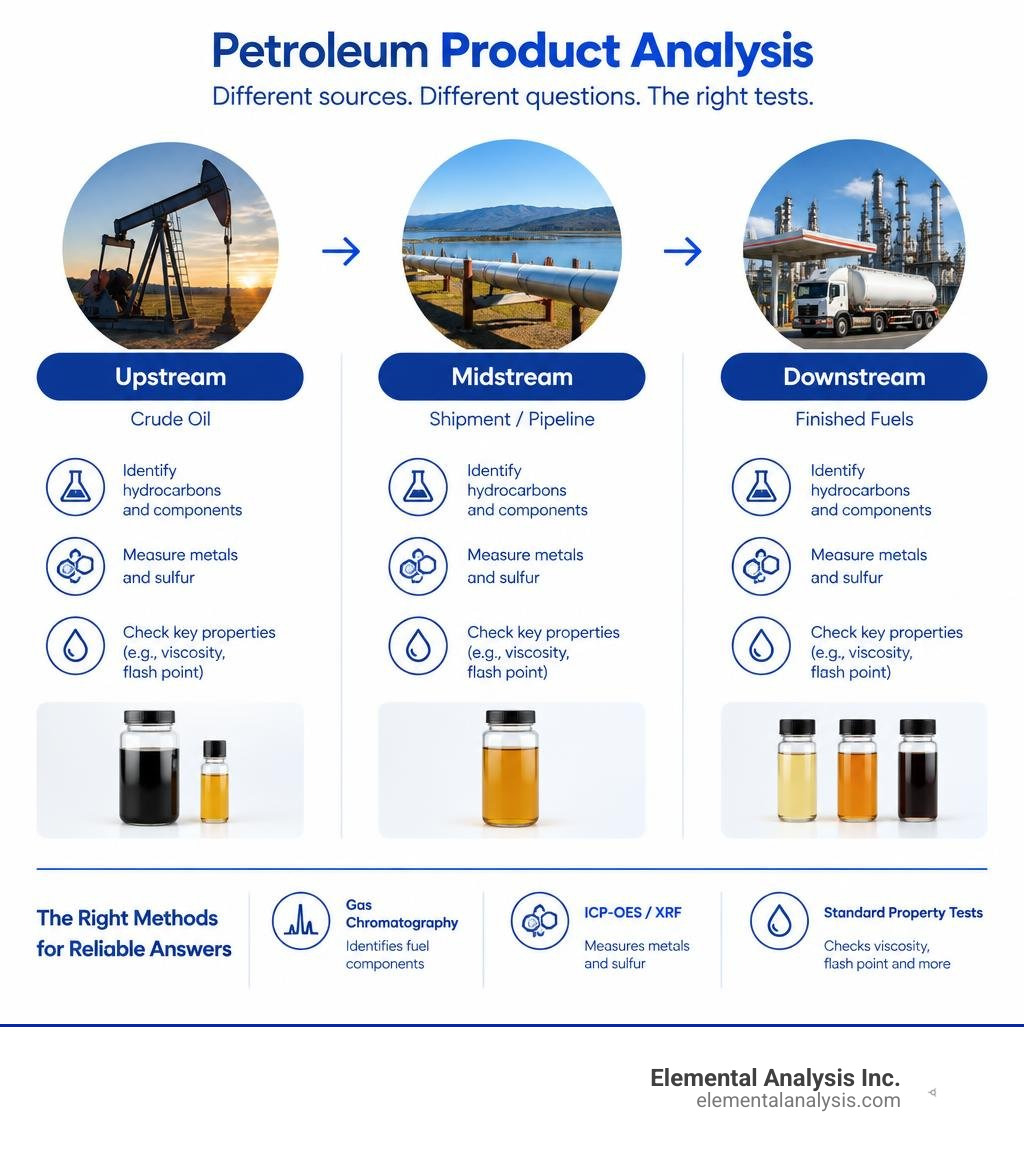
Petroleum product analysis word list:
Production Stages and Fractionation: Upstream, Midstream, and Downstream Testing
Refining crude oil requires continuous verification at every stage of the supply chain. Crude oil is a complex mixture of hydrocarbons, non-hydrocarbon organic compounds containing nitrogen, sulfur, and oxygen, and organometallic compounds like nickel, iron, and vanadium. Because no two oil reservoirs yield the same chemical fingerprint, analytical workflows must adapt as material moves from the ground to the consumer.
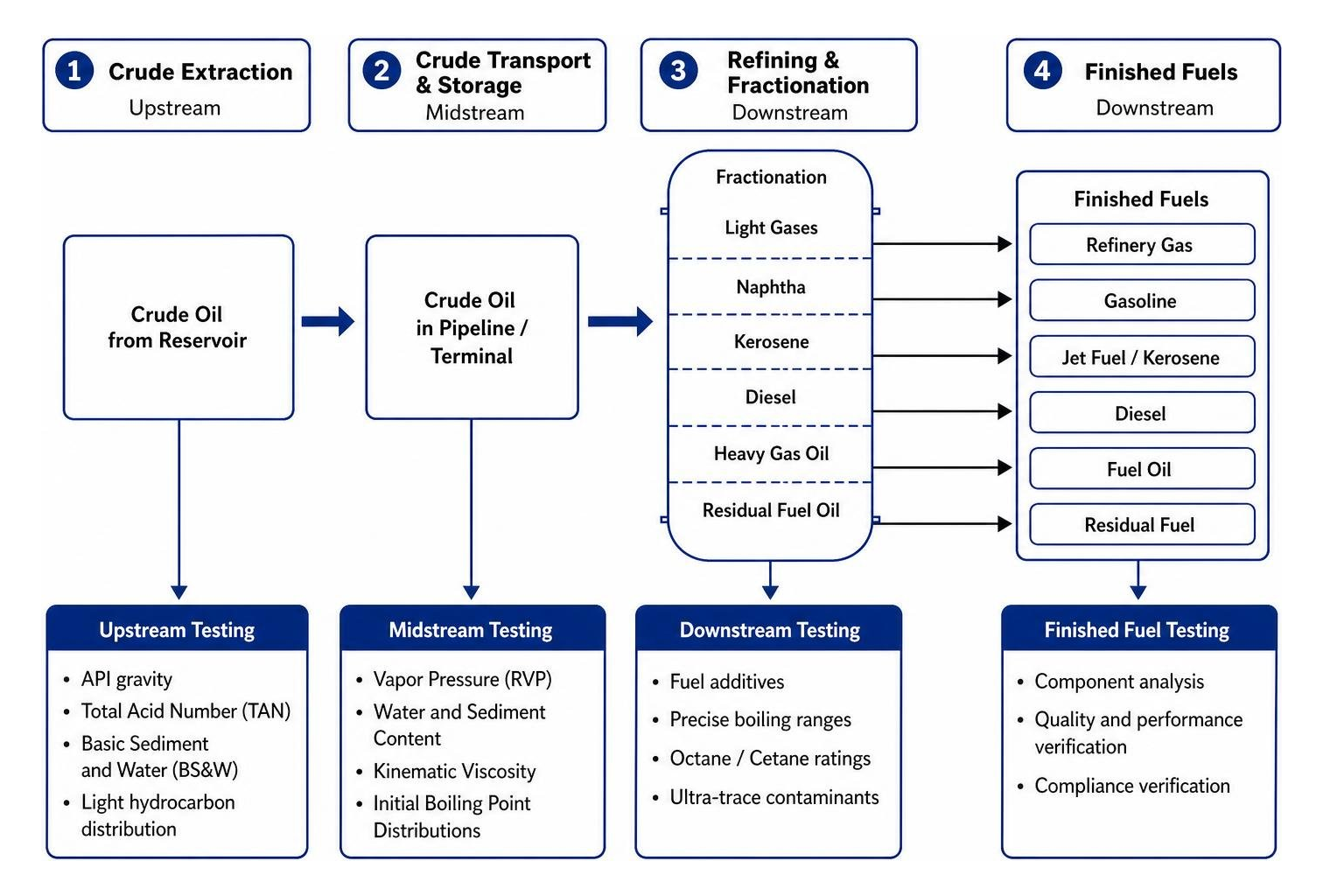
- Upstream (Extraction and Exploration): Testing focuses on comprehensive crude assays. Characterizing crude gravity (API gravity), Total Acid Number (TAN), basic sediment and water (BS&W), and light hydrocarbon distribution helps operators determine the economic value of a wellhead cut.
- Midstream (Transportation and Storage): Pipeline operators and terminal managers require rapid verification of custody transfer specifications. Testing focuses on vapor pressure (RVP), water and sediment content, kinematic viscosity, and initial boiling point distributions to prevent pipeline corrosion and vapor lock.
- Downstream (Refining and Blending): Refineries rely on precise chemical assays to optimize catalytic crackers, hydrotreaters, and reforming units. Downstream testing evaluates fuel additives, precise boiling ranges, octane/cetane ratings, and ultra-trace contaminants in finished products.
Distillation Fractions and Petroleum Product Analysis Across the Refining Stream
Crude fractionation separates complex hydrocarbon mixtures by boiling point. Each cut serves distinct commercial applications or downstream chemical processes:
| Fraction Cut | Boiling Point Range (°C) | Carbon Number Range | Primary End Products & Derivatives |
|---|---|---|---|
| Petroleum Gases (LPG) | < 35 | $C1 – C4$ | Propane, butane, petrochemical feedstocks |
| Light & Heavy Naphtha | 35 – 180 | $C5 – C{10}$ | Gasoline blending, chemical feedstocks, solvents |
| Kerosene / Jet Fuel | 180 – 240 | $C_{10} – C_{14}$ | Jet fuel (Jet A-1), heating fuel, lamp oils |
| Diesel / Middle Distillate | 240 – 360 | $C_{14} – C_{20}$ | Automotive diesel, heating oil, marine gas oil |
| Vacuum Gas Oil (VGO) | 360 – 540 | $C_{20} – C_{40}$ | Catalytic cracking feedstock, lubricating bases |
| Atmospheric / Vacuum Residua | > 540 | $C_{40+}$ | Asphalt, heavy bunker fuel, petroleum coke |
Refineries evaluate these fractions using established industry standard test methods to ensure physical and chemical properties stay within design limits. For light and middle cuts, standard gas chromatography (GC) operates efficiently up to carbon numbers near $C_{35}$, where the operational temperature ceiling sits around 325°C. Beyond this point, high-temperature gas chromatography (HT-GC) or liquid chromatography combined with mass spectrometry (LC-MS) becomes essential for tracking heavy hydrocarbons.
Individual spark-ignition engine fuels and oxygenated additives (such as MTBE, ETBE, ethanol, benzene, and toluene) demand high-resolution speciation. For example, ASTM D6730 uses a 100-meter capillary column with a pre-column to separate co-eluting paraffin, olefin, naphthene, and aromatic (PONA) groups, measuring component concentrations from 0.01% up to 30% by mass.
Elemental Analysis for Petroleum Products
Elemental analysis reveals the inorganic and heteroatomic backbone of hydrocarbons. While chromatographic tools define the carbon skeleton, elemental techniques quantify catalyst poisons, corrosive species, and regulated emissions precursors.
At our laboratory in Lexington, Kentucky, we combine non-destructive and destructive testing methods to evaluate both light distillates and heavy crude fractions:
- Proton-Induced X-ray Emission (PIXE): An accelerator-based, non-destructive technique that delivers rapid multi-element screening across a wide range of atomic numbers without complex chemical digestions.
- Inductively Coupled Plasma Optical Emission Spectroscopy (ICP-OES): Suited for routine screening of wear metals, additive packages, and process contaminants in liquid matrices.
- Inductively Coupled Plasma Mass Spectrometry (ICP-MS): Applied according to standards like ASTM D8110 to measure trace elements in distillates down to sub-ng/g (ppb) concentrations.
- X-ray Fluorescence (EDXRF / WDXRF): Ideal for non-destructive sulfur, nickel, iron, and vanadium quantification in liquid fuels and lubricants without extensive chemical digestion.
Non-Destructive Elemental Analysis with PIXE
As the first commercial PIXE laboratory, Elemental Analysis Inc. delivers multi-element screening for petroleum and petrochemical matrices. Because Particle-Induced X-ray Emission interacts directly with the atomic core of the target sample using an accelerated ion beam, it avoids the volatilization losses that can skew conventional wet-chemical testing.
PIXE provides simultaneous identification and quantification from sodium to uranium. This capability makes it an effective initial screening tool when evaluating unfamiliar crude feeds, pilot plant streams, or specialized hydrocarbon additives before selecting destructive, wet-chemical methods.
Elemental Analysis Challenges in Heavy Petroleum Fractions
Heavy petroleum fractions—such as vacuum residues, heavy fuel oils, and bitumen—present demanding analytical challenges. Asphaltenes and high-molecular-weight polar components form complex, refractory matrices rich in organic nitrogen, sulfur, and metals.
During sample digestion, these heavy cuts resist acid breakdown, which can lead to incomplete recoveries, particulate precipitation, or burner clogging in plasma torches. When standardized digestion protocols fall short on heavy bottoms, partnering with a lab capable of specialized custom method development ensures custom digestion matrices, high-pressure microwave systems, or solvent-dilution ICP-MS workflows yield repeatable results.
Trace Contaminants and Elemental Analysis: Sulfur, Halogens, and Metals
Trace contaminants can degrade product quality and damage refinery infrastructure. Managing corrosive species and catalyst poisons requires rigorous contract laboratory elemental analysis across every refining block.
Ultra-Low Sulfur and Halogen Quantification
Sulfur is one of the most strictly regulated elements in petroleum refining. Under global Tier 3 and Euro 6 frameworks, sulfur concentrations in automotive gasoline and diesel are capped at 10 ppm (mg/kg). In marine transport, the International Maritime Organization (IMO 2020) standard caps fuel sulfur at 0.50% mass/mass globally, and 0.10% within designated Emission Control Areas (ECAs).
Refineries verify these ultra-low thresholds through established procedures for measuring sulfur in petroleum and marine fuels using Energy-Dispersive or Wavelength-Dispersive XRF (ASTM D4294, ASTM D2622) and Ultraviolet Fluorescence (ASTM D5453). For trace halogens (chlorine, fluorine, bromine) that cause downstream unit corrosion and catalyst degradation, combustion ion chromatography (CIC) provides low-detection limit quantification. Analysts can review our guide on trace sulfur analysis techniques for a detailed comparison of detector sensitivities across different hydrocarbon streams.
Trace Metals Screening and Catalyst Protection
Organometallic compounds containing nickel (Ni), vanadium (V), and iron (Fe) occur naturally in heavy crude oils. During fluid catalytic cracking (FCC) and hydrotreating:
- Nickel and Vanadium deposit irreversibly onto zeolitic catalyst surfaces, accelerating dehydrogenation, reducing cracking selectivity, and increasing hydrogen and coke production.
- Iron forms scale, fouls pre-heaters, and induces bed plugging.
- Sodium and Potassium degrade refractory furnace linings and deactivate acid-cracking sites on catalysts.
Refineries establish trace metal monitoring protocols using ICP-OES and ICP-MS to protect catalyst investments. When choosing an analytical partner, review our criteria for heavy metal testing laboratory selection to ensure the facility maintains appropriate organic sample preparation equipment and matrix-matched standards.
Regulatory Compliance and Environmental Frameworks
Petroleum testing must satisfy stringent commercial specifications and environmental rules. The ASTM Manual on Hydrocarbon Analysis details over 200 standard test methods maintained by ASTM Committee D02, covering properties from auto-ignition temperature to trace element speciation.
Key regulatory frameworks include:
- US EPA Tier 3 Program: Mandates an annual average gasoline sulfur content of 10 ppm to protect vehicle catalytic converters and cut nitrogen oxide emissions.
- California Air Resources Board (CARB): Enforces strict limits on fuel aromatics, olefins, and benzene (often measured by ASTM D3606 or ASTM D5580).
- IMO MARPOL Annex VI: Limits sulfur oxides from commercial marine vessels, requiring bunker delivery documentation and verified XRF sulfur testing.
- ISO 8217 Specifications: Governs marine residual and distillate fuels, setting clear parameters for kinematic viscosity, density, flash point, pour point, and trace metals like Al + Si (catalytic fines) to prevent engine wear.
Frequently Asked Questions About Petroleum Testing Methods
How can PIXE support elemental analysis of petroleum products?
Particle-Induced X-ray Emission (PIXE) delivers non-destructive multi-element quantification from sodium to uranium. It provides rapid screening of crude oils, additives, and residues without requiring acid digestion, helping labs identify trace impurities while preserving sample integrity.
Why can heavy petroleum fractions be challenging to analyze?
Heavy fractions like atmospheric residua, vacuum residua, and asphaltenes have high boiling points (above 540°C), elevated viscosities, and complex aromatic structures. Standard gas chromatography columns foul at these boiling ranges, and refractory organic matrices often resist conventional acid digestion, requiring specialized sample preparation and high-temperature or mass-spectrometric techniques.
How does sulfur content testing relate to IMO 2020 and Tier 3 compliance?
IMO 2020 caps marine bunker fuel sulfur at 0.50% (5,000 ppm) globally and 0.10% (1,000 ppm) in ECA zones, whereas EPA Tier 3 mandates an average sulfur limit of 10 ppm for automotive gasoline. Meeting both targets requires calibrated analytical techniques—such as EDXRF/WDXRF for bunker fuels and UV-Fluorescence for finished gasoline—to verify compliance and prevent regulatory penalties.
Conclusion
Maximizing refinery margins while complying with strict emissions limits requires fast, accurate hydrocarbon characterization. From tracking light-end boiling distributions in crude assays to detecting sub-ppm catalyst poisons in hydrocracker feeds, precise testing protects operational uptime and confirms product quality.
Based in Lexington, Kentucky, Elemental Analysis Inc. supports refinery engineers, blenders, and environmental managers with specialized testing capabilities. As the first commercial PIXE laboratory, we provide both non-destructive screening and high-precision destructive elemental assays. Explore our comprehensive analytical testing services to discuss your testing requirements with our technical team.