
Weighing the Pros and Cons of Neutron Activation Analysis (NAA)
Is Neutron Activation Analysis Worth It? A Balanced Look at the Pros and Cons
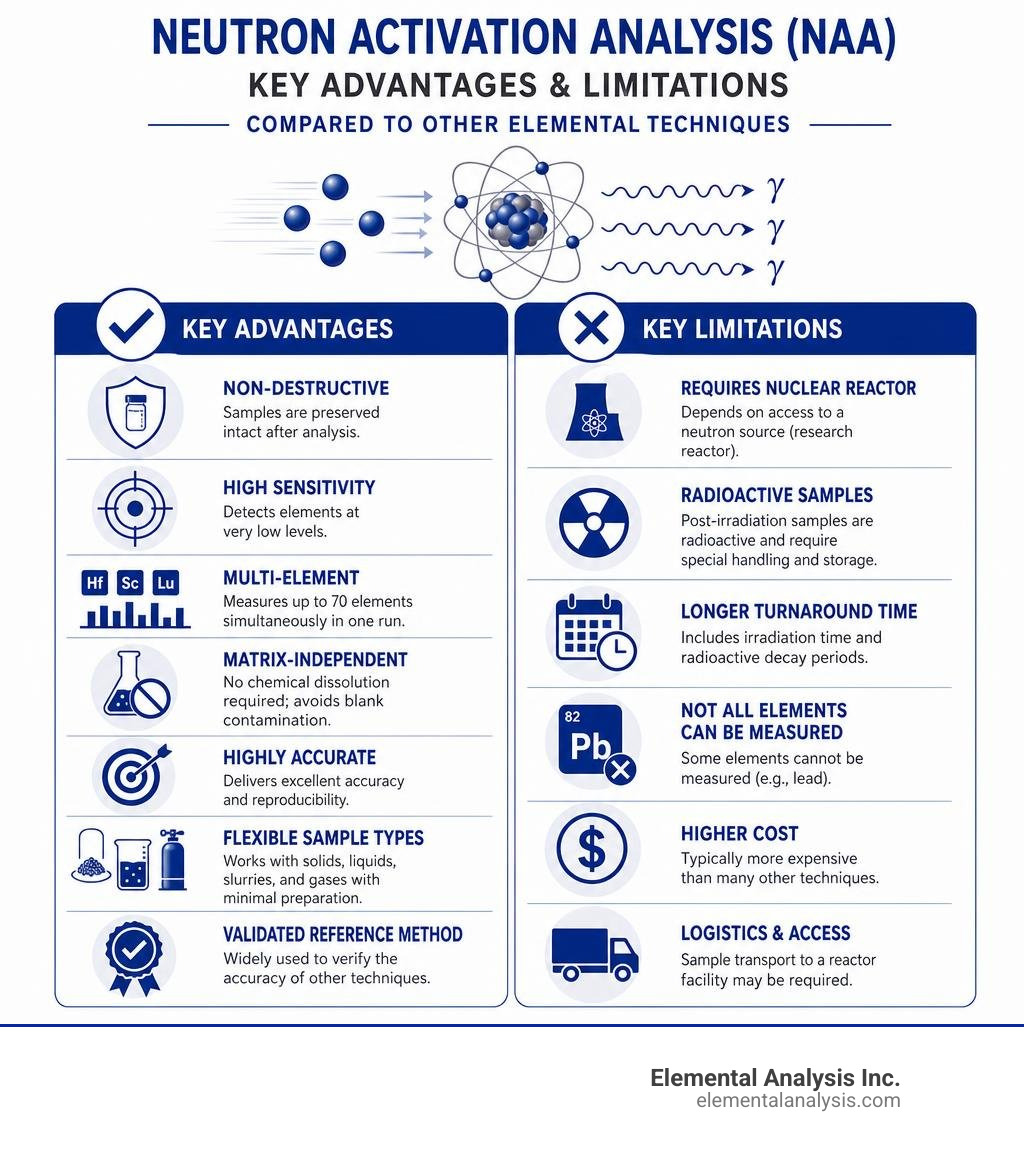
The advantage of neutron activation analysis NAA that most lab professionals cite first is simple: you can identify up to 70 elements in a single sample — without destroying it.
For a quick answer, here are the core advantages of NAA at a glance:
- Non-destructive — samples are preserved intact after analysis
- High sensitivity — detection limits as low as 0.03 nanograms for many elements
- Multi-element — up to 70 elements measured simultaneously in one run
- Matrix-independent — no chemical dissolution required, so no blank contamination
- Highly accurate — overall errors of just 2–5% relative standard deviation (RSD)
- Flexible sample types — solids, liquids, slurries, and gases with minimal preparation
- Validated reference method — widely used to verify the accuracy of other techniques
But NAA is not without trade-offs. It depends on specialized neutron sources (typically a nuclear reactor), post-irradiation samples are radioactive and require careful handling, and some elements — like lead — simply cannot be measured by this technique.
For lab supervisors managing aerospace alloy certification, pharmaceutical trace-element compliance, or environmental monitoring programs, those trade-offs matter. Knowing when NAA is the right tool — and when it isn’t — can save significant time and cost.
This guide walks through both sides clearly.
What is the Primary Advantage of Neutron Activation Analysis NAA?
When you need to know the exact elemental makeup of a sample without losing a single microgram of it, few methods can compete with Neutron Activation Analysis (NAA). Discovered in 1936 by George de Hevesy and Hilde Levi, this nuclear-based technique has stood the test of time.
Unlike conventional spectroscopic methods that rely on electronic transitions in the outer electron shells of an atom, NAA targets the atomic nucleus itself.
This fundamental difference is where the primary advantage of neutron activation analysis NAA comes from: it is an inherently non-destructive, bulk analytical technique.
When we irradiate a sample with neutrons, the stable isotopes within the material capture these neutrons and transform into radioactive isotopes (radionuclides). As these radionuclides decay, they emit characteristic gamma rays. Because gamma rays easily escape from deep within a solid sample without being absorbed or attenuated by atmospheric gases, we can measure the bulk composition of the entire sample, not just its surface.
This makes NAA uniquely suited for:
- Priceless Historical Artifacts: Analyzing ancient pottery, medieval coins, or rare paintings without leaving so much as a scratch.
- Forensic Evidence: Evaluating single strands of hair, gunshot residue, or explosive debris that must be preserved for court trials.
- Difficult Solid Matrices: Measuring elements inside tough geological rocks, high-purity silicon, or industrial sludges without having to dissolve them first.
By bypassing the need to physically or chemically break down a sample, NAA ensures the material remains physically intact and chemically unaltered for future studies. To see how we apply these advanced nuclear principles to complex materials, you can read more on our NAA page or review the Overview of Neutron Activation Analysis provided by the McClellan Nuclear Research Center.
High Sensitivity and Multi-Element Detection: A Key Advantage of Neutron Activation Analysis NAA
Another major advantage of neutron activation analysis NAA is its incredible sensitivity and broad multi-element detection capabilities. Depending on the exact experimental setup, NAA can simultaneously identify and quantify up to 74 elements in a single sample.
The detection limits of this technique are remarkably low, typically ranging from 0.03 nanograms to 4 micrograms for most elements. For highly sensitive elements like dysprosium (Dy) or europium (Eu), detection limits can reach down to an astonishing 1 picogram. Under ideal conditions, even tricky trace elements like arsenic can be detected at levels as low as 5 nanograms. This translates to a concentration sensitivity of 0.1 to 1 million ng/g (parts-per-billion to parts-per-million levels).
How does it achieve this? The answer lies in the high neutron flux of nuclear research reactors. A typical 1-megawatt research reactor delivers a thermal neutron flux of approximately $10^{13}\text{ n cm}^{-2}\text{ s}^{-1}$. Bombarding a sample with this many neutrons ensures that even ultra-trace amounts of target elements are activated and made visible to high-resolution gamma-ray spectrometers.
For more information on reactor-level neutron activation and its extreme sensitivity limits, refer to the USGS TRIGA Reactor NAA Guide.
Why Matrix Independence is a Crucial Advantage of Neutron Activation Analysis NAA
In traditional wet chemistry techniques like Inductively Coupled Plasma Mass Spectrometry (ICP-MS) or Atomic Absorption Spectroscopy (AAS), the “matrix effect” is a constant headache. If you are analyzing trace metals in a dense geological rock or a sticky polymer, you must first dissolve the sample using hot, concentrated acids. This process is not only dangerous and time-consuming, but it also introduces two major sources of error:
- Incomplete Dissolution: Some minerals (like zircon or chromite) are incredibly resistant to acid digestion. If they do not dissolve completely, the trace elements trapped inside them are missed.
- Reagent Blanks (Contamination): The very acids and water used to dissolve your sample contain trace impurities. These impurities can artificially inflate your results, making it difficult to distinguish between the actual sample and the “blank” background.
NAA completely bypasses these issues because it is entirely matrix-independent. Because neutrons interact directly with atomic nuclei rather than outer electron shells, the chemical state of the element (whether it is an oxide, a metal, or bound in an organic molecule) has zero effect on its activation.
Furthermore, because Instrumental NAA (INAA) requires no chemical pre-treatment, there is a virtual absence of an analytical blank. You simply place the solid sample into a high-purity polyethylene or quartz vial, seal it, and irradiate it. Any handling or container transfer occurs after the sample has been activated. Since any dust or contaminants introduced post-irradiation are not radioactive, they do not emit gamma rays and are completely ignored by the detector.
To learn more about how to manage these practical workflows and eliminate systematic errors, consult the IAEA’s technical document on the PRACTICAL ASPECTS OF OPERATING A NEUTRON ACTIVATION ANALYSIS LABORATORY.
Comparing Methodologies: INAA vs. RNAA and PGNAA vs. DGNAA
To make the most of the advantage of neutron activation analysis NAA, it is important to understand that the technique is not one-size-fits-all. It can be divided into different methodologies based on whether chemical separation is used, and when the gamma rays are measured.
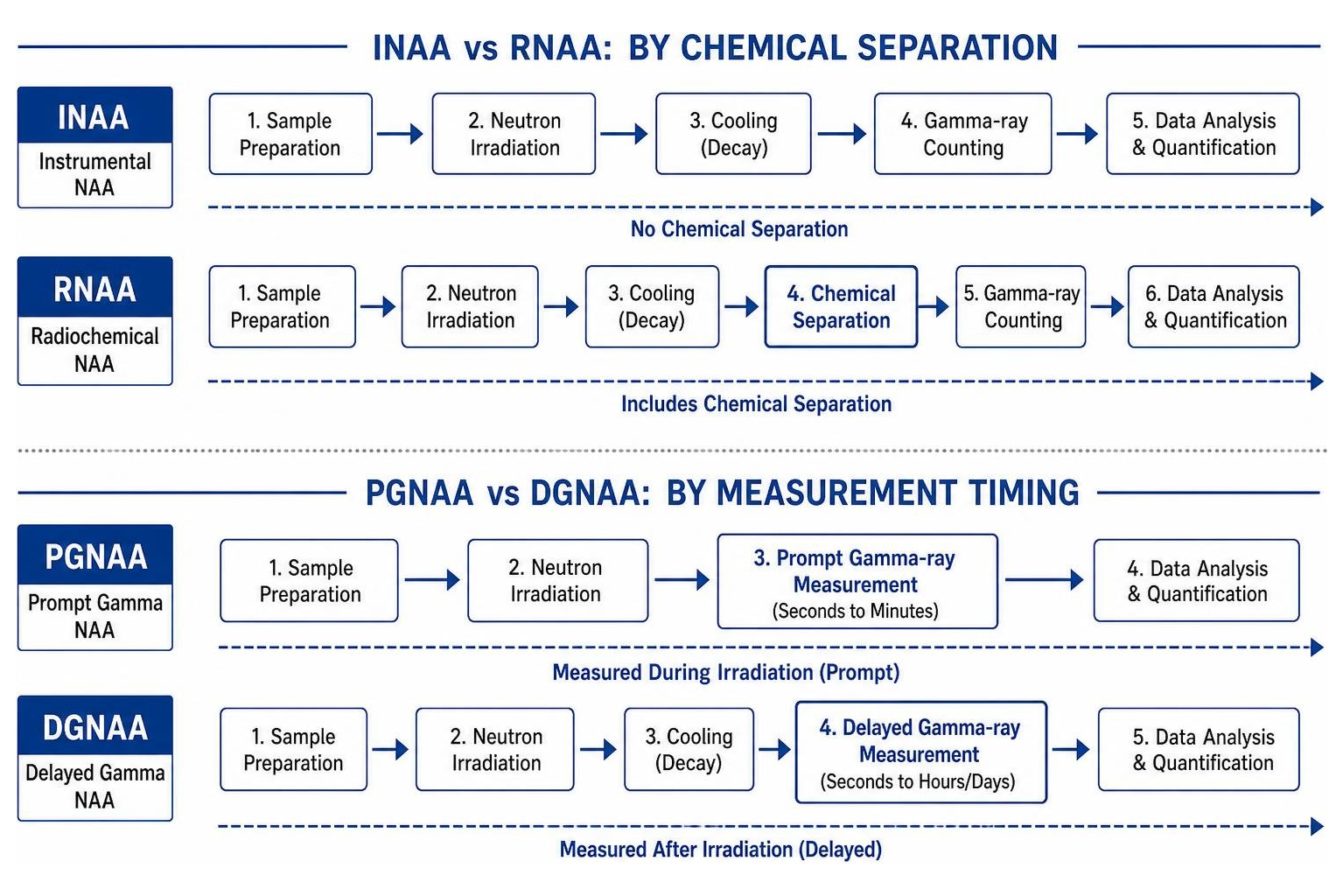
The table below outlines the key differences between these variations:
| Methodology | Chemical Separation? | Measurement Timing | Primary Strengths | Best Used For |
|---|---|---|---|---|
| Instrumental NAA (INAA) | No (Entirely non-destructive) | Delayed (Hours to weeks post-irradiation) | Lowest cost, zero reagent blanks, simple workflow | Bulk analysis of rocks, ceramics, and coal |
| Radiochemical NAA (RNAA) | Yes (Destructive post-irradiation) | Delayed (After chemical separation) | Eliminates spectral interference, achieves ultra-low detection limits | Isolating rare trace elements in complex biological matrices |
| Prompt Gamma NAA (PGNAA) | No (Non-destructive) | Real-time (During neutron bombardment) | Measures elements that decay in seconds or have high neutron capture cross-sections | Detecting Boron, Cadmium, Hydrogen, and Sulfur |
| Delayed Gamma NAA (DGNAA) | Optional (Usually non-destructive) | Delayed (After irradiation concludes) | Allows short-lived interfering isotopes to decay first, high precision | The vast majority of standard elemental analyses |
Instrumental vs. Radiochemical NAA
The choice between INAA and RNAA comes down to a balance between sample preservation and absolute sensitivity.
INAA is the most common form of the technique. Because it requires no chemistry, it is fast, cost-effective, and completely non-destructive. However, if a sample contains extremely high levels of highly active elements like sodium ($^{24}\text{Na}$) or scandium ($^{46}\text{Sc}$), the intense background radiation they produce can mask the weaker signals of other trace elements.
In those rare cases, RNAA is used. By performing chemical separation after the sample has been irradiated, chemists can physically remove the interfering radioactive “matrix” and isolate the specific radionuclides of interest. While this destroys the physical sample, it retains the “blank-free” advantage of NAA because any reagents added during the separation step are not radioactive and cannot contaminate the active signal.
Prompt Gamma vs. Delayed Gamma NAA
The distinction between PGNAA and DGNAA is purely a matter of timing.
PGNAA measures the “prompt” gamma rays emitted immediately (within $10^{-14}$ seconds) after a nucleus captures a neutron. This requires placing the gamma-ray detector right next to the neutron beam line. It is highly effective for elements that do not form radioactive isotopes with convenient half-lives, or those with massive neutron capture cross-sections.
DGNAA, on the other hand, waits for the irradiation process to end. The sample is removed from the reactor and allowed to “cool” for a specific decay period. This decay period acts as a natural separation chemist. For example, if you want to measure long-lived isotopes, you can let short-lived interfering isotopes (like aluminum-28, which has a half-life of only 2.2 minutes) decay away completely before you begin counting.
To explore how these different methodologies fit into a broader suite of analytical tools, visit our Services page or read the detailed breakdown of isotopic neutron sources in the guide All About Neutron Activation Analysis (NAA): What It Is & ….
The Limitations and Challenges of NAA
While the advantage of neutron activation analysis NAA makes it a gold standard for accuracy and matrix independence, we must also look at its limitations. No analytical technique is perfect, and NAA has a few distinct challenges that prevent it from being a routine, high-throughput tool for every laboratory.
- Reactor Dependency and Infrastructure Decline: Traditional high-sensitivity NAA requires a nuclear research reactor to provide a sufficient thermal neutron flux ($10^{12}$ to $10^{14}\text{ n cm}^{-2}\text{ s}^{-1}$). However, the number of operational research reactors worldwide has been steadily declining. This limited infrastructure makes accessing NAA logistically complex, expensive, and subject to scheduling delays. While alternative neutron sources like Californium-252 isotope sources or compact accelerator-driven systems exist, they generally offer lower neutron fluxes and cannot match the ultra-low detection limits of a full-scale reactor.
- Spectral Interferences: Sometimes, different radionuclides emit gamma rays with energies that are too close to be resolved, even by high-resolution High-Purity Germanium (HPGe) detectors. For example, the fission products of trace uranium in a sample can produce isotopes that directly interfere with the measurement of rare earth elements like lanthanum (La), cerium (Ce), and neodymium (Nd).
- The Self-Shielding Effect: If a sample contains high concentrations of elements with extremely high neutron capture cross-sections (like boron, cadmium, or certain rare earths), these elements will absorb the neutrons at the outer boundary of the sample. This “shields” the interior of the sample from the neutron flux, leading to under-activation and underestimation of the elements inside.
- Elemental Blind Spots: NAA is highly dependent on the nuclear properties of each element. Some important elements cannot be effectively analyzed. Lead (Pb), for instance, is a critical environmental contaminant, but it cannot be measured at trace levels by NAA because its neutron activation product has an inconveniently long half-life and very low gamma emission probability. For elements like lead, we must pair NAA with complementary techniques.
For a deeper dive into the global infrastructure challenges and the future of sustainable neutron sources, see the Sustainable Nuclear Analytical Infrastructure Study.
Frequently Asked Questions about Neutron Activation Analysis
What are the main applications of NAA?
Because of its non-destructive nature and high accuracy, NAA is widely used across several fields:
- Archaeology: Sourcing the origin of ancient pottery, obsidian tools, and coins by identifying their unique trace-element “fingerprints.”
- Forensics: Analyzing hair, nail, or fiber samples for toxic elements (like arsenic) or matching glass fragments from crime scenes.
- Geology: Quantifying rare earth elements (REEs) in rocks, meteorites, and deep-sea sediments where acid digestion is difficult.
- Semiconductors: Detecting ultra-trace impurities in high-purity silicon wafers where even parts-per-billion contamination can ruin integrated circuits.
To stay up to date on how nuclear and chemical testing techniques are applied to modern industrial challenges, check out the latest articles on our Blog page.
How does NAA serve as a reference or validation technique?
In chemical metrology, NAA is recognized as a “primary ratio method.” Because its physical principles are based on well-understood nuclear constants (like half-lives and neutron cross-sections) rather than empirical calibration curves, it is incredibly resistant to systematic errors.
When commercial labs develop new testing methods using ICP-MS or X-ray Fluorescence (XRF), they often use NAA to analyze their calibration standards. By comparing their results against the “true” values established by NAA, they can validate their own workflows and ensure regulatory compliance. To explore our full suite of validation and testing capabilities, visit our A to Z testing page.
What sample sizes are required for NAA?
One of the most practical benefits of NAA is its flexibility with sample sizes. While a typical sample size is around 50 milligrams (about one-twentieth of a gram), the technique is sensitive enough to analyze samples as small as a few micrograms. This tiny sample requirement ensures that even when a small portion must be drilled or scraped from a precious museum artifact, the physical damage to the object is virtually invisible.
Conclusion
Neutron Activation Analysis remains an indispensable pillar of modern analytical chemistry. The unique advantage of neutron activation analysis NAA — combining non-destructive bulk analysis with absolute matrix independence and multi-element sensitivity — makes it the ultimate “referee” technique when high-precision and sample preservation are non-negotiable.
While the logistical challenges of reactor access and the inability to detect certain elements like lead mean it may not replace high-throughput routine laboratory testing, its role as a validation standard is secure.
At Elemental Analysis Inc., based in Lexington, Kentucky, we understand that choosing the right analytical approach is a balance of speed, cost, and precision. As the first commercial laboratory to offer Proton Induced X-ray Emission (PIXE) testing alongside our extensive suite of destructive and non-destructive analytical chemistry services, we help you navigate these complex testing decisions.
To learn more about our team, our quality standards, and our mission to provide fast, reliable testing solutions, visit our About us page. If you are ready to discuss how we can support your next high-precision project, Partner with us for high-precision NAA services today.