
The Nuclear Haircut: How NAA Solves Crimes Through Hair Analysis
When a Single Strand of Hair Becomes the Most Powerful Evidence in the Room
How does hair analysis help with NAA is one of the most important questions in modern forensic and trace-element science — and the answer changes how labs think about biological evidence entirely.
Here’s the short version:
- Hair captures a chemical history. A standard 1.5-inch scalp hair sample holds roughly 90 days of exposure data for drugs, heavy metals, and trace elements.
- NAA reads that history at the atomic level. Instead of dissolving or destroying the sample, neutron activation analysis bombards it with neutrons, causing elements to emit unique gamma-ray signatures that identify and quantify what’s there.
- The combination is powerful. NAA can detect up to 74 elements in a hair sample — from arsenic to zinc — at concentrations as low as parts-per-trillion, all without chemically altering the sample.
- It’s objective. Unlike older microscopic hair comparison methods (which contained errors in 96% of reviewed FBI trial cases), NAA produces hard nuclear data, not subjective visual interpretation.
This matters whether you’re running a forensic toxicology lab, monitoring environmental heavy metal exposure, or validating elemental contamination in a pharmaceutical or aerospace context.
Hair is stable, easy to collect, and — when analyzed with NAA — extraordinarily informative. A strand of hair doesn’t lie, and NAA has the sensitivity to prove it.
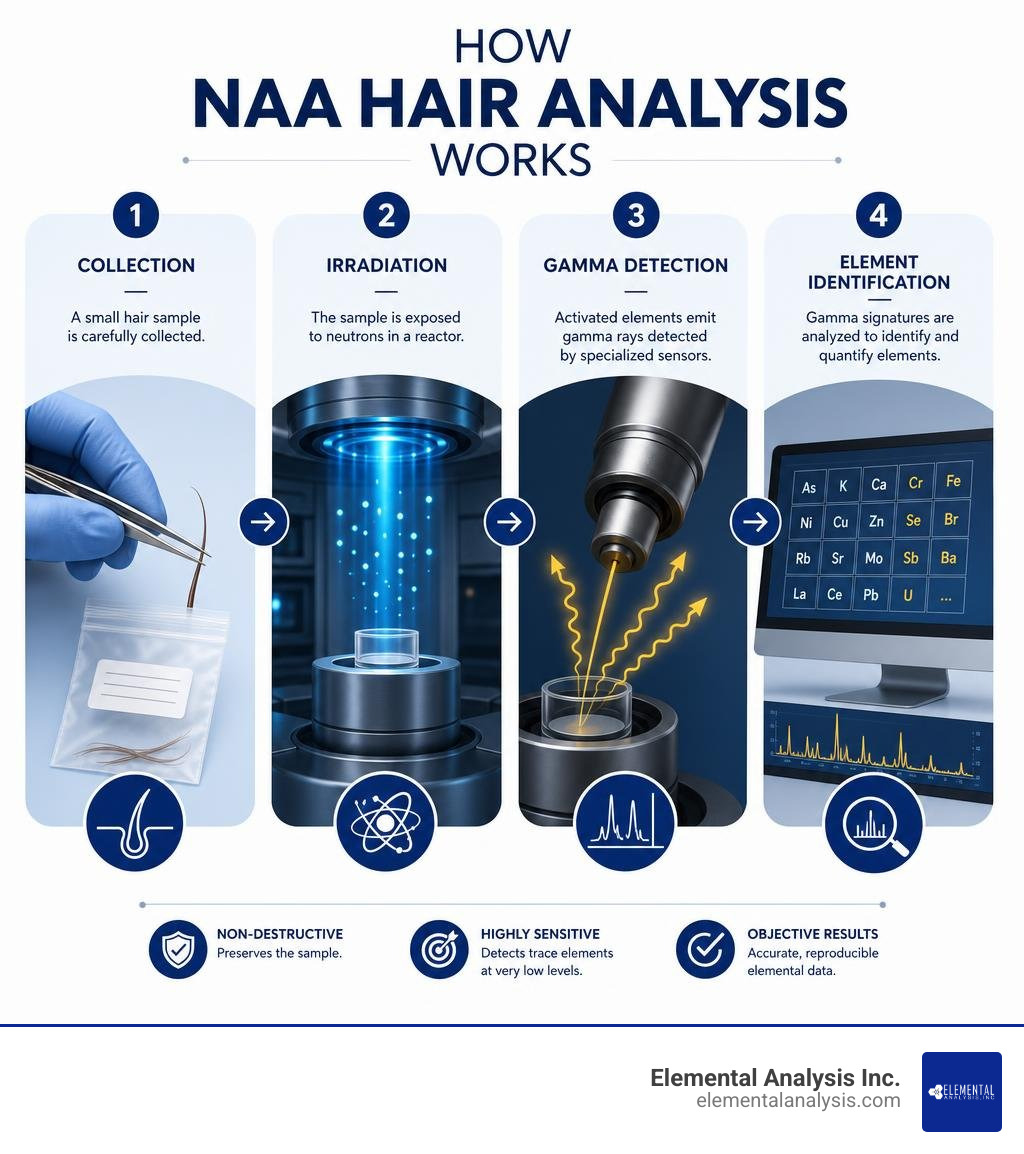
What is Neutron Activation Analysis (NAA)?
To understand how hair and nuclear physics make such a formidable crime-fighting duo, we first need to look at the science of Neutron Activation Analysis (NAA). Discovered in 1936 by George de Hevesy and Hilde Levi, NAA is a premier nuclear process used to determine the concentrations of elements in vast arrays of materials.
Unlike mass spectrometry or chromatographic methods that identify molecules and chemical formulations, NAA focuses exclusively on the atom’s nucleus. It completely ignores how atoms are bound together chemically. This means whether an arsenic atom is bound to organic molecules or sitting as a free inorganic ion, NAA sees it simply as arsenic.
The basic physics of the process is elegant:
- Neutron Bombardment: We place a sample inside a research nuclear reactor, where it is bombarded with a high flux of thermal neutrons.
- Radioactive Activation: The stable nuclei of the elements within the sample capture these neutrons, transforming them into radioactive isotopes (radionuclides).
- Gamma Emission: As these newly formed radioactive isotopes decay, they emit characteristic gamma rays.
- Spectroscopic Measurement: Using high-resolution semiconductor detectors (such as High-Purity Germanium detectors), we measure the energy and intensity of these emitted gamma rays. Because every element has a unique gamma-ray “fingerprint,” we can identify and quantify exactly which elements are present and in what amounts.
Because NAA operates directly on the atomic nucleus, it provides incredibly high sensitivity and precision (often better than 0.1%). It is uniquely capable of analyzing solids, liquids, and suspensions with minimal physical preparation, making it a gold-standard technique for trace element analysis.
How Does Hair Analysis Help with NAA in Forensic Investigations?
In forensic science, the combination of hair analysis and NAA has solved cold cases, unmasked historic poisonings, and provided ironclad evidence in courts of law. Hair is a uniquely durable biological matrix. It is composed of 65% to 95% keratin, 1% to 9% lipids, and less than 1% minerals. Because of this tough, keratinized structure, hair resists decay. In fact, toxicologists have successfully detected opiates in the hair of the Victorian poet John Keats 167 years after his death, and cocaine metabolites in 2,000-year-old Peruvian mummies.
When a person ingests a toxin, heavy metal, or drug, the substance is absorbed into the bloodstream. As hair grows from the follicle (which is buried 3 to 5 mm beneath the scalp), it is fed by blood vessels. The growing hair cells absorb these circulating elements, trapping them permanently inside the keratin matrix as the hair shaft keratinizes and emerges from the skin.
By using NAA, forensic scientists can analyze these trapped elements without destroying the precious, often microscopic, physical evidence. This non-destructive comparison of evidentiary materials is one of the chief advantages of NAA in forensics. If a suspect’s hair is found at a crime scene, we can use NAA to compare its trace-element profile to a sample taken directly from the suspect. If the unique trace element “fingerprints” match across dozens of elements, it provides highly compelling circumstantial evidence.
A classic real-world application is detailed in Forensic Hair Sample Analysis using NAA and AAS – Forensic Reader, which explains how both NAA and Atomic Absorption Spectroscopy (AAS) are utilized to estimate concentrations of toxic metals like arsenic in biological tissues. If a victim is slowly poisoned with arsenic, the poison is deposited in the hair over time. Because scalp hair grows at a highly predictable rate of approximately 0.3 to 0.5 mm per day (roughly 1 cm or 0.5 inches per month), we can perform segmental analysis—cutting the hair into tiny slices—to construct an exact chronological timeline of the poisoning.
How Does Hair Analysis Help with NAA for Trace Element Detection?
When we look specifically at trace element detection, the analytical capabilities of NAA are staggering. Depending on the experimental procedure and the reactor’s neutron flux, NAA can detect up to 74 elements. At advanced facilities like the High Flux Isotope Reactor (HFIR), approximately 65 elements can be determined at levels ranging from parts-per-million (ppm) down to parts-per-trillion (ppt) or below.
According to a review on The multifaceted role of hair as a biospecimen: recent advances in precision medicine and forensic science, trace element analysis in hair has evolved from a basic toxicological tool into a sophisticated diagnostic resource. For example, clinical studies have achieved 98.2% accuracy in distinguishing prostate cancer patients from healthy controls by analyzing the concentrations of just nine trace elements in scalp hair.
For forensic and toxicological applications, the detection limits of NAA for heavy metals and poisons like mercury, cadmium, selenium, and antimony range from 0.1 to 1 million ng/g (nanograms per gram). This incredible sensitivity allows us to identify occupational exposures, environmental poisoning, or deliberate homicide even when only a single strand of hair is available for testing.
How Does Hair Analysis Help with NAA to Overcome Microscopic Hair Comparison Errors?
Historically, forensic hair analysis relied on microscopic hair comparison—essentially, an examiner looking at two hairs under a microscope and declaring if they “matched” based on visual characteristics like color, thickness, and pigment distribution.
However, this method was highly subjective and prone to human error. In a massive review of the FBI’s Microscopic Hair Comparison Analysis, examiners were found to have made erroneous, scientifically invalid statements in 96% of the 268 cases where they provided testimony used to inculpate a defendant at trial. This systemic failure contributed to dozens of wrongful convictions and played a role in 74 of the first 329 DNA exonerations in the United States.
This is where NAA steps in to save the day. By providing objective, quantitative nuclear data, NAA removes human bias from the equation. Instead of saying, “These two hairs look similar under a lens,” NAA allows us to say, “These two hairs share identical concentrations of 15 rare trace elements down to the parts-per-billion level.” Combined with modern mitochondrial DNA testing, NAA has helped restore scientific integrity to forensic hair analysis, ensuring that innocent people are not wrongfully convicted based on flawed visual comparisons.
The Step-by-Step Process of Hair Analysis via NAA
How exactly do we take a strand of hair from a crime scene and extract its nuclear secrets? It requires a meticulous, highly standardized protocol to prevent environmental contamination and ensure absolute accuracy.
Step 1: Sample Collection
First, we collect the hair sample. In forensic and clinical settings, we prefer to collect hair from the vertex posterior (the back of the head), cutting it as close to the scalp as possible. To establish a reliable timeline of exposure, we keep the root end clearly marked. For general drug and environmental testing, a standard 1.5-inch sample is collected, which represents approximately 90 days of growth. If scalp hair is unavailable, body hair (axillary, pubic, or chest hair) can be collected, though its growth rate and cycles differ.
Step 2: Decontamination and Washing
Hair is a magnet for dust, sweat, grease, and external pollutants. Before we can analyze the internal elements, we must strip away any external contaminants. This step is critical; otherwise, we might mistake external environmental dust for ingested poisons. We wash the hair using a sequential combination of organic solvents and aqueous solutions (such as acetone, ether, and ultra-pure water). This process, detailed in reviews like the Forensic toxicological analysis of hair: a review, removes surface lipids, cosmetic products, and external dirt without leaching out the trace elements locked deep inside the inner cortex.
Step 3: Encapsulation
Once washed and dried (often in a HEPA-filtered drying oven to prevent contamination from ambient dust), the hair is weighed. Because NAA is so sensitive, we can analyze samples weighing as little as 0.001 grams. The dried hair is then sealed inside high-purity linear polyethylene or quartz vials. These encapsulation materials are chosen because they contain virtually no trace elements that could interfere with the analysis.
Step 4: Irradiation
The sealed vial is placed inside an irradiation container, affectionately known in reactor physics as a “rabbit.” This rabbit is pneumatically shot into the core of a research nuclear reactor. For example, at facilities utilizing pneumatic tubes, the sample is exposed to a massive thermal neutron flux (often between $10^{13}$ and $10^{14}$ neutrons $cm^{-2} s^{-1}$) for a precise duration—ranging from a few seconds for short-lived isotopes to several hours for long-lived elements.
Step 5: Decay and Measurement
After irradiation, the sample is allowed to “cool” or decay for a calculated period. This decay period is crucial because it allows highly active, short-lived radionuclides (like sodium-24) to decay away, preventing them from overwhelming the detector and masking the weaker signals of target trace elements like arsenic, mercury, or gold.
Finally, the sample is placed in front of a gamma-ray spectrometer. The detector counts the gamma photons emitted by the decaying isotopes, and our software generates a spectrum showing distinct energy peaks. By analyzing these peaks, we calculate the exact concentration of each element present in the hair.
Comparing NAA to Other Elemental Hair Testing Methods
While NAA is an extraordinary tool, it is not the only method available for analyzing hair. Let’s look at how it stacks up against other common laboratory techniques, such as Inductively Coupled Plasma Mass Spectrometry (ICP-MS) and Inductively Coupled Plasma Optical Emission Spectrometry (ICP-OES).
| Feature / Metric | Neutron Activation Analysis (NAA) | ICP-MS | ICP-OES |
|---|---|---|---|
| Primary Mechanism | Nuclear excitation & gamma spectroscopy | Atomization, ionization & mass filtering | Thermal excitation & light emission |
| Sample Destruction | Non-destructive (Sample remains chemically intact) | Destructive (Requires complete acid digestion) | Destructive (Requires complete acid digestion) |
| Detection Limits | Parts-per-million (ppm) to parts-per-trillion (ppt) | Parts-per-trillion (ppt) to parts-per-quadrillion (ppq) | Parts-per-billion (ppb) to parts-per-million (ppm) |
| Chemical Form Interference | None (Ignores chemical bonds completely) | Minimal (Requires digestion to free ions) | Minimal (Requires digestion to free ions) |
| Sample Size Required | Extremely small (down to 1 mg) | Small (typically 10-50 mg) | Moderate (typically 50-100 mg) |
| Primary Use Cases | Forensic comparison, archaeological artifacts, high-purity materials | Multi-element clinical testing, environmental toxicology | Routine industrial screening, major mineral analysis |
The most significant differentiator is preservation of evidence. Techniques like ICP-MS and ICP-OES require us to dissolve the hair sample in concentrated nitric acid. Once the sample is dissolved, it is gone forever. If the defense in a trial demands an independent test of the evidence, a dissolved sample leaves them with nothing. NAA, on the other hand, preserves the physical structure of the hair. Although the sample remains mildly radioactive for a period after testing, its chemical and physical structure is completely unchanged.
However, for routine clinical drug testing—such as identifying cocaine, amphetamines, or opioids—laboratories generally rely on initial enzyme-linked immunosorbent assays (ELISA) followed by gas chromatography-mass spectrometry (GC-MS) or liquid chromatography-tandem mass spectrometry (LC-MS/MS). These methods are optimized for organic molecules rather than inorganic trace elements.
As highlighted in the Invited critical review State of the art in hair analysis for detection of drug and alcohol abuse, chromatographic techniques excel at identifying parent drugs and their metabolites (which prove ingestion and rule out external exposure). For instance, standard follicle tests correctly identify about 52.3% of recent cannabis users and 65.2% of recent cocaine users. But when the target is an inorganic poison, a heavy metal, or a non-destructive comparison of trace elements, NAA remains unmatched.
Frequently Asked Questions about Hair Analysis and NAA
What are the detection limits of NAA for hair analysis?
NAA is exceptionally sensitive, with minimum detection limits ranging from 0.1 to 1 million ng/g depending on the specific element under investigation. For highly sensitive elements like dysprosium (Dy) and europium (Eu), NAA can detect amounts as small as 1 picogram ($10^{-12}$ grams). This makes it highly effective for identifying even trace exposures to heavy metals or poisons trapped within a single strand of hair.
How does hair pigmentation or cosmetic treatment affect NAA results?
Hair pigmentation and cosmetic treatments can significantly influence hair analysis, and must be accounted for during interpretation.
- Melanin and Pigmentation: Melanin pigments (eumelanin and pheomelanin) located in the hair cortex have a high affinity for basic, lipophilic compounds and certain metal ions. As noted in research regarding Hair testing for investigating intake and use history of hypnotics in the forensic field, drugs and elements incorporate at much higher concentrations in dark, highly pigmented hair than in light or white hair. For example, zolpidem concentrations can be up to five times higher in black hair than in white hair after identical dosing.
- Cosmetic Treatments: Bleaching, dyeing, perming, and chemical straightening can damage the hair’s protective cuticle. This damage can cause trapped trace elements to leach out during washing, or allow external contaminants from hair dyes (which often contain trace metals like lead, copper, or bismuth) to penetrate deep into the hair shaft. Standardized decontamination and careful examination of hair damage are vital to prevent false positives or negatives.
What are the main limitations of using NAA for hair testing?
While powerful, NAA has several practical limitations:
- Access to a Nuclear Reactor: Unlike an ICP-MS instrument, which can sit on a laboratory bench, NAA requires a live nuclear reactor as a neutron source. This limits the number of facilities worldwide that can perform the analysis.
- Radioactivity: Irradiated samples remain radioactive for days, weeks, or even years depending on the elements present, requiring specialized handling, licensing, and disposal protocols.
- Turnaround Time: Because some elements require long irradiation and decay periods to eliminate background interference, turnaround times can range from several days to weeks.
- Organic Compounds: NAA cannot identify organic molecules, drugs, or proteins directly; it only identifies the individual chemical elements (atoms) that make them up.
Conclusion
When it comes to analyzing trace elements with absolute precision, hair analysis via Neutron Activation Analysis is a marvel of modern nuclear chemistry. By unlocking the chronological record stored within keratin, NAA provides forensic scientists, clinicians, and researchers with an objective, non-destructive, and highly sensitive window into the past.
At Elemental Analysis Inc., based right here in Lexington, KY, we understand the power of atomic-scale detection. As the first commercial PIXE (Proton Induced X-ray Emission) laboratory, we have spent decades pioneering the field of non-destructive and destructive trace element identification, quantification, and speciation.
Whether you require rapid-turnaround trace element analysis, heavy metal screening, or specialized forensic testing, we deliver highly precise, competitive pricing and peerless laboratory expertise. We invite you to explore our advanced analytical services and discover how we can help you solve your most complex elemental challenges.
Ready to unlock the atomic secrets of your samples? Explore our specialized Instrumental Neutron Activation Analysis (INAA) Services today, or contact our Lexington, Kentucky team to discuss your project requirements!
Additional Resources and References
- For local drug testing services in Kentucky, you can explore options like Hair Follicle Drug Testing – Lexington, KY or Hair Follicle Drug Testing – Haldeman, KY.
- For general medical info on hair testing, see Hair Analysis – Cigna Healthcare and the clinical overview in Human hair as a diagnostic tool in medicine.
- To dive deeper into high-resolution toxicological techniques, read about Micro-segmental hair analysis: detailed procedures and applications in forensic toxicology.