
Clay, Chemistry, and Neutrons: The Science of NAA Ceramic Analysis
Why NAA Ceramic Analysis Is the Gold Standard for Pottery Provenance
NAA ceramic analysis — neutron activation analysis applied to pottery and clay — is one of the most precise methods available for determining where a ceramic vessel was made and what raw materials were used to produce it.
Here’s what you need to know at a glance:
- What it does: Measures trace-element concentrations in ceramic paste to create a unique chemical fingerprint
- How it works: Bombards a small powder sample (~80 mg) with neutrons, triggering radioactive emissions that identify up to 33 elements
- Detection limits: Reaches the ng/g (nanogram per gram) level — far below what most competing techniques can achieve
- Key output: Elemental profiles that can be matched to known clay sources or regional compositional databases
- Typical project scale: 100–500 samples per study; results in 4–6 months for smaller projects
- Cost range: Roughly $100–$500 per sample depending on sample type and analysis scope
The core idea is simple: clay from different geographic regions has a distinctive chemical signature. If you can measure that signature precisely enough, you can trace a finished pot back to its source — even across centuries.
This technique has been used in archaeological research for more than 60 years, and it remains the preferred method when researchers need high sensitivity, broad elemental coverage, and data that can be compared across large reference databases.
Whether you’re sourcing pottery from a Mediterranean workshop or tracking trade networks in the prehistoric Caribbean, NAA gives you a level of chemical resolution that visual inspection and most other lab methods simply can’t match.
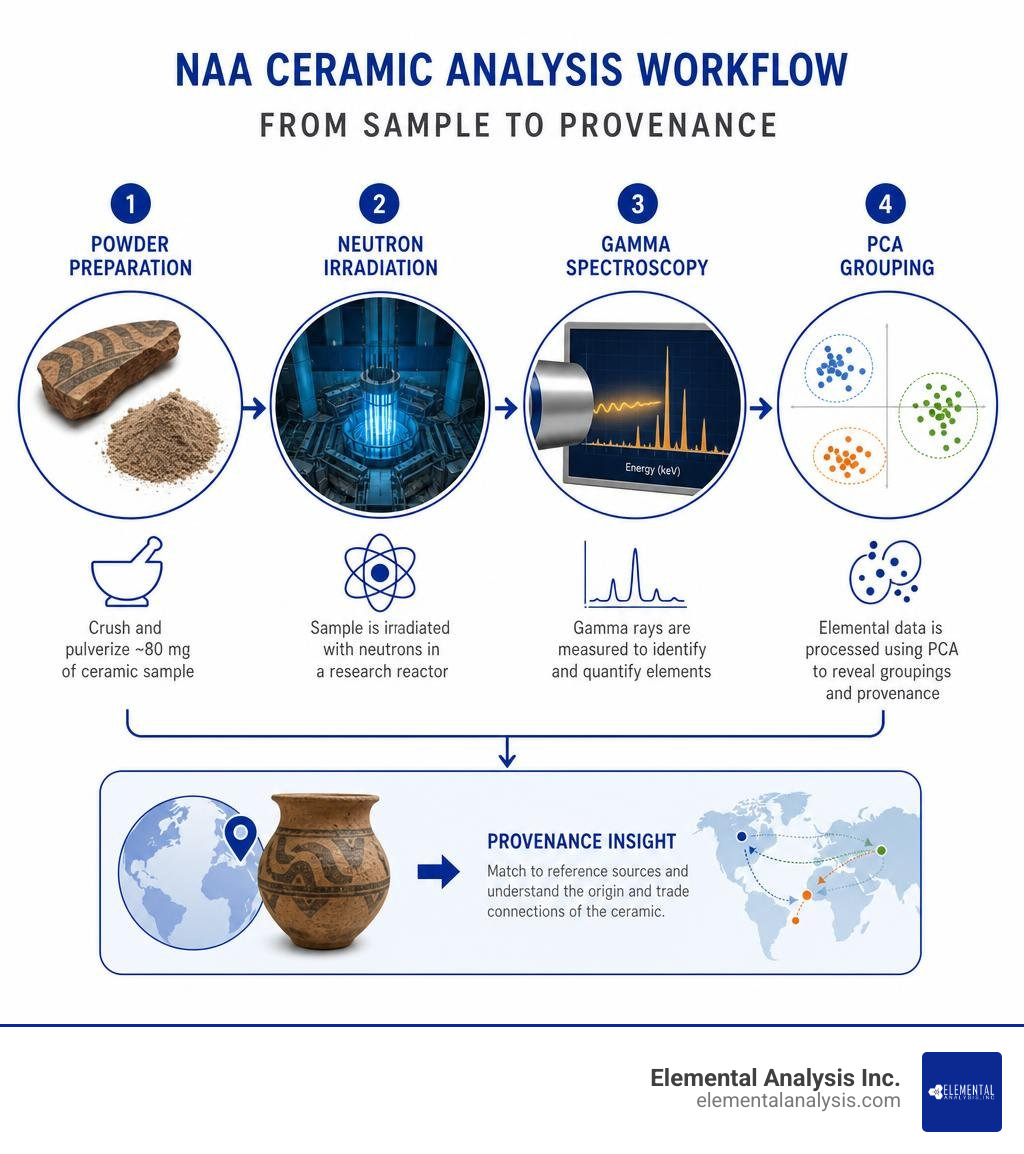
What is Neutron Activation Analysis (NAA) in Archaeology?
At its heart, Neutron Activation Analysis (NAA) is a nuclear chemistry technique used to determine the concentration of elements in a vast range of materials. In archaeology, we use it as a high-precision tool to reconstruct ancient human behaviors, trade networks, and manufacturing choices by analyzing clay and pottery.
But how does bombarding a piece of pottery with neutrons actually tell us where it came from?
The process relies on the physics of the atomic nucleus. When we place a small, prepared sample of archaeological pottery into a research nuclear reactor, we expose it to an intense flood of neutrons. The stable atomic nuclei within the sample capture these free neutrons, transforming into unstable, radioactive isotopes.
As these newly formed radioactive isotopes decay back to a stable state, they emit energy in the form of characteristic gamma rays. Every element on the periodic table has its own unique “gamma-ray signature” — a specific energy level and decay rate (half-life) that acts like a chemical fingerprint.
By measuring the intensity and energy of these emitted gamma rays using high-resolution detectors, we can identify exactly which elements are present and calculate their precise concentrations, down to parts per million (ppm) or even nanograms per gram (ng/g).
For archaeologists, this level of detail is a game-changer. While two pots might look identical to the naked eye, their trace-element profiles will reveal whether they were made from the same local clay bed or imported from hundreds of miles away.
To explore how these nuclear capabilities can be applied to your research or industrial testing needs, you can find more info about NAA services through our analytical suite.
Why Archaeologists Choose NAA Ceramic Analysis
When it comes to ceramic sourcing, archaeologists have several analytical techniques at their disposal, including X-ray Fluorescence (XRF), Inductively Coupled Plasma Mass Spectrometry (ICP-MS), and thin-section petrography. However, naa ceramic analysis remains highly favored for several key reasons:
- Unmatched Sensitivity: NAA can measure elemental concentrations at the ng/g level for archaeological ceramics. This means even the most minute trace elements — which are often the most geographically diagnostic — are captured with incredible precision.
- Broad Elemental Spectrum: The technique can simultaneously measure up to 33 elements in a single ceramic sample, spanning major elements (like sodium, potassium, and iron) and rare earth elements (such as lanthanum, lutetium, and europium).
- Bulk Composition Focus: Unlike surface-level techniques, NAA analyzes a homogenized bulk powder sample. This ensures that surface decorations, slips, or post-depositional staining do not skew the results of the underlying clay paste.

To help you choose the right tool for your project, here is how NAA compares to other standard archaeometric techniques:
| Feature | Neutron Activation Analysis (NAA) | X-ray Fluorescence (XRF) | Petrography (Thin-Section) |
|---|---|---|---|
| Primary Output | Bulk elemental chemistry (up to 33 elements) | Surface or bulk chemistry (mostly major/minor elements) | Mineralogical composition and paste texture |
| Sensitivity | Extremely high (down to ng/g / ppb) | Moderate (down to ppm) | Qualitative / Quantitative mineral counting |
| Sample Prep | Destructive (requires ~80 mg of powder) | Non-destructive (for hand-held) or destructive (pellets) | Destructive (requires cutting a thin section) |
| Best Used For | High-precision provenance and database matching | Rapid screening of large assemblages | Identifying temper types, paste recipes, and technology |
While NAA provides unmatched chemical resolution, it does not tell you how the pot was made. It cannot identify the sand, crushed shell, or organic temper that a potter manually added to the clay.
That is why the most robust archaeological interpretations combine chemical and mineralogical data. By reading combined NAA and petrography research, you can see how researchers use both tools to reconstruct both the geological source of the clay and the cultural choices of the potter.
The Step-by-Step NAA Workflow for Pottery
Executing a successful naa ceramic analysis project requires a careful, systematic workflow to ensure that the chemical data we collect is accurate, clean, and free of modern contamination.
Here is how a typical ceramic sample moves through the laboratory:
- Sample Selection and Documentation: Researchers select representative sherds from an archaeological assemblage. A typical project involves between 100 and 500 NAA analyses to establish statistically meaningful groups.
- Surface Cleaning: The outer surfaces of the sherd are carefully scraped using a silicon carbide or tungsten carbide burr to remove any dirt, slips, paints, or post-depositional soil chemistry that might alter the raw clay signature.
- Powder Homogenization: The cleaned interior paste is ground into a fine powder. While NAA can analyze samples as small as 50 mg for pottery, we typically request a slightly larger sample (around 150 to 200 mg) to ensure the powder is fully representative of the bulk vessel.
- Short Irradiation: The powder is packed into high-purity polyethylene vials. It undergoes a “short count” irradiation, where it is bombarded with neutrons for just a few seconds. This triggers short-lived isotopes, allowing us to quickly measure elements like aluminum, calcium, manganese, sodium, and titanium.
- Long Irradiation: The same samples (or a secondary aliquot) are subjected to a “long count” irradiation lasting up to 24 hours. After a decay period of several days to weeks, we measure the medium- and long-lived isotopes, capturing rare earth elements and heavy metals.
- Gamma-Ray Spectroscopy: High-purity germanium detectors measure the emitted gamma spectrum, converting the peaks of energy into precise elemental concentrations.
To learn more about how we handle diverse materials and our specific analytical limits, check out more info about testing capabilities at our Lexington, Kentucky facility.
Standard Laboratory Procedures for NAA Ceramic Analysis
To maintain absolute precision, laboratory technicians follow strict quality control protocols.
We use tungsten carbide drills to minimize trace-metal contamination during powder extraction. Every batch of archaeological samples is bracketed by certified reference standards, such as NIST (National Institute of Standards and Technology) coal fly ash (SRM-1633b) or basalt standards.
Additionally, standard reference clays like Ohio Red Clay are processed alongside the unknowns to verify analytical reproducibility across different reactor cycles.
One major logistical factor in planning an NAA project is reactor availability. Because this work requires a functioning nuclear reactor, projects must be scheduled around reactor maintenance cycles.
Furthermore, maintaining database comparability is vital. Because labs around the world have generated thousands of ceramic datasets over the past six decades, keeping calibration factors standardized ensures that your new data can be seamlessly compared to legacy databases.
Data Processing and Statistical Grouping
Once the laboratory instruments have finished counting gamma rays, you are left with a massive spreadsheet containing concentrations for up to 33 elements across hundreds of samples. To make sense of this raw data, we must transition from nuclear chemistry to multivariate statistics.
The primary goal of data processing is to identify “compositional groups” — clusters of samples that share highly similar chemical signatures. According to the provenance postulate, compositionally homogeneous groups are assumed to represent clay harvested from geographically restricted source zones.
However, several factors can complicate this process:
- Dilution Effects: Potters often add temper (like sand, volcanic ash, or crushed shell) to raw clay to prevent cracking during firing. This temper acts as a chemical diluent, lowering the overall concentrations of trace elements in the bulk sample.
- Calcium Dilution: Ceramics with high calcium content (often from calcareous clays or added shell temper) require mathematical correction factors. If calcium levels exceed 1%, we often normalize the remaining elements to prevent calcium from artificially distorting the rest of the chemical profile.
- Inter-laboratory Comparability: If you are matching your results to existing databases, you must apply standard correction factors to account for slight calibration differences between different research reactors.
Statistical Modeling in NAA Ceramic Analysis
To find patterns in the data, we utilize advanced statistical methods:
- Principal Component Analysis (PCA): This technique reduces the dimensionality of the 33-element dataset, projecting the sample variations onto a two- or three-dimensional scatter plot. This allows us to visually identify distinct compositional clusters.
- Mahalanobis Distance: We use Mahalanobis distance to calculate the probability that an individual sample belongs to a specific chemical group. This is particularly useful for identifying “outliers” or verifying if an imported vessel matches a suspected source.
- The Bonn Filter Method: Developed specifically for archaeometric data, this statistical filtering approach accounts for experimental uncertainties and dilution effects, helping us link tempered pottery back to its original plastic clay source.
For a real-world look at how these statistical groups translate into archaeological discoveries, read this research on Nasca ceramic production. The study demonstrates how researchers used NAA to move beyond simple visual style, proving that while highly decorated Nasca fineware was produced in a few specialized workshops, utilitarian plainware was manufactured across multiple decentralized resource zones.
Archaeological Applications: From the Mediterranean to the Caribbean
Over the last 60 years, naa ceramic analysis has reshaped our understanding of ancient economies, migration, and colonial interactions.
In Mediterranean archaeology, NAA has been instrumental in mapping the complex trade networks of the Bronze and Iron Ages. For example, chemical fingerprinting revealed that the famous “South Ionian Wild Goat style” pottery — once thought to be produced by workshops scattered across the Aegean — was almost exclusively manufactured in the city of Miletos.
Conversely, studies have shown that other popular styles, like PSC skyphoi, were actually produced by at least 12 different regional workshops, illustrating how local potters copied prestigious foreign styles to satisfy local demand.
In the Americas, the technique has shed light on both prehistoric trade and colonial-era social dynamics. In the Caribbean, which was historically underrepresented in chemical characterization studies, NAA has helped model how early indigenous communities navigated island environments.
By reading this comprehensive report on compositional studies of Caribbean ceramics, you can see how researchers traced pottery from the Indian Creek site in Antigua. The study successfully sourced ceramics found on low-lying coral islands (which lack natural clay sources) back to volcanic islands, proving the existence of highly organized inter-island exchange networks.
Furthermore, during the colonial period in the Caribbean and North America, NAA has been used to study “Yabba ware” and other earthenwares produced by enslaved African potters. By comparing the chemical signatures of these wares, archaeologists can determine whether enslaved communities were sharing clay resources, trading vessels across plantations, or maintaining independent regional markets despite colonial restrictions.
Frequently Asked Questions about Ceramic Sourcing
What is the minimum sample size required for NAA ceramic analysis?
While modern gamma-ray detectors are incredibly sensitive and can analyze samples as small as 5 to 10 mg for highly homogeneous materials like obsidian, pottery requires a minimum of 50 mg of powder.
However, we generally recommend submitting a physical potsherd weighing at least 2 grams (about the size of a postage stamp or a 3-4 cm² area). This larger size is important for two reasons:
- Sample Conservation: It allows us to retain a small, un-irradiated archival piece of the sherd for future reference or alternative testing (like petrography).
- Representativeness: Pottery is heterogeneous; it contains clay mixed with temper. Drilling a slightly larger area ensures the extracted powder represents the true bulk mixture of the vessel, rather than a single large sand grain.
Note: Because the portion of the sample that enters the nuclear reactor becomes radioactive, it cannot be returned to the researcher. It is considered a destructive testing method.
How long does a typical NAA ceramic project take to complete?
For standard projects containing 100 samples or fewer, the typical turnaround time is 4 to 6 months.
Very large projects containing hundreds of samples can take up to a year. This timeline is driven by several unavoidable steps:
- Preparation Backlog: Safely cleaning, drilling, and weighing hundreds of samples is a meticulous process performed by hand.
- Reactor Scheduling: Samples must be queued and scheduled around nuclear research reactor operations.
- Decay Periods: Following long irradiation, samples must sit in a secure decay vault for 7 to 24 days to allow short-lived radioactivity to subside before we can safely measure the long-lived isotopes.
- Shipping and Documentation: Interestingly, about 25% of shipments received by analytical laboratories contain errors (such as missing samples, unlabelled bags, or mismatched log sheets). Ensuring your submission paperwork is flawless is the easiest way to prevent delays!
Can NAA distinguish between different clay recipes and tempers?
Yes, but it requires careful statistical handling. Because NAA measures the bulk chemistry of the sherd, the resulting data reflects both the natural clay and any temper the potter added (such as sand, shell, or crushed rock).
If a potter adds a large amount of quartz sand (which is mostly pure silica), it will dilute the concentrations of trace elements in the clay. We call this a dilution effect.
Using statistical tools like the Bonn filter method or calcium correction formulas, we can mathematically “strip away” these dilution effects to identify the original clay recipe.
However, for the most robust results, we recommend integrating NAA with petrography. Petrography identifies the physical mineral grains (the temper), while NAA identifies the chemical paste. Combining these two lines of evidence gives you the ultimate picture of both where the clay was harvested and how the potter prepared their recipe.
Conclusion
Neutron Activation Analysis remains one of the most powerful tools in the archaeometric toolkit, providing the chemical precision needed to unlock the hidden histories of ancient ceramic production and exchange. By measuring up to 33 elements down to the nanogram level, naa ceramic analysis allows us to trace trade routes, identify specialized workshops, and understand the technological choices of ancient potters.
At Elemental Analysis Inc., based in Lexington, Kentucky, we specialize in high-precision trace element identification, quantification, and speciation. As pioneers in the commercial analytical space — including operating as the first commercial Proton Induced X-ray Emission (PIXE) laboratory — we understand the value of multi-method integration. Whether your project requires destructive bulk chemistry like NAA or rapid, non-destructive surface screening, we provide fast turnaround times and competitive pricing tailored to your research goals.
Ready to begin sourcing your ceramic assemblage or exploring our full suite of elemental testing services? Learn more about our NAA services and let us help you uncover the chemistry behind your material culture.