
Get Glowing with This Complete X-Ray Fluorescence PDF Guide
What You’ll Find in This X-Ray Fluorescence PDF Guide
If you’re working with an X-ray fluorescence PDF reference for the first time — or brushing up before a project — here’s the core of what XRF is and does:
XRF at a glance:
| Feature | Detail |
|---|---|
| What it is | A non-destructive method for elemental analysis |
| How it works | X-rays excite atoms, which emit characteristic fluorescent X-rays |
| Elements detectable | Be to U (WDXRF) or Na to U (EDXRF); not H, He, or Li |
| Detection range | Sub-ppm levels up to 100% concentration |
| Measurement time | Seconds to 30 minutes depending on elements and accuracy |
| Main types | Energy-dispersive (EDXRF) and wavelength-dispersive (WDXRF) |
| Key advantage | Minimal sample prep, fast results, works on solids, powders, and liquids |
X-ray fluorescence has been a workhorse of elemental analysis since the 1950s — and for good reason.
Whether you’re screening soil for RCRA metals, verifying alloy composition in aerospace parts, or measuring thin-film coatings in semiconductor production, XRF delivers fast, reliable, multi-element data without destroying your sample. Facilities using XRF exist in virtually every country worldwide, and the technique covers nearly the entire periodic table in a single measurement run.
This guide walks you through everything: the underlying physics, how spectrometers are built, what the numbers mean, and where XRF fits versus competing techniques like AAS or EPMA.
Fundamental Physics: The Science Behind the X-Ray Fluorescence PDF
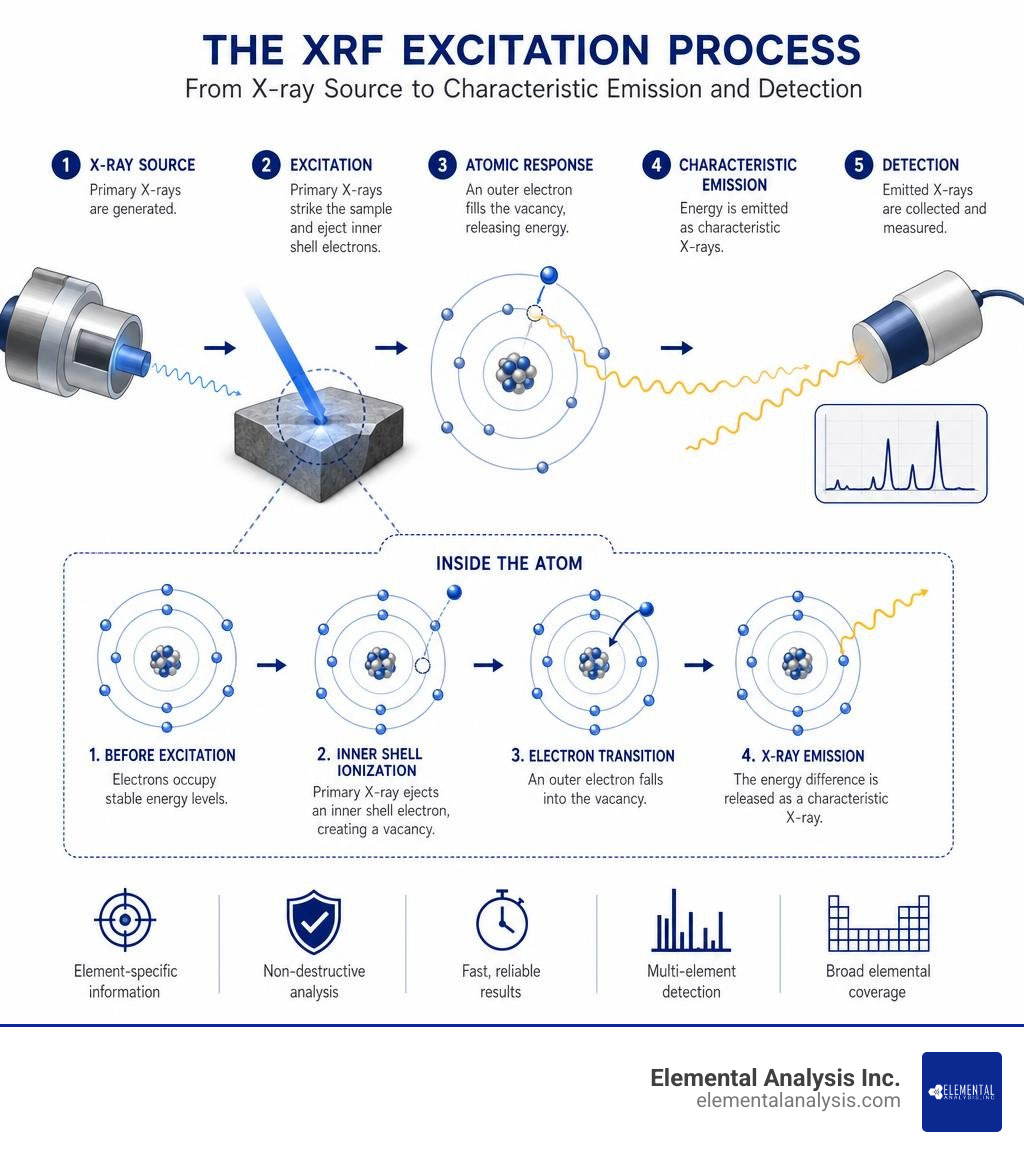
At its core, X-ray fluorescence is a game of atomic musical chairs. When we shine high-energy primary X-rays at a sample, we kick off a chain reaction at the subatomic level. This process relies on a phenomenon known as the photoelectric effect.
When an incoming X-ray photon from our instrument’s source strikes an atom in the sample, it can transfer all its energy to an electron living in one of the inner shells (typically the K or L shell). If the X-ray has more energy than the binding energy holding that electron in place, the electron is violently ejected from the atom. This leaves behind an unstable, highly energetic vacancy—a process called inner-shell ionization.
Atoms absolutely detest being unstable. To fix this, an electron from an outer shell (where electrons have higher energy) immediately drops down to fill the vacancy. Because the outer shell has a higher energy state than the inner shell, the electron must shed its excess energy to make the jump. It releases this energy in the form of a secondary X-ray photon.
Because the energy spacing between electron shells is a rigid, unique fingerprint for every single element on the periodic table, the emitted photon is a “characteristic X-ray.” By measuring the energy or wavelength of these emitted photons, we can tell exactly which elements are present.
For a deep dive into the mathematical and physical foundations of this process, you can consult this Scientific research on XRF theory.
Understanding Moseley’s Law and Atomic Numbers
We can’t talk about XRF physics without tipping our hats to Henry Moseley. In 1913, Moseley established a brilliant mathematical relationship that changed chemistry forever. He discovered that the square root of the frequency ($\nu$) of characteristic X-ray lines exhibits a direct linear relationship with the atomic number ($Z$) of the emitting element.
Moseley’s equation can be simplified as:
$$E = k(Z – \sigma)^2$$
Where:
- $E$ is the energy of the emitted spectral line,
- $Z$ is the atomic number of the element,
- $k$ and $\sigma$ are constants specific to the spectral series (like K or L lines).
This simple law proved that the periodic table was organized by atomic number rather than atomic weight. In practical terms, it means that as you move up the periodic table, the characteristic X-rays emitted by elements get progressively more energetic.
When analyzing a spectrum, we categorize these emissions into spectral series based on which shell the vacancy occurred in:
- K series: Vacancies in the innermost K shell filled by electrons from the L shell ($K\alpha$) or M shell ($K\beta$).
- L series: Vacancies in the L shell filled by electrons from the M shell ($L\alpha$) or N shell ($L\beta$).
Because transition probabilities vary, $K\alpha$ lines are roughly seven times more intense than $K\beta$ lines, making them the preferred choice for qualitative identification and quantitative analysis.
Rayleigh vs Compton Scattering in XRF Spectra
When primary X-rays bombard a sample, not every photon succeeds in knocking out an inner-shell electron. Many of them simply bounce off. This scattering behavior is one of the main sources of background noise and spectral artifacts in XRF measurements. There are two primary types of scattering to watch out for:
- Rayleigh Scattering (Elastic): In this scenario, the primary X-ray photon collides with an atom’s tightly bound electrons and bounces off without losing any energy. Think of it like a billiard ball bouncing off a cushion. Because no energy is lost, Rayleigh scattering shows up in your spectrum as sharp, intense peaks at the exact energy lines of your instrument’s X-ray tube target (such as rhodium, silver, or tungsten).
- Compton Scattering (Inelastic): Here, the incoming X-ray photon collides with a weakly bound outer-shell electron. The photon ejects the electron, losing a portion of its energy in the process, and continues on a deflected path with a lower energy level. In your spectrum, Compton scattering produces broad, messy humps on the lower-energy side of the Rayleigh scatter peaks.
Understanding the balance between these two scatters is actually quite useful. For instance, the ratio of coherent (Rayleigh) to incoherent (Compton) scatter can be used to estimate the effective atomic number of organic or low-mass matrices, which is highly valuable when performing standardless quantitative corrections. You can read more about how these scattering mechanisms influence measurements in this X-ray fluorescence analysis guide.
Instrumentation: How XRF Spectrometers Work
To capture and translate these atomic interactions into readable data, an XRF spectrometer relies on a highly coordinated sequence of optical and electronic components.
The basic setup requires a primary excitation source (usually an X-ray tube), a sample chamber, a dispersive system to sort the incoming radiation, and a highly sensitive detection system. Depending on your analytical goals, you might also employ secondary targets or primary beam filters to shape the excitation beam and clean up unwanted background noise.
Wavelength-Dispersive vs Energy-Dispersive Systems
Modern XRF instruments are split into two major technological camps: Energy-Dispersive XRF (EDXRF) and Wavelength-Dispersive XRF (WDXRF). They differ fundamentally in how they separate and measure the incoming characteristic X-rays.
| Feature | Energy-Dispersive XRF (EDXRF) | Wavelength-Dispersive XRF (WDXRF) |
|---|---|---|
| Separation Method | Electronic sorting via detector | Physical diffraction using analyzing crystals |
| Spectral Resolution | ~145 eV to 170 eV (at Mn $K\alpha$) | ~24 eV (at Mn $K\alpha$) |
| Elemental Range | Sodium to Uranium (Na to U) | Beryllium to Uranium (Be to U) |
| Detection Limits | ppm levels | Sub-ppm to ppm levels |
| Speed & Portability | Extremely fast; easily made into handheld units | Slower; generally large, stationary laboratory systems |
| Typical Use Case | Fast field screening, alloy sorting, scrap recycling | High-precision industrial QA/QC, geological research |
EDXRF acts like a digital camera, taking in all the emitted X-rays at once. The detector itself measures the energy of each incoming photon and sorts them electronically into a histogram (the spectrum).
WDXRF, on the other hand, acts like a prism. It uses a high-precision analyzing crystal to physically disperse the emitted X-rays by wavelength according to Bragg’s Law ($n\lambda = 2d\sin\theta$). By rotating the crystal and detector to specific angles ($\theta$), WDXRF isolates individual wavelengths one by one. This optical separation yields vastly superior spectral resolution (24 eV compared to 145 eV for EDXRF), which virtually eliminates peak overlaps and allows for the detection of ultra-light elements like beryllium.
Key Components of an X-Ray Fluorescence PDF Instrument Guide
To understand the schematics inside any X-ray fluorescence PDF manual, you need to know what the key hardware components do:
- X-Ray Tubes: These generate the primary excitation beam. They typically operate at voltages ranging from 4 to 50 kV. Anodes are chosen based on the target elements; for example, a silver (Ag) anode is excellent for general purposes, while rhodium (Rh) or tungsten (W) anodes are favored for specialized heavy-element excitation.
- Silicon Drift Detectors (SDDs): The gold standard for modern EDXRF. SDDs can handle incredibly high count rates (up to 200,000 counts per second) with excellent energy resolution, making them perfect for portable and benchtop units.
- Gas-Flow Proportional Counters: Frequently used in WDXRF systems. These detectors are filled with a gas mixture (typically argon/methane) that ionizes when low-energy, long-wavelength X-rays from light elements enter, making them highly sensitive to elements like carbon, sodium, and magnesium.
- Scintillation Counters: Used alongside gas-flow counters in WDXRF to detect short-wavelength, high-energy X-rays from heavy elements. They use a crystal that flashes light when struck by an X-ray, which a photomultiplier tube then converts into an electrical signal.
- Analyzing Crystals: In WDXRF, selecting the right crystal is vital. Different crystals have different $d$-spacings to optimize the diffraction of specific elements. Common options include Lithium Fluoride (LiF 200 with $2d = 4.028$ Å) for transition metals, PET ($2d = 8.742$ Å) for light elements, and synthetic multilayers ($2d = 55\text{–}160$ Å) for ultra-light elements.
- Collimators: These metal blade systems act as physical “blinders,” ensuring only parallel beams of X-rays reach the analyzing crystal, preventing peak broadening and maintaining high resolution.
Analytical Capabilities, Matrix Effects, and Limitations
XRF is incredibly versatile, but like any analytical technique, it has its boundary lines. The routine elemental range for EDXRF spans from sodium (Na) to uranium (U), while WDXRF extends down to beryllium (Be).
Detection limits typically range from sub-parts-per-million (sub-ppm) levels for heavy metals up to 100% for major components. However, light elements suffer from a physical limitation known as low fluorescence yield; they are far more likely to release an Auger electron than a fluorescent photon, making them inherently harder to detect at trace levels.
For a comprehensive review of these analytical boundaries, refer to the Encyclopedia of Materials Characterization.
Overcoming Matrix Effects and Spectral Interferences
The biggest headache in quantitative XRF is the “matrix effect.” The matrix is everything else in the sample besides the element you are trying to measure. This background environment can severely distort your readings through two primary mechanisms:
- Absorption (Attenuation): The surrounding matrix can absorb the characteristic X-rays emitted by your target element before they can escape the sample surface and reach the detector. For example, if you are measuring trace copper in a lead matrix, the heavy lead atoms will absorb a massive portion of the copper’s emitted $K\alpha$ rays, making the copper concentration look much lower than it actually is.
- Enhancement (Secondary Fluorescence): This happens when a heavy matrix element emits characteristic X-rays that have just enough energy to excite a lighter target element in the sample. This secondary excitation can boost the lighter element’s signal by up to 20%, artificially inflating your readings.
Additionally, spectral interferences can muddy your data:
- Peak Overlaps: When two different elements have emission lines very close to one another (e.g., the $K\alpha$ line of arsenic at 10.54 keV and the $L\alpha$ line of lead at 10.55 keV).
- Escape Peaks: A detector-based artifact occurring when an incoming X-ray excites a silicon atom in the detector itself. If that silicon $K\alpha$ photon escapes, the detector registers a peak exactly 1.74 keV below the parent peak.
- Sum Peaks (Pile-up): When two photons enter the detector simultaneously, the electronics register them as a single photon with double the energy.
To overcome these hurdles, modern spectrometers rely on sophisticated mathematical correction models, such as the Fundamental Parameters (FP) method, or empirical calibrations built using Certified Reference Materials (CRMs) that closely match the physical and chemical matrix of the unknowns.
Sample Preparation: An X-Ray Fluorescence PDF Checklist
While XRF is famous for requiring minimal sample prep, “minimal” doesn’t mean “none.” Your data is only as good as your sample preparation.
Here is a quick checklist of preparation methods based on sample type:
- Solids (Metals, Plastics): Ensure the analyzed surface is flat, clean, and free of oxidation or grease. A quick grind or polish is often recommended.
- Powders (Soils, Ores, Cements):
- Loose Powder: Poured directly into a plastic sample cup lined with a thin polymer film (such as Mylar or Prolene). Great for quick qualitative screening.
- Pressed Pellets: The powder is ground to a fine, uniform particle size (usually $<75\,\mu\text{m}$), mixed with a binder (like wax or cellulose), and compressed under high pressure (20–30 tons) using a hydraulic press. This eliminates particle size effects and provides excellent quantitative accuracy.
- Liquids (Oils, Water, Fuels): Analyzed in specialized sample cups under a helium atmosphere or ambient air. Never run liquids under a vacuum, or they will boil violently and ruin your expensive detector window!
- Fused Beads (Glass Disks): The gold standard for geological and mineralogical samples. The powdered sample is mixed with a lithium borate flux and melted in a platinum crucible at temperatures exceeding $1000^\circ\text{C}$ to form a homogeneous glass disk. This completely destroys the sample’s mineralogical history and eliminates all particle size and matrix effects.
For a detailed walkthrough of preparing complex matrices, you can reference the Handbook of Practical X-Ray Fluorescence Analysis.
Industrial Applications and Technique Comparisons
Because of its speed and non-destructive nature, XRF is utilized across a massive array of global industries. If you are exploring custom analytical options, you can find more info about XRF services to see how these testing methods are deployed commercially.
Real-World Applications Across Industries
- Metals and Alloys: Used extensively for Positive Material Identification (PMI) in scrap metal recycling, aerospace manufacturing, and foundry quality control. A handheld XRF can identify a stainless steel grade (like 316 vs. 304) in under two seconds.
- Environmental Analysis: Crucial for rapid field screening of soils and sediments. Following EPA Method 6200, field-portable XRF instruments allow geologists to map out heavy metal contamination plumes (like lead, arsenic, and cadmium) on-site without waiting days for laboratory returns.
- Geology and Mining: Used to analyze drill cores, grade control in open-pit mines, and geochemical exploration.
- Thin-Film Materials: Since the 1970s, XRF has been a critical tool for simultaneously measuring both the composition and thickness of thin-film coatings (ranging from a few nanometers to micrometers) on semiconductors, electronic components, and automotive parts.
How XRF Compares to EDS, EPMA, and AAS
When choosing an analytical technique, it helps to understand how XRF stacks up against other common methods:
- EDS (Energy-Dispersive Spectroscopy): Typically paired with a Scanning Electron Microscope (SEM). While EDS uses the same fundamental physics as EDXRF, it uses a highly focused electron beam rather than X-rays to excite the sample. EDS is unmatched for micro-scale imaging and mapping (down to the nanometer scale), but bulk XRF offers far superior detection limits for trace elements.
- EPMA (Electron Probe Microanalysis): Like an SEM-EDS system on steroids, EPMA uses multiple WDXRF-style crystal spectrometers mounted on an electron column. It offers incredible spatial resolution and high precision for micro-samples, but the instrument is highly complex, expensive, and requires intensive sample preparation under high vacuum.
- AAS (Atomic Absorption Spectroscopy): A classic wet-chemical technique. AAS offers incredible sensitivity (often down to parts-per-billion), but it is inherently destructive. The sample must be completely dissolved in strong acids, and AAS can generally only measure one element at a time, whereas XRF can analyze dozens of elements simultaneously in minutes.
Frequently Asked Questions about XRF
What elements cannot be routinely analyzed by XRF?
The ultra-light elements—specifically Hydrogen (H), Helium (He), and Lithium (Li)—cannot be routinely analyzed by XRF. Because these elements have very low atomic numbers, their inner-shell electrons are bound incredibly loosely. As a result, their characteristic X-rays have extremely low energies (long wavelengths) that are easily absorbed by air, the sample itself, or even the thinnest detector windows. Furthermore, their fluorescence yield is nearly zero, meaning they almost always release Auger electrons instead of X-rays.
What is the difference between K-alpha and K-beta lines?
The difference lies in which electron shell drops down to fill the vacancy in the innermost K shell:
- $K\alpha$ lines occur when an electron transitions from the L shell (the second shell) to the K shell.
- $K\beta$ lines occur when an electron transitions from the M shell (the third shell) to the K shell.
Because the L shell is closer to the K shell, the transition probability is much higher, making the $K\alpha$ peak roughly seven times more intense and the primary choice for elemental quantification.
How deep does XRF radiation penetrate a sample?
Penetration depth varies dramatically depending on the density of the sample matrix and the energy of the emission lines. For example, low-energy light elements like magnesium ($Mg\,K\alpha$) can only escape from the top $0.7\,\mu\text{m}$ of a heavy lead matrix.
Conversely, high-energy heavy elements like tin ($Sn\,K\alpha$) can penetrate and escape from up to $5.3\,\text{cm}$ deep in water, or about $55\,\mu\text{m}$ in solid lead. This means XRF is essentially a surface or near-surface technique for light elements, but can probe much deeper into low-density matrices.
Conclusion
Whether you are looking to screen environmental soils, verify alloy compositions, or analyze thin-film coatings, understanding the fundamentals of X-ray fluorescence is the key to unlocking reliable, high-quality data.
At Elemental Analysis Inc., based proudly in Lexington, Kentucky, we combine this deep technical expertise with a commitment to fast turnaround times and highly competitive pricing. As pioneers in the field—including operating as the first commercial Proton-Induced X-ray Emission (PIXE) laboratory—we offer a comprehensive suite of both non-destructive and destructive elemental testing services tailored to your exact industry needs.
Ready to take your materials characterization to the next level? Get started with professional XRF analysis today and let our team of specialists deliver the precise, reliable data your project demands.