
Unlocking the Elements with ICP Laboratory Analysis
What ICP Laboratory Analysis Actually Does (And Why It Matters)
ICP laboratory analysis is a technique that measures the concentration of trace elements in a sample — with precision down to parts per trillion (ppt) in some cases.
Here’s a quick summary of what you need to know:
| Question | Answer |
|---|---|
| What does ICP stand for? | Inductively Coupled Plasma |
| What does it measure? | Elemental concentrations across ~70+ elements simultaneously |
| Main techniques | ICP-OES (parts per billion sensitivity) and ICP-MS (parts per trillion sensitivity) |
| Common sample types | Liquids, digested solids, environmental samples, biological tissues |
| Key industries | Pharma, aerospace, environmental, food safety, cosmetics, petroleum |
| Cannot measure | Carbon, hydrogen, oxygen, nitrogen, halogens, noble gases |
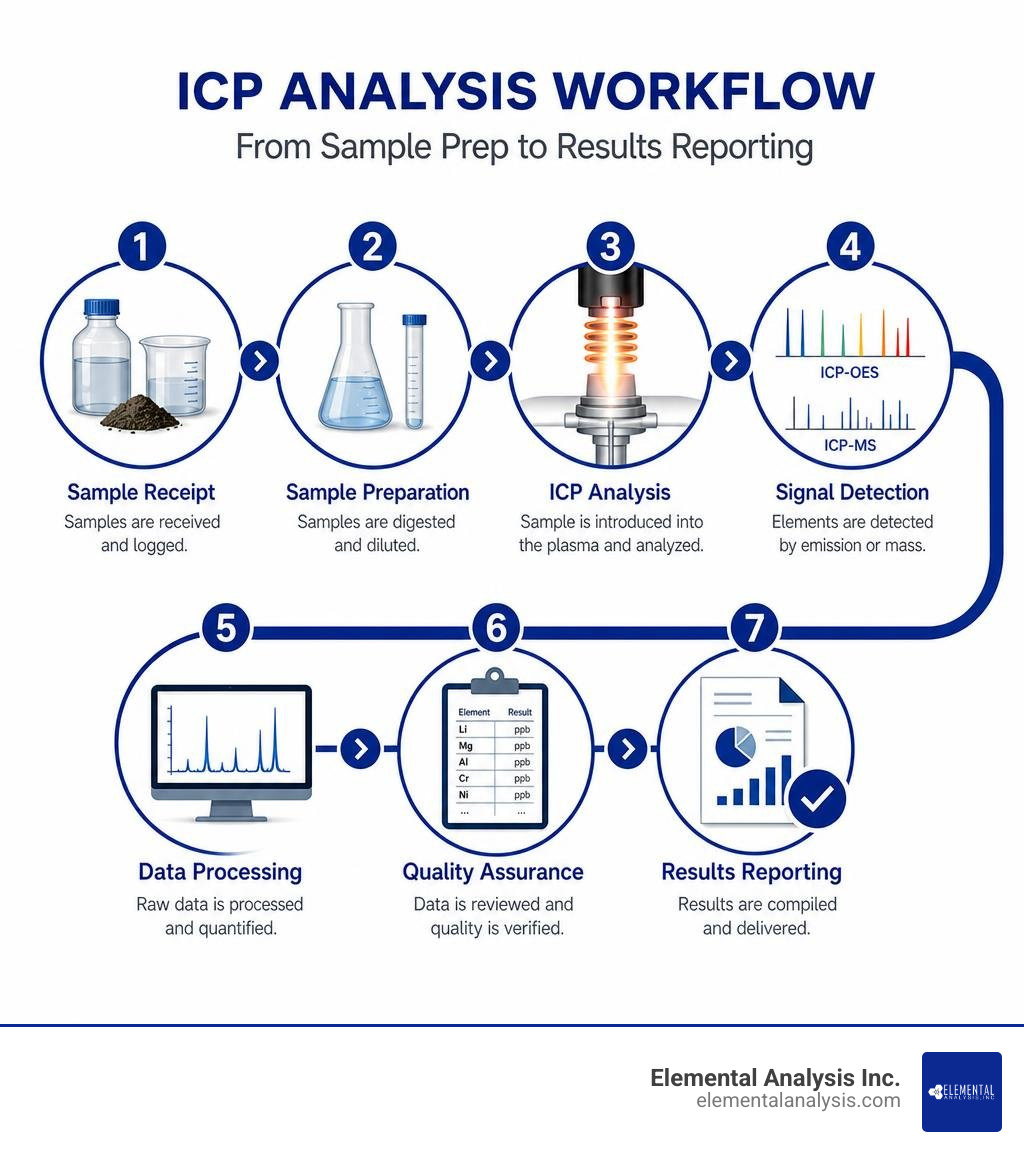
The core idea is simple: a sample is introduced into an extremely hot plasma (6,000–10,000°C), which breaks it down to its individual atoms. Those atoms either emit light or get sorted by mass, depending on which ICP technique is used. The result is a detailed elemental “fingerprint” of your sample.
Why does this matter? Because whether you’re testing for elemental impurities in a pharmaceutical batch, verifying the purity of aerospace alloys, or checking water for toxic heavy metals, knowing exactly what’s in your sample — at trace levels — is non-negotiable.
ICP-MS can detect some elements at concentrations below 0.1 ppt. To put that in perspective, that’s roughly equivalent to detecting a single drop of water in 200 Olympic-sized swimming pools.
What is ICP Laboratory Analysis and How Does It Work?
At its heart, icp laboratory analysis relies on one of the most energetic states of matter: plasma. In our laboratory, we generate this plasma by coupling radio-frequency (RF) electromagnetic energy to a stream of high-purity argon gas.
Once ignited, this creates a stable, self-sustaining plasma torch. This torch reaches mind-boggling temperatures of 6,000 to 10,000 Kelvin—which is actually hotter than the surface of the sun!
When we introduce a liquid sample into this environment, it undergoes a rapid physical and chemical transformation. First, the sample is nebulized, meaning it is converted into a fine aerosol mist. This mist is then swept directly into the core of the argon plasma.
Because we specialize in comprehensive Elemental Analysis Services, we rely on these extreme temperatures to completely break down complex matrices, ensuring that every element present is freed from its molecular bonds.
The Core Principles of ICP Laboratory Analysis
Once the sample aerosol enters the plasma, it undergoes five distinct, successive steps in a fraction of a second:
- Desolvation: The liquid solvent (usually water or acid) is instantly evaporated, leaving behind tiny, solid microscopic particles.
- Vaporization: The extreme heat vaporizes these solid particles into a gaseous state.
- Atomization: The chemical bonds holding the gas molecules together are broken, reducing the sample to its individual, ground-state atoms.
- Ionization: For most elements, the plasma is energetic enough to knock an electron off the ground-state atoms, converting them into positively charged, single-valence ions.
- Excitation Wavelengths: In the plasma, atoms and ions absorb thermal energy, forcing their electrons into higher energy levels. As these electrons inevitably fall back down to their stable ground state, they release energy in the form of light at highly specific, characteristic wavelengths.
Depending on whether we want to measure the light emitted during excitation or the mass of the ions themselves, we route the sample to one of two primary detection systems: ICP-OES or ICP-MS.
Comparing ICP Techniques: ICP-OES vs. ICP-MS
Choosing the right tool for the job is essential for getting accurate, cost-effective results. While both techniques rely on the same argon plasma source, their detection systems are entirely different.
| Feature | ICP-OES (Optical Emission) | ICP-MS (Mass Spectrometry) |
|---|---|---|
| Primary Detection Method | Light emission wavelengths | Mass-to-charge (m/z) ratio |
| Typical Sensitivity Range | Parts per billion (ppb) to % levels | Parts per trillion (ppt) to ppb levels |
| Linear Dynamic Range | 5 to 6 orders of magnitude | Up to 10 orders of magnitude |
| Interferences | Spectral (overlapping light wavelengths) | Polyatomic & isobaric mass overlaps |
| Tolerable Dissolved Solids | Up to 2% to 10% (depending on nebulizer) | Generally < 0.2% to prevent cone clogging |
| Speed | Excellent for major/minor elements fast | Fast multi-element trace screening |
Inductively Coupled Plasma Optical Emission Spectroscopy (ICP-OES)
ICP-OES (historically referred to as ICP-AES, or Atomic Emission Spectroscopy) operates by measuring the light emitted by excited atoms and ions. As these excited species return to their ground state, they emit light at wavelengths unique to each element. By splitting this light through a high-resolution spectrometer, we can measure the intensity of specific wavelengths to determine exactly how much of an element is present.
ICP-OES is highly reliable and can determine concentrations for about 70 elements simultaneously. It is particularly valued for its robustness when handling samples with high total dissolved solids (TDS).
Regulatory bodies often mandate this technique for environmental and industrial testing. For instance, when monitoring heavy metals in industrial discharge, laboratories frequently adhere to established EPA guidelines for ICP-AES analysis.
Inductively Coupled Plasma Mass Spectrometry (ICP-MS)
If ICP-OES is a high-powered magnifying glass, ICP-MS is an advanced electron microscope. Instead of measuring light, ICP-MS extracts the ions directly from the plasma and introduces them into a mass spectrometer. The ions are separated based on their mass-to-charge (m/z) ratio, typically using a quadrupole analyzer.
ICP-MS is roughly one to two orders of magnitude more sensitive than ICP-OES, making it the premier choice for ultra-trace elemental analysis. Modern instruments feature a linear dynamic range spanning up to 10 orders of magnitude, allowing us to measure parts-per-trillion impurities alongside parts-per-million components in a single run.
To manage spectral interferences—such as argon gas combining with solvent elements to create polyatomic molecules like argon chloride ($^{40}\text{Ar}^{35}\text{Cl}^{+}$), which interferes with arsenic ($^{75}\text{As}$)—we utilize collision/reaction cell technology. This system passes a collision gas like helium through the cell to selectively slow down and filter out larger polyatomic interferences.
For high-sensitivity work, following a strict SOP for environmental ICP-MS testing ensures that the ultra-trace data remains accurate and free from contamination.
Sample Preparation and Element Capabilities
No matter how advanced our analytical instruments are in 2026, the quality of our data is only as good as our sample preparation.

Elements Measured and Excluded in ICP Laboratory Analysis
While ICP techniques are incredibly versatile, they cannot measure every single element on the periodic table.
- What We Can Measure: We can routinely detect and quantify approximately 70 elements, including transition metals, heavy metals, alkali metals, and alkaline earth metals.
- What We Cannot Measure:
- Organic Elements: Carbon (C), Hydrogen (H), Oxygen (O), and Nitrogen (N) cannot be reliably measured. The atmospheric background, combined with the solvents used to prepare samples, floods the detector with these elements.
- Halogens: Elements like Fluorine (F) and Chlorine (Cl) have extremely high ionization potentials, meaning the argon plasma cannot easily convert them into positive ions.
- Noble Gases: Helium, neon, argon, and krypton do not form stable ions in an argon-based plasma.
In specialized academic and environmental research, converting raw analytical counts into meaningful elemental ratios is critical. Researchers often use specialized software, such as the Matlab data processing for element ratios package, to process raw data and correct for matrix variations.
Sample Preparation Protocols for Accurate Testing
To achieve stable and reproducible results, samples must be prepared according to strict laboratory protocols:
- Acid Digestion: Solid materials—such as soil, plastics, tissues, or metal alloys—must be completely dissolved. We typically perform microwave-assisted digestion using concentrated, trace-metal-grade nitric acid ($\text{HNO}_3$), sometimes blended with hydrochloric acid ($\text{HCl}$) or hydrogen peroxide ($\text{H}_2\text{O}_2$).
- Contamination Control: Because we are measuring elements at the ppb and ppt levels, even dust in the air can ruin an analysis. We use ultra-pure water (18.2 $\text{M}\Omega\cdot\text{cm}$) and acid-washed fluoropolymer vessels.
- Total Dissolved Solids (TDS) Limits: High concentrations of dissolved salts can deposit on the instrument’s nebulizer or interface cones. We dilute digests to keep the final TDS below 0.2% for ICP-MS and below 2% for ICP-OES.
- Internal Standardization: We add a known concentration of elements not present in the samples (like Rhodium, Indium, or Yttrium) to every standard and sample. This allows us to mathematically correct for physical interferences, such as changes in sample viscosity or instrument drift over time.
For a comprehensive overview of our analytical capabilities, you can explore our full range of A to Z Testing services.
Industry Applications and Regulatory Standards
ICP testing is a vital tool across multiple sectors, ensuring product safety, environmental health, and regulatory compliance.
Our understanding of historical climate patterns and global pollution levels relies heavily on these high-sensitivity techniques. For example, recent research on ultra-trace elements in ice cores demonstrates how ICP-TOF-MS (Time-of-Flight) can detect sub-ppt levels of industrial metals locked deep inside ancient glacial ice, providing a detailed record of atmospheric emissions over centuries.
Pharmaceutical and Cosmetic Compliance
In the pharmaceutical sector, heavy metal impurities are strictly regulated to protect patient safety. Manufacturers must comply with guidelines like USP <233> and ICH Q3D, which require precise ICP-MS screening for toxic elemental impurities—specifically the “big four” heavy metals: arsenic, cadmium, lead, and mercury.
Similarly, the cosmetics industry relies on ICP testing to comply with standards like ISO 21392. This standard sets strict limits on heavy metals in raw cosmetic ingredients and finished products, ensuring that trace contaminants in color pigments do not pose a health risk to consumers.
Food Safety and Environmental Regulations
Food safety laboratories rely on ICP technology to monitor nutritional content and detect toxic contaminants. Global trade requires strict adherence to international standards.
For instance, the Chinese national standard, GB 5009.268-2025 food safety standard, outlines validated ICP-MS and ICP-OES methodologies for measuring up to 30 elements in food products, ensuring that imports and domestic goods are free from harmful heavy metals.
In environmental monitoring, municipal water authorities and soil scientists use ICP-OES and ICP-MS to track runoff, verify drinking water safety, and measure heavy metal contamination in agricultural soils.
Frequently Asked Questions about ICP Laboratory Analysis
What are the detection limits of ICP testing?
Detection limits depend heavily on the instrument and the sample matrix. Generally, ICP-OES can reliably measure elements down to the parts-per-billion (ppb) range. ICP-MS is significantly more sensitive, regularly reaching detection limits in the parts-per-trillion (ppt) or even sub-ppt range for clean, aqueous samples.
What elements cannot be detected by ICP methods?
ICP methods cannot measure carbon, hydrogen, oxygen, or nitrogen due to high atmospheric background levels. Halogens like fluorine and chlorine are also excluded because they do not ionize efficiently in an argon plasma, while noble gases cannot be measured as they do not form positive ions.
How long does a typical ICP test take?
While the actual instrument runtime for a single sample is only 2 to 5 minutes, the total turnaround time is determined by sample preparation. Acid digestion of solid samples, dilution, calibration of the instrument, and quality control validation typically take anywhere from a few days to a week, depending on the batch size.
Conclusion
Whether you are looking to meet strict regulatory compliance standards, analyze trace environmental contaminants, or solve a complex manufacturing issue, icp laboratory analysis provides the high-precision elemental data you need.
At Elemental Analysis Inc., based in Lexington, Kentucky, we combine decades of analytical expertise with advanced testing capabilities. We are proud to operate as the first commercial PIXE (Proton Induced X-ray Emission) laboratory, allowing us to offer a unique combination of non-destructive and destructive testing services. With our fast turnaround times and competitive pricing, we help you get the accurate results you need without unnecessary delays.
Ready to find out exactly what is in your samples? Schedule an ICP Laboratory Analysis with our expert team today, or contact us to discuss your specific analytical goals!