
Testing the Waters: A Complete Guide to the Analysis of Heavy Metals in Water
Why the Analysis of Heavy Metals in Water Is a Critical Public Health Priority
The analysis of heavy metals in water is one of the most important steps you can take to protect human health — whether you’re managing an industrial site, overseeing environmental compliance, or evaluating drinking water safety.
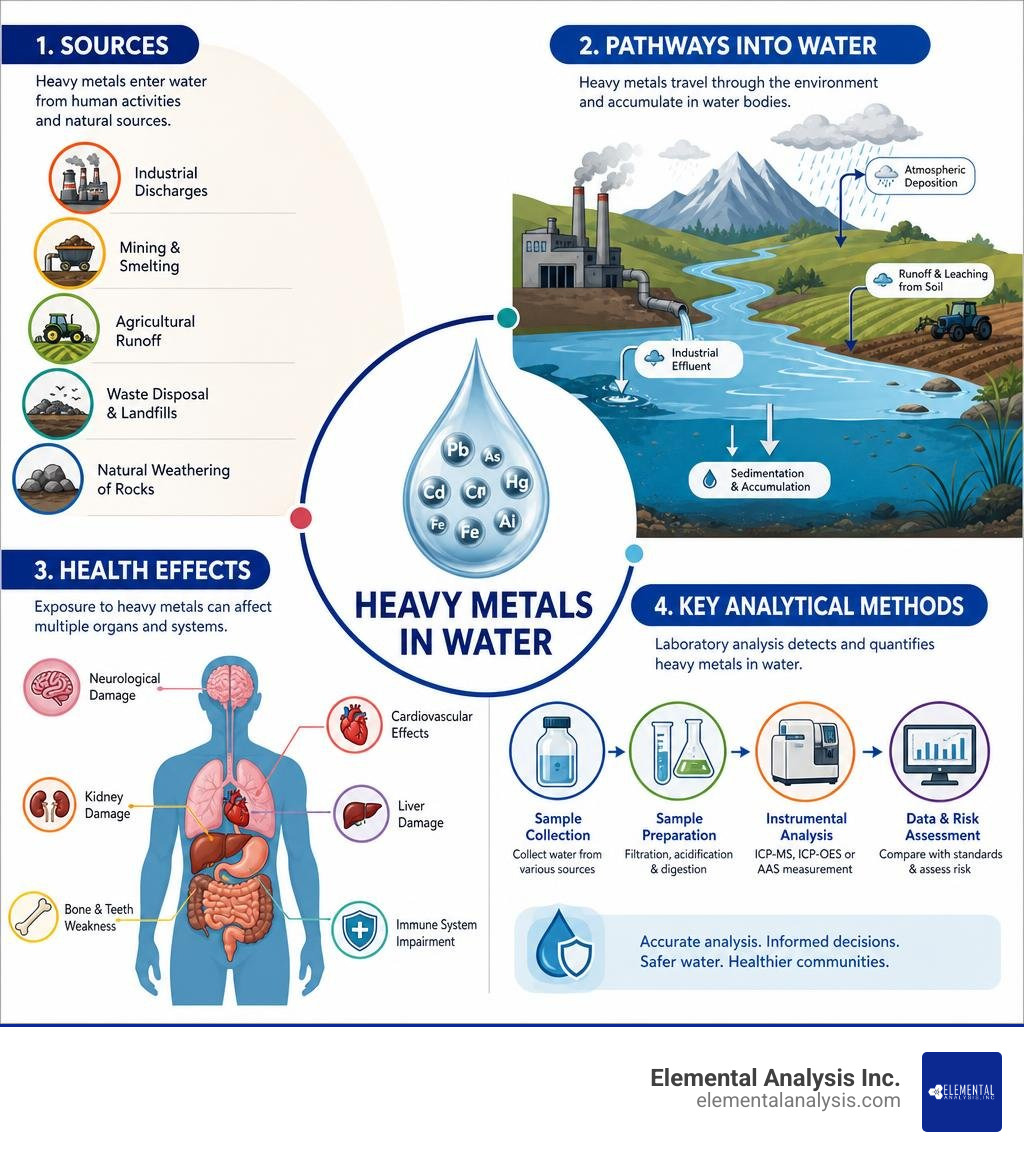
Here’s a quick answer to what this process involves:
What is the analysis of heavy metals in water?
| Step | What Happens |
|---|---|
| Sample collection | Water is collected from target sources (wells, taps, surface water, industrial effluent) |
| Lab preparation | Samples are filtered, acidified, and digested to release dissolved metals |
| Instrumental analysis | Metals are measured using techniques like ICP-MS, ICP-OES, or Atomic Absorption Spectroscopy |
| Data comparison | Results are compared against WHO, EPA, or national regulatory limits |
| Risk interpretation | Concentrations are used to calculate health risk indices and water quality scores |
The metals most commonly screened include cadmium (Cd), lead (Pb), chromium (Cr), arsenic (As), mercury (Hg), iron (Fe), nickel (Ni), and aluminium (Al).
Heavy metals can’t be seen, smelled, or tasted in water. That’s what makes them so dangerous.
Research from industrial zones in Gujranwala, Pakistan illustrates the scale of the problem: cadmium levels in one zone reached 0.331 mg/L and lead hit 0.573 mg/L — both far above WHO permissible limits. Across all sampled sites, 86% of water samples showed a Health Risk Index greater than 1, meaning the water was unsafe for human consumption. And 40% of samples were classified as unsuitable based on Water Quality Index scores.
This isn’t a problem limited to one city or one country. Studies from Bangladesh, India, Ethiopia, Morocco, Turkey, and Nigeria show the same pattern: industrial activity, poor wastewater management, and inadequate monitoring combine to put communities at serious risk.
The good news? Rigorous, lab-based analysis gives you the data to act — before health consequences become irreversible.
Key Contaminants and Regulatory Standards in the Analysis of Heavy Metals in Water
To understand water quality, we must look at the specific regulatory thresholds that separate safe drinking water from toxic exposure. Organizations like the World Health Organization (WHO), the United States Environmental Protection Agency (US EPA), and national bodies like the Pakistan Standards and Quality Control Authority (PSQCA) establish Maximum Contaminant Levels (MCLs) for toxic elements.
When these elements exceed permissible limits, they transition from trace nutrients (in some cases) to severe systemic toxins. For example, while iron and manganese are essential to human physiology in tiny quantities, heavy metals like lead, cadmium, arsenic, and mercury serve no biological purpose in the human body. They are classified as primary carcinogens and systemic toxicants even at incredibly low concentrations.
Zonal Contamination Profiles: Gujranwala Case Study
A striking example of how industrial activities dictate local water quality is found in the Comparative analysis of heavy metals toxicity in drinking water of industrial zones in Gujranwala. By analyzing 100 water samples across five distinct industrial zones, researchers identified clear “contamination signatures” matching the types of manufacturing nearby.
- Zone 2 (Engineering Industries): This zone exhibited the most severe multi-metal contamination. It recorded the highest mean concentrations of cadmium (0.331 mg/L), lead (0.573 mg/L), chromium (0.164 mg/L), arsenic (0.042 mg/L), and aluminium (0.484 mg/L). Every single one of these values vastly exceeds WHO and PSQCA safety standards.
- Zone 4 (Iron and Steel Industries): This zone showed a completely different chemical profile, dominated by elevated mean levels of iron (1.88 mg/L) and mercury (0.259 mg/L).
To put these numbers into perspective, let’s look at how they compare to global standards:
| Heavy Metal | Zone 2 Mean (mg/L) | Zone 4 Mean (mg/L) | WHO Standard (mg/L) | Primary Industrial Source |
|---|---|---|---|---|
| Cadmium (Cd) | 0.331 | < 0.003 | 0.003 | Electroplating, plastics, batteries |
| Lead (Pb) | 0.573 | < 0.01 | 0.01 | Metal alloys, battery recycling, pipes |
| Chromium (Cr) | 0.164 | 0.021 | 0.05 | Tanning, pigment manufacturing |
| Arsenic (As) | 0.042 | 0.005 | 0.01 | Glassmaking, metal smelting |
| Aluminium (Al) | 0.484 | 0.112 | 0.20 | Water treatment coagulants, alloys |
| Iron (Fe) | 0.245 | 1.88 | 0.30 | Steel manufacturing, rust |
| Mercury (Hg) | < 0.001 | 0.259 | 0.006 | Electrical equipment, chemical synthesis |
These stark variations highlight why a “one-size-fits-all” testing approach doesn’t work. Testing must be tailored to the specific industrial inputs of the local watershed.
Physicochemical Parameters and Their Influence on Metal Mobility
We cannot analyze heavy metals in a vacuum. The physical and chemical state of the water itself determines how these metals behave. Parameters such as pH, electrical conductivity (EC), and total dissolved solids (TDS) act as the environmental “volume knobs” for metal toxicity.
In a Comparative appraisal of heavy metals and physicochemical parameters in industrial effluents, researchers demonstrated that water chemistry directly controls metal solubility.
- pH (The Master Variable): Under acidic conditions (low pH), heavy metals become highly soluble and mobile. They detach from sediment particles and dissolve into the water column, making them far easier for plants, animals, and humans to absorb. This is a massive issue in areas suffering from acid mine drainage, where exposed sulfide minerals lower pH and release toxic plumes of dissolved lead, cadmium, and copper.
- Electrical Conductivity (EC) & TDS: High EC and TDS values indicate a high concentration of dissolved ions. When wastewater is dumped into local streams, it raises the salinity and ionic strength of the water, often displacing heavy metals from sediments back into the active water supply.
Advanced Analytical Techniques for Water Quality Assessment
To protect communities and maintain regulatory compliance, we rely on advanced analytical chemistry. Measuring trace elements down to parts-per-billion (ppb) or parts-per-trillion (ppt) levels requires specialized sample digestion, rigorous quality control, and state-of-the-art instrumentation.

Spectroscopic Methods for the Analysis of Heavy Metals in Water
Spectroscopy is the workhorse of modern environmental testing. Depending on your required detection limits and budget, three main methods dominate the industry:
- Flame Atomic Absorption Spectrophotometry (FAAS): An excellent, cost-effective option for measuring single elements at parts-per-million (ppm) levels. It works by atomizing the liquid sample in a flame and measuring the light absorbed by the free atoms.
- Inductively Coupled Plasma Optical Emission Spectrometry (ICP-OES): By using an argon plasma torch at temperatures up to 10,000 K, ICP-OES excites atoms so they emit characteristic light. This allows for rapid, multi-element analysis across a broad dynamic range.
- Inductively Coupled Plasma Mass Spectrometry (ICP-MS): The gold standard for trace analysis. Instead of measuring light, it measures the mass-to-charge ratio of the ions themselves. This provides incredibly low detection limits (often in the ppt range), allowing us to find even the smallest traces of highly toxic elements like mercury and lead.
At Elemental Analysis Inc., we specialize in advanced ICP services to help municipal utilities, industrial operators, and environmental engineers screen for toxic metals. Our comprehensive A to Z Testing suite ensures that no contaminant goes unnoticed.
Non-Destructive and Nuclear Analytical Methods
While traditional spectroscopic methods are incredibly powerful, they require liquid samples. If you are analyzing suspended solids in water, filter media, or riverbed sediments, dissolving the sample in strong acids (destructive testing) can introduce contamination or destroy valuable structural context.
That is where nuclear and non-destructive testing (NDT) methods shine:
- X-Ray Fluorescence (XRF): By bombarding a sample with high-energy X-rays, we can measure the secondary fluorescent X-rays emitted to determine the elemental composition of sediments or filter residues. Discover how we apply this with our XRF services.
- Proton-Induced X-Ray Emission (PIXE): As the operator of the first commercial PIXE laboratory, Elemental Analysis Inc. uses particle accelerators to fire proton beams at samples. This provides ultra-sensitive, non-destructive multi-element analysis with exceptionally fast turnaround times. Learn more about our specialized PIXE services.
- Neutron Activation Analysis (NAA): By placing a sample inside a nuclear reactor, we can irradiate it with neutrons, causing elements to emit gamma rays. This is an incredibly precise method for determining trace and ultra-trace elements in complex matrices. Explore our NAA services to see how we tackle the most demanding analytical challenges.
Statistical Modeling and Spatial Distribution of Water Pollution
Environmental scientists don’t just look at raw numbers; we use advanced statistics and spatial mapping to trace pollutants back to their source. By mapping heavy metal concentrations using Inverse Distance Weighting (IDW) interpolation in GIS software, we can pinpoint exact geographic pollution hotspots.
Multivariate Statistics and Source Apportionment
How do we prove that a specific factory is responsible for a toxic plume? We use multivariate statistical analysis to uncover hidden relationships between different water quality parameters.
A prime example of this is found in the study of Heavy Metal Contamination and Human Health Risks in the Nilüfer Stream. By utilizing Principal Component Analysis (PCA) and correlation matrices, researchers identified distinct pollution pathways:
- Spearman Correlation: In the Gujranwala study, a strong positive Spearman correlation (0.701) was discovered between arsenic (As) and mercury (Hg). This highly significant relationship indicates that these two toxic metals share a common industrial source—likely chemical manufacturing or coal combustion.
- Kruskal–Wallis & Mann–Whitney U Tests: These non-parametric tests are used to determine if there are statistically significant differences between different sampling sites. In the Gujranwala basin, the Kruskal–Wallis test revealed significant spatial variation (p < 0.05) across zones for pH, EC, TDS, Cd, Pb, Fe, Cu, Mn, and Al, proving that local industrial zoning directly dictates groundwater safety.
Water Quality Index (WQI) and Pollution Indices
To make complex chemical data understandable to the public and policymakers, scientists compress multiple parameters into single, easy-to-read scores:
- Water Quality Index (WQI): This index rates water on a scale from “Excellent” to “Unsuitable for Consumption.” In industrial zones globally, WQI calculations frequently reveal that a massive proportion of local drinking water sources are highly compromised. In the Gujranwala dataset, 40% of all drinking water samples were classified as completely unsuitable for human consumption.
- Heavy Metal Pollution Index (HPI): This index specifically weights the toxicity of heavy metals. An HPI value above the critical threshold of 100 indicates severe contamination.
- Heavy Metal Evaluation Index (HEI) & Degree of Contamination (Cd): These indices offer a cumulative look at how far water samples deviate from baseline safety limits.
For instance, the Comprehensive evaluation of surface water quality: heavy metals, speciation, and human health risks highlights how speciation modeling (using tools like Visual MINTEQ) is essential. Knowing the total concentration of a metal is helpful, but knowing its chemical species tells us how toxic and mobile it actually is. For example, Chromium(VI) is a potent carcinogen, whereas Chromium(III) is far less toxic and highly immobile.
Human Health Risk Assessment and Toxicological Impacts
When we drink water contaminated with heavy metals, our bodies absorb these elements, which then accumulate in our vital organs over time. This process of bioaccumulation can lead to chronic, long-term health crises.

Quantifying Exposure Risks in Vulnerable Populations
To evaluate the actual danger posed to a community, toxicologists calculate the Chronic Daily Intake (CDI), Hazard Quotients (HQ), and the overall Hazard Index (HI).
A major finding in the Risk assessment of potentially toxic elements in water, sediment, aquatic mussels, and edible crops is that children are far more vulnerable to heavy metal toxicity than adults. Because of their lower body weight, rapid development, and higher rate of water consumption relative to size, children face a disproportionately high risk of neurological damage, developmental delays, and organ failure from metals like lead and cadmium.
In the Gujranwala study, an alarming 86% of water samples had a Health Risk Index (HRI) value greater than 1. Any HRI or HQ value above 1 indicates that the exposed population is highly likely to experience non-carcinogenic health issues over their lifetime.
Epidemiological Symptoms and Reported Health Issues
The real-world consequences of these high risk indices are visible in the health struggles of local populations. A survey of residents and industrial workers living near the contaminated zones revealed a high prevalence of chronic illnesses:
- Gastrointestinal Issues (34% of respondents): Chronic cramping, diarrhea, and nausea caused by the ingestion of copper, iron, and cadmium.
- Dermatological Disorders (17% of respondents): Severe skin lesions, rashes, and hair loss, which are classic symptoms of chronic arsenic exposure and contact allergies to nickel.
- Respiratory Problems (11% of respondents): Caused by inhaling aerosolized industrial wastewater or drinking water contaminated with high levels of chromium and manganese.
- Neurological Symptoms (6% of respondents): Tremors, cognitive decline, and developmental issues in children, directly linked to lead and mercury exposure.
Similar health crises are documented in the Trace metal and health risk analysis of water and soil of Periyar River basin, where industrial discharges have elevated lead and cadmium levels, threatening local agricultural soil and drinking water aquifers alike.
Frequently Asked Questions about the Analysis of Heavy Metals in Water
What is the most accurate method for the analysis of heavy metals in water?
For liquid drinking water and wastewater samples, ICP-MS (Inductively Coupled Plasma Mass Spectrometry) is widely regarded as the most accurate and sensitive method. It can detect virtually all heavy metals down to parts-per-billion (ppb) and parts-per-trillion (ppt) levels, which is crucial for identifying highly toxic elements like mercury and lead. For solid samples, sediments, or filters, non-destructive methods like PIXE provide exceptional precision without requiring acid digestion.
Does boiling water remove heavy metals?
No, boiling water does not remove heavy metals. In fact, boiling water causes some of the water to evaporate, which actually concentrates the heavy metals left behind, making the water more toxic. Heavy metals are elemental and highly stable; they do not break down with heat. To remove heavy metals, you must use specialized treatment technologies such as reverse osmosis, activated carbon filters certified to NSF Standard 53, or ion-exchange systems.
How often should industrial zones monitor drinking water quality?
Industrial zones and nearby community water supplies should be monitored at least quarterly, with monthly testing recommended in highly active manufacturing areas. Monitoring programs must account for seasonal variations, as periods of dry weather can concentrate pollutants due to low dilution, while heavy monsoons or rain can wash industrial runoff directly into shallow aquifers.
Conclusion
The analysis of heavy metals in water is not just a regulatory hurdle—it is a cornerstone of environmental safety and public health. As our global industrial footprint grows, maintaining clean water requires a multi-pronged approach:
- Source Control & Wastewater Management: Industries must implement tailored, sector-specific treatment systems to neutralize and remove heavy metals before discharging wastewater.
- Sustained Infrastructure Development: Municipalities need to invest in modern piping materials, water treatment facilities, and centralized monitoring networks to prevent lead leaching and industrial infiltration.
- Public Awareness: Communities must be educated on the dangers of utilizing untested well water near industrial clusters, and regular water quality reports should be made transparently available.
At Elemental Analysis Inc., based in Lexington, Kentucky, we are dedicated to providing the precise analytical data needed to make these critical decisions. By leveraging our state-of-the-art Elemental Analysis Services, including our industry-leading PIXE, XRF, and ICP testing, we offer non-destructive and destructive testing with fast turnaround times and highly competitive pricing.
Whether you need routine compliance testing or deep-dive trace element identification, we have the tools, the technology, and the expertise to help you protect your water resources. Reach out to us today to schedule your water quality analysis.