
Elemental, My Dear Watson: A Guide to ICP Metal Analysis
What Is ICP Metal Analysis? A Quick-Start Guide
ICP metal analysis — short for Inductively Coupled Plasma metal analysis — is one of the most powerful techniques available for identifying and measuring the elemental composition of a sample.
Here’s the short answer:
| Question | Answer |
|---|---|
| What is it? | A technique that uses an argon plasma torch to atomize and ionize a sample, then measures which elements are present and at what concentrations |
| What can it detect? | Up to 86 elements, from lithium to uranium — including toxic heavy metals like lead, arsenic, cadmium, and mercury |
| How sensitive is it? | Down to parts-per-trillion (ppt) with ICP-MS; parts-per-billion (ppb) with ICP-OES |
| What samples work? | Liquids directly; solids after acid digestion — including water, soils, alloys, food, biological fluids, and more |
| Two main variants? | ICP-OES (better for higher concentrations, high throughput) and ICP-MS (better for ultra-trace, isotope ratios) |
If you manage a lab that needs fast, multi-element results with low detection limits — for aerospace alloys, pharma elemental impurities, or environmental compliance — ICP is almost certainly already on your radar.
But choosing the right technique, preparing your samples correctly, and knowing what the method can’t do? That’s where it gets more nuanced.
This guide walks you through everything: how ICP works, ICP-OES vs. ICP-MS, sample prep, applications, interferences, and quality standards — so you can make confident decisions about your testing program.
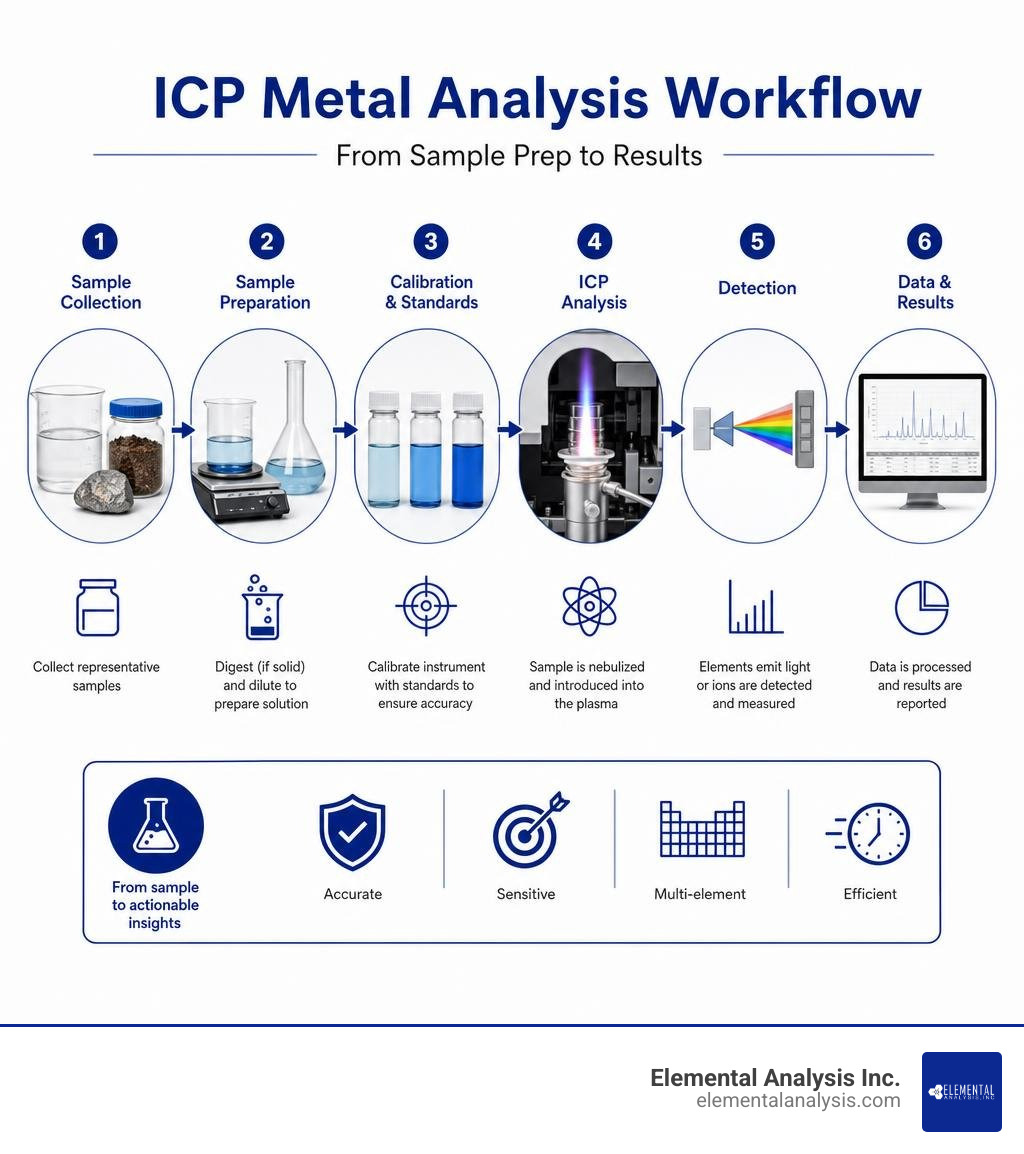
What is ICP Metal Analysis and How Does It Work?

At its heart, icp metal analysis relies on one of the most energetic states of matter: plasma. While we often think of solids, liquids, and gases as the primary states of matter, plasma is an ionized gas superheated to temperatures that rival the surface of the sun.
In an ICP system, this intense heat is used to rip molecules apart into their individual atoms and ions. Once the sample is reduced to its elemental form, we can measure either the light those atoms emit (in optical emission spectroscopy) or their physical mass (in mass spectrometry).
To learn more about our specific capabilities and how we apply this technology for our clients, you can explore More info about ICP services.
The Core Principles of ICP Metal Analysis
The journey of a sample through an ICP instrument is a masterclass in analytical engineering. It begins with sample introduction. Because the plasma torch requires a steady, uniform feed, liquid samples must first be converted into a fine mist. This process, known as nebulization, uses high-pressure argon gas to break the liquid down into a micro-droplet aerosol. Only the smallest droplets make it past the spray chamber and into the plasma.
Once the aerosol reaches the plasma torch, it meets an electromagnetic field generated by a radiofrequency (RF) generator. This RF generator drives an induction coil wrapped around the top of the quartz torch, creating a powerful electromagnetic field. When argon gas flows through this field, it is ionized, initiating a self-sustaining argon plasma.
As the sample aerosol passes directly through the center of this 10,000 Kelvin plasma, the solvent is instantaneously evaporated, the remaining solid particles are vaporized, and the molecules are completely atomized and ionized. This process is so reliable that regulatory bodies rely on it for highly sensitive monitoring; for example, you can read the Scientific research on workplace atmospheres to see how ICP is used to protect workers from airborne metal exposures.
The Role of Argon Plasma in Elemental Detection
Why do we use argon gas? Argon is the unsung hero of ICP analysis. It is chemically inert, meaning it won’t react with your sample or the instrument components. More importantly, argon has a high first ionization potential. This means it takes a massive amount of energy to strip an electron from an argon atom. Once ionized in the plasma, argon easily transfers this energy to the target elements in your sample, ensuring they are efficiently atomized and excited.
Within the plasma, temperatures range from 7,000 Kelvin in the sample introduction zone to a blistering 10,000 Kelvin in the outer induction rings. At these extreme temperatures, elements are pushed into an excited state or ionized completely. As they cool or transition back to lower energy states, they reveal their chemical identities. It is this predictable behavior of atoms within the argon plasma that allows us to perform both qualitative identification (what elements are present) and quantitative measurement (how much of each is there).
ICP-OES vs. ICP-MS: Choosing the Right Technique
When setting up an icp metal analysis, one of the most critical decisions is choosing between the two primary detection methods: ICP-OES (Optical Emission Spectroscopy, sometimes called ICP-AES) and ICP-MS (Mass Spectrometry).
While both use the same inductively coupled argon plasma to atomize samples, they look at completely different physical properties to identify the elements.
| Feature | ICP-OES (Optical Emission) | ICP-MS (Mass Spectrometry) |
|---|---|---|
| Primary Detection Mechanism | Measures light (photons) emitted by excited atoms/ions | Measures mass-to-charge ratio ($m/z$) of ions |
| Element Coverage | Up to 74 elements simultaneously | Up to 86 elements simultaneously |
| Typical Detection Limits | Parts-per-billion (ppb) range (typically 1–10 ppb) | Parts-per-trillion (ppt) range (often <1 ppt) |
| Linear Dynamic Range | 5 to 6 orders of magnitude | Up to 12 orders of magnitude |
| High TDS Tolerance | Excellent (up to 10% or more total dissolved solids) | Moderate (typically <0.2% TDS without online dilution) |
| Sample Throughput | Very high (2,000–2,500 samples/day with switching valves) | High (up to 1,200 samples/day) |
| Isotopic Analysis | No | Yes (can distinguish isotopes like Pb-206 vs. Pb-207) |
| Capital & Operating Cost | Moderate | High |
To see how these techniques fit into our broader suite of testing capabilities, check out More info about A to Z testing.
Inductively Coupled Plasma Optical Emission Spectroscopy (ICP-OES)
In ICP-OES, we take advantage of the fact that when excited atoms and ions in the plasma return to their ground state, they release energy in the form of light (photons). Each element emits light at highly specific, characteristic wavelengths—acting like an elemental barcode.
The emitted light is collected by the instrument’s optics and separated by a high-resolution spectrometer. Modern systems utilize advanced charge-coupled device (CCD) detectors to measure these wavelengths simultaneously. This allows ICP-OES to analyze up to 74 elements in under a minute.
ICP-OES is the absolute workhorse for samples with concentrations above 10 ppb. It is highly robust, easily tolerating samples with high total dissolved solids (TDS) like brines, industrial waste streams, and dissolved alloys. This makes it ideal for regulatory frameworks such as the EPA Method IO-3.4 for ambient air testing, where suspended particulate matter on filters must be routinely quantified.
Inductively Coupled Plasma Mass Spectrometry (ICP-MS)
If ICP-OES is a high-powered telescope looking at light, ICP-MS is an ultra-precise scale weighing the elements. Instead of measuring light emissions, ICP-MS extracts the ions directly from the argon plasma into a high-vacuum mass spectrometer.
Once inside, a mass analyzer—typically a high-speed quadrupole—separates the ions based on their mass-to-charge ($m/z$) ratio. The detector then counts individual ions, allowing for unmatched sensitivity. ICP-MS can measure elements across an astonishing 12 orders of magnitude (from 1 ppt up to 100 ppm) and is capable of analyzing 86 elements, including lithium through uranium (mass ranges 7 to 250).
Because of its extreme sensitivity, ICP-MS is the gold standard for trace and ultra-trace analysis. It is the only choice when you need to measure parts-per-trillion concentrations, detect single nanoparticles, or analyze isotopic ratios. For a deeper look into how researchers push this technology to its absolute limits, see this Research on ultra-trace elements in ice cores, which details how ICP-TOF-MS tracks historical global pollution levels in glacial ice.
Sample Preparation and Digestion Protocols

A common saying in analytical chemistry is: “A result is only as good as the sample preparation.” Because ICP instruments rely on nebulizers to introduce the sample as a fine mist, icp metal analysis generally requires samples to be in liquid form. If you bring us a solid block of titanium alloy, a soil sample, or a dietary supplement, we must first completely dissolve it.
To explore the full scope of how we handle diverse matrices, you can read More info about elemental analysis services.
Sample Preparation for ICP Metal Analysis
Converting a solid material into a completely clear, particle-free liquid is no small feat. It typically involves acid digestion, where the sample is mixed with high-purity mineral acids and heated.
- Nitric Acid ($HNO_3$): The primary acid used for most organic and metal samples due to its strong oxidizing power.
- Hydrochloric Acid ($HCl$): Essential for stabilizing elements like gold, platinum, and high concentrations of tin or iron.
- Hydrofluoric Acid ($HF$): The only acid capable of breaking down silica-based matrices (like glass, soil, or geological rocks), though it requires specialized, HF-resistant instrument sample introduction systems.
To speed up this process and prevent the loss of volatile elements (like mercury or arsenic), laboratories use microwave-assisted digestion. The sample and acid mixture are sealed inside a heavy-duty, high-pressure Teflon vessel and placed in a laboratory microwave. The system heats the mixture far past its atmospheric boiling point, rapidly dissolving even the toughest matrices in minutes.
This rigorous preparation is strictly defined in international standards, such as the Chinese national food safety standard GB 5009.268-2025, which outlines precise microwave digestion protocols for identifying trace metals in food products.
Overcoming Spectral and Matrix Interferences
No analytical method is entirely free from interferences. In ICP analysis, we must constantly account for two main types:
- Spectral Interferences: This occurs when an interfering species shares the same mass (in ICP-MS) or emission wavelength (in ICP-OES) as your target analyte. For example, argon ($^{40}Ar$) and oxygen ($^{16}O$) can combine in the plasma to form an argide ion ($^{40}Ar^{16}O^+$), which has a mass of 56—the exact mass of the most abundant iron isotope ($^{56}Fe$). To solve this, modern ICP-MS instruments utilize collision/reaction cells (CRCs). By introducing a gas like helium (in collision mode) or oxygen (for a reactive mass shift), we can filter out these unwanted polyatomic interferences before they reach the detector.
- Matrix Interferences: High concentrations of physical elements in the sample (like sodium in seawater) can suppress or enhance the ionization of your target elements. We combat this using matrix matching (ensuring our calibration standards have the exact same acid and salt concentrations as the samples) and by adding internal standards (elements like Yttrium, Indium, or Terbium that are not present in the sample) to continuously monitor and correct for signal drift.
Industrial and Research Applications of ICP
Because of its speed, sensitivity, and broad element coverage, icp metal analysis is used across almost every major scientific and industrial sector.
Environmental and Food Safety Compliance
Clean water, safe soil, and uncontaminated food are fundamental to public health. Environmental laboratories rely on ICP-MS to monitor municipal drinking water and industrial wastewater, detecting ultra-trace levels of toxic heavy metals like lead, cadmium, arsenic, and mercury.
In agriculture, ICP-OES is used to measure essential nutrients in soil and plant tissues, while food safety labs screen products for contaminants. To understand the sophisticated biological research enabled by these methods, you can read this Research on biological specimen quantification, which demonstrates how researchers standardize metal measurements in biological tissue using sulfur and phosphorus as internal markers.
Advanced Materials and Geochemical Research
For high-tech industries, material purity is everything. In aerospace and metallurgy, ICP is used to verify the exact chemical composition of advanced superalloys, ensuring they can withstand extreme environments without structural failure. In the semiconductor sector, where even a single parts-per-billion metal impurity can ruin a silicon wafer, high-resolution ICP-MS is used to test raw chemicals and materials.
Geologists and geochemists also rely on ICP to analyze rock samples, trace rare earth elements, and determine the age of geological formations by measuring precise uranium-lead isotope ratios.
Frequently Asked Questions about ICP Analysis
What elements cannot be measured by ICP methods?
While ICP can measure up to 86 elements, it has some hard physical limits. It cannot measure carbon, hydrogen, oxygen, and nitrogen (C, H, O, N) because these elements are highly abundant in the surrounding air, water solvent, or the argon gas itself, creating an overwhelming background signal. Additionally, halogens like fluorine, chlorine, bromine, and iodine are incredibly difficult to measure by standard ICP because their first ionization potentials are higher than that of the argon plasma, meaning they do not ionize efficiently enough to be reliably detected.
What are the typical sample volume and weight requirements?
For standard liquid samples, we generally require 10 to 50 mL of fluid. For solid samples requiring acid digestion, we typically need 0.2 to 1.0 grams of material. However, if you have highly precious or limited samples, modern micro-sampling and high-efficiency nebulizers allow us to run specialized analyses on liquid volumes as small as a few microliters or solid weights in the low milligram range.
How do laboratories ensure accuracy and precision in results?
Quality assurance is built into every step of our workflow. We generate highly accurate calibration curves using certified, NIST-traceable multi-element standards. Every batch of samples we run includes rigorous quality control checks:
- Method Blanks: To ensure no contamination was introduced during sample preparation.
- Spike Recoveries: Adding a known concentration of an element to a sample to verify that our extraction and measurement are 100% efficient.
- Certified Reference Materials (CRMs): Analyzing standardized materials with known elemental compositions to verify instrument accuracy.
Furthermore, we operate under strict quality management systems, ensuring our testing procedures are fully validated and traceably documented.
Conclusion
Whether you are verifying the purity of an aerospace superalloy, meeting strict environmental water standards, or conducting advanced geochemical research, icp metal analysis provides the ultimate clarity on what is happening at the elemental level.
At Elemental Analysis Inc., located in Lexington, Kentucky, we combine this powerful technology with our unique expertise. As the first commercial Proton Induced X-ray Emission (PIXE) laboratory, we specialize in both non-destructive and destructive testing. This allows us to offer comprehensive trace element identification, quantification, and speciation services with exceptionally fast turnaround times and competitive pricing.
Ready to get precise, reliable data for your next project? Inquire about our professional ICP metal analysis services today and let our team of experienced scientists handle your analytical challenges.